
Chiropractic email marketing is the use of email to bring active patients back for planned visits and to invite lapsed patients to return. Follow two rule sets: CAN-SPAM, which requires an honest subject line, a postal address and a working opt-out, and HIPAA, which limits third-party marketing. Segment the list and measure kept visits.
Recall and reactivation are the two email jobs most clinics need. Few guides explain the rules behind them. The sections below set out what the FTC and HHS say, how to split a patient list, what a short sequence looks like and how to judge results. It sits inside the chiropractic practice management guide, which routes the other areas of running a clinic.
Key takeaways
- CAN-SPAM covers commercial email to current patients; treat recall and win-back emails as commercial, with opt-out, postal address and ad disclosure.
- HIPAA excludes treatment and own-services messages from marketing unless a third party pays the clinic to send them.
- Honor opt-outs fast: the legal limit is 10 business days; Google asks bulk senders to act within 48 hours.
- Use four segments, active, lapsed, discharged and do-not-email, and suppress before every send.
- Measure booked and kept visits, including phone bookings. No independent open-rate benchmark was verified.
What does chiropractic email marketing do for a clinic?
It does two jobs. Recall brings active patients back for the visits already in their plan of care. Reactivation reaches people who stopped coming and invites them to book again. Both are messages to people the clinic already knows, which makes email different from the ads and search work in the chiropractic digital marketing guide.
Email is also the channel where two rule sets meet. The sender is a business, so the federal CAN-SPAM Act applies. The sender is also a health care provider, so HIPAA decides what the message may say and who may see the list. We checked three top-ranking guides (ChiroTouch, Redefine Web, Perfect Patients). None mentions CAN-SPAM.
It does not repeat the claim and testimonial rules in chiropractic marketing, and it covers email only. Social channels are in the chiropractic social media guide.
Which rules apply to a recall or reactivation email?
Two apply to every send: CAN-SPAM for form and opt-outs, and HIPAA for content and recipients. The FTC says CAN-SPAM turns on the “primary purpose” of a message. A message that only promotes a service is commercial. A message that only confirms a transaction the patient already agreed to is transactional or relationship, and is exempt from most CAN-SPAM provisions (FTC compliance guide, updated January 2024).
The FTC reads the transactional categories narrowly. A reminder of a booked appointment sits closest to the confirmation category. A “you are due, book now” recall or a win-back offer is not clearly inside any category. Our conservative reading is to treat both as commercial and give them every CAN-SPAM element. Have counsel confirm.
| Message | CAN-SPAM view | HIPAA view | Practical rule |
|---|---|---|---|
| Appointment confirmation or change notice | Likely transactional or relationship; headers must still be truthful | Treatment communication | Send without a promotion; keep detail minimal |
| Recall: you are due for a scheduled visit | Not clearly a listed category; treat as commercial | Treatment or the clinic’s own services; not marketing unless a third party pays | Include opt-out, address and ad disclosure |
| Reactivation: invitation to return | Commercial | Own-services communication; not marketing unless a third party pays | Full CAN-SPAM elements; no health detail in the subject |
| Newsletter with an offer | Commercial | Own-services communication | Same elements; offer terms stated plainly |
| Message promoting a vendor’s product that pays the clinic | Commercial | Marketing; written authorization needed | Do not send without counsel’s review |
Source: FTC, CAN-SPAM Act: A Compliance Guide for Business (updated 2024); HHS, Marketing (content last reviewed July 26, 2013); 45 CFR 164.501 (eCFR). Message-type readings are our interpretation, not a regulator’s statement.
On the HIPAA side, the Privacy Rule requires written authorization before protected health information is used for marketing, with exceptions. The HHS marketing guidance and the definition in 45 CFR 164.501 exclude treatment communications, care coordination and descriptions of the covered entity’s own health-related services, but only when the clinic is not paid by a third party to send the message. A supplement vendor paying for a mention is a different case from an email about the clinic’s own care. The refill-reminder FAQ (FAQ 1514) covers a narrow pharmacy exception, so rely on the treatment and own-services exclusions.
The penalty is per email. The FTC guide states that each separate violating email can bring penalties of up to $53,088, and that hiring a vendor to send mail does not transfer legal responsibility.
What consent and unsubscribe setup does the clinic need?
CAN-SPAM does not require advance consent for commercial email, but it does require a working opt-out. HIPAA adds a patient-preference rule. Record how each address was collected.
- Collect addresses at intake with plain wording. Add a line to the new-patient form that says what the clinic will send (reminders, recall notices, a newsletter) and how to stop. The chiropractic website design guide covers web forms; the same wording belongs on paper forms.
- Keep two lists. Appointment messages go to the schedule. Recall, reactivation and newsletters go to a marketing list that honors opt-outs. An opt-out from the marketing list should not cancel appointment reminders unless the patient asks.
- Include the required elements in every commercial email. The FTC lists accurate header information, a non-deceptive subject line, a clear ad disclosure, a valid physical postal address and a working opt-out (FTC).
- Honor opt-outs fast. The legal limit is 10 business days, the opt-out must work for at least 30 days after sending, and the clinic cannot charge a fee or ask for more than an email address. Google asks bulk senders to act within 48 hours, a better internal target.
- Never sell or share the opt-out list. The FTC says opted-out addresses cannot be sold or transferred, apart from a company hired to help with compliance.
HHS FAQ 570 says the Privacy Rule permits providers to email patients when reasonable safeguards are used, such as confirming the address and limiting how much information the message carries. Patients may ask for an alternative channel, and the FAQ gives the example of honoring a request for reminders by email instead of postcard. If a patient says email is unsafe, offer phone or mail. The page was last reviewed July 26, 2013 (HHS FAQ 570).
Treat the patient list as protected health information
An email address that marks a person as a chiropractic patient identifies the person and the provider. Our conservative view is to treat the list as protected health information. A platform that stores it is then likely a business associate, and HHS says the HIPAA Rules generally require a written contract that limits use of the data, requires safeguards and breach reporting, and lets the clinic end the contract (HHS). Ask any vendor for a Business Associate Agreement before you upload the list. If it will not sign, do not upload patient data. Counsel should confirm your own case.
Google’s sender guidelines apply to anyone sending close to 5,000 messages a day to Gmail accounts, which most single clinics never reach. They are still a sensible baseline: authenticate with SPF and DKIM, publish a DMARC record, offer one-click unsubscribe on promotional mail, and keep user-reported spam below 0.1% and never at 0.3% or higher (Google). The HIPAA compliance checklist for medical practices covers the wider policy set.
Which segments should the list have?
Four segments cover most clinics: active, lapsed, discharged and do-not-email. A message that fits one group can be wrong for another, so assign each patient to one segment from the practice system and rebuild the segments on a schedule. The windows below are examples. Set your own from your visit pattern.
| Segment | Example definition | Goal of the email | Watch for |
|---|---|---|---|
| Active | Has a visit booked or a plan of care in progress | Keep the next visit booked | Do not send reactivation copy to someone with an open plan |
| Lapsed | Plan not finished, no visit in an example window such as 90 days, no discharge note | Invite a return visit or a call | Keep the tone neutral; no guilt, no health claims |
| Discharged | Care ended by agreement or goal met | Optional check-in at long intervals | Skip anyone discharged after a dispute or a request for no contact |
| Do-not-email | Opted out, asked for no contact, bad address, or flagged by the front desk | No marketing mail | Keep this list permanently and apply it before every send |
Source: RCM Finder workflow framework. Windows are examples, not benchmarks.
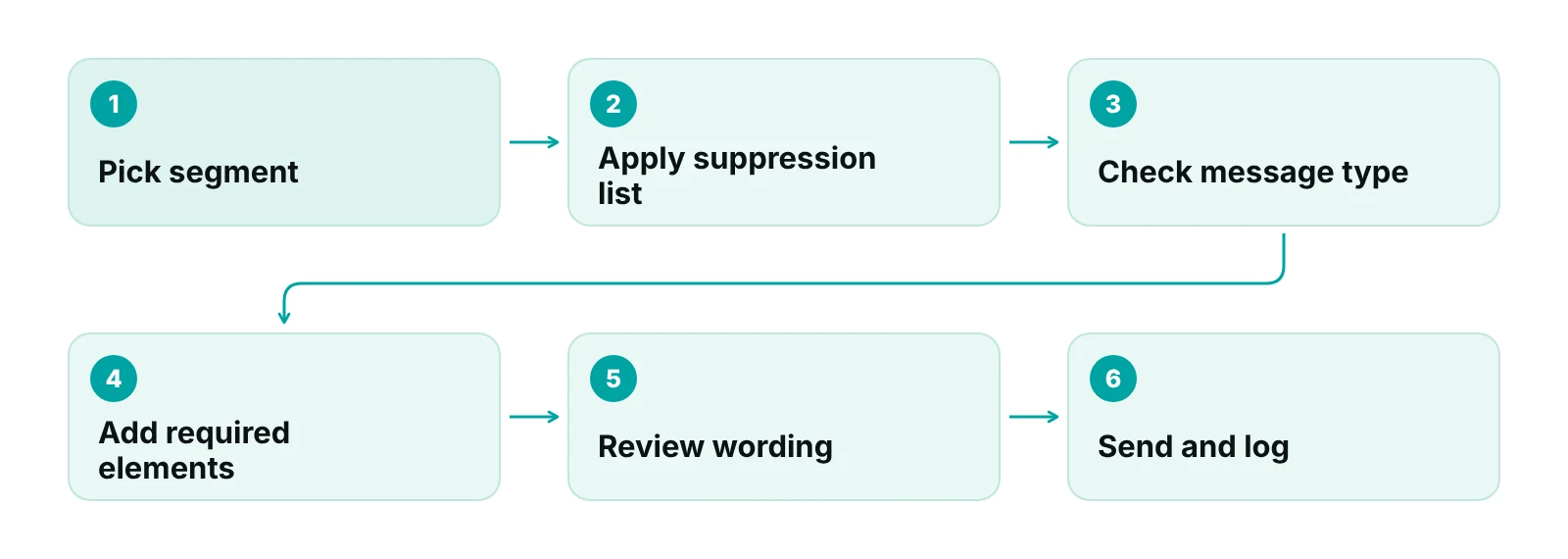
Two checks protect the list. First, suppress at send time against the do-not-email list, not weeks earlier. Second, ask the clinical team which discharge reasons exclude a patient from “we miss you” mail. Our chiropractic practice management software checklist covers recall lists and status fields.
What do recall and reactivation sequences look like?
A sequence is a short set of messages that ends when the patient books, replies, opts out or reaches the last message. An open-ended drip invites complaints.
| Step | When | Purpose | Content limits |
|---|---|---|---|
| Recall 1 | At the point the plan calls for the next visit | Invite the patient to book the next visit | Name the clinic; no diagnosis in the subject; one booking link and a phone number |
| Recall 2 | A few days after Recall 1 if not booked | Offer help finding a time | Same limits; do not repeat the first message word for word |
| Reactivation 1 | After the lapse window | Say the clinic is available and invite a call or booking | No claim that care is needed; no insurance coverage promise |
| Reactivation 2 | A couple of weeks later | Share one practical piece of office information | Hours, new location, new booking tool; no pressure |
| Reactivation 3 | A few weeks later | Close the loop and say the clinic will stop | Offer the phone number; then move the patient to a quiet segment |
Source: RCM Finder workflow framework. Timing is for the clinic to set; no response rates are claimed.
Three content rules hold across the sequence. First, do not imply that insurance will pay for ongoing visits. Medicare, for example, covers manual manipulation of the spine to correct a subluxation and does not cover maintenance therapy, per a Medicare contractor’s fact sheet (revised December 12, 2017). Our Medicare billing guide for chiropractors covers the rules; check payers before you mention coverage. Second, keep health detail out of the body as well as the subject. A message that says only that a visit is due is enough. Third, check any free exam or discount offer against the rules in the marketing guide first.
Phone follow-up is the next step when email does not work. The call can come from the front desk or from a virtual medical assistant working in the practice’s time zone, with the same minimum-detail rule.
What are the subject-line rules?
A subject line must not mislead. CAN-SPAM requires subject lines that accurately reflect the message content, and the FTC says mixed messages are judged partly by what a reasonable reader takes the subject to mean (FTC). Subject lines also show in phone notifications, so they should not name a condition.
- Say what the email is. “Time to book your next visit at [Clinic name]” matches a recall. “Urgent: your results” does not.
- No condition, body part or diagnosis. “Your back pain plan” gives a reader’s lock screen a health detail. “Your next visit” does not.
- Name the clinic in the From line. No fake “Re:” prefixes or false urgency.
- Keep it short enough to read on a phone. Test two versions on a small slice of the list and keep what books visits, not only what gets opened.
We do not quote open-rate or return figures. The guides we reviewed give them without a method or source: one cites a $38-per-dollar return from an agency link, and another gives open rates for sender names with no source. Use your own numbers.
What should the clinic measure?
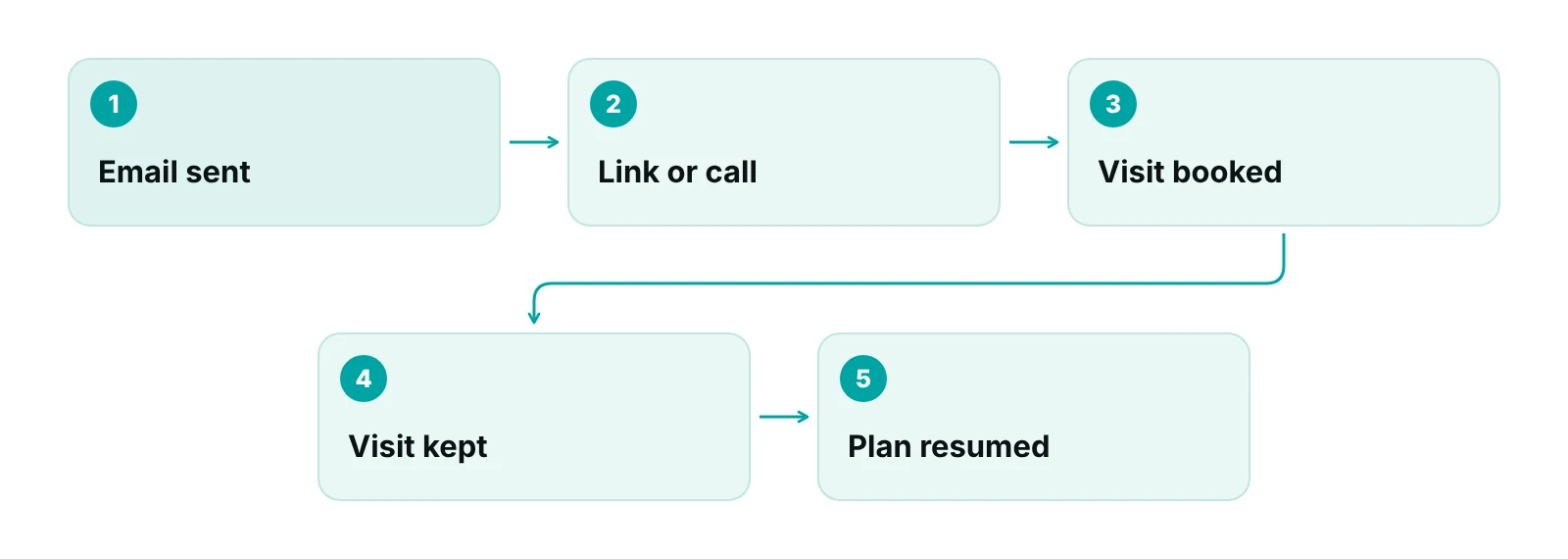
Measure rebooked visits first, because an open does not show a visit. Track each campaign from send to kept appointment, with opt-outs and complaints beside it.
- Emails sent to the right segment. Shows list quality. Read it in the email platform plus practice system. Action: Fix segment rules if the wrong patients appear.
- Booked visits from the campaign. Shows whether the message moved a patient. Read it in the scheduling system. Action: Compare against the call log for phone bookings.
- Kept visits. Shows whether the booking turned into care. Read it in the practice system. Action: Count a patient once; link to the original message.
- Opt-outs and spam complaints. Shows whether the audience objects. Read it in the email platform. Action: Cut frequency or fix targeting; keep complaints under Google’s thresholds.
- Bounces. Shows list hygiene. Read it in the email platform. Action: Remove dead addresses and fix entry errors at intake.
A patient may get the email, then call. Read the schedule and call log with the email report, or the campaign will look weaker than it was. Our medical marketing ROI guide shows how to tie spend to booked patients.
Who should run it, and where does RCM Finder fit?
One named person should own the lists, the suppression file and the send schedule, often the office manager, with the doctor approving wording. Vendors can send the mail, but the FTC says responsibility stays with the sender, so the clinic approves every template.
RCM Finder’s team works inside your existing systems and supports the front-desk side of recall and follow-up calls, with healthcare digital marketing for clinics that want outside help. We put a Business Associate Agreement in place before accessing patient data. Pricing is quoted after a free practice audit.
See where lapsed patients are slipping away
A free practice audit reviews recall, scheduling and follow-up together, so email is built on a clean patient list.
Our recommendations
- Name one owner for the email program. One person owns the lists, the suppression file and template approval.
- Split the list before writing a word. Build active, lapsed, discharged and do-not-email segments from the patient system.
- Treat every recall and reactivation email as commercial. Add an ad disclosure, a postal address and a working opt-out. It removes a grey area.
- Get a Business Associate Agreement before the upload. If a platform will hold patient names and visit data, ask for the agreement first. If it will not sign, keep patient data out.
- Keep health detail out of subject lines and bodies. Say a visit is due and give a booking link and phone number. Leave out conditions and coverage promises.
- Cap each sequence and stop on any response. Set a fixed number of messages, stop when the patient books, replies or opts out, then move the patient to a quiet segment.
- Count kept visits, not opens. Report booked and kept visits by campaign, including phone bookings.
Bottom line
Chiropractic email marketing is a recall and reactivation tool when the list is segmented, the rules are built into every template and results are counted in kept visits. Set the segments and suppression file first, then add short sequences with a stopping point. The chiropractic practice management guide shows where email fits among scheduling, billing and patient communication, and RCM Finder’s healthcare digital marketing service is there for clinics that want help.
Frequently asked questions
Does CAN-SPAM apply to emails to existing chiropractic patients?
Yes, if the primary purpose is commercial. The FTC says being a current customer or member does not turn a promotional email into a transactional one, because those categories are read narrowly. Confirmation of a booked visit is closer to transactional. Recall and win-back emails are safest treated as commercial, with an opt-out and a postal address.
Do HIPAA rules prohibit marketing emails to patients?
No. HIPAA requires written authorization for marketing uses of patient information, but HHS excludes treatment communications and descriptions of the clinic’s own health-related services unless a third party pays the clinic to send them. The HHS marketing page was last reviewed in July 2013, so confirm with counsel before you rely on it.
Can a clinic use an ordinary email platform for recall messages?
Only after you check what data goes into it. A patient list with visit dates identifies people as patients of a health care provider, so we treat it as protected health information. HHS says business associates generally need a written contract. Ask for a Business Associate Agreement, and keep the list out of any tool that will not sign.
How long does a clinic have to honor an unsubscribe?
The FTC says opt-out requests must be honored within 10 business days, and the opt-out method must work for at least 30 days after a message is sent. The clinic cannot charge a fee or require more than an email address. Google asks bulk senders to process unsubscribes within 48 hours, which is a better internal target.
Should reactivation emails go to discharged patients?
Not by default. Discharged patients are a separate segment. Skip anyone who asked for no contact, was discharged after a dispute, or opted out, and have the doctor decide which discharge reasons are safe for a long-interval check-in. Anyone who opted out stays on the do-not-email list for good.
What open rate should a chiropractic clinic expect?
There is no independent benchmark we can verify. The articles we reviewed gave open rates and returns without a method or source. Compare each campaign with your own earlier sends and judge it by booked and kept visits, with opt-outs and complaints shown beside them.
Get your free practice audit
Tell us about your practice. We will contact you using the details you give.
- A review of your recent claims, denials and A/R aging
- Where your front desk and prior authorizations slow payment
- A prioritized fix list you keep, whether or not you hire us
Pricing is quoted after the audit, based on your volume and the services you choose. Prefer to talk? Call +1 (302) 556-2288.
Sources
- CAN-SPAM Act: A Compliance Guide for Business — Federal Trade Commission (2024 (updated January 2024))
- CAN-SPAM Rule (16 CFR Part 316) — Federal Trade Commission (2026)
- Marketing (HIPAA Privacy Rule) — HHS Office for Civil Rights (2013 (content last reviewed July 26, 2013))
- 45 CFR 164.501 Definitions (Marketing) — eCFR (2026)
- Does HIPAA permit health care providers to use email to discuss health issues with patients? (FAQ 570) — HHS Office for Civil Rights (2013 (content last reviewed July 26, 2013))
- What types of communications fall within the refill reminder exception? (FAQ 1514) — HHS Office for Civil Rights (2023 (content last reviewed February 8, 2023))
- Business Associate Contracts — HHS Office for Civil Rights (2017 (content last reviewed June 16, 2017))
- Email sender guidelines — Google Workspace Admin Help (2026)
- Medicare Coverage of Chiropractic Services (fact sheet) — CGS Administrators (Medicare contractor) (2017 (revised December 12, 2017))
- Chiropractic email marketing — ChiroTouch (2022)
- Email marketing for chiropractors wins back exams — Redefine Web (2026)
- Email marketing tips for chiropractors — Perfect Patients (2025 (updated November 5, 2025))
Disclaimer: This article is educational and is not legal, coding or compliance advice. Email, privacy, advertising and payer rules differ by state and by plan and change over time, so confirm current requirements with your attorney, your state chiropractic board and each payer before acting.