
Chiropractic practice management means running scheduling, intake, documentation, billing, collections, patient communication, marketing and software as one connected system. Most losses happen at the handoffs, such as an unscheduled plan of care, a missing modifier or an unchecked benefit. Fix those handoffs first, then build growth on top of them.
This guide is for chiropractic owners and office managers who run the whole clinic and want one map of it. It covers each operating area briefly, gives the rules that matter with sources, and sends you to a deeper guide where one exists.
It does not compare products or give clinical advice. Rules cited are federal unless stated; state boards and payers add their own, so confirm them before you act. If you want the software view, read the chiropractic practice management software guide.
Key takeaways
- Most chiropractic revenue is lost at handoffs: booking to benefits, note to claim, claim to payment, patient to recall.
- Medicare coverage is narrow: Part B covers spinal manipulation to correct a subluxation, and the claim depends on the note.
- Build deadlines into the workflow: 12 months to file a Medicare claim and 120 days to request a redetermination.
- Growth work must pass state board, FTC and HIPAA checks before ads, reviews, tags or messages go live.
- Review the clinic on a fixed daily, weekly and monthly rhythm with an owner for each handoff.
What does chiropractic practice management cover?
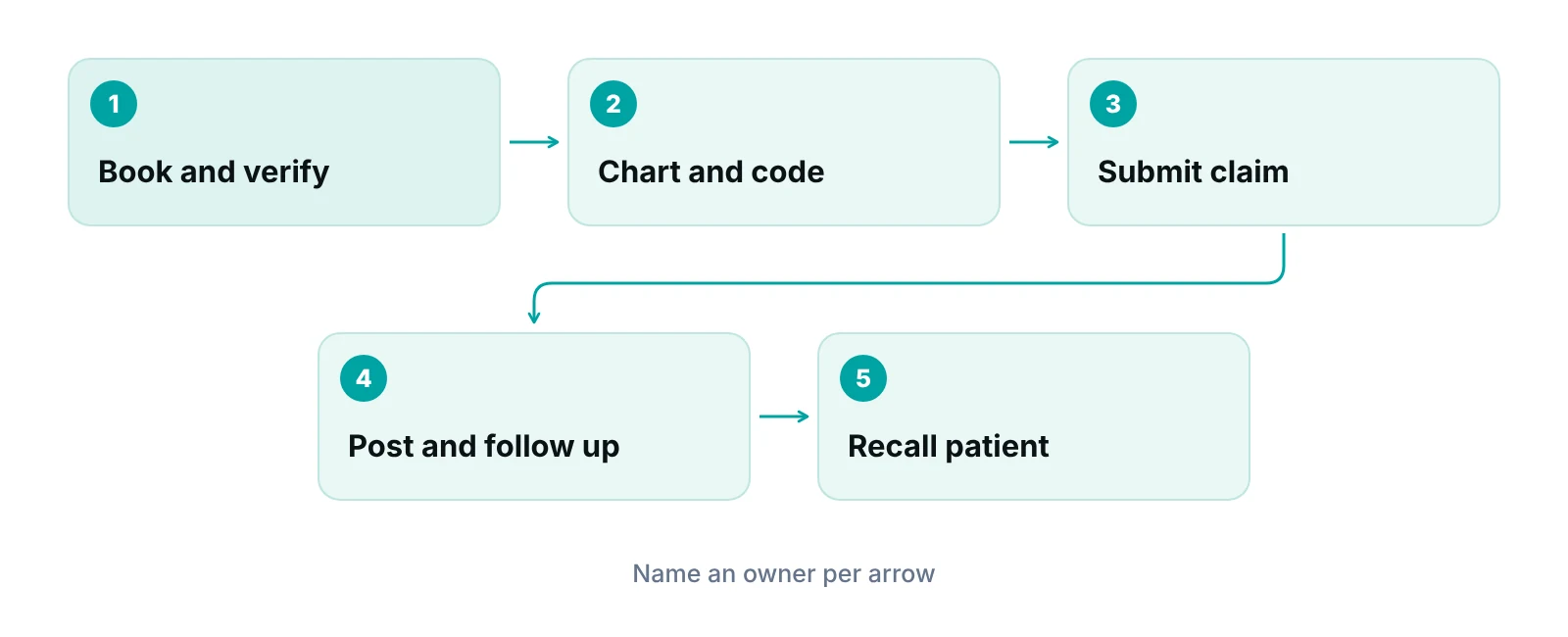
It covers every step between a new patient’s first call and the last payment on the claim, plus the systems and marketing that feed that flow. The work is organized around a few handoffs: booking to benefits check, visit note to claim, claim to payment, patient to recall. Most lost revenue sits in those handoffs, not in the clinical work.
The business case for getting this right is plain. The U.S. Bureau of Labor Statistics lists 61,700 chiropractor jobs in 2025, projects 9% growth from 2025 to 2035, and reports that 36% of chiropractors are self-employed (BLS Occupational Outlook Handbook). Many clinics are owner-run, so the doctor is often the marketing lead, compliance officer and head of billing as well as the clinician.
Use the table as a map. Each row names an operating area, the usual failure and the deeper guide that covers it. The sections below follow the same order.
| Operating area | Common failure | Deeper guide |
|---|---|---|
| Front desk and scheduling | Plans of care are not booked ahead; missed visits are not followed up | Section on the front desk (this guide) |
| Intake and eligibility | Visit limits and authorizations found after the visit | Patient insurance verification guide |
| Documentation and charge capture | Missing exam findings, modifier or diagnosis order | Chiropractic CPT codes and modifiers guide |
| Billing and claims | Claims filed late or without a data check | Chiropractic billing services guide |
| Denials and A/R | Denials sit unworked; appeal windows pass | Medical billing denial management guide |
| Patient communication | Recall messages go out without a consent or privacy check | Chiropractic email marketing guide |
| Marketing and growth | Claims in ads that a state board would not accept | Chiropractic marketing, SEO and website guides |
| Software and EHR | Systems do not hand data to each other | Chiropractic EHR and software guides |
Source: RCM Finder operating framework; failure patterns are common-sense examples, not measured rates.
How should the front desk and schedule be run?
The schedule should be built around the plan of care, not around open slots. A chiropractic patient is usually prescribed a frequency and duration, so the desk should book the series before the patient leaves and follow up the same week when a visit is missed. A desk that only fills the next open slot lets care plans drift.
Define who does what at the desk. One person owns new-patient calls, one owns reschedules and missed-visit calls, and one owns check-out, where the next visits and any balance are handled. The front desk and revenue cycle guide explains why front-desk errors become billing errors later.
If calls go unanswered at lunch or after hours, a trained remote front-desk team can cover booking, intake and benefit checks inside your own systems. See the virtual medical assistant service for how RCM Finder frames that role. Online booking inside RCM Finder’s portal is early access, so plan on your current scheduling tool for now.
A simple desk rule
Before a patient leaves, three things should be in the chart: the next appointment, the visits left in the plan of care, and any amount due today. If one is missing, the desk has an open task.
What should intake and eligibility check before the first visit?
Intake should confirm the payer, the chiropractic benefit, any visit limit and any authorization rule before the first visit. Chiropractic benefits are often capped by visit count, and some plans approve care in blocks. Finding that out after the visit turns an avoidable question into a write-off or a patient bill.
One health plan’s published notice shows how this works. It requires prior authorization for all spinal manipulation, approves ten visits to start, and reauthorizes further care in blocks of up to ten visits, with notes that show improvement (Kaiser Permanente notice, most recent date listed 12/23/2024). It also tells reviewers to check the member’s benefit document first, because plan limits apply. Other payers differ, so record limits per plan.
For Medicare patients, the coverage is narrow. Medicare.gov says Part B covers spinal adjustments by a chiropractor to correct a subluxation, and does not cover other services or tests the chiropractor orders, including X-rays, massage therapy and acupuncture (Medicare.gov). Patients pay 20% of the Medicare-approved amount after the Part B deductible. Tell Medicare patients what is not covered before the visit, using the notice rules in the next section.
Use a written checklist: payer and plan ID, chiropractic benefit and visit limit, copay or coinsurance, authorization rule, and the date the check was done. The patient insurance verification guide gives the full process. Eligibility checks inside RCM Finder’s portal are not live yet, so today they are done by staff in your existing systems or by a remote front-desk team.
How do documentation and charge capture protect revenue?
The visit note is the source of the claim, so a claim is only as strong as the note behind it. For Medicare, CMS describes what the record must show: the date of initial treatment, the subluxation shown by imaging or by physical exam, the spinal levels treated, and a signature (CMS chiropractic educational tool). The physical exam route needs at least two of four findings (pain, asymmetry or misalignment, range-of-motion abnormality, tissue tone change), and one must be asymmetry or range of motion.
Charge capture means moving what was done at the visit onto the claim, once, in the right order. The Medicare contractor guidance says the subluxation level is the primary diagnosis, the neuromusculoskeletal condition is secondary, and that failing to report these can cause denial or delay (Medicare Coverage Database, CHIRO-001). The chiropractic CPT codes and modifiers guide and the Medicare billing guide for chiropractors go through codes, modifiers and Medicare rules in depth.
| Item | What the source says | Build it into |
|---|---|---|
| Initial treatment date | Enter the date of initial treatment or of the exacerbation in Item 14 of the CMS-1500 | Required field in the new-patient and flare-up note |
| Diagnosis order | Subluxation level is primary; the neuromusculoskeletal condition is secondary | Claim template that blocks the wrong order |
| AT modifier | Use on spinal manipulation claims for active or corrective treatment; not for maintenance; it does not prove necessity | Prompt tied to care type, never a default |
| ABN and GA modifier | If the provider expects a denial as not reasonable and necessary, the patient signs an ABN beforehand and GA is used | Front-desk notice step before the visit |
| One treatment per day | Payment is limited to one treatment per day unless documentation supports more | Daily edit that flags a second same-day line |
| Office visits and X-rays | A chiropractor’s office visit is excluded from Medicare coverage; X-rays ordered by a chiropractor are not covered | Patient notice and fee schedule |
| Timely filing | Medicare denies a claim received more than 12 months after the service | Aging report with a 90-day alert |
| Appeal window | Redetermination must be requested within 120 days of receiving the notice; receipt is presumed 5 days after the notice date | Denial log with a deadline column |
Sources: CMS Medicare Coverage Database CHIRO-001 (revised 12/01/2015); CMS MLN educational tool (2022); CMS Claims Processing Manual ch. 30 (ABN); CMS Transmittal 12909 (2024); 42 CFR 405.942. Contractor policy can change; confirm with your Medicare Administrative Contractor.
Why documentation gets so much attention
An OIG audit estimated that $358.8 million of $438.1 million Medicare paid for chiropractic services in 2013, about 82%, did not meet Medicare requirements (OIG A-09-14-02033, October 2016). A separate OIG study of 2013 claims found $76 million in questionable payments, almost half for claims suggesting maintenance therapy (OIG OEI-01-14-00200, September 2015). Both are older data, but they explain why reviewers look closely at chiropractic notes.
How should billing and claim submission be organized?
Billing needs one accountable owner and a data check before each claim leaves the office. The main choice is whether to do it in-house, outsource it or split the work. That decision depends on volume, staff skill and how many payers the clinic bills; it is covered in the chiropractic billing services guide.
Whichever model you choose, the practice remains responsible for the claims filed in its name. Set a filing standard well inside the 12-month Medicare limit (CMS Transmittal 12909, October 2024) and review a weekly report of charges not yet billed. Notes that stay unsigned are the most common reason a visit never reaches a claim.
If you use an outside biller, a Business Associate Agreement is required before they see patient data. HHS says the contract must limit uses of PHI, require safeguards, require reporting of unauthorized use, and require return or destruction of PHI at termination, if feasible (HHS business associate contracts).
How do denials and accounts receivable get worked?
Work denials by cause and by deadline, not in the order they arrive. Each denial should record the reason, the owner and the last date to act. Medicare allows 120 days from receipt of the initial determination notice to request a redetermination, and receipt is presumed five days after the notice date (42 CFR 405.942). Commercial plans set their own windows, so keep a payer-by-payer list.
Chiropractic denials cluster around a few causes: missing or wrong modifiers, exceeded visit limits, no authorization, maintenance-care findings and missing documentation. Group them monthly and fix the upstream step. The denial management guide shows the process, and the revenue cycle management service page describes how RCM Finder supports follow-up on unpaid claims.
For patient balances, state the policy in writing at intake, collect the copay at check-out, and send statements on a fixed schedule. Keep insurance follow-up and patient statements as two separate work queues.
How should patient communication and recall work?
Recall should be driven by the plan of care and by a simple list of patients who have not been seen in a set period. The practical goal is a short, regular message to patients who have gone quiet, with a clear way to book. The chiropractic email marketing guide covers recall and reactivation sequences in detail.
Two rules matter. First, HHS says marketing generally needs the patient’s written authorization, while a communication made for the patient’s treatment is not marketing (HHS marketing guidance); a recall notice tied to the patient’s own care is closer to treatment, but a promotion for a new product line is closer to marketing, so ask counsel where your message sits. Second, the FTC’s CAN-SPAM guide requires honest subject lines, a postal address, a working opt-out, and honoring opt-outs within 10 business days, with penalties of up to $53,088 per violating email (FTC CAN-SPAM guide). Text messages have their own consent rules, so confirm those with counsel before launching them.
“In my experience, most recall problems are list problems. The message is fine; the right patients never get it.”
— Awais Afzal, Healthcare Operations & Data Analyst
How does chiropractic practice growth fit with compliance?
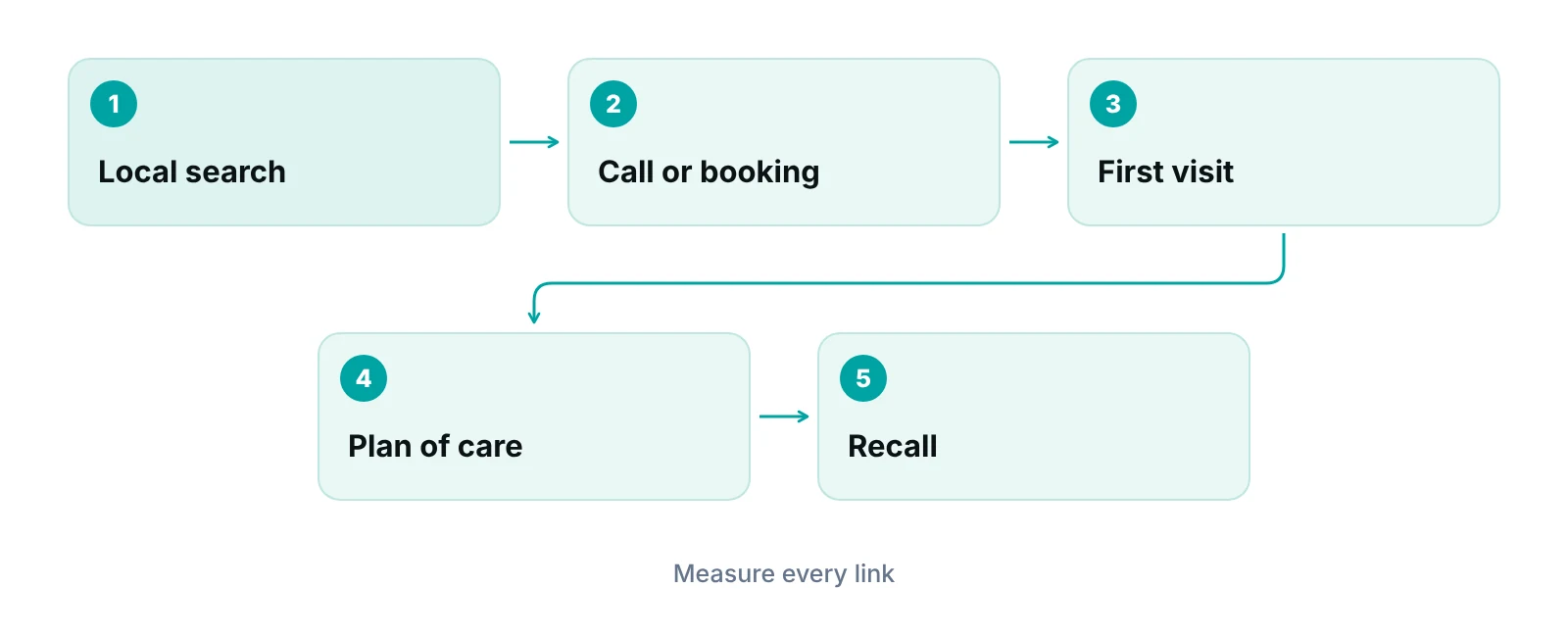
Chiropractic practice growth comes from being found locally, converting the inquiry into a first visit and keeping patients on their plan, within the advertising rules of your state board. Start with the chiropractic marketing guide, which covers what ads, testimonials and offers can claim.
Search and reviews are the second layer. The chiropractic SEO guide covers Google Business Profile and review requests, and the chiropractic digital marketing guide covers ads, tracking tags and referral tools. The chiropractic website design guide covers the pages that turn a search into a booking, and the chiropractic social media guide covers content and what not to post.
Three rules apply across all of them. The FTC’s rule on reviews and testimonials, effective October 21, 2024, prohibits fake reviews, buying reviews and certain review suppression (Federal Register). Florida’s chiropractic statute makes false or misleading ads and free or reduced-price ads without the usual fee grounds for discipline (Florida Statutes 460.413); your state will have its own rule. And HHS says tracking technologies on appointment pages can disclose PHI, requiring a Business Associate Agreement with the vendor, although part of that guidance was vacated by a federal court on June 20, 2024 (HHS tracking technology guidance).
See where your growth chain leaks
A free practice audit reviews how calls, bookings, claims and recall move through your clinic and where the gaps sit. Pricing is quoted after the audit.
What should the software and security setup look like?
The record system should hold the fields payers expect, track visits against limits and hand clean data to billing. The chiropractic EHR evaluation checklist covers how to assess a records system, and the chiropractic practice management software guide covers scheduling, visit tracking and claim features. This guide does not compare products.
Security stays with the practice whichever system you buy. HHS describes the Security Rule risk analysis as covering all electronic PHI the organization creates, receives, maintains or transmits, including data held by vendors, and says it should be ongoing, with triggers such as adopting new technology or staff turnover (HHS risk analysis guidance). Keep a dated copy and revisit it when you change systems.
RCM Finder’s practice management system is built for the billing side: claim tracking by stage, claim data-completeness checks, underpayment detection, role-based access and an audit log. Clinical charting stays in your own EHR.
What operating rhythm keeps the clinic on track?
A short, fixed review rhythm keeps small problems from becoming write-offs. Hold a weekly operations meeting of about 30 minutes, a monthly financial review and a yearly rules check. Use the same few measures every time so trends are visible.
| Cadence | What to review | Owner |
|---|---|---|
| Daily | Unsigned notes, charges not yet billed, same-day schedule gaps | Office manager |
| Weekly | Missed-visit follow-up list, claims rejected or denied, upcoming authorization expiries | Office manager and biller |
| Monthly | Denials grouped by cause, aged A/R by payer, new-patient count by source, recall list results | Owner and biller |
| Quarterly | Payer visit limits and policies, fee schedule, staff training gaps | Owner |
| Yearly | Security risk analysis, Medicare contractor policy check, state board advertising rules, vendor contracts | Owner and counsel |
Source: RCM Finder operating framework; the risk-analysis item reflects HHS guidance that the analysis should be ongoing (HHS risk analysis guidance).
The monthly review is also where the software and the staffing question surface. If the same errors repeat, fix the step that causes them before adding people.
Our recommendations
- Assign an owner to every handoff. Name one person for booking, one for benefit checks, one for notes, one for claims and one for denials.
- Book the plan of care, not the next slot. Schedule the series at check-out and follow up missed visits the same week.
- Check benefits before the first visit. Record the visit limit, authorization rule and copay in the chart, with the date checked.
- Make required fields required. Block closing a note without the initial treatment date, subluxation level, findings and signature.
- Keep a denial log with deadlines. Record cause, owner and last action date, and review causes monthly.
- Check every ad and message against your state board and HHS rules. Review claims, offers, testimonials, tracking tags and recall messages before they go live.
- Review the clinic on a fixed rhythm. Daily, weekly and monthly reviews with the same measures catch problems early.
Bottom line
Running a chiropractic clinic well means fixing the handoffs: booking to benefits, note to claim, claim to payment, patient to recall. Start with one area, assign an owner and review it monthly. For the billing-side workflow layer, see the practice management system page or request a free practice audit.
Frequently asked questions
What is chiropractic practice management?
It is the work of running a clinic as a connected system: scheduling, intake, documentation, billing, collections, patient communication, marketing and software. The aim is to keep each handoff clean so visits become paid claims and patients stay on their plan of care.
What should a chiropractic clinic fix first?
Start with the step that loses the most money or the most patients. For many clinics that is benefit checks before the first visit, missing documentation fields, or unworked denials. Pick one, assign an owner, measure it for a month, then move to the next.
Does Medicare cover chiropractic care?
Medicare.gov says Part B covers spinal adjustments by a chiropractor to correct a subluxation. It does not cover other services or tests the chiropractor orders, such as X-rays, massage therapy or acupuncture. Patients pay 20% of the approved amount after the deductible.
How long does a clinic have to file Medicare claims?
CMS says Medicare denies a claim received more than 12 months after the service was furnished, with limited exceptions listed in 42 CFR 424.44(b). Most clinics set a much shorter internal standard so that rejected claims can be corrected well within the limit.
Can a chiropractic clinic use ads and testimonials freely?
No. The FTC’s rule on reviews and testimonials, effective October 21, 2024, bans fake or bought reviews, and state boards set their own advertising rules. Florida, for example, makes misleading ads grounds for discipline. Check your state board before launching any ad or offer.
Should a chiropractic clinic outsource billing?
It depends on volume, staff skill and payer mix. Some clinics keep billing in-house, some outsource it, and some split the work. Whichever you choose, the practice stays responsible for claims filed in its name and needs a Business Associate Agreement with any outside biller.
Get your free practice audit
Tell us about your practice. We will contact you using the details you give.
- A review of your recent claims, denials and A/R aging
- Where your front desk and prior authorizations slow payment
- A prioritized fix list you keep, whether or not you hire us
Pricing is quoted after the audit, based on your volume and the services you choose. Prefer to talk? Call +1 (302) 556-2288.
Sources
- Chiropractors: Occupational Outlook Handbook — U.S. Bureau of Labor Statistics (2025)
- Chiropractic Services Educational Tool (MLN1232664) — CMS (2022)
- Chiropractic Billing Guidelines (CHIRO-001) — Medicare Coverage Database / CMS (2015 revision)
- Medicare Claims Processing Manual ch. 30 section 50 (ABN) — CMS (n.d.)
- Timely filing of Medicare claims (Transmittal 12909) — CMS (2024)
- 42 CFR 405.942 Time for filing a request for redetermination — Cornell Legal Information Institute (eCFR text) (current)
- Chiropractic services — Medicare.gov (current)
- Unnecessary and improper chiropractic payments (A-09-14-02033) — HHS OIG (2016)
- Questionable Medicare chiropractic payments (OEI-01-14-00200) — HHS OIG (2015)
- Reauthorization for spinal manipulation — Kaiser Permanente (2024)
- HIPAA marketing guidance — HHS OCR (current)
- CAN-SPAM Act: A Compliance Guide for Business — FTC (current)
- Trade regulation rule on consumer reviews and testimonials — Federal Register / FTC (2024)
- Florida Statutes 460.413 — Florida Legislature (current)
- Use of online tracking technologies by HIPAA covered entities — HHS OCR (current)
- Guidance on risk analysis — HHS OCR (current)
- Business associate contracts — HHS OCR (current)
Disclaimer: This article is educational and is not legal, coding, tax or compliance advice, and it does not tell any clinician how to treat a patient. State board rules, payer policies and Medicare contractor policies differ and change, so confirm the current rule with your state board, your payers, your Medicare contractor and qualified counsel before you act. CPT is a registered trademark of the American Medical Association.
