
Chiropractic billing services can be run in-house, outsourced or as a hybrid, and the right model depends on claim volume, payer mix and staff depth. In every model the practice keeps clinical documentation, advance notices and legal responsibility, so ask vendors about contract terms, payment handling, reporting and handoff before signing.
The biller gives notice, the aged claims list is longer than anyone remembers, and the owner has two offers from billing companies with very different promises. This is the moment the in-house or outsourced question gets decided, usually in a hurry. This guide is for chiropractic owners and managers who want to decide with a checklist instead.
It does not repeat coding or Medicare coverage rules, which the CPT codes and modifiers guide and the Medicare billing guide for chiropractors cover. The case for a billing specialist is in the billing specialist post. This one is about the decision: who does what, what to ask, and how the move works.
Key takeaways
- Three models exist: in-house, outsourced and hybrid. The right one depends on claim volume, payer mix and the practice’s ability to supervise.
- Documentation stays with the practice. OIG guidance says providers document services, and an OIG audit estimated 82% of sampled 2013 Medicare chiropractic payments were unallowable.
- Ask how payments are received. Medicare sets conditions when a billing agent receives payment on a provider’s behalf, including payment made in the provider’s name.
- A Business Associate Agreement is required, and it should cover breach reporting, subcontractors and return or destruction of data at the end.
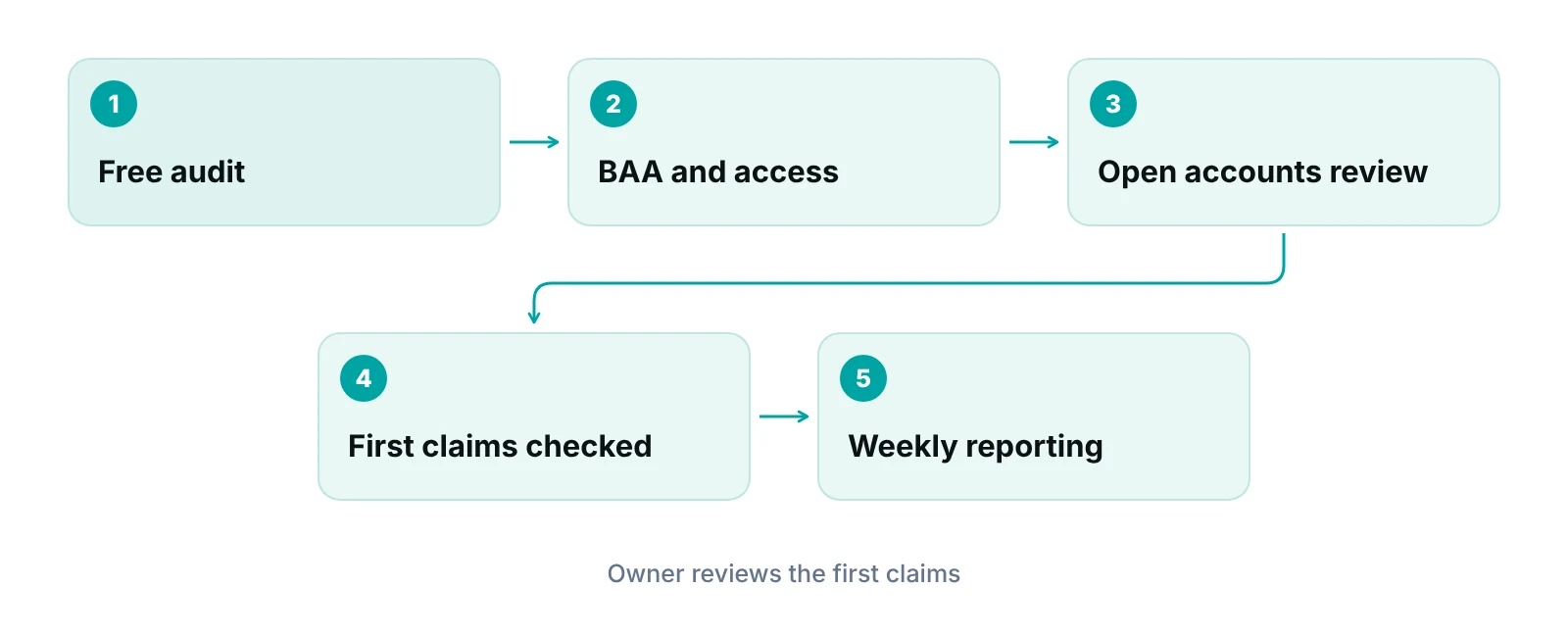
- Plan the handoff in writing: open accounts, unbilled visits, access, first-claim review and weekly reporting.
What does the billing function include, and who needs to decide?
The billing function runs from the front desk to the bank deposit, and the decision should cover all of it. The steps are benefits and visit-limit checks, charge entry, claim submission, payment posting, denial follow-up, patient statements and reporting. Owners often compare vendors on claim submission alone and discover later that denials and patient balances were out of scope. The general questions are in the questions to ask a medical billing company post, and this guide adds the chiropractic specifics.
Payer mix shapes the decision. A trade summary of the 2020 NBCE practice analysis reported private pay or cash at 36.3% of cases and Medicare or Medicaid at 14.3%, so a clinic with many cash and package patients may have fewer claims to manage than its visit count suggests. The summary is secondary and its remaining 14.7% was unexplained, so use the clinic’s own ledger. Claim count, not visit count, drives the workload.
The owner, the office manager and whoever supervises billing should decide together. The clinician’s role is to document, and the manager’s role is to supervise the result. A written scope that names each step and its owner is the first deliverable, whichever model wins.
What stays with the practice in every model?
Documentation, advance notices and responsibility for the claim stay with the practice. OIG’s compliance guidance for third-party billing companies says providers are responsible for documenting services, that coders should encourage proper documentation, and that an ineffective billing-company compliance program can expose provider clients to liability when they rely on the company’s assurances. A vendor can submit and follow up on claims, but it cannot write a note that was not written.
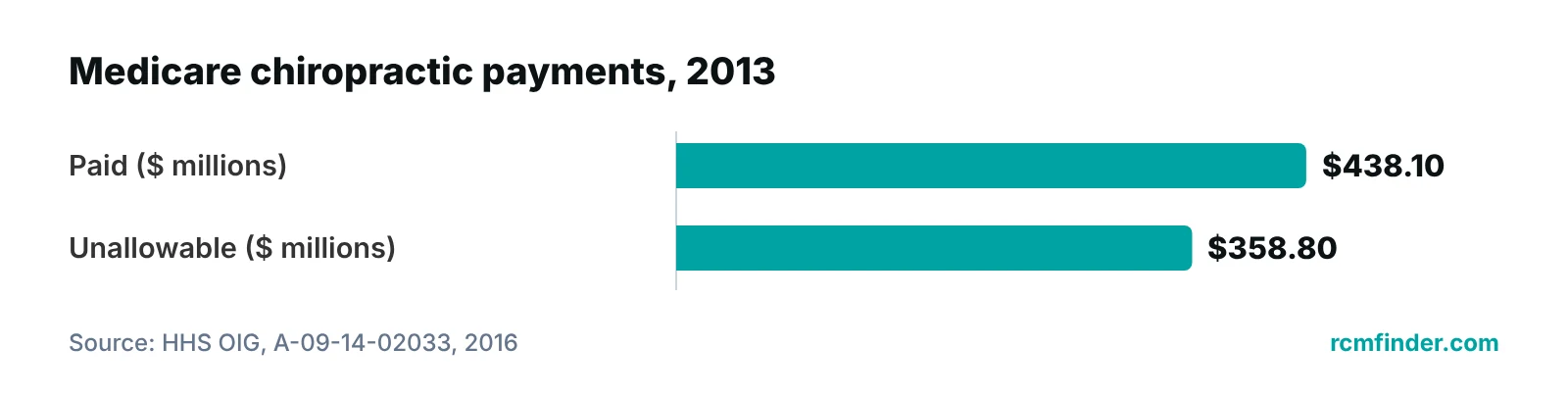
The chiropractic audit record shows why that matters. An OIG audit estimated that $358.8 million, about 82%, of $438.1 million Medicare paid for chiropractic services in 2013 was unallowable (OIG A-09-14-02033, October 2016). An earlier OIG evaluation found $76 million in questionable payments, almost half for claims suggestive of maintenance therapy, with about 2% of chiropractors responsible for half (OIG OEI-01-14-00200, September 2015). In a 2018 audit of one practice, 33 of 100 sampled services failed, 31 for medical necessity and 2 for missing documentation (OIG A-04-16-07064). These are older, sample-based findings, but they show the exposure.
Three duties remain with the office whoever bills. The first is the clinical note and plan of care. The second is the advance notice: the CMS Claims Processing Manual, chapter 30 says the ABN is issued before care expected to be denied, applies to Original Medicare, and is not given as a blanket form, and the CHIRO-001 guideline ties the GA or GZ modifier to it. The third is timing. A CMS transmittal states Medicare denies claims received more than 12 months after service (Transmittal 12909), so notes must be signed and charges released promptly. The CMS educational tool adds that the AT modifier does not prove medical necessity.
How do in-house, outsourced and hybrid billing compare?
Each model trades control for capacity, and none removes the need for supervision. The table compares them on the points that matter most to a chiropractic office. It is a decision framework, not a sourced statistic about any vendor or model.
| Point | In-house | Outsourced | Hybrid |
|---|---|---|---|
| Control of daily work | Highest; staff are on site | Shared; set by contract and reports | Split by task |
| Cost structure | Salary, benefits, software, training | Fee model set by contract (see below) | Smaller staff cost plus a vendor fee |
| Chiropractic knowledge | Depends on one or two people | Ask what the team handles and how it is trained | Can combine front-desk knowledge with vendor depth |
| Coverage during absence | A gap when the biller is out | Team coverage is the usual selling point; confirm | Vendor covers peaks |
| Reporting | Whatever the system produces | Defined in the contract; confirm format and frequency | Defined for the outsourced tasks |
| Main risk | Single point of failure; thin supervision | Weak oversight; unclear scope | Handoff gaps between two parties |
Framework prepared by RCM Finder; not sourced statistics.
- In-house fits when claim volume is modest, the biller knows Medicare chiropractic rules, and the owner reviews a monthly report.
- Outsourcing fits when turnover is high, aged claims are piling up, or several providers and payers outgrow one person.
- Hybrid fits when the front desk handles benefits checks and charge entry well and the harder work, such as denials and aged claims, needs depth.
Whichever model is chosen, use the same three reports to supervise it: claims by status, aged accounts, and denials by reason. The denial management guide explains the denial view.
What should a practice ask a billing vendor?
Ask for written answers on contract terms, payment handling, compliance, chiropractic workflow, reporting and exit. The table links each question area to a source text so the answer can be judged, not just heard.
| Question area | What to ask | Source basis |
|---|---|---|
| Business Associate Agreement | Will you sign one? Does it cover breach reporting, subcontractors and return or destruction of PHI? | HHS business associate contract requirements and sample provisions |
| Receiving payments | Do you ever receive Medicare payments for the practice? If so, how is that set up? | 42 CFR 424.73(b)(3): agency agreement, compensation not related to amounts billed or collected, not dependent on collection, revocable instructions, acts only for the provider, payment in the provider’s name |
| Compensation | How are you paid, and does the fee reward higher billing? | OIG: percentage arrangements may increase upcoding risk |
| Compliance program | Do you have written standards, training, audits and a compliance officer? | OIG’s seven compliance elements for billing companies |
| Chiropractic workflow | How do you handle AT, the Item 14 date, ABN modifiers and visit limits? | CMS MLN1232664; CHIRO-001; payer notices |
| Reporting and access | What reports does the practice see, how often, and can staff view claim status? | Practice’s supervision duty |
| Staff and subcontractors | Who handles the practice’s claims, and do any subcontractors or offshore teams see PHI? | BAA subcontractor terms |
| Exit | What happens to the practice’s data, open claims and access at exit? | HHS sample BAA provisions; AMA six-year retention |
Sources: HHS (business associate contracts); 42 CFR 424.73; OIG third-party billing guidance (1998); CMS MLN1232664; CMS CHIRO-001; AMA HIPAA Security Rule guidance.
Payment handling is the question practices skip most often. Under 42 CFR 424.73(b)(3), Medicare may pay an agent that furnishes billing and collection services only when five conditions are met, and payment is always made in the provider’s name. Many practices avoid the question by having payments deposited to an account in the practice’s own name, but that is a reasoned approach rather than a quoted rule, so confirm it with counsel.
On compensation, the OIG guidance says it has a long-standing concern that percentage billing arrangements may increase upcoding and similar practices, and that coder compensation should not create an incentive to upcode. That does not make any one fee model improper. It means the practice should understand how the fee is set, review the coding, and pick a model it can supervise. RCM Finder quotes pricing after a free audit.
“A billing company should be easy to supervise. If the reports are hard to read, the contract is not finished.”
— Awais Afzal, Healthcare Operations & Data Analyst
Ask for a sample report
Request a real, de-identified aging and denial report. If the vendor cannot show one, ask how the practice will know what is happening.
How should fee models be compared?
Compare what each fee covers before comparing the rate. Vendors commonly charge a percentage of collections, a fee per claim, or an hourly or flat rate, and the same headline number can buy very different scope. This article quotes no prices, and RCM Finder quotes pricing after a free audit, so the useful comparison is the list of what is included.
- Scope. Does the fee include eligibility checks, denial follow-up, patient statements and credentialing support, or are those extra?
- Minimums and terms. Is there a minimum fee, a set contract length or a notice period?
- Software. Is the vendor’s system included, or does the practice supply access to its own?
- What is not billed. Cash and package patients may sit outside the claim fee; confirm how they are treated.
- Change rules. What happens to the fee if volume, providers or payers change?
The clean claims guide is a useful reference for what a first-pass claim should contain, and it helps when reading a vendor’s reporting on how many claims were paid without rework. Ask the vendor to define every metric in writing, because the same name can mean different things in different reports.
How does the handoff work?
A good handoff has a start date, a list of what moves, and a first-claims review. Start before the old biller leaves if possible, because open claims and unbilled visits are where money is lost. The table shows the stages and who does what.
| Stage | Practice provides | Vendor provides | Check |
|---|---|---|---|
| Agreements | Signed scope and Business Associate Agreement | Compliance and data terms | BAA in place before PHI moves |
| Access | Role-based logins for the vendor | Named staff list | Each user has a separate login |
| Open work | Open claims, unbilled visits, denials log, payer list | Open-accounts review | Visits near the 12-month Medicare limit flagged first |
| First claims | Signed notes, plan of care, ABN copies | Claim data check before submission | Owner reviews the first claims |
| Steady state | Prompt note signing, front-desk data | Weekly status and aging reports | Variances answered in writing |
| Exit terms | Agreed data return path | Return or destroy PHI on termination | Written confirmation at exit |
Framework prepared by RCM Finder from HHS, CMS and OIG texts cited above; not sourced statistics.
Allow time for the vendor to learn the practice’s payer rules. One published payer notice, for example, requires prior authorization for all spinal manipulation, approves ten visits to start, and allows reauthorization up to ten visits at a time with documentation (Kaiser Permanente notice, 12/23/2024). A vendor that does not ask about visit limits and authorizations during onboarding has not yet understood the workflow. The practice management software guide covers how those limits are tracked in the system.
How does RCM Finder fit the decision?
RCM Finder offers end-to-end revenue cycle management, including billing, coding support, claim scrubbing, denial management and A/R follow-up, and the team works inside the practice’s existing EHR. The matching service page is end-to-end revenue cycle management. RCM Finder puts a Business Associate Agreement in place before accessing patient data, and the practice’s own time zone governs every staff member’s schedule.
The RCM Finder portal supports the supervision this guide recommends. It tracks claims by stage, runs data-completeness checks before submission, detects underpayments against expected amounts, applies workflow rules, uses role-based staff permissions, keeps an audit log and provides reporting dashboards. A Virtual Medical Assistant can take on benefits checks, prior authorizations and intake at the front desk, which is a natural hybrid arrangement. Marketing that fills the schedule is covered in the chiropractic marketing guide, chiropractic SEO post and digital marketing post.
Compare your options with a free audit
A free practice audit reviews your claim flow, aged accounts and documentation process and shows which model fits. Pricing is quoted after the audit.
Our recommendations
- Write the scope first. List every step from benefits check to patient statement and name the owner of each before comparing vendors.
- Pull the clinic's own numbers. Count claims, payer mix and aged accounts for the last year; decide from those, not from visit counts.
- Get answers in writing. Use the vendor question table and file the written replies with the contract.
- Settle how payments are received. Choose a deposit arrangement that keeps payments in the practice’s name and confirm it with counsel.
- Keep notes and ABNs on time. Set a signing deadline for notes and a rule for ABN copies reaching billing the same day.
- Review the first claims. Check the first batch of claims before steady-state reporting starts.
- Define the exit before signing. Agree on data return, open-claim handling and written confirmation of destruction.
Bottom line
Chiropractic billing services are a supervision decision as much as a staffing one. Pick the model the practice can oversee, keep documentation and ABN duties in-house, put payment handling and data terms in writing, and run the handoff with a first-claims review. To compare the options with your own numbers, see the revenue cycle management page or request a free practice audit.
Frequently asked questions
Is outsourcing chiropractic billing better than in-house?
Neither is better in every case. In-house gives control but depends on one or two people. Outsourcing adds capacity but needs oversight. A hybrid splits tasks. Decide from claim volume, payer mix and supervision capacity, and keep documentation and ABN duties in the practice either way.
What stays with the practice if billing is outsourced?
The clinical note, plan of care and advance notices stay with the practice. OIG guidance says providers document services, and an ineffective billing-company compliance program can expose provider clients to liability. The practice also controls timely note signing and supervises reports and denials.
Can a billing company receive Medicare payments for a practice?
Only under conditions. 42 CFR 424.73(b)(3) allows payment to an agent under an agency agreement when compensation is unrelated to amounts billed or collected, does not depend on collection, instructions are revocable, the agent acts only for the provider, and payment is made in the provider’s name. Confirm the arrangement with counsel.
What should be in the Business Associate Agreement?
HHS says it should set permitted uses, require safeguards including Security Rule compliance, require reporting of improper disclosures and breaches, bind subcontractors and allow termination for a material violation. Sample provisions also require returning or destroying protected information at the end, if feasible.
How does the handoff to a billing company work?
Sign the scope and Business Associate Agreement, give role-based access, transfer open claims and unbilled visits, review the first claims and set weekly reporting. Flag visits near Medicare’s 12-month filing limit first. Agree on data return at exit before the start date.
Do cash-heavy chiropractic clinics need billing services?
Maybe not full services. A trade summary of a 2020 practice analysis put private pay at 36.3% of cases, but the clinic’s ledger decides. If insured claims are few, a hybrid with front-desk benefits checks and outsourced denial follow-up may be enough.
Get your free practice audit
Tell us about your practice. We will contact you using the details you give.
- A review of your recent claims, denials and A/R aging
- Where your front desk and prior authorizations slow payment
- A prioritized fix list you keep, whether or not you hire us
Pricing is quoted after the audit, based on your volume and the services you choose. Prefer to talk? Call +1 (302) 556-2288.
Sources
- OIG Compliance Program Guidance for Third-Party Medical Billing Companies — Federal Register / HHS OIG (1998)
- 42 CFR 424.73 Prohibition of assignment of claims by suppliers — Legal Information Institute (Cornell) (current)
- Business associate contracts — HHS Office for Civil Rights (current)
- Sample business associate agreement provisions — HHS (current)
- Hundreds of Millions in Medicare Payments for Chiropractic Services Did Not Comply With Medicare Requirements (A-09-14-02033) — HHS OIG (2016)
- CMS Should Use Targeted Tactics to Curb Questionable and Inappropriate Payments for Chiropractic Services (OEI-01-14-00200) — HHS OIG (2015)
- Etheredge Chiropractic Received Unallowable Medicare Payments (A-04-16-07064) — HHS OIG (2018)
- MLN1232664 Chiropractic Services educational tool — CMS (2022)
- CHIRO-001 Chiropractic Services billing guideline — CMS Medicare Coverage Database (2015)
- Medicare Claims Processing Manual, Chapter 30, Section 50 (ABN) — CMS (current)
- Transmittal 12909, Claims Processing Manual Chapter 1 — CMS (2024)
- Reauthorization for spinal manipulation visits — Kaiser Permanente (2024)
- NBCE Practice Analysis 2020: New Trends in Chiropractic — MPA Media (2020)
- Guidance on Risk Analysis — HHS Office for Civil Rights (current)
Disclaimer: This article is educational and is not legal, coding, tax or compliance advice, and it does not tell any clinician how to treat a patient. State board rules, payer policies and Medicare contractor policies differ and change, so confirm the current rule with your state board, your payers, your Medicare contractor and qualified counsel before you act. CPT is a registered trademark of the American Medical Association.
