

Chiropractic SEO is the work of making a clinic easy to find and trust in local search. It rests on an accurate Google Business Profile, a website with honest service pages, and reviews requested within Google and FTC rules. HIPAA also limits how the clinic may reply to a review.
A patient types a neck-pain search on a phone, sees three clinics on a map and taps the one with the clearest profile and the best reviews. Everything that happens next, the call, the form, the first visit, depends on work done weeks earlier. This guide is for chiropractic owners and managers who want that work done correctly.
It covers profile rules for solo and group clinics, the review rules that trip up well-meaning offices, how to reply without disclosing patient information, and which website pages deserve attention. Claims, offers and payer mix are in the chiropractic marketing guide, and paid channels are in the chiropractic digital marketing post.
Key takeaways
- Google’s profile rules govern the business name, address and practitioner profiles, and they treat solo and multi-provider clinics differently.
- Google bans rewarded reviews and selectively asking only happy patients; the FTC rule bans buying reviews tied to a sentiment.
- In an OCR settlement, a dental practice paid $10,000 after replying to an online review with patient details.
- Service pages should describe care without cure or guarantee claims that state boards and the FTC restrict.
- Appointment and intake pages need a privacy check before any tracking tool is added.
What does chiropractic SEO include?
It covers three assets: the business profile that appears on maps, the website that answers the patient’s questions, and the reviews that help a stranger decide. Each has written rules from the platform, a regulator or both. This post keeps to those rules and does not make claims about ranking formulas that no source in this article supports.
Local intent is the reason these assets matter for a clinic. A patient looking for a chiropractor wants a close, trustworthy option and a quick way to book. In a 2025 RepuGen survey of 1,212 U.S. respondents, 73.28% said they consider online reviews when selecting a provider, and Google was the most used review platform at 77.78% (RepuGen). RepuGen sells reputation software, so read the figures as one vendor’s survey, not a neutral benchmark. The wider guide on healthcare SEO covers search basics for all specialties.
What are the Google Business Profile rules for a chiropractic clinic?
The clinic’s profile must reflect the real-world business, and Google’s guidelines for representing your business set the limits. They say the name must match the name used on the storefront, website and stationery, and they bar taglines, hours, phone numbers, URLs and service details from the name. For a clinic, that means leaving out phrases such as a condition or a promise from the profile name.
| Google guideline | What it means for a chiropractic clinic |
|---|---|
| Name must match the real-world name; no taglines, services or URLs | Use the signage name, not ‘Back Pain Relief’ or a keyword string |
| Address must be real; virtual offices are not eligible | A mailbox or shared virtual suite does not qualify for a profile |
| Each location gets one profile | Two offices with separate staff each need their own profile; do not duplicate one office |
| Practitioners may have profiles if public-facing at the verified location | A chiropractor seeing patients at the clinic may qualify; support staff may not |
| Several practitioners at one location: the organization has its own profile and each practitioner uses only the practitioner’s name | In a group clinic, set up the clinic profile first, then individual doctors |
| A practitioner gets one profile, not one per specialty | Do not create separate sports, pediatric and wellness profiles for one doctor |
| Businesses that operate only by appointment should not list hours | If patients are seen by appointment only, follow the guideline |
| Descriptions cannot include promotions, prices or links | Keep the free-exam offer and package prices off the description |
Source: Google Business Profile Help, ‘Guidelines for representing your business on Google’ (fetched October 2026).
Check the profile against that table on a set schedule, because a change to the signage, a new associate or a second location can put the profile out of line. A suspended or edited profile is hard to fix under pressure.
Solo clinic or group clinic?
The guidelines treat the two differently. A solo practitioner in a branded organization shares one profile named with the brand and the practitioner’s name. When several practitioners share a location, the organization gets its own profile and each practitioner’s profile uses only that practitioner’s name. A clinic that adds an associate should decide in advance which structure applies, because moving from one to the other is easier before reviews pile up on the wrong listing.
Mobile care and service areas
Some chiropractors treat patients at workplaces, gyms or homes. Google says service-area businesses get one profile for the central office with a designated service area, and a business with no storefront should hide its address. A hybrid business can show a storefront and a service area if the location is staffed and can receive customers during stated hours. The guideline adds that service areas generally should not extend beyond about two hours of driving time.
A monthly local-search review
- Compare the profile name, address, phone and hours with the signage and website.
- Check that each practitioner and location is listed as the guideline describes.
- Read new reviews and confirm every reply follows the written policy.
- Test the booking and call links from a phone.
- Record inquiries, booked visits and kept visits by source.
The medical website design post is a useful companion for the site itself.
How can a clinic ask for reviews without breaking the rules?
Ask every patient the same way, offer nothing in return and never pick who gets asked. Google’s prohibited and restricted content policy says reviews prompted by rewards such as payment, discounts or free goods or services are removed, and that merchants may not selectively ask only satisfied customers, set staff quotas for reviews or require specific content such as mentioning staff. Asking for genuine reviews without incentives or attempts to shape the rating is allowed.
The FTC adds a federal layer. Its consumer reviews rule, announced August 14, 2024 and effective October 21, 2024 (Federal Register), prohibits fake reviews, buying reviews tied to a positive or negative sentiment, undisclosed insider reviews, and suppressing negative reviews through groundless legal threats. It applies to services as well as products. The Endorsement Guides also say advertisers should not procure, suppress or edit reviews in ways that distort what consumers think.
| Practice | Allowed? | Basis |
|---|---|---|
| Send every patient the same neutral review request | Yes | Google allows genuine requests without incentives |
| Offer a free adjustment or discount for a review | No | Google removes reviews prompted by rewards; FTC rule bars buying reviews tied to sentiment |
| Ask only patients who said they were happy | No | Google bars selectively asking satisfied customers |
| Set a staff quota or require staff names in reviews | No | Google restricts quotas and required content |
| Have employees or relatives post reviews | Restricted | Google conflict-of-interest rule; FTC rule on insider reviews |
| Threaten a reviewer to remove a negative post | No | FTC rule bars review suppression through groundless threats |
Sources: Google contribution policy; FTC final rule announcement (2024); Federal Register 89 FR 68034.
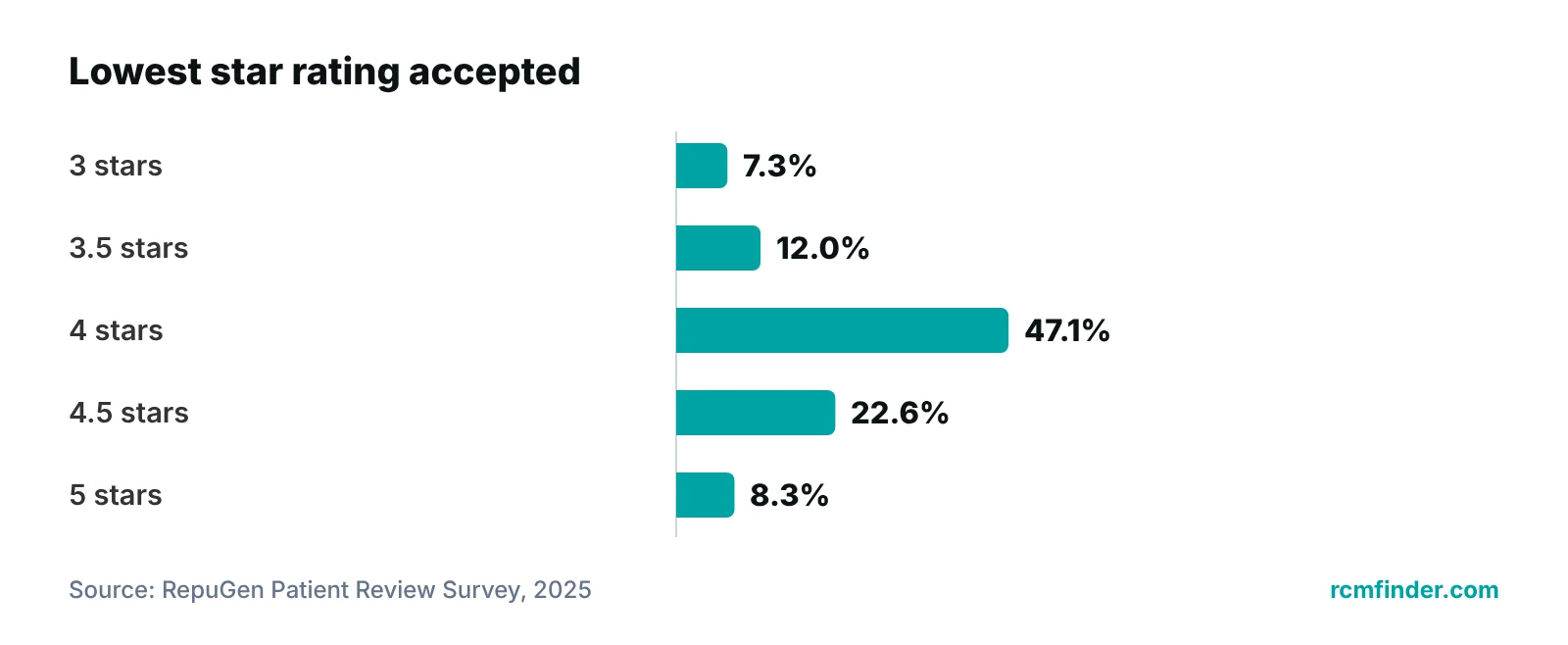
The same RepuGen survey asked about minimum star ratings. Adding the table’s 4-star, 4.5-star and 5-star groups gives 77.92% who need at least four stars, although the report’s own summary says 70%, so the table figure is used here. The practical point is not to chase five stars. It is to make the request routine so an honest rating reflects the clinic’s real service.
How should a clinic reply to a review?
Reply in general terms and never confirm treatment or share any detail about the patient. In an OCR settlement reported by HIPAA Journal, a Texas dental practice paid $10,000 and agreed to a corrective action plan after replying to a Yelp review with the patient’s last name, health condition details, treatment plan, insurance information and cost information. OCR also cited the lack of a policy on posting health information on social media and a privacy notice missing required content.
Chiropractic clinics face the same exposure on Google, Facebook and other sites. A cautious reply thanks the reviewer, expresses concern in general terms and invites contact by phone. Whether to confirm that the reviewer was a patient is a judgement for the clinic’s privacy officer, since the settlement involved detailed disclosures and the safest approach is to avoid confirming anything. The reputation management post covers tone, and the HIPAA checklist covers the policy.
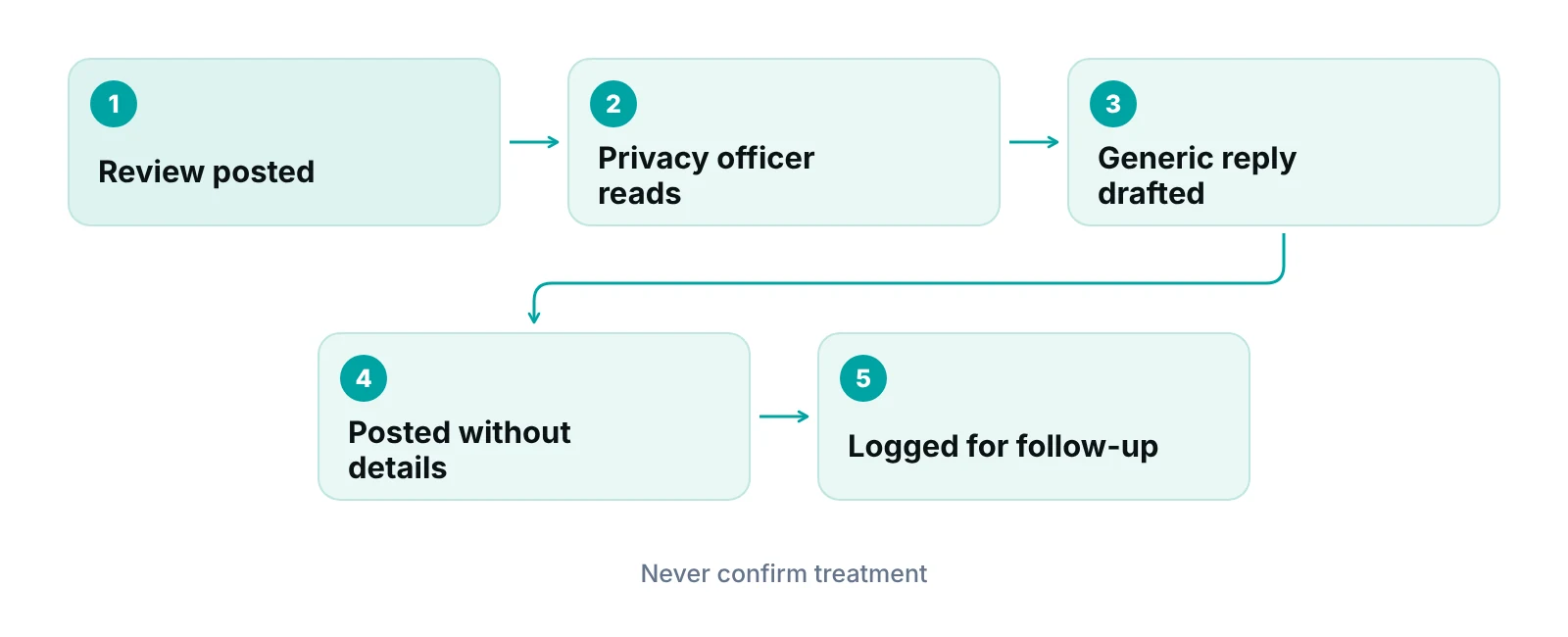
Write the policy before the first bad review
A one-page rule for who may reply, what the reply may say and how the reply is approved prevents the mistakes that led to the settlement above.
Which website pages matter, and what should they say?
Build a small set of pages that answer real questions: one page per service, one per location, and a biography page for each clinician. Keep every page factual. The FTC told one chiropractic clinic in a 2021 warning letter that service claims need competent and reliable scientific evidence, and Texas rule 22 TAC 77.4 bars cure and guarantee claims. State advertising texts may also set name rules: Minnesota requires the licensee’s name in advertising (Minn. R. 2500.0200), and Florida requires ads to identify the practitioner as a chiropractic physician (s. 460.413). Confirm whether your state treats the website as advertising.
| Page | Search job | Check before publishing |
|---|---|---|
| Service page (for example, spinal manipulation or sports injuries) | Match what a patient types | No cure, guarantee or disease claims without evidence on file |
| Location page | Support the map listing | Same name, address and phone as the profile; one page per real office |
| Provider biography | Show who the patient will see | Credentials and licence name stated as the board requires |
| Condition or symptom page | Capture questions | Educational wording; no diagnosis or outcome promise |
| Appointment or intake form | Convert the visit | Privacy check on any tracking tool; secure form delivery |
Sources: FTC warning letter (2021); Texas 22 TAC 77.4; Minn. R. 2500.0200; Florida Statutes 460.413; HHS OCR tracking bulletin.
A useful service page answers the questions a new patient asks before calling. Keep each answer plain, keep it tied to what the clinic actually offers, and keep it free of outcome promises.
- What the visit involves and how long a first visit usually takes at this clinic
- Who the clinicians are and what licence they hold
- Whether the clinic bills insurance, accepts cash payment or both, stated without promising coverage
- Where the office is, how to park or arrive, and how to book
- What to bring and which forms are sent in advance
The appointment page needs special care. The HHS OCR bulletin on online tracking technologies says information collected when someone schedules an appointment is treated as protected health information, and a vendor that receives it may need a Business Associate Agreement. A federal court vacated part of the bulletin on June 20, 2024, concerning some unauthenticated pages, so counsel should confirm the current position. The digital marketing post explains tracking in more detail.
Who keeps the work going?
Local SEO is a routine, not a project. Someone must check the profile, watch for new reviews, update pages when services or staff change, and answer the calls that search produces. The healthcare digital marketing service from RCM Finder covers local SEO, Google Ads and reputation work. A Virtual Medical Assistant can staff the front desk that handles the calls, scheduling and intake those searches create, working in the practice’s time zone.
RCM Finder puts a Business Associate Agreement in place before accessing patient data. Measure results from the inquiry to the kept visit, as described in the marketing ROI guide. Clinics that run software for scheduling should also check how it records the source of each new patient; the practice management software post lists what to look for, and the billing services guide covers what happens after the visit.
Get a second set of eyes on local search
A free practice audit reviews your profile, review process and the front-desk path from a search call to a booked visit. Pricing is quoted after the audit.
Our recommendations
- Audit the profile against Google's text. Compare name, address, hours and practitioner profiles with the guideline table every quarter and after any change in staff or location.
- Make the review request identical for everyone. Send the same neutral request to every patient at the same point in the visit, with no reward and no screening.
- Write a reply policy. State who may reply, what is never mentioned and who approves wording. Train the front desk on it.
- Keep claims off service pages. Describe the care and the patient it suits. Leave out cure, guarantee and disease claims unless evidence is on file.
- Check forms before adding tracking. Review each intake and booking page with counsel before adding analytics or advertising tags.
- Match name, address and phone everywhere. Keep the profile, website, directories and insurance listings identical.
- Report on booked and kept visits. Track calls and forms through to kept first visits, split by payer type.
Bottom line
Chiropractic SEO is mostly disciplined housekeeping: a profile that follows Google’s text, reviews requested the same way for everyone, replies that reveal nothing about a patient, and pages that describe care without promises. For help with local search and reputation, see the healthcare digital marketing service or request a free practice audit.
Frequently asked questions
Can a chiropractor offer a discount for a Google review?
No. Google’s policy removes reviews prompted by rewards such as discounts or free services, and the FTC rule bars buying reviews tied to a positive or negative sentiment. Ask every patient for an honest review, offer nothing in return, and do not choose who is asked.
Can a clinic reply to a review and thank the patient by name?
Avoid it. An OCR settlement involved a practice that replied to a review with the patient’s name, condition, treatment and insurance details. Use a general reply, avoid confirming treatment and invite the reviewer to call. Let the privacy officer approve the wording.
Do individual chiropractors need their own Google profile?
Not necessarily. Google lets public-facing practitioners have a profile at the verified location, but a group clinic should have its own organization profile and each practitioner profile should use only the practitioner’s name. A practitioner gets one profile, not one per specialty.
Can keywords go in a Google business name?
No. Google says the name must match the real-world name and excludes taglines, services, phone numbers and URLs from it. Adding a condition or a promise risks an edit or suspension. Put that language on the website, within advertising rules.
Is the booking page part of SEO or privacy?
Both. The page should be easy to find and fast to use, and it should be checked for tracking tools. OCR treats appointment details as protected health information, and a vendor receiving them may need a Business Associate Agreement. A court vacated part of the bulletin in 2024.
How many stars does a clinic need?
There is no fixed number. In a 2025 vendor survey, 77.92% of respondents needed at least four stars, but the survey is from a reputation-software company. Focus on a steady flow of honest reviews and good service, not on chasing a perfect score.
Get your free practice audit
Tell us about your practice. We will contact you using the details you give.
- A review of your recent claims, denials and A/R aging
- Where your front desk and prior authorizations slow payment
- A prioritized fix list you keep, whether or not you hire us
Pricing is quoted after the audit, based on your volume and the services you choose. Prefer to talk? Call +1 (302) 556-2288.
Sources
- Guidelines for representing your business on Google — Google Business Profile Help (2026)
- Prohibited and restricted content (contribution policy) — Google Maps Help (2026)
- FTC announces final rule banning fake reviews and testimonials — Federal Trade Commission (2024)
- Trade Regulation Rule on the Use of Consumer Reviews and Testimonials — Federal Register (2024)
- Guides Concerning the Use of Endorsements and Testimonials, 16 CFR Part 255 — eCFR (current)
- Use of Online Tracking Technologies by HIPAA Covered Entities — HHS Office for Civil Rights (2024)
- Dental practice fined $10,000 for PHI disclosures on Yelp — HIPAA Journal (2019)
- RepuGen Patient Review Survey 2025 — RepuGen (2025)
- Warning letter to Freedman Chiropractic Center — Federal Trade Commission (2021)
- Texas Administrative Code 22 TAC 77.4 — Texas Board of Chiropractic Examiners (via Justia) (2025)
- Minnesota Rules 2500.0200 — Minnesota Board of Chiropractic Examiners (via Justia) (current)
- Florida Statutes 460.413 — Florida Senate (2023)
Disclaimer: This article is educational and is not legal, coding, tax or compliance advice, and it does not tell any clinician how to treat a patient. State board rules, payer policies and Medicare contractor policies differ and change, so confirm the current rule with your state board, your payers, your Medicare contractor and qualified counsel before you act. CPT is a registered trademark of the American Medical Association.