
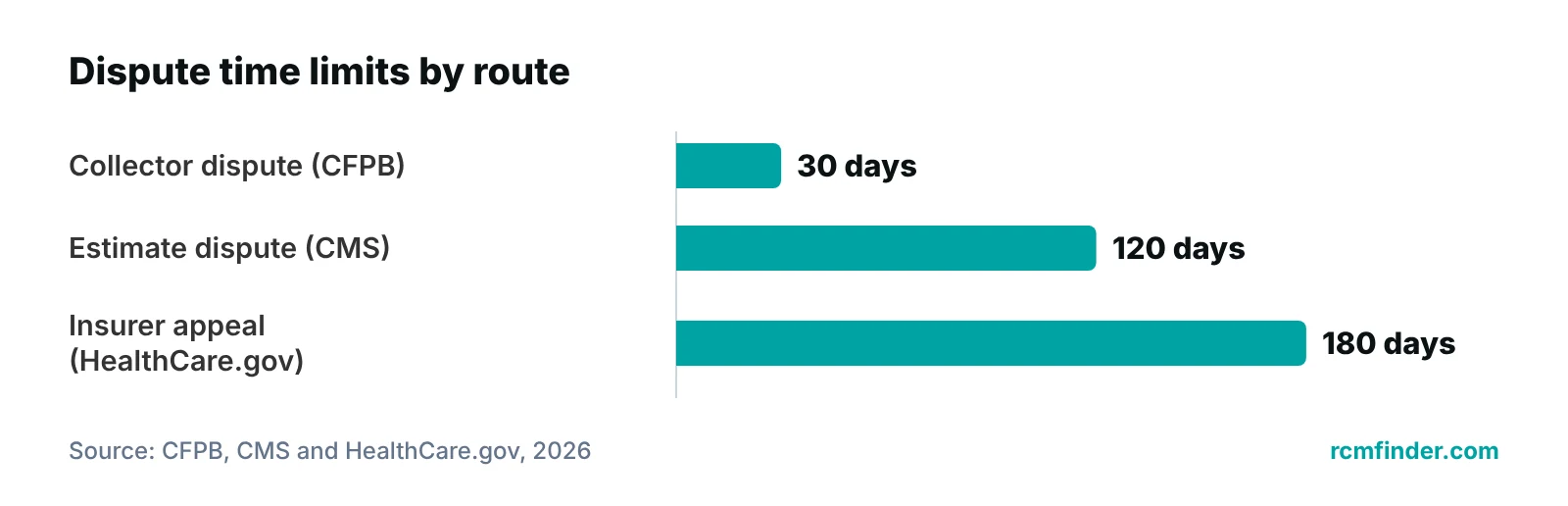
To dispute a medical bill, request an itemized bill, compare it with your insurer's Explanation of Benefits, call the billing office, then put the dispute in writing. The formal route depends on your situation, and each has its own clock: 30 days for a collector, 120 for an uninsured estimate dispute, 180 to appeal an insurer denial.
Billing mistakes are common enough that every patient should know the steps. Federal rules also give some patients specific rights and time limits, and those details are easy to miss. This guide is written for patients first, with a short section at the end for practices.
Key takeaways
- Start with an itemized bill and your EOB, and dispute a specific line, not the total.
- Time limits differ: 30 days (collector), 120 days (estimate dispute), 180 days (insurer appeal).
- Federal surprise-bill protections apply to certain out-of-network care, and not to ground ambulances, Medicare or Medicaid.
- A bill in collections can still be disputed, but the first window is short.
- Practices prevent most disputes with clear estimates, verified coverage and readable statements.
Which dispute route fits your bill?
The route depends on three facts: whether you used insurance, who is asking for payment now, and what the error is. A wrong date of service goes to the billing office. A denied claim goes to your insurer. A bill that is far above a written estimate goes through a federal process. Pick the row that matches, then follow the steps in the next sections.
| Your situation | Where to go | Time limit |
|---|---|---|
| Uninsured or not using insurance, and the bill is at least $400 above your good faith estimate | Federal patient-provider dispute resolution | Start within 120 days of the initial bill |
| Insured, and you got an out-of-network emergency bill or an out-of-network bill at an in-network facility | Complaint to the No Surprises Help Desk | The CMS page does not state a deadline |
| Your insurer denied part or all of a claim | Internal appeal with your insurer | 180 days from the denial notice |
| A debt collector contacted you about the bill | Written dispute to the collector | 30 days from receiving the validation information |
| The bill has a duplicate charge, wrong date or service you did not receive | Provider billing office, then a written dispute | Set by the provider; no single federal limit is covered here |
Source: CMS, Dispute a medical bill; HealthCare.gov, Internal appeals; CFPB, What is a debt collection validation notice (accessed 2026)
If your bill involves out-of-network care you did not choose, read our guide to surprise medical bills first. It covers how those bills arise. This page covers what to do about them, and about every other kind of billing mistake.
Step 1 to 3: Check the bill before you dispute it
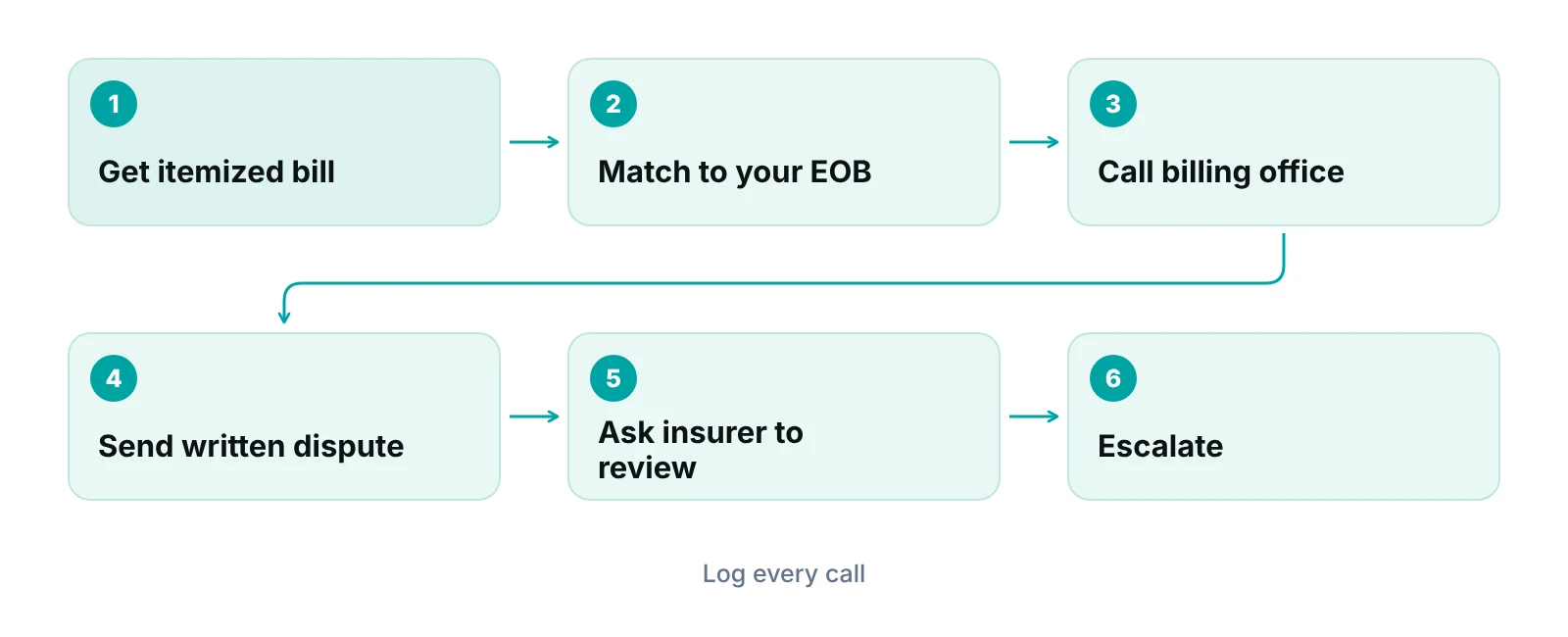
Start by getting two documents: an itemized bill and your insurer’s Explanation of Benefits (EOB). An itemized bill lists each service, date and charge. The EOB shows what the plan allowed and what it says you owe. A dispute built on a comparison of the two is much harder to brush off than a general complaint that the bill seems high.
- Ask for the itemized bill. Call or write to the billing office and ask for a line-by-line statement with dates and procedure codes.
- Compare it with your EOB. The patient amount on the bill should match the patient responsibility on the EOB. A gap is the first thing to question.
- Look for the usual errors. Check for the same service billed twice, a service you did not receive, a wrong date, the wrong provider, and a charge insurance already paid.
Before you call
Write down the account number, the date of service and the exact line you question. Note the date, time and name of every person you speak with. If the billing office says it will fix the bill, ask for that in an email or a corrected statement.
Step 4 and 5: Call the billing office, then put it in writing
Call first because many errors are fixed in one conversation. Follow up in writing the same day, because a written record is what you rely on if the bill is not corrected. Keep the tone plain and specific.
A dispute letter or secure message should contain:
- Your name, the patient name, the account number, the date of service and the statement date.
- The specific charge you dispute and why, for example “billed twice on the same date” or “EOB shows a lower patient amount”.
- Copies (not originals) of the EOB, the itemized bill and anything else that supports your point.
- What you want: a corrected bill, a written explanation, or a hold on collection while the provider reviews.
- A reasonable date for a reply, and how to reach you.
“Most billing disputes are settled by a clear paper trail, not by a louder phone call.”
If the provider agrees the bill was wrong, ask for the corrected statement in writing and confirm the balance before you pay anything. If it disagrees, ask for the reason in writing and move to the formal routes below.
If you have insurance: appeal the denial or file a complaint
If your insurer denied a claim, file an internal appeal within 180 days of receiving the denial notice. If the problem is a surprise bill for out-of-network care, a complaint to the federal No Surprises Help Desk is the route. These are different problems with different processes.
Appealing a denied claim
HealthCare.gov explains that you must file an internal appeal within 180 days of receiving notice that your claim was denied. Use your insurer’s form or write a letter with your name, claim number and member ID, and include supporting information such as a letter from your doctor. Your state’s Consumer Assistance Program can file the appeal for you.
| Stage | What happens | Timing |
|---|---|---|
| File the appeal | You send the insurer’s form or a letter with claim details and support | Within 180 days of the denial notice |
| Insurer decides (service already received) | Written decision at the end of the process | Within 60 days |
| Insurer decides (service not yet received) | Written decision at the end of the process | Within 30 days |
| Expedited appeal | For when waiting could seriously jeopardize life or the ability to regain maximum function | Decision within 4 business days of the request |
| Insurer still says no | You can request an external review; the final decision must explain how | Follow the notice |
Source: HealthCare.gov, Internal appeals (accessed 2026). Plan documents and state law may add rules; check your denial notice.
Surprise bills and the No Surprises Act
For people with most employer, union, individual and Marketplace plans, federal law protects against surprise bills for most emergency services from out-of-network providers, and for certain out-of-network services at in-network hospitals and surgical centers. Anesthesiology, radiology and pathology are named as always protected. For protected services, cost sharing cannot be greater than in-network requirements. Providers may ask you to waive protections only in limited cases, with a standard written form, and never for ancillary services.
There are limits. The CMS toolkit says ground ambulance services are not covered by the federal rules, though some states offer protection. Medicare, Medicaid, CHIP, VA, IHS and TRICARE are not covered by these protections. If you believe you were billed in violation of them, CMS says to submit a complaint if you got care on or after January 1, 2022. The No Surprises Help Desk number is 1-800-985-3059, and there is an online complaint form on the CMS site. Not having met your deductible is not a violation.
If you are uninsured or paying yourself: use the good faith estimate
Uninsured and self-pay patients can dispute a bill that is at least $400 more than their written good faith estimate. You must start the dispute within 120 days of the initial bill, and a $25 non-refundable fee applies. The fee is deducted from what you owe if you win.
A good faith estimate is a list of expected charges given before care. It is not a bill. CMS explains that you need it in writing, and that one estimate covers only one provider or facility, so a surgeon and a hospital each give their own. To use the process under the CMS dispute page, you must also meet these conditions:
- You had no insurance or did not use it, and you told the provider so before care.
- You received the estimate at least three days before your scheduled appointment.
- You received the care on or after January 1, 2022.
- A provider or facility charged at least $400 more than the estimate.
An independent reviewer decides the case. If the care was unexpected but reasonably priced, the bill can stay as it is. If the provider should have disclosed costs in advance, or the services were not medically necessary, the provider must reduce the bill. You can also settle directly with the provider before the process ends. In that case, the provider must reduce your bill by at least $12.50 and notify the reviewer.
If the bill is already in collections
Yes, you can still dispute a bill that has gone to collections, and the first deadline is short. A debt collector’s validation notice should state an end date for a 30-day dispute period. If you dispute in writing within that period, the collector must pause collecting the disputed amount until it adequately responds.
The CFPB describes the notice as including the creditor’s name, an itemization of the debt, and information for replying if you think the amount is wrong or the debt is not yours. Send your dispute in writing and keep a copy. Missing the 30-day window can affect your ability to assert your rights under the debt collection rule.
| Situation | What the rule says |
|---|---|
| Estimate dispute is pending (uninsured or self-pay) | The provider cannot send the bill to collections or threaten to, cannot collect existing late fees until the process ends, and cannot retaliate |
| The bill is already in collections when that dispute starts | The provider must stop pursuing payment until the dispute is resolved |
| You dispute a collector’s debt in writing within 30 days | The collector must pause collecting the disputed amount until it adequately responds |
| You win a dispute but the provider still bills you or sends you to collections | Submit a complaint to the No Surprises Help Desk |
| You file an estimate dispute | Your costs will not increase because you disputed |
Source: CMS, Dispute a medical bill (2026); CFPB, What is a debt collection validation notice (2026)
On credit reports, a federal rule that would have barred medical debt from reports was vacated by a court in July 2025, according to the National Consumer Law Center. Do not assume medical debt is automatically hidden. Check your credit reports, and if you see an error or a collection that is under dispute, the CMS page directs credit report and debt collection problems to the CFPB at consumerfinance.gov/complaint or 1-855-411-2372. For a view from the practice side, see how practices handle patient collections.
When the bill is correct but you cannot pay it
A correct bill can still be reduced. Nonprofit hospitals must have a financial assistance policy, and the IRS limits what they can charge people who qualify. Ask the billing office for its policy and application before you agree to a payment plan.
Under Section 501(r)(5), the IRS limitation on charges says emergency and other medically necessary care may not be charged to financial-assistance-eligible people above the amount generally billed to insured individuals. This applies to charitable hospital facilities, not to every physician office. If you paid before you were found eligible, the hospital must refund the amount above what you owe as an eligible person, with a small exception for amounts under $5.
Do you need a medical billing advocate?
Many errors can be fixed with a call and a letter. Consider an advocate when the bill is large, involves several providers and an insurer, or when you do not have the time to manage a dispute. An advocate reviews bills, helps with appeals and talks to the billing office for you.
- Ask how they charge (hourly, flat or a share of savings) and get it in writing before you sign.
- Ask what credentials or training they hold, and what they will and will not do for you.
- Check your state’s Consumer Assistance Program or insurance department first. Those services are public and may cost nothing.
- Do not give anyone an original document or pay a large upfront fee on a promise of a specific saving.
If your bill comes from an injury claim with an attorney involved, bring the bill and the EOB to your attorney before you dispute or pay it. Settlement and liens can affect what you owe, and that is a legal question this guide does not answer.
For practices: stop disputes before they start
Most patient disputes begin with a bill the patient cannot read or an amount they did not expect. Practices reduce them by getting the front end right: verify coverage, give a clear estimate, and send a statement a patient can understand. Billing rules differ by specialty billing pages, so check how your own mix of services creates surprises.
- Verify coverage before the visit. Read our guide to patient insurance verification so the patient hears the likely cost before care.
- Know the estimate rule. For uninsured and self-pay patients, an estimate is required when care is scheduled 3 or more business days ahead or the patient asks. If scheduled 3 to 9 business days ahead it is due within 1 business day; if 10 or more business days ahead, or on request, within 3 business days. It is not required for emergency care or walk-in visits.
- Send statements people can read. See our notes on patient-friendly billing statements for layout and wording.
- Fix errors at the source. A claim built on complete data is less likely to produce a wrong patient balance; see clean claims.
Tracking each claim from submission to payment, with an owner at every stage, makes it easier to answer a patient who calls about a balance. Some practices use a practice management system that tracks claims by stage for this. If you outsource billing, ask the vendor how patient balance questions are logged and answered, and look at our medical billing services overview for what that work covers.
Where do patient billing questions come from in your practice?
Get a free practice audit to see which statements, estimates and claim errors are generating patient calls.
Our recommendations
- Get the itemized bill and EOB first. Never dispute a total. Dispute a line, and show the document that proves it.
- Write down every deadline the day a notice arrives. The windows are 30, 120 and 180 days for different routes, and each starts from a different notice.
- Dispute in writing within 30 days if a collector contacts you. Send it by a method that gives you a record and keep a copy.
- Do not pay a disputed amount from pressure on a call. Ask for a written corrected statement or written reason first.
- Check financial assistance before a payment plan. If a nonprofit hospital billed you, ask for its policy and application.
- For practices, answer the estimate question before care. A written estimate and a readable statement prevent most disputes.
Give every patient balance question an owner.
Our portal tracks each claim by stage with an assigned owner, so staff can see where a claim stands when a patient calls. Role-based permissions and an audit log show who changed what.
See how the RCM Finder portal works · Create a portal account
Disclosure: RCM Finder builds and sells this portal. It is a practice management system, not an EHR.
Bottom line
A billing dispute is won with a short, dated paper trail and the right route. Patients should start with the itemized bill and EOB, then use the route that matches their situation. Practices that want fewer disputes can look at denial management services and review how denials are handled.
Frequently asked questions
What does it mean to dispute a medical bill?
To dispute a medical bill means to formally challenge a charge you believe is wrong, unexpected or not yours to pay. You do it by asking the provider to review it, usually starting with an itemized bill and your insurance EOB, and then putting the dispute in writing.
How do I know if there is an error on my medical bill?
Compare the itemized bill with your EOB and your own records. Look for duplicate charges, services you did not receive, wrong dates or providers, and amounts that differ from the patient responsibility shown on the EOB. A mismatch is a reason to call the billing office.
Can I dispute a medical bill that is in collections?
Yes. A collector’s validation notice should state a 30-day dispute period. If you dispute in writing within it, the collector must pause collecting the disputed amount until it adequately responds. Keep a copy of what you send, and note the date you received the notice.
How long do I have to dispute a medical bill?
It depends on the route. Insurer appeals must be filed within 180 days of the denial notice. The federal estimate dispute must be started within 120 days of the initial bill. A collector dispute has a 30-day window. A simple billing error has no single federal limit, but act promptly.
Do I need a medical billing advocate or can I do it myself?
Many simple errors can be resolved yourself with a call and a letter. An advocate may help with large bills, several providers or repeated denials. Ask how they charge before you agree, and check free state help first, such as your Consumer Assistance Program or insurance department.
What if my bill relates to a personal injury claim?
Talk to your attorney before you pay or dispute it. How medical bills are handled in a claim, and how compensation is calculated, depends on the state and the case. This guide does not give legal advice on settlements or damages.
Get your free practice audit
Tell us about your practice. We will contact you using the details you give.
- A review of your recent claims, denials and A/R aging
- Where your front desk and prior authorizations slow payment
- A prioritized fix list you keep, whether or not you hire us
Pricing is quoted after the audit, based on your volume and the services you choose. Prefer to talk? Call +1 (302) 556-2288.
Sources
- Dispute a medical bill — CMS (2026)
- Know your medical bill rights when not using insurance — CMS (2026)
- No Surprises Act consumer toolkit — CMS (2026)
- What is a debt collection validation notice? — CFPB (2026)
- Internal appeals — HealthCare.gov (2026)
- Limitation on charges, Section 501(r)(5) — IRS (2026)
- Keeping medical debt out of credit reports — National Consumer Law Center (2025)
Disclaimer: This guide is educational and is not legal, financial or insurance advice. Rules, deadlines and fees change and vary by state and plan. Confirm with your insurer, your state insurance department or an attorney for your situation.
