
Workers' comp medical billing means billing the employer's workers' compensation carrier, not the patient or their health plan, under the state's own deadlines, forms and fee schedule. The carrier decides whether the injury is compensable, and the injured worker usually cannot be billed for a balance.
Rules differ by state, so this guide uses Texas and California as examples drawn from their agencies’ own pages and shows what to look up for yours. If you are comparing how to staff or outsource this work, our medical billing services page describes what we offer.
Key takeaways
- Bill the workers’ comp carrier, not the patient’s health plan, and confirm the claim number before you submit.
- Filing limits, payment deadlines and fee schedules are set by each state; keep a rule sheet per state.
- A state fee schedule, not your contract rate or a Medicare rate, decides the expected payment.
- Hold patient statements until compensability is decided and the state’s balance-billing rule is clear.
- Sort denials by cause, because wrong payer, late filing and missing reports each need a different fix.
Who pays for a work injury visit: the carrier, not the patient
A provider bills the employer’s workers’ compensation insurance carrier (or a self-insured employer or its third-party administrator), not the injured worker and not the worker’s health plan. The visit is treated as a work-injury claim from the first encounter, and the carrier decides whether the injury is compensable.
That changes almost everything about the claim. The payer is a different organization from the one that pays the rest of your schedule. The fee comes from a state fee schedule, not your contract rates. The deadlines come from state rules. The patient usually cannot be billed for the balance.
The old version of this post described workers’ comp mainly from the employee’s side: what benefits exist and how a worker files. A biller needs the other half, so this guide covers what the provider has to do. For the denial side of the story, see our guide to the PR-3 denial code on workers’ compensation claims.
Workers' comp rules are state-specific
There is no single national workers’ compensation billing rulebook. Deadlines, forms, fee schedules and dispute steps are set by each state. This post uses Texas and California as worked examples, taken from their own agency pages. Treat them as illustrations of what to look up, not as rules for your state.
What do state rules actually decide?
They decide four things that drive your revenue: how long you have to bill, how fast the carrier must pay, what the carrier must pay, and whether you may ever collect from the patient. Two states show how different the details are.
| Question | Texas | California |
|---|---|---|
| How long to submit the bill? | Providers must submit bills to the payor within 95 days of the date of service, with limited exceptions and extension by agreement (Labor Code 408.027, 408.0272) | Not covered in the sources checked for this post; look up the current California regulations and your payor’s instructions |
| How fast must the carrier pay? | Not later than the 45th day after the carrier receives a complete medical bill (28 TAC 133.240(a)) | Not covered in the sources checked for this post |
| What drives the fee? | Medicare payment policies with Texas conversion factors adjusted each year by the Medicare Economic Index (28 TAC 134.203(c)) | The Official Medical Fee Schedule (8 CCR 9789.14 sets which reports are billable and how) |
| First report of injury? | Not covered in the sources checked for this post | Doctor’s First Report (Form 5021) within 5 days of the initial examination, two copies to the carrier |
| Billing the injured worker? | Generally prohibited, with narrow exceptions (Labor Code 413.042) | Not covered in the sources checked for this post |
Sources: Texas Department of Insurance medical fee dispute decision (2026) and 28 TAC 134.203 (Cornell LII); TDI Bulletin B-0033-06 (2006, check current law); California DWC Form 5021 and 8 CCR 9789.14.
The empty cells in that table are the point: the same question has a different answer in each state, and your answer depends on where the injury is treated and where the claim is filed. Build a short state sheet for every state you see, covering the filing limit, payment deadline, fee schedule, required forms and dispute path. Our state guide to medical billing time limits is a starting place for the timely filing side.
“Workers' comp is the one line of business where the state, not the payer contract, sets the rules.”
How does a workers' comp claim move from visit to payment?
It moves through the same stages as any claim, but the front end carries more work: you establish that the visit is a work injury, identify the carrier and the claim, send any required first report, then bill under the state’s rules and follow up against the state’s payment deadline.
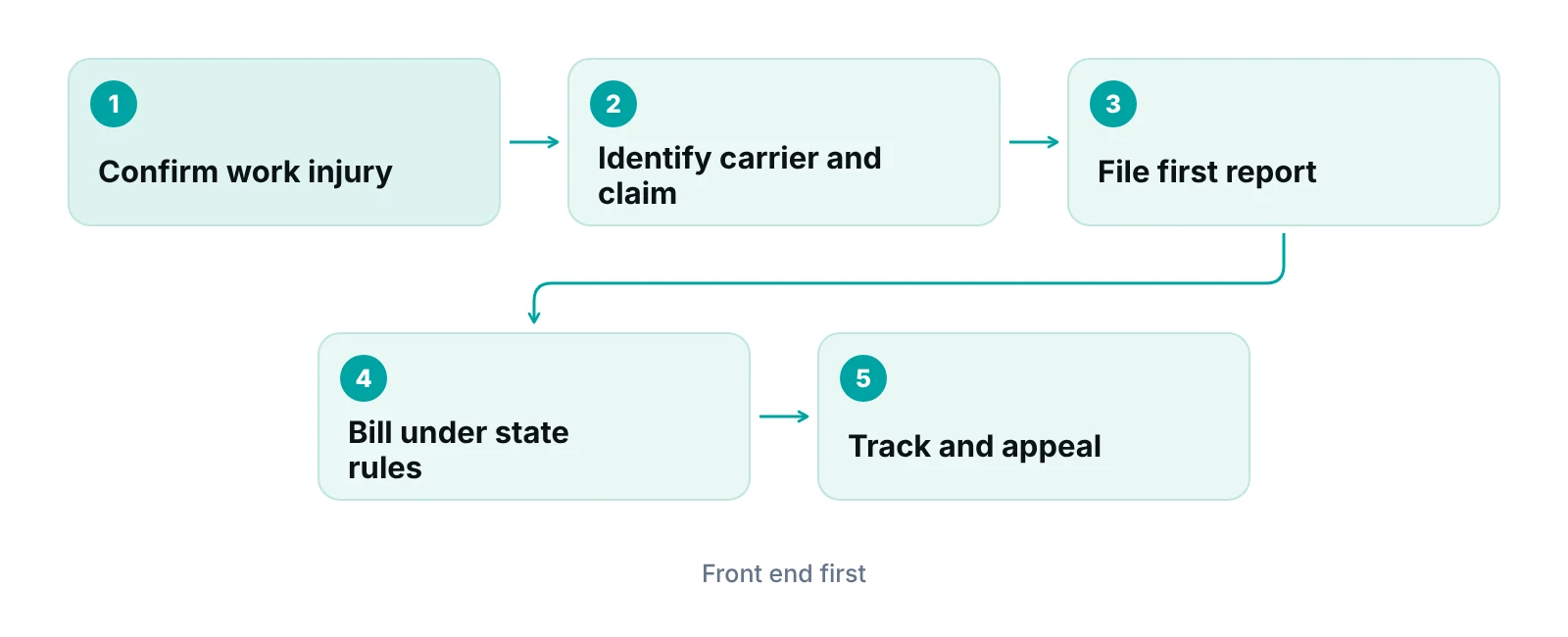
- Confirm it is a work injury at check-in. Ask whether the injury happened at work. Record the employer, the date of injury and a contact at the employer. Do not register the visit under the patient’s health plan.
- Identify the carrier, claim number and adjuster. Ask for them in writing or from the employer. Without a claim number, the carrier may not be able to match the bill. The carrier, not the practice, decides whether the injury is compensable.
- File the required first report. Some states require the treating doctor to file one. California, for example, requires the Doctor’s First Report (Form 5021) within 5 days of the initial examination, and says late filing may result in a civil penalty (California DWC Form 5021).
- Bill the right payer on the right form with the right attachments. The standard professional claim form is used in many states, but states add their own fields, forms, report attachments or electronic formats. Our CMS-1500 claim form guide covers the standard form; confirm your state’s additions in its billing manual.
- Track against the state payment clock. In Texas the carrier must pay within 45 days of receiving a complete bill (TDI decision citing 28 TAC 133.240(a)). Put the due date on the claim when you submit it, not when the payer is late.
- Appeal or dispute inside the state process. Workers’ comp disputes usually run through the state agency, not the usual payer appeal route. Know the filing window for your state.
Accurate data on the first submission matters here because the fix for a bad bill is a corrected resubmission against a state clock. Run every injury claim through the same pre-submission checks you use for clean claims.
How much will the carrier pay?
The carrier pays the amount set by the state’s medical fee schedule or fee guideline, not your billed charge and not your commercial contract rate. Some states build their schedules from Medicare’s, but conversion factors, codes and exceptions differ, so a Medicare rate is not a safe stand-in for the state rate.
Texas shows the pattern. Its rule says professional services are paid by applying Medicare payment policies, with Texas conversion factors that are adjusted each year using the Medicare Economic Index (28 TAC 134.203). The state does not follow Medicare in every case: its own fee guideline FAQ states that the system does not use the Medicare anesthesia conversion factors, and durable medical equipment is paid under a separate subsection of the rule, where the first option is 125 percent of the Medicare DMEPOS fee for listed code ranges (TDI medical fee guideline FAQ).
California takes a different route. Its regulation separates reports that are billable (such as the PR-2, PR-3 and PR-4 reports) from those that are not. The Doctor’s First Report is not separately billable, and chart notes and duplicate reports are billed ‘By Report’ on written request from the claims administrator (8 CCR 9789.14).
Load the state schedule into your billing system
Expected-payment checks only work if the expected amount is the state rate. If your system estimates from commercial or Medicare rates, every correct workers’ comp payment will look like an underpayment, and every real underpayment will be hidden.
What documentation do workers' comp carriers expect?
Carriers expect proof that the injury is work-related, a clear treatment plan and, in many states, regular status reports. The details are state-specific, but the habits that prevent denials are the same in every state.
- Mechanism of injury and date. The note should say how and when the injury happened, in the patient’s words, and link it to the diagnosis being treated.
- Work status. Many carriers want to know if the worker can return to work and with what limits. Where a state form exists for this, use it.
- Medical necessity for each service. Carriers can deny care they judge unrelated to the accepted injury or not necessary, so tie each service to the injury.
- Authorization where required. Some states and carriers require prior authorization for certain services. Check before scheduling, not after.
Orthopedic, chiropractic, therapy and pain practices can see many injury claims, and repeat visits, imaging and procedures make authorization and report timing the main risks. If that sounds like your practice, the orthopedics billing and revenue cycle page shows how these claims fit into a specialty workflow.
Can you bill the patient or their health plan?
Usually not for care related to an accepted work injury. In Texas, a provider may not pursue a private claim against a workers’ compensation claimant for the cost of care, except where the injury is finally adjudicated not compensable or the employee violated the rule on selecting a doctor and the doctor was unaware at the time (Labor Code 413.042, as described in TDI Bulletin B-0033-06; that bulletin dates from 2006, so confirm against current law). A provider who improperly balance bills can face administrative enforcement.
While the question ‘is this claim accepted?’ is open, we recommend holding the patient statement rather than sending it, and reading your state’s rule before any balance is billed. For how patient balances work in ordinary claims, see patient responsibility in medical billing.
Medicare patients with a work injury
When the patient is a Medicare beneficiary, workers’ comp is generally expected to cover the work injury first. CMS says that parties resolving a workers’ comp case with future medical needs have ‘significant responsibilities’ under the Medicare Secondary Payer laws, and that where a Medicare set-aside (WCMSA) exists, those funds must be depleted before Medicare will pay for related treatment (CMS, Workers’ Compensation Medicare Set-Aside Arrangements). For billers, that means asking at intake whether there is a settlement or set-aside, and keeping injury-related care apart from care for unrelated conditions. Our guide to coordination of benefits covers the general rules for deciding which payer is first.
Why do workers' comp claims get denied, and what should you do?
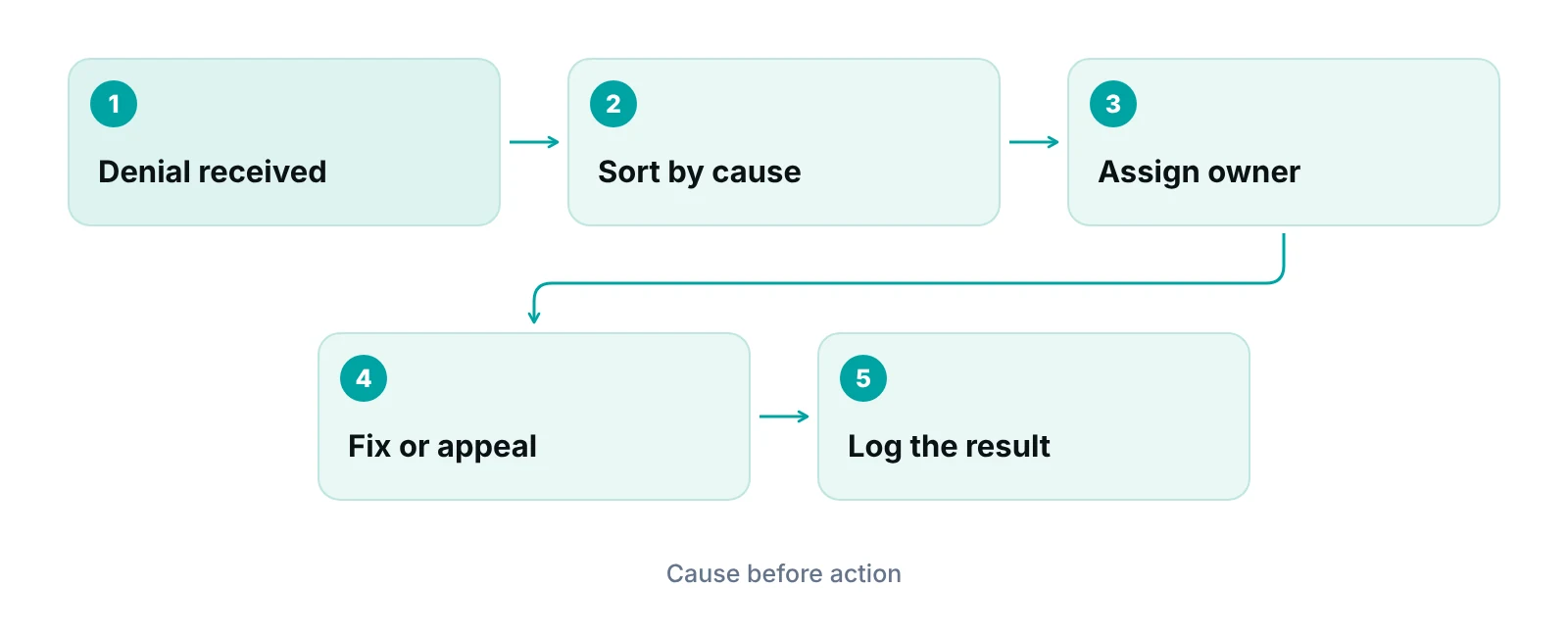
Denials usually fall into a few groups: the claim was sent to the wrong payer, the carrier has not accepted the injury, the bill missed a deadline or lacked a required report, or the service was judged unrelated or unnecessary. Each group has a different fix, so sort denials by cause before you work them.
| Likely cause | First check | Who usually fixes it |
|---|---|---|
| Billed to a health plan or wrong carrier | Registration: was a work injury flagged at check-in? | Front desk, then billing |
| Claim not accepted or still under review | Ask the adjuster for the status and decision date; hold patient statements | Billing |
| Late submission | Compare the date of service to the state filing limit and any exception | Billing manager |
| Missing report or attachment | Check the state’s required forms and the payer’s request | Provider and billing |
| Service not related or not necessary | Does the note tie the service to the accepted injury and diagnosis? | Provider, with billing for the appeal |
| Paid below the state rate | Compare the payment to the state fee schedule, not to your charge | Billing |
Prepared by RCM Finder as a working checklist. Not a list of official reason codes; use your state’s and the carrier’s own codes.
Keep a log of every denial with its cause. After a month, the log will show whether the leak is at intake, at the state-rule step or at documentation. If denials are piling up faster than your team can work them, denial management services can take over the appeals and tracking.
How can a practice make workers' comp billing predictable?
Treat workers’ comp as its own workflow with its own checklist, owner and report. Mixing it into the general A/R queue is how deadlines pass unnoticed.
A practice management system that tracks claims by stage, with an owner on each claim, makes the state clocks visible. RCM Finder’s practice management system that tracks claims by stage includes data-completeness checks before submission, underpayment flags against expected amounts and workflow rules that flag a claim for review or hold a stage. It is a claim-tracking system that works alongside the EHR you already use, not an EHR.
Find the gaps in your workers' comp billing
Our free practice audit looks at how injury claims enter your workflow, where they stall and what comes back unpaid.
| Step | Owner | Evidence to keep |
|---|---|---|
| Work-injury flag and carrier details | Front desk | Registration record and employer contact |
| Claim acceptance and authorization | Billing or authorization staff | Adjuster name, decision date, authorization number |
| First report and status reports | Treating provider and clinical staff | Copy of each form and the date sent |
| Submission and deadline tracking | Billing | Submission proof and due date on the claim |
| Denials and disputes | Billing manager | Denial log with cause and appeal date |
Our recommendations
- Flag work injuries at scheduling and check-in. Add one required question, ‘Was this injury caused at work?’, to scheduling and registration. Everything downstream depends on it.
- Keep a one-page rule sheet for every state you bill. List the filing limit, payment deadline, fee schedule source, required forms and dispute path, with the agency page where you found each. Review it at least once a year.
- Put the due date on the claim at submission. Record the state payment deadline when the bill goes out so follow-up starts on the due date, not when someone notices.
- Hold patient statements until the carrier decides. Do not bill the patient while compensability is open, and read your state’s balance-billing rule before any statement goes out.
- Load the state fee schedule, not your contract rates. Expected-payment checks and underpayment reviews are only as good as the expected amount.
- Separate workers' comp denials from the general queue. Review them weekly by cause, using the table above, and track which root cause repeats.
- Ask any billing vendor how they handle state rules. Ask which states they bill, how they track each state’s deadlines and fee schedule, who owns appeals and whether they will sign a Business Associate Agreement.
Track every injury claim by stage, with an owner and a due date.
RCM Finder's practice management portal shows each claim's stage and owner, runs data-completeness checks before submission and flags payments below the expected amount. It works alongside the EHR you already use.
See how the RCM Finder portal works · Create a portal account
Disclosure: RCM Finder builds and sells this portal. It is a practice management system, not an EHR.
Bottom line
Workers’ comp medical billing rewards a front-end routine: flag the injury, identify the carrier, know the state’s clocks and bill at the state’s rate. If your team handles these claims alongside everything else, medical billing services and denial management services can take the state-specific work off your desk. To see what unpaid injury claims may be costing you, try the revenue calculator or contact our team.
Frequently asked questions
Who pays the medical bills for a work injury?
The employer’s workers’ compensation insurance carrier, or a self-insured employer or its administrator, pays an accepted claim under the state’s fee schedule. The provider bills that payer, not the patient’s health plan. Compensability is the carrier’s decision, so a claim can be pending or denied even when the injury looks clearly work-related.
Can a provider bill the injured worker for a workers' comp balance?
Usually not. In Texas, for example, Labor Code 413.042 bars a provider from pursuing a private claim against a claimant, with narrow exceptions such as an injury finally found not compensable. Other states have their own rules, so check yours before sending any patient statement.
What is the timely filing limit for workers' comp claims?
It is set by each state. Texas requires providers to submit bills within 95 days of the date of service, subject to limited exceptions. Other states use different limits, so confirm the current rule for the state where the claim is filed and the payer’s own instructions.
What form do providers use to bill workers' comp?
Many states use the standard professional claim form, but each state may add fields, attachments, report forms or electronic formats. California also requires a Doctor’s First Report within 5 days of the first exam. Use your state’s billing manual and the carrier’s instructions as the final word.
Does Medicare pay for a work-related injury?
Workers’ comp is generally expected to pay for the work injury first. CMS says that where a Medicare set-aside arrangement exists, those funds must be used up before Medicare pays for related treatment. Ask at intake about any settlement or set-aside, and keep unrelated care on a separate claim.
How is workers' comp reimbursement calculated?
The state sets it. Texas applies Medicare payment policies with its own conversion factors, adjusted yearly, and makes exceptions such as anesthesia. California bills under its Official Medical Fee Schedule. Neither equals a commercial contract rate, so compare each payment to the state schedule.
Get your free practice audit
Tell us about your practice. We will contact you using the details you give.
- A review of your recent claims, denials and A/R aging
- Where your front desk and prior authorizations slow payment
- A prioritized fix list you keep, whether or not you hire us
Pricing is quoted after the audit, based on your volume and the services you choose. Prefer to talk? Call +1 (302) 556-2288.
Sources
- Texas DWC medical fee dispute decision (2026) — Texas Department of Insurance (2026)
- 28 TAC 134.203, Medical Fee Guideline for Professional Services — Texas Administrative Code (Cornell LII) (current)
- Medical fee guideline FAQ — Texas Department of Insurance (current)
- Bulletin B-0033-06, balance billing — Texas Department of Insurance (2006)
- Doctor's First Report of Occupational Injury or Illness (Form 5021) — California Department of Industrial Relations, DWC (current)
- 8 CCR 9789.14, reports other than medical-legal reports — California Department of Industrial Relations (current)
- Workers' Compensation Medicare Set-Aside Arrangements — Centers for Medicare & Medicaid Services (current)
Disclaimer: This article is educational and is not legal, billing or compliance advice. Workers' compensation rules vary by state and change over time, and the Texas and California items are examples, not a statement of the law in your state. Verify current requirements with your state agency, the carrier and your counsel before you act.