
Locum tenens vs per diem comes down to how long you need coverage and which name goes on the claim. Locum tenens fills a defined block of weeks or months; per diem fills single shifts. Medicare lets the regular physician bill for a substitute for up to 60 continuous days (modifiers Q5 or Q6).
Staffing a gap is a revenue decision as much as a scheduling one. The model you choose affects credentialing lead time, who can bill, and how long a payer allows the arrangement. This guide is written for practice owners and managers, and it uses primary sources for the rules it states. It is education, not legal or compliance advice.
Key takeaways
- Locum tenens suits a defined block of weeks or months; per diem suits individual days or shifts.
- Medicare’s substitute billing (Q5 reciprocal, Q6 fee-for-time) is limited to 60 continuous days per substitute.
- A covering clinician beyond that limit must bill in their own name, so enrollment has to be ready.
- Commercial plans and Medicaid set their own rules: get each answer in writing.
- A contractor label does not settle IRS classification; HIPAA workforce rules still apply.
What is the difference between locum tenens and per diem coverage?
For a practice owner, the difference is mostly about length, structure and paperwork. Locum tenens usually means a clinician placed for a defined stretch, often weeks to months, to hold the place of a regular provider. Per diem usually means a clinician you call on for individual days or shifts, with no set run of coverage. Both are industry terms, not legal categories, so what matters is the written agreement and how the clinician is paid.
Most articles on this topic are written for the clinician deciding which work to take. This guide takes the other seat: you have a gap on the schedule (leave, a resignation, a surge in demand) and need to know which model fits, what each does to claims, and what must be in place before the first patient is seen.
| Question | Locum tenens (typical) | Per diem (typical) |
|---|---|---|
| Length of coverage | Defined block of weeks or months | Single days or shifts, called as needed |
| Best fit | Leave, vacancy, ramp-up before a permanent hire | Predictable peaks, vacation cover, short gaps |
| Who arranges it | Often an agency, or a direct contract | Often a direct arrangement with a known clinician or a local pool |
| Lead time you need | Longer: contract, onboarding, payer setup | Shorter if the clinician is already set up with you |
| Claim route to plan | Usually billed under the absent clinician (Medicare) or under the covering clinician once enrolled | Same choices, but repeated short stints make the paperwork easy to miss |
| Main risk | Running past a payer time limit | Treating a recurring arrangement as informal |
Typical patterns are general staffing practice, not rules. Medicare billing rules are in the table further down.
Both models work. The mistake is choosing on hourly cost alone and finding out later that the claims cannot go out under the name you assumed.
Which coverage model fits your practice?
Choose by the shape of the gap first, then by the billing consequences. A known, bounded absence points to locum tenens. A recurring need for a few extra clinic days points to per diem. An open-ended vacancy points to a short locum bridge while you recruit.
- Planned leave of several weeks or more: a locum placement lets one clinician carry the schedule and the patient relationships for the whole period.
- Seasonal or weekly peaks: per diem days let you add capacity without carrying a full salary.
- Vacancy with no end date: a locum bridge covers patients while you recruit, but plan the payer setup for the long term, not week to week.
- One-off sick days: a per diem clinician who already knows your EHR and workflow loses the least time to orientation.
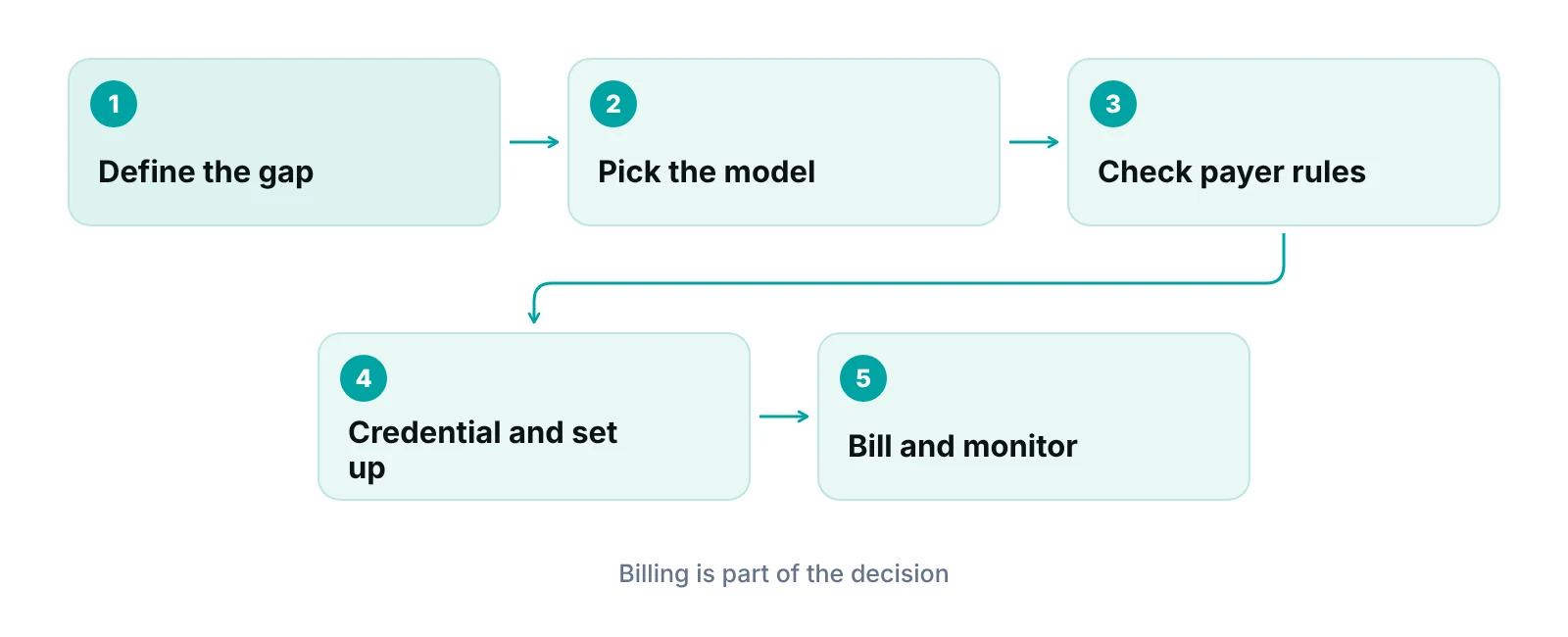
“Coverage is only solved when the visits it produces can be billed cleanly. Settle the claim route before the contract is signed, not after the first remittance.”
Medical specialties differ in how much continuity patients expect and in which codes the covering clinician will bill. See how billing patterns differ across fields on the specialty billing pages.
How does Medicare handle billing when a covering clinician steps in?
Medicare has two substitute-billing routes that let the regular physician bill for a covering clinician’s services: reciprocal billing (modifier Q5) and fee-for-time compensation (modifier Q6). Both limit the substitute to no more than 60 continuous days of services to Medicare patients. A per diem or locum placement paid on a fee-for-time basis normally falls under Q6.
The details below come from the CMS Medicare Claims Processing Manual, Chapter 1 (Transmittal 3774), sections 30.2.10 and 30.2.11. Medicare’s own wording is “substitute physician” rather than “locum tenens,” and the manual has been updated since this transmittal, so have your biller confirm the current text.
| Item | Reciprocal billing (Q5) | Fee-for-time / locum (Q6) |
|---|---|---|
| Arrangement | Two physicians cover each other’s Medicare patients | Regular physician pays the substitute on a per diem or similar fee-for-time basis |
| Regular physician unavailable? | Yes, required | Yes, required |
| Patient chose the regular physician? | The patient must have arranged, or be seeking, care from the regular physician | Same |
| Time limit | No more than 60 continuous days of covered visit services by the same substitute | Same |
| Written agreement | Not required by the manual for reciprocal billing | Not described here; put it in writing anyway |
| Claim | Regular physician bills with modifier Q5 on the line item (CMS-1500 item 24d) | Regular physician bills with modifier Q6 on the line item (item 24d) |
| Records | Regular physician keeps a record of each service, with the substitute’s NPI, available to the MAC on request | Same |
Source: CMS, Medicare Claims Processing Manual, Chapter 1, sections 30.2.10 and 30.2.11 (Transmittal 3774, 2017).
The 60-day clock and what happens after it
The manual counts the 60 days as one continuous period from the substitute’s first day of covered visit services to the last day before the regular physician returns. Its example is a 63-day period: services after day 60 cannot be billed by the regular physician. From that point the substitute must bill in their own name and number, or reassign payment. A Q5 or Q6 line is presumed compliant unless evidence says otherwise, and contractors do not track the 60 days before payment, so compliance depends on your own calendar.
Does a short-term substitute need to enroll in Medicare?
Usually not for a stay within the limit. A CMS provider enrollment FAQ states that a locum tenens substitute who will not serve Medicare patients over a continuous period longer than 60 days need not enroll via the CMS-855 form, and that one who will exceed it must enroll. For group claims, the manual adds that the substitute may not have reassigned their own Medicare payment to the group on a CMS-855R. Both points are easy to get wrong, so confirm them with your Medicare Administrative Contractor.
Plan around day 45
Because nothing stops a claim at the front door, an overrun usually shows up later as a post-payment review. Put the substitute’s start date and day 60 on one shared calendar, and decide by about day 45 whether the clinician will leave or enroll.
The manual also allows an extension for a physician called to active duty in the Armed Forces, and group claims must show the performing member’s NPI in block 24J.
What about credentialing and commercial payers?
Medicare’s substitute rules do not automatically apply to commercial plans or Medicaid. Each payer decides whether a covering clinician can be billed under the regular clinician and for how long, and many require the covering clinician to be credentialed and enrolled before billing in their own name. No single rule fits every payer, so ask each plan in writing.
- Ask each payer: may the regular clinician bill for a covering clinician, under what modifier or form, for how many days, and with what documentation?
- Start enrollment early: if the placement will run long, a clinician who bills in their own name needs enrollment completed first. Our credentialing guide for group practices explains the steps, and payer enrollment strategies covers sequencing.
- Check Medicaid by state: rules differ, as in this overview of Medicaid credentialing.
- Use a credentialing partner for long placements: credentialing and payer enrollment services can track applications while you run the schedule.
Incident-to rules and supervision also interact with who actually saw the patient. If your practice bills services under another clinician’s number, read the Medicare incident-to billing guide so the two arrangements are not mixed up.
What contract and compliance issues come with temporary clinicians?
A short engagement still creates worker-classification and privacy duties. The label in the contract does not decide whether a clinician is an employee or an independent contractor, and a covering clinician who sees your patients is part of your HIPAA workforce or a business associate.
Employee or contractor?
The IRS looks at the whole relationship under three headings: behavioral control (whether you direct how the work is done), financial control (expenses, investment, how payment is made, chance of profit or loss) and the relationship of the parties (written terms, benefits, permanence). It treats the answer as depending on the facts. A worker or business can ask the IRS to decide using Form SS-8. Have your attorney or tax adviser review any per diem model your practice repeats.
Access to patient information
HIPAA defines workforce as employees, volunteers, trainees and other persons whose conduct, in the performance of work for the entity, is under its direct control, whether or not paid by it (45 CFR 160.103). Treat a locum or per diem clinician like any other staff member: individual login, role-based access, training on your policies, and access removed on the last day. The HIPAA compliance checklist lists what to cover.
Pay attention to the front desk too. A rotating clinician is a new name on charts, schedules and referrals every week, and front desk errors are a common place for a wrong rendering-clinician name or missing data to enter a claim.
How should you run claims for a covering clinician?
Set one claim route per placement and write it down before day one: whose name is on the claim, which modifier applies, which payers allow it, and who watches the clock. A practice management system that tracks claims by stage, such as a practice management system that tracks claims by stage, can flag claims that lack required data and show which are held for review.
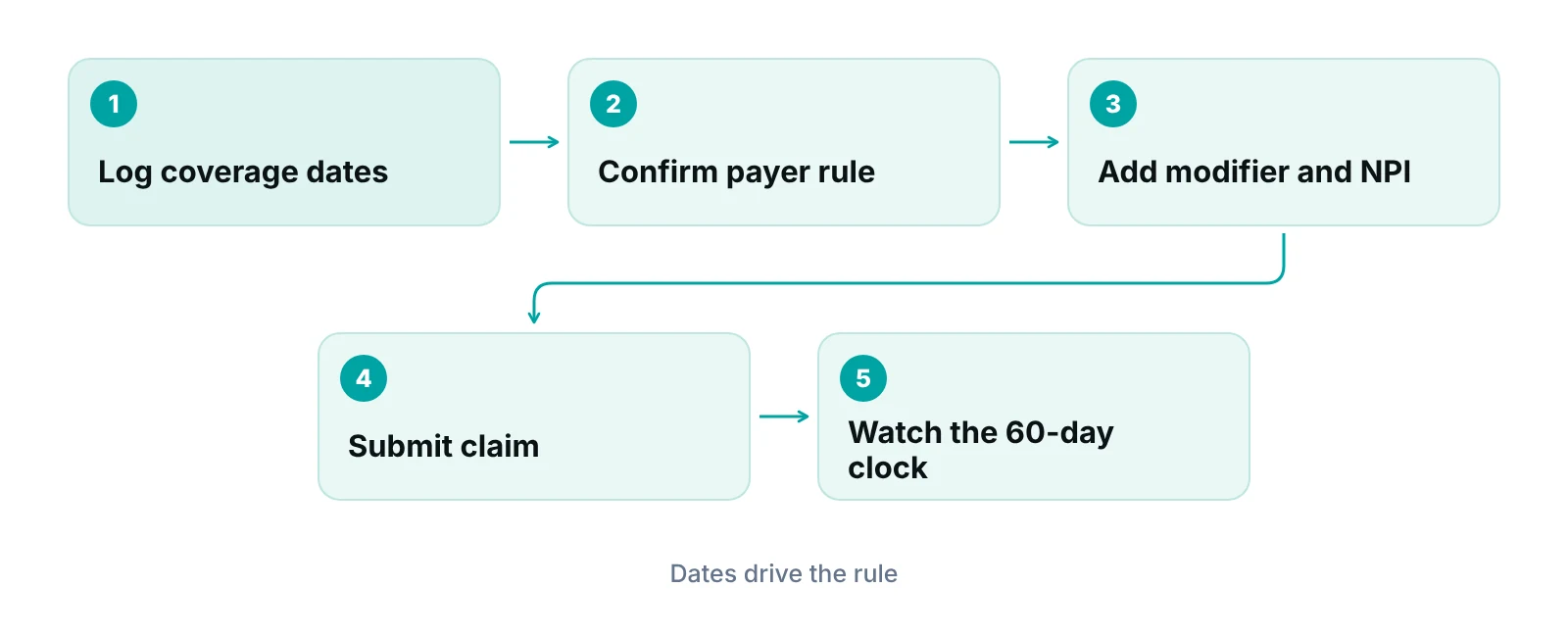
| When | Check | Owner |
|---|---|---|
| Before signing | Payer-by-payer answer on billing the covering clinician; expected length of coverage vs 60 days | Practice manager and biller |
| Before day one | Credentials and licence verified; EHR and portal access set up; contract classification reviewed | Practice manager and counsel |
| Week one | Test charge entry for the first visits; confirm modifier, NPI and records requirements are met | Biller |
| Day 45 | Decide: end the stint, enroll the clinician, or change the arrangement | Owner and biller |
| Last day | Remove system access; retain service records with the substitute’s NPI | Practice manager |
Process checklist. Record and 60-day items follow CMS Claims Processing Manual, Chapter 1, sections 30.2.10 and 30.2.11.
If these steps are not covered by someone in the practice today, medical billing services can take over charge entry and claim follow-up for the covering clinician’s visits.
Not sure which claims route fits your coverage plan?
Request a free practice audit and we will look at how your current claims are tracked, so a coverage gap does not become a revenue gap.
Our recommendations
- Define the gap before you pick the model. Write down start date, expected end date and the visits per week. Length of coverage drives which billing route is open to you.
- Get each payer's rule in writing. Medicare has published rules; commercial plans and Medicaid differ. Keep the answer with the contract.
- Put day 45 on the calendar. Decide whether the clinician leaves or enrolls before the Medicare 60-day limit is reached.
- Start credentialing earlier than feels necessary. Payer enrollment is not instant, so begin as soon as a placement looks likely to run long.
- Document every covered visit. Keep a service record that includes the covering clinician’s NPI and makes it easy to answer a contractor request.
- Have counsel review the contract label. A contractor title does not settle classification. Have a lawyer or tax adviser review any repeated per diem arrangement.
- Remove access on the last day. Treat covering clinicians like staff: individual logins, role-based access and a documented removal step.
Track covering-clinician claims by stage.
The RCM Finder portal follows each claim by stage with an owner, checks data completeness before submission and applies workflow rules, which helps a practice see where covering-clinician claims are held.
See how the RCM Finder portal works · Create a portal account
Disclosure: RCM Finder builds and sells this portal. It is a practice management system, not an EHR.
Bottom line
Choose locum tenens or per diem by the length of the gap, then confirm each payer’s billing rule before the clinician starts. If you want a second pair of eyes on claim routes for covering clinicians, medical billing services and credentialing support can take that work off your team, and you can talk to RCM Finder first.
Frequently asked questions
Can a practice bill Medicare for a locum tenens physician's services?
In many cases yes. Under Medicare’s fee-for-time rule, the regular physician bills with modifier Q6 when the substitute is paid per diem or on a similar basis, the regular physician is unavailable, and the substitute treats Medicare patients for no more than 60 continuous days. Confirm the current manual text with your Medicare Administrative Contractor.
What is the difference between Q5 and Q6?
Q5 marks reciprocal billing, where two physicians cover each other’s Medicare patients. Q6 marks fee-for-time compensation, where the regular physician pays the substitute per diem or similar. Both go on the claim line in item 24d of the CMS-1500 and share the same 60-day limit.
What happens if a locum stays longer than 60 days?
Under the CMS manual, services after day 60 cannot be billed by the regular physician. The substitute must bill in their own name and billing number, or reassign payment, which means enrollment must be in place. Track the clock yourself; contractors do not check it before paying.
Does a locum or per diem clinician count as an employee?
Not automatically. The IRS weighs behavioral control, financial control and the relationship of the parties, and the answer depends on the facts. A contract that says contractor does not decide it. Ask your attorney or tax adviser to review the arrangement.
Do commercial insurers follow the Medicare 60-day rule?
Not necessarily. Each plan sets its own rule on billing for a covering clinician, and many want the clinician credentialed before billing in their own name. Ask each payer in writing before the placement starts.
Does a covering clinician need access to our EHR?
Usually yes, and that access should be individual and role-based. Under HIPAA, a person working under your direct control is part of your workforce, paid or not, so apply your normal training and access removal steps.
Get your free practice audit
Tell us about your practice. We will contact you using the details you give.
- A review of your recent claims, denials and A/R aging
- Where your front desk and prior authorizations slow payment
- A prioritized fix list you keep, whether or not you hire us
Pricing is quoted after the audit, based on your volume and the services you choose. Prefer to talk? Call +1 (302) 556-2288.
Sources
- Medicare Claims Processing Manual, Chapter 1 (Transmittal 3774): sections 30.2.10, 30.2.11 — CMS (2017)
- 2019 National Provider Enrollment Conference FAQs — CMS (2019)
- Topic no. 762, Independent contractor vs. employee — IRS
- 45 CFR 160.103 Definitions (workforce) — Legal Information Institute / eCFR text
Disclaimer: This article is educational and is not legal, tax, coding or compliance advice. Payer rules vary and change; confirm the current rules with your Medicare Administrative Contractor, each payer and your attorney.
