
Medicaid provider enrollment is the application you file with your state Medicaid agency so it can screen you and approve you to bill Medicaid. You need an NPI, a valid license and your tax details. States set their own forms and timelines, and managed care plans then credential you separately.
Most guides call this “Medicaid credentialing” and treat it as one task. It is really two: enrollment with the state, and credentialing by each managed care plan that serves Medicaid members. This guide covers the steps, what federal rules require, where states differ and what to confirm before you schedule a Medicaid patient. It draws on federal regulations, a June 2026 report from the Medicaid and CHIP Payment and Access Commission (MACPAC) and state Medicaid pages. It is general information, not legal or compliance advice.
Key takeaways
- Medicaid enrollment is with the state; managed care credentialing is separate and done by each plan.
- There is no federal deadline for enrollment decisions, so ask your state agency for its current processing time.
- Physicians are generally rated limited risk: license and database checks.
- Do not assume you can bill before your state agreement and effective date are confirmed in writing.
- Enrollment is not one-and-done: revalidate at least every five years and report changes quickly.
Medicaid enrollment and credentialing are two different steps
Enrollment is the state’s decision that you may deliver and be paid for Medicaid services. Credentialing is a managed care plan’s decision that you are qualified to serve its members. Fee-for-service providers need only the first; network providers of a managed care plan generally need both.
That split comes from the federal rules summarized by MACPAC in its June 2026 report. Federal rules also require managed care network providers to be enrolled with the state (42 CFR 438.602(b)).
| State Medicaid enrollment | Managed care credentialing | |
|---|---|---|
| Who decides | The state Medicaid agency or its contractor | The managed care plan, or a state or contractor on its behalf |
| What it decides | Whether you may deliver and be paid for Medicaid services | Whether you are qualified to serve the plan’s members in your specialty |
| Who needs it | Fee-for-service providers and managed care network providers | Managed care network providers only |
| Agreement you sign | A provider agreement with the state | A network agreement with each plan |
| Federal timeline | None; CMS recommends a 60-day screening timeline that states often struggle to meet | None for recredentialing; states may set plan deadlines |
Source: MACPAC, Provider Enrollment and Credentialing in Medicaid (June 2026), Chapter 7
A practical consequence
If you plan to join managed care networks, start with state enrollment. Indiana, for example, says IHCP enrollment comes first, then enrollment with each member’s managed care entity (Indiana FSSA). Check your state’s order.
Is Medicaid enrollment worth the effort for your practice?
It can be, if your community has meaningful Medicaid demand and you can handle the paperwork and the payer rules. CMS reported 73,167,389 people enrolled in Medicaid and CHIP in June 2026 across the 50 states and D.C. that reported, of whom 65,969,381 were in Medicaid. CMS also reports Medicaid spending of $931.7 billion in 2024, about 18 percent of national health spending.
Before you apply, check how many of your inquiries are Medicaid patients, whether local managed care plans have open networks for your specialty, and whether your staff can verify eligibility and follow plan billing rules. Our revenue calculator can help you size what a delayed enrollment costs each month.
Requirements and the fee-for-service and managed care mix differ by specialty. Our specialty RCM pages show how we think about billing patterns for each one.
What to have ready before you apply
Start with identifiers that must match everywhere: legal name, license, NPI, tax ID and practice addresses. Iowa Medicaid lists form-versus-record mismatches among its top enrollment errors.
- NPI. Almost all providers need one. CMS says applying online through NPPES is the route for the fastest receipt of an NPI, and gives no fixed processing time. Under HIPAA rules you must report changes to NPPES within 30 days (45 CFR 162.410). For help with which NPI type applies, see our NPI Type 1 vs Type 2 guide.
- State license and other required certifications. The list depends on your provider type and specialty.
- Tax ID, business and banking details, and group information. Alabama’s enrollment FAQ lists the NPI, business office data, IRS tax ID, banking information and group identification data as typical application content, and says each practice location and each physician in a group must be enrolled under its own NPI.
- Ownership and disclosure information where the form asks for it.
- Proof of insurance or other certificates where your provider type requires them.
Because documents vary, treat this list as a starting point and build your checklist from your state’s current packet instructions.
The enrollment process, step by step
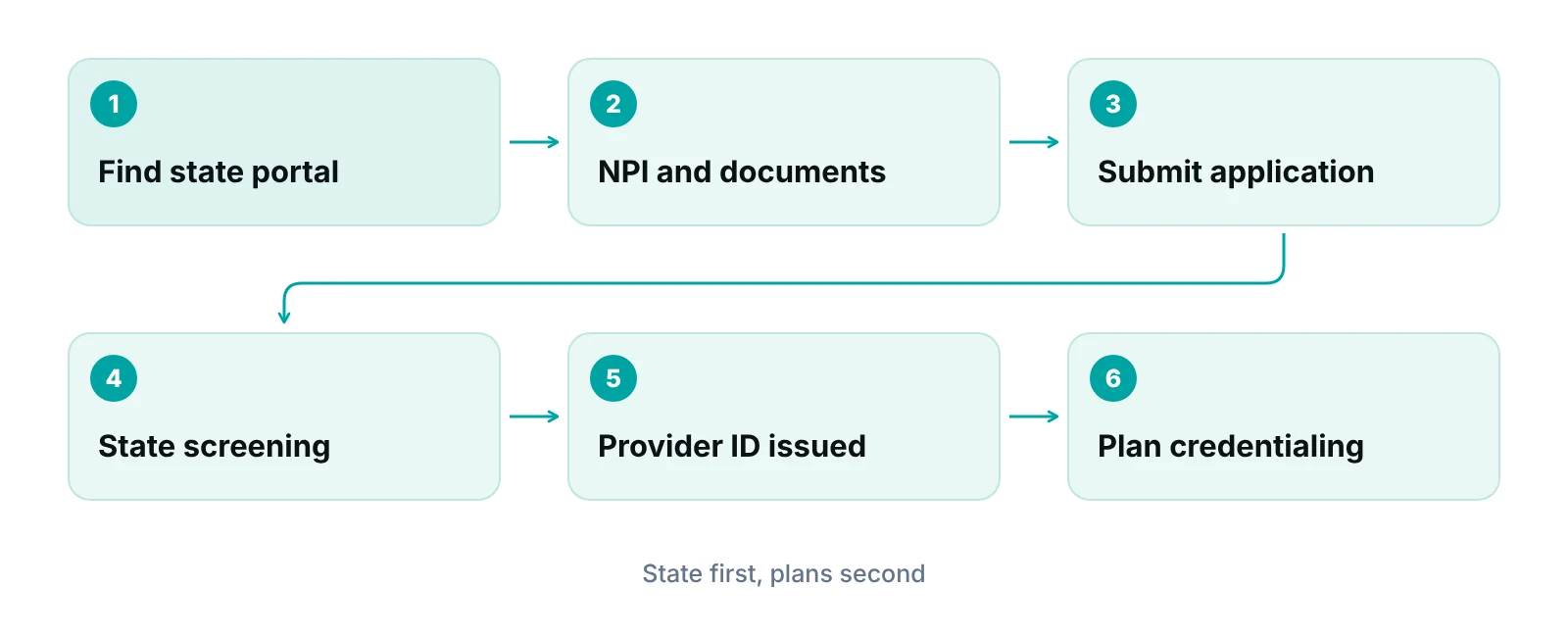
The order below holds across most states. Forms, portals and wait times do not.
| Step | What you do | Where | Watch for |
|---|---|---|---|
| 1. Find your state’s process | Locate the Medicaid agency’s provider enrollment page and choose your provider type and specialty. | State Medicaid agency or its fiscal agent portal | Some states have special paths, such as ordering, prescribing or referring only. |
| 2. Confirm identifiers | Verify license, NPI and tax ID; update NPPES if anything has changed. | State licensing board; NPPES | Names and addresses must match across systems. |
| 3. Submit the application | Apply online if the state offers it, or send the paper packet with every supporting document. | State portal or mailing address | Use the current form; duplicate or outdated forms slow processing. |
| 4. Respond to screening | The state verifies licensure and databases; moderate and high-risk types face site visits or fingerprinting. | State enrollment unit | Give the agency a contact who answers calls and email. |
| 5. Receive your provider agreement and ID | The state approves you and issues a Medicaid provider ID and effective date. | State portal or notice | Get the effective date in writing. |
| 6. Credential with managed care plans | Apply to each plan that serves your patients; the state enrollment usually comes first. | Each plan’s provider relations page | Each plan has its own application and timeline. |
| 7. Test before you scale | Verify patient eligibility, then send a first claim and confirm it is accepted. | State portal; plan portal | Set up a calendar for recertification and revalidation. |
Sources: Indiana FSSA IHCP enrollment page (2026); Iowa Medicaid enrollment outreach slides (September 30, 2025); MACPAC (June 2026)
How states screen providers, and what that means for you
Federal rules require states to screen every enrolled provider at one of three risk levels. Physicians are generally rated limited risk, per MACPAC, so expect license and database checks rather than a site visit or fingerprinting. Higher levels add checks.
| Risk level | What the state checks | Example from the sources | What you should expect |
|---|---|---|---|
| Limited | Verifies federal and state enrollment requirements and licenses; runs federal database checks before and after enrollment | Physicians | A document review; keep your license and ownership data current |
| Moderate | All limited checks plus pre- and post-enrollment site visits, which may be unannounced | Set by Medicare’s level for the type, or higher | Your locations must be open to inspection |
| High | All moderate checks plus a criminal background check and fingerprints; owners with a 5 percent or greater interest submit fingerprints within 30 days of a request | Newly enrolling home health agencies | Plan time for fingerprinting by every required person |
| Automatic upgrade | A provider moves to high risk after a payment suspension for a credible fraud allegation, an existing Medicaid overpayment, or an exclusion within the past decade | Applies to any provider type | Resolve overpayments before reapplying |
Sources: 42 CFR 455.432, 455.434, 455.450 (eCFR); MACPAC (June 2026)
States can also rely on screening done by Medicare contractors or other states (42 CFR 455.410(c)), and an enrolled Medicare provider who meets Medicaid’s requirements must be allowed to enroll so Medicare cost-sharing claims can be processed (455.410(d)). If you are enrolled in Medicare, ask whether your state accepts that screening.
Checks continue after enrollment: states check federal exclusion lists at least monthly.
The application fee
Institutional providers pay a federal application fee when they enroll or revalidate. For applications submitted in calendar year 2026 it is $750, per the Federal Register notice of December 3, 2025. Individual physicians and non-physician practitioners are exempt, and so are providers who have already paid the fee to Medicare or another state’s Medicaid or CHIP program. The amount is adjusted annually, so check the current year’s figure.
How long Medicaid enrollment takes
There is no federal deadline for a state to decide your application. MACPAC reports that CMS recommends a 60-day screening timeline, which states often struggle to meet. Anyone quoting a flat “30 to 60 days” is guessing for your state.
What the sources do document are state-level rules and processes:
- Pennsylvania requires plans to finish credentialing within 60 calendar days of a complete application and estimates 30 days for a revalidation (MACPAC, June 2026).
- Under federal rules, a plan may sign a network agreement before the state has enrolled you, but it must end that agreement if the state denies enrollment or 120 days pass without a state-executed agreement (42 CFR 438.602(b)(2), as summarized by MACPAC).
- Iowa Medicaid told providers in a September 30, 2025 session that applications are processed in the order received and that an incomplete application which is not corrected recycles automatically after 90 days (Iowa Medicaid outreach slides).
Ask for the number that matters
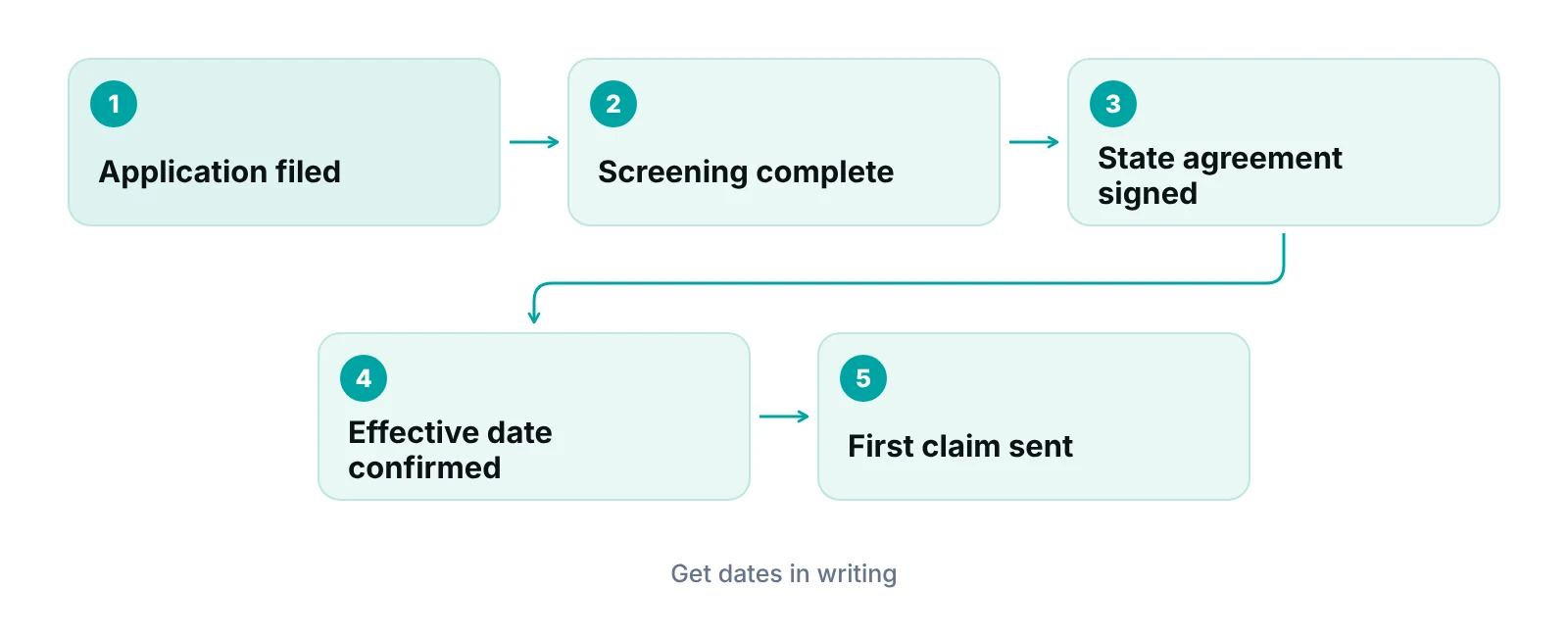
Ask your state enrollment unit for the current processing time for your provider type, how it notifies you of missing items and how the effective date is set. Record the answers with the date.
Can you bill Medicaid before you are approved?
Do not assume you can. CMS’s Medicaid Provider Enrollment Compendium says that, since January 1, 2018, providers in every Medicaid delivery model may furnish services only after the state has a provider agreement with them and has completed screening. MACPAC notes that provisional enrollment existed under COVID-19 emergency waivers, and states were given six months after the public health emergency ended to fully enroll or terminate those providers.
Some states do allow a retroactive effective date. MACPAC reports a federal ceiling of one year, with Ohio and Oregon allowing the full year and Pennsylvania requiring justification for requests beyond 30 days before the application. Indiana’s page says that if enrollment lapses, a retroactive date can be requested back to the day it was deactivated, but only if you have a claim for that date. These are state choices, not guarantees.
Our advice: treat the date on your approval notice as the earliest date you can safely bill. If a retroactive date is possible in your state, ask in writing before you rely on it.
A related trap is ordering and referring. Federal rules require physicians and other professionals who order or refer services to enroll as participating providers, even if they never bill (42 CFR 455.410(b)). Alabama’s FAQ states the consequence plainly: claims will deny if the ordering provider is not enrolled.
Staying enrolled: revalidation and changes
States must revalidate every provider at least every five years (42 CFR 455.414). MACPAC adds that revalidation is not required if the provider was revalidated in Medicare. Some states also tie credentials to shorter cycles; Ohio requires some providers every three years.
This area is moving. MACPAC reports that on April 23, 2026, CMS asked states for a two-year revalidation strategy and urged more frequent revalidation of high-risk providers. Plan around the notices your state sends, not a fixed five-year gap.
Between revalidations, small changes cause problems. State examples, not universal rules:
- Indiana asks providers to report profile changes within 10 business days, sends a notice 60 days before eligibility to participate ends, and asks for recertification 30 days before a credential expires. A provider who misses it must re-enroll and gets a new provider ID (Indiana recertification page).
- Alabama says missing re-enrollment closes the provider file and requires a new application.
- Report NPPES changes within 30 days.
Give one named person ownership of these dates. A shared inbox is not an owner.
Where Medicaid applications stall
State enrollment staff publish their own lists of common errors, and they are mostly clerical. Iowa Medicaid’s September 2025 slides name five for fee-for-service enrollment:
- Using one application for several tax IDs. Each tax ID needs its own application.
- Submitting duplicates for the same tax ID, provider and location, which can slow processing or lead to withdrawal.
- Using an outdated form instead of the current revision on the state website.
- A provider-type mismatch between the individual and the group.
- A group-linkage mismatch, where the NPI, taxonomy code or ZIP code does not match the group file exactly.
Iowa’s slides add tips that apply anywhere: list a contact who answers questions, quote your packet number in every message, and answer correction requests fast. An uncorrected incomplete application recycles after 90 days.
If you are also working through commercial payers, our credentialing guide and payer enrollment strategies post cover that side, and our group practice credentialing guide covers several providers applying together.
Doing it yourself or getting help
A solo practice with one location, a clean license record and one state can often manage enrollment in-house; the work is mostly forms and follow-up. Outside help makes sense with several providers, several tax IDs, more than one state, higher-risk provider types or a start date you cannot miss.
Our credentialing services handle enrollment paperwork and follow-up, and enrollment has to connect to how you bill afterward, which is where our medical billing services take over. See also our Medicare and Medicaid billing tips.
Not sure how long your Medicaid enrollment will take?
Send us your state, provider type and number of providers. We will review what your application would involve and where it is likely to slow down.
Our recommendations
- Start with the state agency, not a template. We would download the state’s current application and instructions first and build the checklist from them.
- Get your NPPES record right before you apply. Names, addresses and taxonomy should match your license and application.
- Ask the agency three questions in writing. Current processing time for your provider type, how you will be told about missing items, and how the effective date is set. Keep the reply.
- Wait for the effective date before scheduling Medicaid patients. We treat the approval notice date as the earliest date to bill unless the state confirms a retroactive date in writing.
- Run managed care credentialing as its own project. After state enrollment, each plan has its own application, contact and timeline. Track them separately.
- Calendar every renewal date by provider. List license, recertification and revalidation dates, and give one named person ownership.
Bottom line
Medicaid provider enrollment rewards preparation: match your identifiers, follow your state’s current process, treat managed care credentialing as a second step, and confirm your effective date before you bill. If you want help with the paperwork and follow-up, see our credentialing services or contact our team.
Frequently asked questions
What is Medicaid provider enrollment?
It is the process of applying to your state Medicaid agency to be screened and approved to deliver and bill Medicaid services. The state verifies your license, checks federal exclusion databases and issues a provider agreement and ID. Most people also call it Medicaid credentialing, but credentialing usually refers to a managed care plan’s separate review.
What documents do I need to enroll as a Medicaid provider?
Requirements vary by state and provider type. Expect your NPI, state license, tax ID, practice and banking details and group information. Some types also need proof of insurance, certifications, ownership disclosures or fingerprints. Download your state agency’s current application and instructions rather than relying on a general list.
How long does Medicaid provider enrollment take?
There is no federal deadline. CMS recommends a 60-day screening timeline, which MACPAC says states often struggle to meet. Pennsylvania estimates 30 days for revalidation, and Iowa recycles uncorrected incomplete applications after 90 days. Ask your state agency for its current processing time for your provider type.
Can I see Medicaid patients while my application is pending?
Do not assume so. CMS guidance says providers may furnish Medicaid services only after the state has a provider agreement and has completed screening. Some states allow a retroactive effective date, but that is a state choice. Get the effective date in writing before you schedule Medicaid patients.
Does Medicaid enrollment cost money?
Individual physicians and non-physician practitioners are exempt from the federal application fee. Institutional providers pay it: $750 for applications submitted in calendar year 2026. It is not charged again if the provider has already paid it to Medicare or another state’s Medicaid or CHIP program. States may have separate costs, so check your state’s instructions.
How often do I have to revalidate?
Federal rules require states to revalidate providers at least every five years, and some states use shorter cycles. You may be exempt if you were revalidated in Medicare. Between revalidations, report changes and recertify licenses on your state’s schedule, because a missed deadline can end your enrollment.
Get your free practice audit
Tell us about your practice. We will contact you using the details you give.
- A review of your recent claims, denials and A/R aging
- Where your front desk and prior authorizations slow payment
- A prioritized fix list you keep, whether or not you hire us
Pricing is quoted after the audit, based on your volume and the services you choose. Prefer to talk? Call +1 (302) 556-2288.
Sources
- Provider Enrollment and Credentialing in Medicaid (Chapter 7) — MACPAC (2026)
- 42 CFR 455.414 Revalidation of enrollment — Cornell LII / eCFR (2026)
- 42 CFR 455.410 Enrollment and screening of providers — Cornell LII / eCFR (2026)
- 42 CFR Part 455 Subpart E (455.432, .434, .436, .440, .450, .460, .470) — eCFR (2026)
- 45 CFR 162.410 Implementation specifications: health care providers — eCFR (2026)
- How to Apply for an NPI — CMS (2026)
- Medicaid & CHIP Enrollment Data Highlights — Medicaid.gov (CMS) (2026)
- National Health Expenditure Fact Sheet — CMS (2024 data)
- Medicare, Medicaid and CHIP: CY 2026 Provider Enrollment Application Fee — Federal Register (2025)
- Medicaid Provider Enrollment Compendium (MPEC) — CMS (2023)
- Provider enrollment and maintenance actions — Indiana FSSA (IHCP) (2026)
- Recertify provider enrollment licenses and other certifications — Indiana FSSA (IHCP) (2026)
- Provider Enrollment FAQ — Alabama Medicaid (2026)
- Iowa Medicaid Provider Outreach Education: FFS enrollment and revalidation — Iowa HHS (2025)
Disclaimer: This page is general educational information for practice owners and managers. It is not legal, coding, billing-compliance or financial advice. Medicaid rules, forms and timelines vary by state and change; confirm current requirements with your state Medicaid agency, each managed care plan and a qualified advisor before acting.
