
Surprise medical bills are unexpected out-of-network charges a patient receives after emergency care, or after non-emergency care at an in-network facility. Under the federal No Surprises Act, covered patients owe only in-network cost sharing, and disputes about payment run between the provider and the health plan, not the patient.
The rules took effect on January 1, 2022, and they put duties on practices as well as on health plans: do not balance bill where the law forbids it, tell patients about their protections, and keep records. This explainer is written for the people who send the bills, with links to the deeper guides on disputing a medical bill and out-of-network medical billing.
This is an overview, not legal advice. State laws, plan type and the exact facts of a visit change the answer, so check each case against the sources linked below.
Key takeaways
- The protections cover most emergency care, many non-emergency services at in-network facilities, and air ambulance, but not ground ambulance.
- Where the ban applies, the patient owes no more than in-network cost sharing, and consent forms cannot waive it for emergency medicine, anesthesiology, pathology, radiology, neonatology or diagnostic services.
- There are three separate dispute paths: provider versus plan (IDR), uninsured patient versus provider (PPDR), and an ordinary bill dispute with the practice.
- Practices must disclose the protections, keep signed notices and consents for at least 7 years, and keep provider directory data accurate.
- Medicare, Medicaid, CHIP, IHS, VA and TRICARE patients are outside these particular rules.
What counts as a surprise medical bill
A surprise medical bill is a charge from an out-of-network provider that the patient did not choose and could not reasonably avoid. The common cases are an emergency visit where the nearest emergency department is out of network, and a planned procedure at an in-network hospital where the anesthesiologist, radiologist or pathologist is not in the patient’s network.
The charge itself is not the problem. The old practice was to bill the patient for the difference between the provider’s charge and what the plan paid, which is called balance billing. For the situations below, federal rules now stop that.
Who the federal rules protect
According to CMS’s key-protections summary, the rules cover people with employer group plans, individual or Marketplace coverage, non-federal government plans, church plans, Federal Employees Health Benefits plans and fully insured student plans. Medicare, Medicaid, CHIP, Indian Health Service, VA and TRICARE are outside these particular rules, as are short-term plans, health care sharing ministries and stand-alone dental or vision plans.
Which services the law covers
The balance billing ban covers most emergency services, certain non-emergency services at participating facilities, and air ambulance. It does not cover ground ambulance. When it applies, the patient’s cost sharing cannot exceed what they would pay in network.
- Emergency services: A nonparticipating emergency facility or provider must not bill, or hold the patient liable for, more than the plan’s cost-sharing requirement for emergency services at a hospital emergency department or an independent freestanding emergency department (45 CFR 149.410). CMS says this includes post-stabilization services unless notice and consent rules are met.
- Non-emergency services at participating facilities: The ban applies at participating hospitals, hospital outpatient departments, critical access hospitals and ambulatory surgical centers (CMS provider overview).
- Air ambulance: Covered services from a nonparticipating air ambulance provider are protected.
- Ground ambulance: CMS states that ground ambulance services are not covered by the Act. CMS’s consumer guidance on ground ambulance bills points patients to state protections, and it lists 10 states with such rules: Colorado, Delaware, Florida, Illinois, Maine, Maryland, New York, Ohio, Vermont and West Virginia.
| Type of care | Protected? | Patient cost sharing | Practice action |
|---|---|---|---|
| Emergency services (including most post-stabilization care) | Yes | In-network level | Bill the plan; do not balance bill the patient |
| Non-emergency care at a participating hospital, outpatient department, critical access hospital or surgery center | Yes, unless valid notice and consent | In-network level | Check whether the service is allowed to use consent at all |
| Air ambulance (covered services) | Yes | In-network level | Do not balance bill |
| Ground ambulance | No (federal) | Depends on state law and the plan | Check state rules |
| Care at a non-participating office where the patient chose the provider | Outside this ban | Per plan benefits | Give clear cost information in advance |
Source: CMS provider requirements overview and key protections; 45 CFR 149.410 and 149.420
Anesthesia is the clearest example. A patient picks an in-network hospital, but the anesthesia group is not in the patient’s network. The rules treat anesthesiology as a service that cannot use a consent form to waive the ban, so the practice has to bill the plan and accept the plan’s payment process. Anesthesia groups that want to see how this plays out in daily billing can read about anesthesia billing and revenue cycle support.
What notice and consent can and cannot do
In a limited set of non-emergency situations a patient can sign a notice and consent form and give up the ban, but many services can never use it. A signed form is not a general escape route.
Under 45 CFR 149.420, the consent exception does not apply to these services, so balance billing stays prohibited:
- Emergency medicine, anesthesiology, pathology, radiology and neonatology services
- Assistant surgeons, hospitalists and intensivists
- Diagnostic services, including radiology and laboratory services
- Services where no participating provider can furnish them at that facility
- Items or services for unforeseen, urgent medical needs that arise at the time of service
When consent is allowed, the rule sets the process. The notice must be on a separate document from other paperwork, delivered on paper or electronically as the patient chooses, and the patient must sign a consent form before the service. The notice has to state that the provider is nonparticipating, include a good faith estimate of charges, and explain that the patient can choose a participating provider instead.
- Appointment scheduled at least 72 hours ahead: notice no later than 72 hours before the service.
- Appointment scheduled within 72 hours: notice on the day it is scheduled.
- Notice given on the day of service: no later than 3 hours before the service.
Keep the paperwork
Facilities must retain signed notices and consents for at least 7 years after the service, according to the same rule. A practice can coordinate with the facility on who keeps the records or keep its own copy.
“A consent form only helps a practice when the service is eligible for consent. Check the service type before relying on the signature.”
What practices must do beyond not balance billing
Practices must also disclose the protections, keep provider directory data accurate and, for uninsured or self-pay patients, give good faith estimates. These duties come from the same law and are easy to miss because they sit outside the billing office.
- Disclosure: CMS says providers and facilities must tell patients about the federal and, where they apply, state protections and how to report violations. The notice is posted prominently at the facility and on a public website if one exists.
- Provider directory: CMS says providers and facilities must have processes to send directory information to health plans, and an out-of-network provider must bill at in-network cost sharing when a patient was misled by an inaccurate directory.
- Good faith estimates: For uninsured or self-pay patients, CMS requires a written estimate when care is scheduled three or more business days ahead or when the patient asks. Any discussion of potential costs counts as a request.
- Dispute participation: If an eligible patient starts patient-provider dispute resolution, the practice must take part.
| Situation | Estimate due |
|---|---|
| Scheduled 3 to 9 business days ahead | Within 1 business day |
| Scheduled 10 or more business days ahead, or the patient asks | Within 3 business days |
| Scheduled fewer than 3 business days ahead, emergency care or walk-in | Not required |
Source: CMS, No Surprises Act key protections (revised June 2026). CMS notes that the requirements for people using insurance have not yet been implemented.
For the patient-facing side of cash-pay care, self-pay patient billing guidelines go further into estimates, statements and payment plans.
The three dispute paths, and why mixing them up causes problems
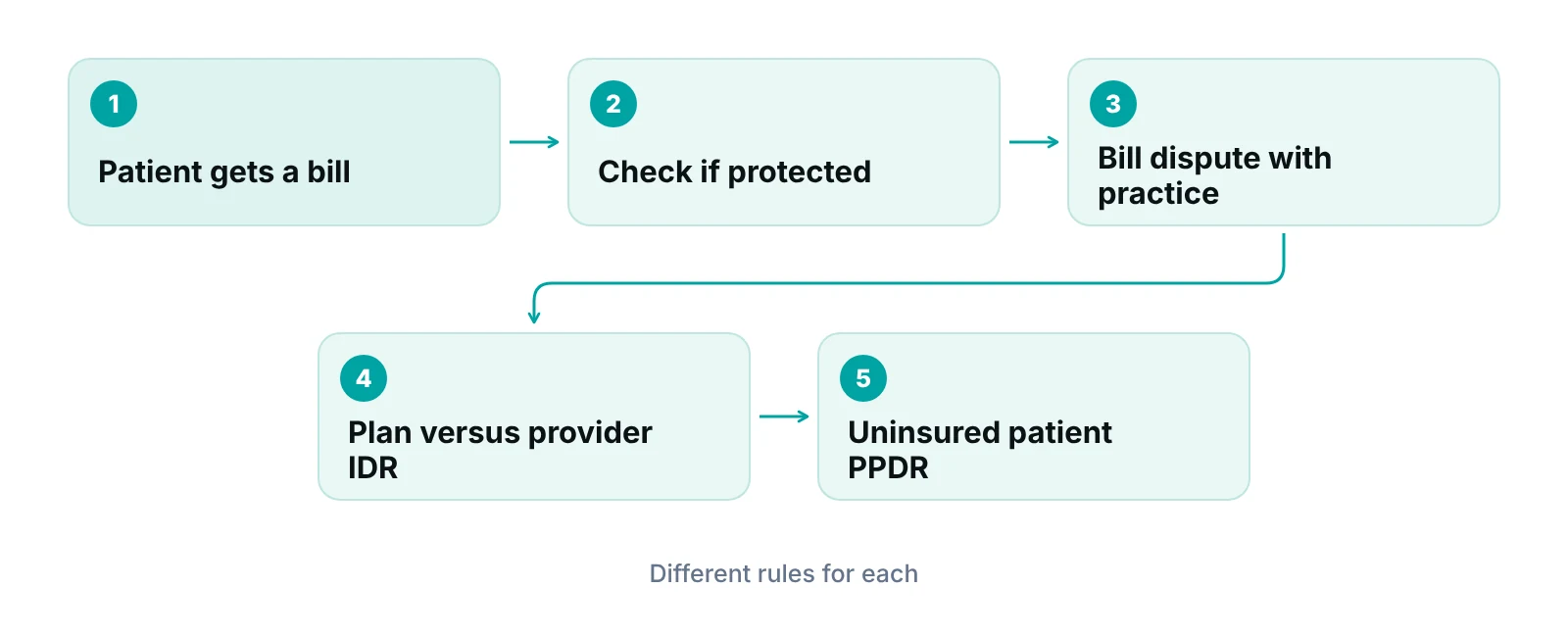
There are three different disputes people call a surprise bill dispute, and each runs through a different process. Sending a patient to the wrong one wastes weeks.
1. Ordinary bill review with the practice
A patient questions a charge, a coding line or a balance. This is a billing office conversation, covered step by step in our guide to disputing medical bills. For protected services the first check is whether the patient was billed more than in-network cost sharing.
2. Provider versus health plan: federal IDR
According to CMS, the health plan and the provider or facility start a 30-business-day open negotiation period after a payment denial or initial payment for certain out-of-network services. If they have not agreed, either party can start independent dispute resolution within 4 business days after that period ends. A certified IDR entity must select one of the two parties’ payment offers, and payment is due within 30 calendar days. The patient is not a party and owes only in-network cost sharing.
3. Uninsured or self-pay patient versus provider: PPDR
Under CMS’s patient-provider dispute resolution process, an uninsured or self-pay patient (or an insured patient not using coverage) can start a dispute when the bill is at least $400 more than the good faith estimate for that provider. The patient must start it within 120 calendar days of the initial bill and pays a $25 administrative fee. An HHS-selected dispute resolution entity decides. While it is pending, the practice cannot send the bill to collections or charge late fees.
| Path | Who is in it | Trigger | Key limit |
|---|---|---|---|
| Bill review | Patient and practice | Patient questions a charge | No fixed federal timeline |
| Federal IDR | Health plan and provider or facility | Out-of-network payment disagreement | 30 business days of open negotiation, then 4 business days to start IDR |
| PPDR | Uninsured or self-pay patient and provider | Bill at least $400 above good faith estimate | Start within 120 calendar days of the initial bill |
Source: CMS, Federal IDR page and PPDR process document
A simple workflow when a patient calls about a surprise bill
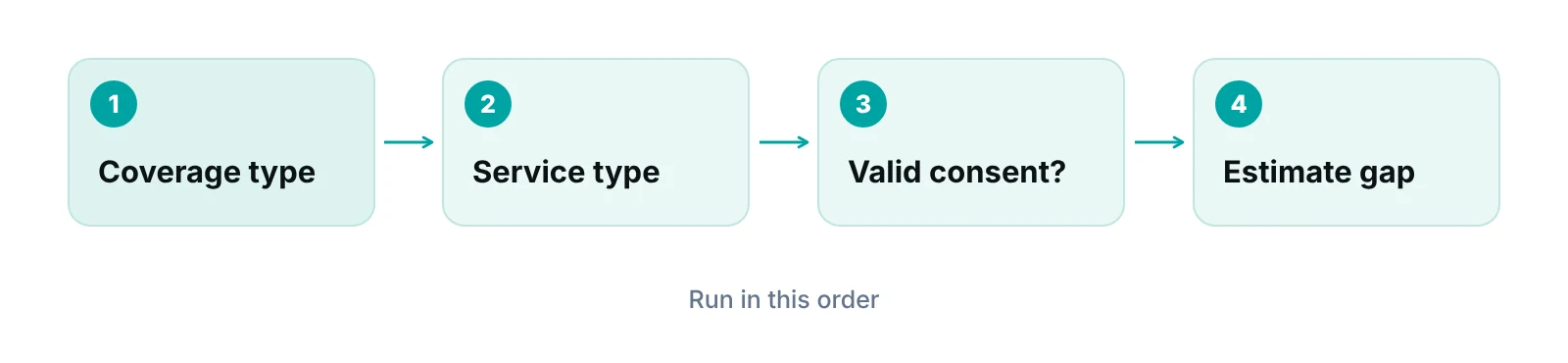
Give front desk and billing staff one short checklist, so every call is checked against the same facts. The order matters more than the script.
- Confirm the plan type. If it is Medicare, Medicaid, CHIP, VA, TRICARE or IHS, the federal balance billing rules do not apply, and the program’s own rules do.
- Confirm the service type: emergency, non-emergency at a participating facility, air ambulance or ground ambulance.
- Check whether the patient was billed more than in-network cost sharing, and whether a valid notice and consent exists for a service that is allowed to use one.
- If the patient is uninsured or self-pay, compare the bill with the good faith estimate and look for a gap of $400 or more.
- Hold collections and late fees on any account in an open dispute, and log who owns the next step.
- Point patients who need outside help to the No Surprises Help Desk at 1-800-985-3059, which CMS lists for questions and complaints.
Tracking each disputed account by stage and owner is the part most billing offices do on spreadsheets. A practice management system that tracks claims by stage can hold the owner and next step, and pairs with medical billing services when the work needs more hands. Cases that start as a plan denial belong in the out-of-network claims guide.
See where your billing process is exposed
A free practice audit reviews how your office handles out-of-network claims, estimates and patient balances.
What to do next
Start with the three facts that decide every case: the coverage type, the service type and who the dispute is between. Then match the answer to the right guide.
- Learn how network status affects payment in in-network versus out-of-network billing.
- See where this rule sits among wider compliance duties in the medical billing compliance guide.
- Estimate the revenue sitting in unpaid and underpaid claims with the revenue calculator.
Our recommendations
- Post and publish the protections notice. We recommend checking that the disclosure of balance billing protections is posted at each location and on your public website, and that staff know where to find it.
- Tag protected services at registration. Flag emergency, facility-based and air ambulance encounters so billers see the in-network cost-sharing limit before a statement goes out.
- Do not rely on consent for ineligible services. We recommend a short list of service types that never use notice and consent, kept next to the consent form, so no one collects a signature that does not protect the practice.
- Keep notices and consents for at least 7 years. Store signed forms where they can be retrieved by patient and date, and confirm with each facility who holds the master copy.
- Compare cash-pay bills to the estimate. For uninsured and self-pay patients, check the final bill against the good faith estimate before it is sent, and flag any gap of $400 or more.
- Pause collections on open disputes. Add a hold flag on any account where a patient has started PPDR, and record the owner and date.
Disputed accounts need an owner and a next step.
RCM Finder's practice management system tracks claims by stage with an assigned owner, and workflow rules can flag accounts for review. It is a claim-centred system, not an EHR.
See how the RCM Finder portal works · Create a portal account
Disclosure: RCM Finder builds and sells this portal. It is a practice management system, not an EHR.
Bottom line
Surprise medical bills are mostly a billing-process issue: the right check on coverage, service type and dispute path prevents most of the damage. If out-of-network claims and patient balances are slowing your cash flow, our denial management services and a free practice audit are the next step.
Frequently asked questions
What is a surprise medical bill?
It is an unexpected charge from an out-of-network provider that the patient did not choose, usually after emergency care or after non-emergency care at an in-network facility. Under the federal No Surprises Act, covered patients owe only their in-network cost sharing for protected services. The practice bills the plan for the rest.
When did the No Surprises Act take effect?
The requirements came from the Consolidated Appropriations Act of 2021, and CMS lists January 1, 2022 as the effective date for the provider requirements. The Act itself was passed earlier; January 2022 is when the rules began to apply.
Does the No Surprises Act cover ground ambulance bills?
No. CMS states that ground ambulance services are not covered by the Act, while air ambulance is. Some states have their own ground ambulance rules. CMS lists Colorado, Delaware, Florida, Illinois, Maine, Maryland, New York, Ohio, Vermont and West Virginia. Check the state where the service was provided.
Do Medicare and Medicaid patients get these protections?
Not through these particular rules. CMS lists Medicare, Medicaid, CHIP, Indian Health Service, VA and TRICARE as outside the balance billing provisions, because those programs have their own protections. The practice must still follow the program’s own billing rules for those patients.
Can a patient sign away the protection?
Only in limited non-emergency cases and never for certain services. Emergency medicine, anesthesiology, pathology, radiology, neonatology, diagnostic services and some other categories cannot use notice and consent. Where it is allowed, the notice and consent must be separate documents, delivered on a set timeline, and kept for at least 7 years.
Who is part of the federal IDR process?
The health plan and the provider or facility, not the patient. CMS describes a 30-business-day open negotiation period, then a request for independent dispute resolution within 4 business days. A certified entity chooses one of the two payment offers. The patient continues to owe only in-network cost sharing.
Get your free practice audit
Tell us about your practice. We will contact you using the details you give.
- A review of your recent claims, denials and A/R aging
- Where your front desk and prior authorizations slow payment
- A prioritized fix list you keep, whether or not you hire us
Pricing is quoted after the audit, based on your volume and the services you choose. Prefer to talk? Call +1 (302) 556-2288.
Sources
- No Surprises Act: key protections (revised June 2026) — CMS (2026)
- Provider requirements and resources — CMS (2026)
- High-level overview of provider requirements — CMS (2022)
- No Surprises Act key responsibilities for providers (rev. 1/2025) — CMS (2025)
- 45 CFR 149.410 Balance billing in cases of emergency services — eCFR / Cornell LII (2026)
- 45 CFR 149.420 Balance billing for non-emergency services at certain participating facilities — eCFR (2026)
- About Independent Dispute Resolution — CMS (2026)
- Good faith estimate and patient-provider dispute resolution process — CMS (2022)
- Action plan: ground ambulance bill — CMS (2026)
Disclaimer: This article is educational and is not legal, coding or compliance advice. The No Surprises Act, its regulations and state laws can change, and facts differ by plan and service. Confirm requirements against current CMS and state guidance before acting.
