
Hyperlipidemia ICD-10 codes sit in category E78. E78.5 (hyperlipidemia, unspecified) is the fallback when the note gives no type. Use E78.00 for pure high cholesterol, E78.1 for high triglycerides, E78.2 for mixed, and E78.49 for other specified types. This guide uses the FY2027 code set.
The provider writes “hyperlipidemia” and the coder picks E78.5. Often that is right. But the old habit of stopping at E78.5 hides a lot: the code book also has codes for high cholesterol alone, high triglycerides alone, mixed patterns, elevated lipoprotein(a) and familial forms.
This guide is for coders, billers and practice managers. It shows the E78 codes in the current code set, how common provider wording maps to them, and which notes in the code book change what you can report. It is not clinical advice, and the provider’s documentation always controls the code.
Key takeaways
- E78.5 is hyperlipidemia, unspecified: use it when the note names no type, not as a default for every lipid problem.
- E78.0 is no longer a billable code on its own: it splits into E78.00 and the familial codes E78.010, E78.011 and E78.019.
- Mixed hyperlipidemia (E78.2), pure hyperglyceridemia (E78.1) and elevated Lp(a) (E78.41) each have their own code.
- The E78.2 Excludes1 note sends familial combined hyperlipidemia to E78.49.
- Check the code against the current fiscal year’s Tabular List before the claim goes out.
Which hyperlipidemia ICD-10 code fits? The FY2027 code map
Start with what the provider documented. If the note says only “hyperlipidemia” or “dyslipidemia,” the ICD-10-CM Index sends both to E78.5. If the note names a type, such as high cholesterol, high triglycerides or a mixed pattern, a more specific E78 code applies (CDC NCHS, FY2027).
The code set year matters. CMS states that the 2027 ICD-10-CM codes are for discharges from October 1, 2026 through September 30, 2027, and the CDC browser lists FY2027 as effective October 1, 2026. Every code in this guide was checked against that set.
| Code | Official title | Use it when the note says | Watch for |
|---|---|---|---|
| E78.00 | Pure hypercholesterolemia, unspecified | Hypercholesterolemia or high cholesterol with no other lipid problem and no familial form named | Includes “(pure) hypercholesterolemia NOS”. If triglycerides are also high, see E78.2. |
| E78.010 | Homozygous familial hypercholesterolemia [HoFH] | The provider documents homozygous familial hypercholesterolemia | Needs the provider’s diagnosis, not a coder’s inference from a family history. |
| E78.011 | Heterozygous familial hypercholesterolemia [HeFH] | The provider documents heterozygous familial hypercholesterolemia | Same documentation rule as E78.010. |
| E78.019 | Familial hypercholesterolemia, unspecified | Familial hypercholesterolemia with no zygosity stated | Ask the provider whether the type is known before settling on this code. |
| E78.1 | Pure hyperglyceridemia | High triglycerides alone (elevated fasting triglycerides is an included term) | If cholesterol is also high, the Index points to E78.2. |
| E78.2 | Mixed hyperlipidemia | Mixed or combined hyperlipidemia, or high cholesterol with high triglycerides | Excludes1: familial combined hyperlipidemia (E78.49). |
| E78.3 | Hyperchylomicronemia | Hyperchylomicronemia, or Fredrickson type I or V | A rare finding. It needs a clear diagnostic statement. |
| E78.41 | Elevated Lipoprotein(a) | Elevated Lp(a) | A separate code. Do not fold it into E78.5. |
| E78.49 | Other hyperlipidemia | A specified hyperlipidemia that has no code of its own, such as familial combined hyperlipidemia | “Specified” means the provider named it. |
| E78.5 | Hyperlipidemia, unspecified | Hyperlipidemia or dyslipidemia with no type given | The fallback, not the goal. |
| E78.6 | Lipoprotein deficiency | Depressed HDL cholesterol or another lipoprotein deficiency | Low HDL is a different code family from high lipids. |
| E78.9 | Disorder of lipoprotein metabolism, unspecified | A lipoprotein metabolism disorder with no further detail | Rarely the best fit for a lipid problem that is clearly “high”. |
Source: CDC National Center for Health Statistics, ICD-10-CM browser, FY2027 Tabular List and Index (2026). Descriptions are our own summaries.
Two things in this table differ from many older code lists. First, E78.0 is a category heading now, not a billable code: the reportable codes are E78.00 and the familial codes below it. Second, E78.4 (other hyperlipidemia) has two codes, E78.41 for elevated Lp(a) and E78.49 for other specified types.
Check the code length
A code that stops at E78.0 or E78.4 is incomplete in the FY2027 code set. Both have more characters under them (E78.00, E78.01-, E78.41, E78.49). If an old template or superbill still shows the short form, update it.
How does provider wording map to a code?
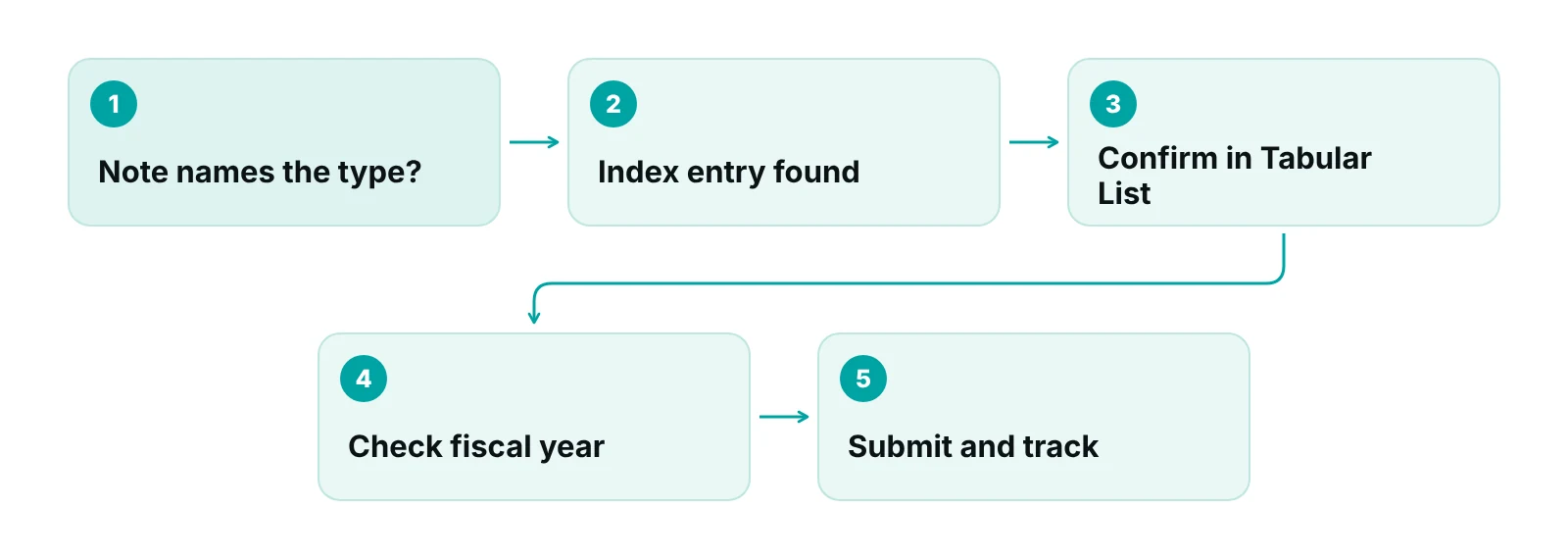
Use the Index first, then confirm in the Tabular List. The Index entries below come straight from the FY2027 Index to Diseases and Injuries (CDC NCHS, FY2027). They are useful because providers rarely write the official code title.
| Provider writes | Index entry | Code |
|---|---|---|
| High cholesterol, hypercholesterolemia | Cholesterol, elevated (high) | E78.00 |
| High triglycerides | Triglycerides, high / Hypertriglyceridemia, essential | E78.1 |
| High cholesterol with high triglycerides | Cholesterol, elevated, with high triglycerides | E78.2 |
| Mixed hyperlipidemia | Hyperlipidemia, mixed | E78.2 |
| Dyslipidemia | Dyslipidemia | E78.5 |
| Hyperlipidemia (no type) | Hyperlipemia, hyperlipidemia | E78.5 |
| Familial hypercholesterolemia | Hypercholesterolemia, familial | E78.019 |
| Hyperlipidemia, other specified type | Hyperlipidemia, specified NEC | E78.49 |
| Elevated Lp(a) | Elevated, lipoprotein a (Lp(a)) level | E78.41 |
| Low HDL cholesterol | Depressed, HDL cholesterol | E78.6 |
Source: CDC National Center for Health Statistics, ICD-10-CM browser, FY2027 Index to Diseases and Injuries (2026).
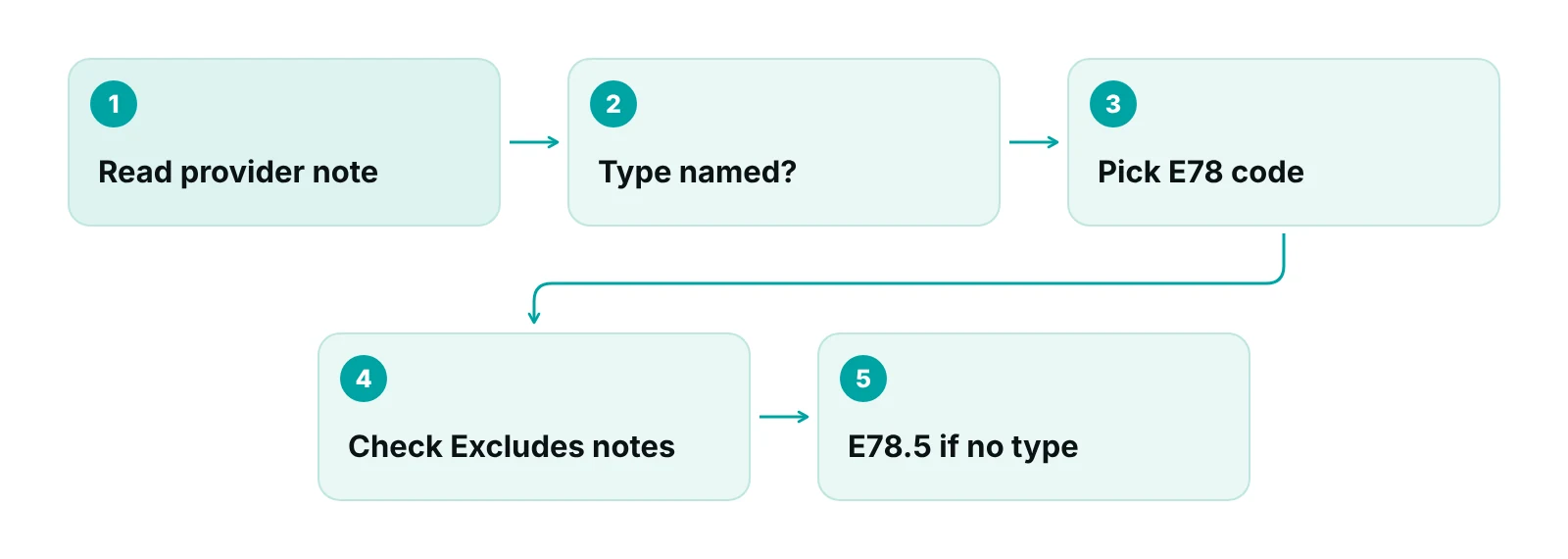
Two wording traps come up most. “Dyslipidemia” and “hyperlipidemia” both point to E78.5, so they do not need a query on their own. But “high cholesterol” alone is E78.00, and adding “and high triglycerides” changes the answer to E78.2. A one-line change in the note can change the code.
When is E78.5 the right code, and when is it a missed chance?
E78.5 is right when the provider documents hyperlipidemia and does not name a type. It is a real code with a real title, hyperlipidemia, unspecified, and the Index uses it for the plain term.
It becomes a missed chance when the chart already holds the detail. A note that says “mixed hyperlipidemia” should be coded E78.2. A note that says “familial hypercholesterolemia, heterozygous” should be coded E78.011. Reporting E78.5 in those cases understates what the provider documented.
A coder should not guess the type from lab values. If the note lists numbers but no diagnosis wording beyond “hyperlipidemia,” the right move is a query to the provider, or E78.5. Lab results alone are not a diagnosis. Our post on ICD-10 coding for lab review covers how lab-driven claims are handled.
“We would rather see a coder send one clear query than guess a hyperlipidemia type from a lab printout. A guessed code is harder to defend than an unspecified one.”
— Awais Afzal, Healthcare Operations & Data Analyst
Which Excludes and Includes notes apply to the E78 codes?
The notes sit in the Tabular List, not in the code title, so they are easy to miss. The CDC browser shows them under each category.
| Where the note sits | Type of note | What it says |
|---|---|---|
| E78 (category) | Excludes1 | Sphingolipidosis (E75.0 to E75.3) is coded elsewhere. |
| E78.2 Mixed hyperlipidemia | Excludes1 | Cerebrotendinous cholesterosis (E75.5) and familial combined hyperlipidemia (E78.49). |
| E78.49 Other hyperlipidemia | Includes | Familial combined hyperlipidemia. |
| E78.7 Disorders of bile acid and cholesterol metabolism | Excludes1 | Niemann-Pick disease type C (E75.242). |
| Metabolic disorders (E70 to E88) | Excludes1 | Includes androgen insensitivity syndrome (E34.5-), congenital adrenal hyperplasia (E25.0), Marfan syndrome (Q87.4-). |
| Metabolic disorders (E70 to E88) | Excludes2 | Ehlers-Danlos syndromes (Q79.6-). |
| Chapter 4 (E00 to E89) | Excludes1 | Transitory endocrine and metabolic disorders specific to the newborn (P70 to P74). |
Source: CDC National Center for Health Statistics, ICD-10-CM browser, FY2027 Tabular List instructions (2026).
The most practical one is at E78.2. Familial combined hyperlipidemia is not coded as mixed hyperlipidemia. The E78.2 Excludes1 note sends it to E78.49, and E78.49 lists it as an included term. A coder who sees “combined hyperlipidemia” in a note should look for the word “familial” before choosing between the two.
The category-level note at E78 matters less often in a general practice. It names sphingolipidosis (E75.0 to E75.3), which is a different disease group with its own codes.
What other codes show up beside a hyperlipidemia diagnosis?
Hyperlipidemia often sits next to other chronic conditions in the same chart, so the claim usually carries more than one diagnosis. This guide covers E78 only, but a few neighbours are worth knowing about.
- Diabetes: lipid disorders and diabetes are common together. Each has its own code family, so see our diabetes ICD-10 codes guide.
- Thyroid disease: coded in a different part of the same chapter. See our hypothyroidism ICD-10 coding guide.
- Screening visits: the Index lists “Cholesterol, elevated (high), screening for” at Z13.220 (CDC NCHS, FY2027). A screening visit and a visit to manage a documented lipid disorder are different encounters, so confirm which one the note describes before choosing.
- Heart disease: cardiology claims often pair a lipid code with a circulatory diagnosis from another chapter. Each diagnosis is coded from its own documentation.
Whichever codes you report, each one needs support in that day’s note. A diagnosis listed on a problem list but never addressed in the visit is a common audit finding. Our post on types of medical coding audits explains how payers and practices test for it.
Why do cardiology and endocrinology practices see this code so often?
Lipid disorders are managed in primary care, cardiology and endocrinology, so the code appears on many claims in those settings. Because the code is common, small errors repeat across many visits.
Practices that bill for cardiology services often carry E78 codes alongside circulatory diagnoses on the same claim. If you run that kind of practice, our cardiology billing and RCM page shows how we approach diagnosis coding and claim follow-up for it.
The common failure is quiet. A template defaults to E78.5, the visit note gets more specific over time, and nobody updates the code. The claim still pays, so nobody notices, until a payer or an internal audit compares the note to the code.
What goes wrong on claims, and how do you catch it before submission?
Most hyperlipidemia coding problems are not rejections. They are mismatches that sit unseen until a review. These are the ones we would check first.
- Outdated code lists: a superbill or EHR favourites list still showing E78.0 or E78.4 without the extra characters.
- Default-to-unspecified: E78.5 used for every lipid visit, even when the note names a type.
- Wrong pair: mixed hyperlipidemia (E78.2) reported together with a code the Excludes1 note points away from.
- Wrong year: a code set carried over from last fiscal year when a new one starts October 1.
- Unsupported diagnosis: a code added from the problem list with nothing in that visit’s note to support it.
A claim scrubber catches some of these, such as an invalid or incomplete code. It does not catch a code that is valid but less specific than the note. That needs a coder or a periodic sample review. Our guide to clean claims explains what a scrubber can and cannot check.
Want a second pair of eyes on your diagnosis coding?
Send us your current claim workflow and we will look at how notes, codes and edits line up. The audit is free, and pricing is quoted after it.
What does RCM Finder do with diagnosis coding?
Our team works inside your existing EHR (for example PrognoCIS, eClinicalWorks or athenahealth). For diagnosis coding, that means reviewing the codes on claims against the note, raising queries with the provider when the note is unclear, and tracking claims that come back with diagnosis-related edits.
Our medical billing services cover charge entry, coding support and claim submission. If you want to estimate what coding gaps may cost your practice, you can try the revenue calculator. We do not quote prices before a free audit.
Our recommendations
- Replace short-form lipid codes in your templates. We would audit superbills and EHR favourites for E78.0 and E78.4 without the extra characters, and replace them with the full codes in the current fiscal year.
- Add a type line to the lipid diagnosis. We would ask providers to write the type in the diagnosis statement when it is known: high cholesterol, high triglycerides, mixed, familial. It gives the coder one clear line to code from.
- Treat E78.5 as a flag, not a default. We would run a monthly list of claims with E78.5 and check whether the note supports a more specific code. Pick a small sample, not every claim.
- Check codes against the new year every October. The code set changes each fiscal year. We would set a date each September to review lipid and other chronic-condition codes against the new Tabular List.
- Query, do not infer. If lab results suggest a type but the note does not say so, we would send a short query. A coder should not turn lab values into a diagnosis.
- Sample your own claims. We would pull a small set of lipid-related claims each quarter and compare note, code and payer response. It is a quick way to see where documentation and coding drift apart.
Bottom line
The right hyperlipidemia ICD-10 code depends on what the provider documented. E78.5 is the honest code when no type is named. E78.00, E78.1, E78.2, E78.41 and E78.49 apply when the note says more, and the Excludes1 note at E78.2 keeps familial combined hyperlipidemia separate. If you want help checking diagnosis coding on your claims, our cardiology billing and RCM page and denial management services are good starting points, or you can talk to our team.
Frequently asked questions
What is the ICD-10 code for hyperlipidemia?
The code for hyperlipidemia with no type given is E78.5, hyperlipidemia, unspecified. If the provider documents a type, a more specific code in category E78 applies, such as E78.00 for pure hypercholesterolemia, E78.1 for high triglycerides or E78.2 for mixed. This answer uses the FY2027 code set.
Is E78.0 still a valid ICD-10 code?
Not on its own. In the FY2027 Tabular List, E78.0 is a heading for pure hypercholesterolemia, and the reportable codes below it are E78.00 and the familial codes E78.010, E78.011 and E78.019. Check any old template or superbill that still lists the short form, because a code that is cut short can fail a claim edit. The same applies to E78.4, which now has E78.41 and E78.49 under it.
What ICD-10 code is used for mixed hyperlipidemia?
Mixed hyperlipidemia is E78.2. The Index also sends combined hyperlipidemia and high cholesterol with high triglycerides to E78.2. Familial combined hyperlipidemia is the exception: the E78.2 Excludes1 note points it to E78.49.
What is the ICD-10 code for dyslipidemia?
The FY2027 Index lists dyslipidemia at E78.5, the same as hyperlipidemia with no type. If the provider documents the type, such as low HDL cholesterol, a different code may fit. Depressed HDL cholesterol, for example, indexes to E78.6.
What code is used for high cholesterol?
High cholesterol with no other detail is E78.00, pure hypercholesterolemia, unspecified. If the provider also documents high triglycerides, the Index points to E78.2 instead. A familial form uses the E78.01 codes.
Should a coder choose E78.5 when unsure?
Only when the note supports hyperlipidemia and names no type. If the note is unclear, a short query to the provider is better than a guess. E78.5 is a valid code, but it should reflect what the provider documented, not a coder’s default. Over time, a high share of E78.5 on your claims is a sign that notes or templates need more detail.
Get your free practice audit
Tell us about your practice. We will contact you using the details you give.
- A review of your recent claims, denials and A/R aging
- Where your front desk and prior authorizations slow payment
- A prioritized fix list you keep, whether or not you hire us
Pricing is quoted after the audit, based on your volume and the services you choose. Prefer to talk? Call +1 (302) 556-2288.
Sources
- ICD-10-CM browser, FY2027 Index and Tabular List — CDC National Center for Health Statistics (2026)
- 2027 ICD-10-CM files — Centers for Medicare & Medicaid Services (2026)
Disclaimer: This article is educational and is not legal, coding, clinical or compliance advice. ICD-10-CM is maintained by the CDC National Center for Health Statistics and CMS, and the code set changes each fiscal year. Payer rules vary, and the provider’s documentation controls code assignment. Confirm each code in the current Tabular List and your payer’s policy before you bill.
