
CPT 99203 reports a new patient office or outpatient visit at the low level, chosen by low medical decision-making or at least 30 minutes of total practitioner time on the date of the visit. Medicare's 2026 national non-facility amount is $117.57.
This guide is for practice managers, coders and physicians who bill new patient visits. It replaces the older history-and-exam explanation with the current MDM-or-time rules, and it shows how to read the 2026 payment table. Rates and rules change each year, so use this as a working reference and confirm with your payer.
Key takeaways
- Choose 99203 by low MDM or by at least 30 minutes of practitioner time, not by history and exam.
- The 30 minutes is a minimum, not a 30 to 44 minute band.
- Medicare’s 2026 national non-facility amount is $117.57; your locality and payer will differ.
- Modifier 25 needs a separate, documented E/M, and it has nothing to do with a 90-day period.
- Prolonged service add-ons do not apply to 99203 under Medicare’s G2212 rule.
What CPT 99203 means
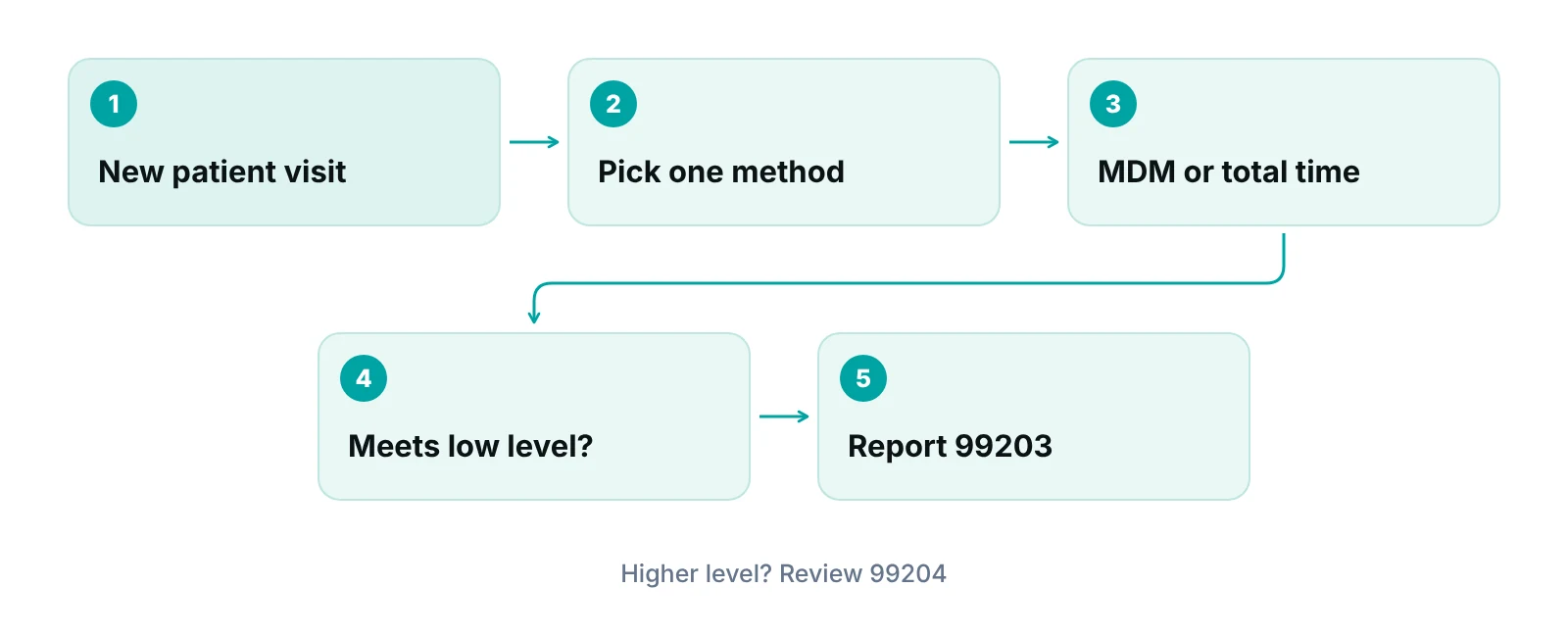
CPT 99203 is an office or other outpatient visit for a new patient at the low level of service. You select that level by medical decision-making (MDM) or by total time. Since the 2021 office visit changes, the old history-and-exam point system no longer decides the level.
Medicare contractor Noridian tells providers they can choose time or MDM for each encounter, and that to select a level by MDM the note must meet or exceed two of the three MDM categories. If the record has no time, Medicare reviews the visit on MDM alone.
The code sits in a four-code ladder. 99202 is straightforward, 99203 is low, 99204 is moderate and 99205 is high. Each code has an MDM level and a minimum time. The time column in the AAFP summary of the CPT time and MDM table is headed ‘must be met or exceeded’, so the listed time is a floor, not a range.
| CPT code | MDM level | Minimum total time on the date of the encounter |
|---|---|---|
| 99202 | Straightforward | 15 minutes |
| 99203 | Low | 30 minutes |
| 99204 | Moderate | 45 minutes |
| 99205 | High | 60 minutes |
Source: American Academy of Family Physicians, time and MDM levels for E/M CPT codes (accessed 2026).
Older guides, including the earlier version of this post, show time bands such as 30 to 44 minutes. Those bands no longer describe how the code is selected. A 40-minute visit that meets low MDM is still 99203, and a 31-minute visit with no other support is also 99203. Moderate MDM at any length points to 99204, so the code is only as strong as the note that supports it.
How to choose 99203 by MDM or by time
Pick one method per visit and document it clearly. Do not mix them: you cannot add minutes to make up for a weak MDM, and you do not need minutes if the MDM carries the level.
Choosing by MDM
The MDM route works when the note shows that at least two of the three MDM categories reach the low level. The reviewer has to be able to see the problems you addressed, the information you reviewed or ordered, and the management decision you made. A note that lists ‘new patient, exam normal’ with no assessment or plan gives a reviewer nothing to score.
Choosing by time
The time route works when your own documented minutes reach at least 30. Noridian says to use only the time you spent on the date of service, so documentation finished the next day does not count. Face-to-face time and appropriate non-face-to-face time both count, but only time by the billing practitioner or other qualified health care professional counts, and ancillary staff time does not. If you perform a procedure the same day, Noridian says to subtract the procedure time from the visit time.
Prolonged service add-ons do not apply to 99203
Noridian describes G2212 as an add-on to 99205 or 99215 only, and only when time selects the level. A long 99203 visit does not become billable as extra time. If the work really reaches a higher level, the level changes, not the add-on.
What Medicare pays for 99203 in 2026
The national Medicare amount for 99203 billed in an office (non-facility) setting is $117.57 for 2026, up from $109.01 in 2025. Both figures come from the American Urological Association’s table of the CMS calendar year 2026 physician fee schedule final rule. They equal the code’s total RVUs multiplied by the conversion factor.
The 2026 conversion factor for clinicians who are not qualifying APM participants is $33.4009. For qualifying participants it is $33.5675 (Minnesota Medical Association summary). The CMS fact sheet on the 2026 final rule rounds these to $33.40 and $33.57. CMS also adopted a 2.5% efficiency adjustment for non-time-based services, and says time-based E/M services are exempt from it. That is why office visit values rose while many procedure values fell.
| CPT code | 2026 total RVUs | 2025 payment | 2026 payment |
|---|---|---|---|
| 99202 | 2.25 | $69.87 | $75.15 |
| 99203 | 3.52 | $109.01 | $117.57 |
| 99204 | 5.31 | $163.35 | $177.36 |
| 99205 | 7.09 | $215.75 | $236.81 |
Source: American Urological Association, CY 2026 MPFS final rule E/M table (CMS-1832-F); conversion factors $32.3465 (2025) and $33.4009 (2026). Check the CMS fee schedule lookup for your locality.
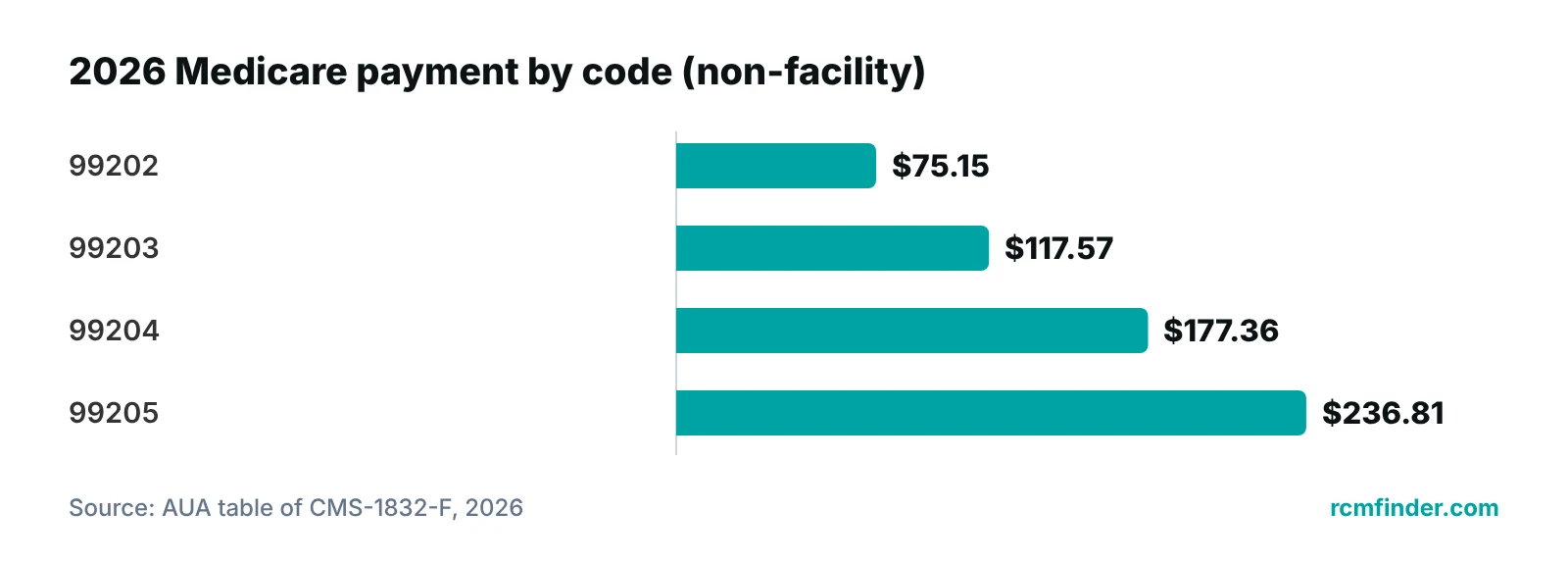
Three things change the number on your remittance. First, location: CMS applies geographic practice cost indices to the total RVUs, so your locality will differ from the national figure. Second, setting: the same AUA table lists 99203 at $71.48 in a facility (hospital) setting for 2026, against $117.57 in an office. Third, payer: commercial and Medicaid plans set their own schedules, so a Medicare amount is a reference point and not a prediction.
A pending change is worth watching. The AUA has also published an analysis of 2027 proposed fee schedule effects on E/M codes, so treat any 2026 figure as dated and re-check it when the 2027 final rule is released.
Documentation that supports a 99203 claim
A 99203 claim holds up when the note answers three questions without the reader having to infer anything: why the patient was seen, what you decided, and which method set the level. Clear notes also speed up coding and make an audit easier. Our guide to documentation in medical billing covers the wider habits.
- State the reason for the visit and each problem addressed. Link every diagnosis on the claim to something in the assessment.
- Show the data and the decision. Note what was reviewed or ordered and what management was chosen, in plain words.
- Record total time only if you bill on time. Write the total minutes and the date, and say that the time is the practitioner’s own.
- Keep the note on the date of service. Work finished on another day does not count toward time, per Noridian.
- Confirm the patient is new to your group under the payer’s definition before you choose from the 9920x family. Check the payer’s policy, because it affects whether 9921x applies.
History and exam are still part of good care, and the CPT rules call for a medically appropriate history and exam. They simply no longer add up to a level. If your templates still force every field to be filled in, the note gets longer without getting stronger, and a long template is not evidence of MDM.
99203 with a same-day procedure: modifier 25
Modifier 25 marks a significant, separately identifiable E/M service on the same day as a procedure. It is not tied to a 90-day recovery period. That is a different question, about global surgery packages, and the earlier version of this post mixed the two together.
A commercial payer’s published payment policy (Louisiana Healthcare Connections, Clinical Validation of Modifier 25) describes the test this way: the E/M must be above and beyond the usual work of the procedure, and the note must meet the criteria for the E/M level billed. Citing NCCI, it says the E/M is reportable with modifier 25 only if it is unrelated to the decision to perform a minor procedure. It also says being a new patient is not enough on its own to justify a same-day E/M.
In practice, a new patient who needs a full workup and also has an injection or a minor in-office procedure may support both lines. A new patient who arrives for a procedure that was already planned usually supports only the procedure. Code the E/M and the procedure from separate parts of the note. Our post on modifier 25 versus modifier 59 goes deeper on when each applies.
“If the visit note would read the same without the procedure, the E/M is probably separate. If it would not, it probably is not.”
Common 99203 errors and how to catch them
Most 99203 problems are small and repeat: a level chosen by habit, minutes with no date, or a same-day procedure with no support for modifier 25. A short pre-submission check catches them. Our clean claims guide explains why catching these before submission is cheaper than appealing afterwards.
| Check | Why it matters | What to look for |
|---|---|---|
| Level matches the method | The note must support the level by MDM or time | MDM at low or above, or documented minutes of at least 30 |
| Time is the practitioner’s own and on the date of service | Other-day work and staff time do not count | Minutes, date and who spent them |
| Patient is new to the group | A new-patient code on an established patient is a classic error | Prior visit history under the payer’s definition |
| Modifier 25 is supported | A procedure line can bundle the E/M without it | A separate assessment that stands apart from the procedure |
| Diagnoses match the note | Unlinked diagnoses weaken medical necessity | Each billed diagnosis appears in the assessment |
| Payer and location rate loaded | Remits are compared against an expected amount | Contract or Medicare locality amount for 99203 |
Overcoding is not the only risk. Undercoding a visit that meets moderate MDM leaves money on the table, while consistently choosing the highest code invites review. A periodic internal sample is the best protection against both, and our guide to medical billing audits shows how to set one up.
Where 99203 shows up in practice
99203 is a general E/M code, so the same rules apply across specialties. It is common in primary care, where a new patient with a limited set of problems fits the low level well. Our family practice billing support page covers how a primary care group’s billing differs from a procedural specialty.
Once the patient is established, the follow-up visit uses the 9921x family, which our 99213 guide covers. If a visit is billed under a physician’s name for a service delivered by someone else, the rules differ again. See our Medicare incident-to billing guide before you assume the code carries over.
Practices that want these checks to happen on every claim, not just when someone remembers, can use a practice management system that tracks claims by stage with a named owner at each step. The coder still chooses the code; the system makes the review step hard to skip.
Check your own E/M pattern
If you are not sure how your new patient visits are being leveled and paid, a second set of eyes can find patterns that a claim-by-claim review misses. Our medical billing services team can review a sample of your new patient claims.
Review your new patient visit coding
Ask for a free practice audit. We look at how your visits are leveled, how claims are paid and where payments fall short of what you expected.
Our recommendations
- Pick one method per visit. Make MDM or time a conscious choice in the template. Do not let the note blend the two.
- Require date and minutes when billing on time. A time statement without a date, or with staff minutes mixed in, will not support the level.
- Stop using the old 30 to 44 minute band. Update superbills, cheat sheets and EHR prompts so they show 30 minutes as a minimum.
- Load expected amounts for each payer. Put your contract rate or Medicare locality amount for 99203 in your system so underpayments stand out.
- Review modifier 25 claims monthly. Pull every 99203 billed with a same-day procedure and read the notes for a separate assessment.
- Re-check rates every January. The conversion factor and RVUs change each year, so refresh your reference tables when the final rule is published.
Keep a second look on new patient claims.
Our portal tracks each claim by stage with an owner, and workflow rules can flag a claim for review before it goes out. Your coders still choose the code.
See how the RCM Finder portal works · Create a portal account
Disclosure: RCM Finder builds and sells this portal. It is a practice management system, not an EHR.
Bottom line
CPT 99203 is a low-level new patient visit, chosen by MDM or by at least 30 minutes of the practitioner’s own time on the date of service. Use the 2026 Medicare amount as a reference and your payer contracts as the real target. If you want an outside check on how your visits are leveled and paid, our revenue cycle management team starts with a free practice audit. You can also estimate what small payment gaps add up to with the revenue calculator.
Frequently asked questions
What is CPT 99203 used for?
CPT 99203 reports a new patient office or other outpatient visit at the low level of service. You choose that level by medical decision-making or by total practitioner time on the date of the visit. The minimum time for 99203 is 30 minutes, and the MDM level is low.
How much does Medicare pay for CPT 99203 in 2026?
The national non-facility amount is $117.57 for 2026, based on 3.52 total RVUs and a $33.4009 conversion factor, according to the AUA’s table of the CMS final rule. Your locality adjusts this through geographic cost indices. Check the CMS fee schedule lookup for your exact amount.
Is 99203 still 30 to 44 minutes?
No. The time column in the current CPT table is a minimum that must be met or exceeded, so 99203 needs at least 30 minutes. A longer visit is not capped at 44 minutes, but a longer visit also does not automatically become 99204. The level depends on MDM or on reaching the next minimum time.
Do I still need a comprehensive history and exam for 99203?
A medically appropriate history and exam are part of care, but they no longer decide the level. Office visit levels are chosen by MDM or total time. Documenting more history and exam than the visit needs does not raise the code.
Can I bill 99203 with a procedure on the same day?
Sometimes. You need a significant, separately identifiable E/M service, supported by its own documentation, and reported with modifier 25. Payers apply their own edits, so check the payer’s policy. Being a new patient alone does not make the E/M separate.
Can I add a prolonged service code to 99203?
Not under Medicare’s G2212 rule. Noridian describes G2212 as an add-on to 99205 or 99215, and only when time selects the level. If a visit runs long and the work supports a higher level, review whether 99204 or 99205 is the right code instead.
Get your free practice audit
Tell us about your practice. We will contact you using the details you give.
- A review of your recent claims, denials and A/R aging
- Where your front desk and prior authorizations slow payment
- A prioritized fix list you keep, whether or not you hire us
Pricing is quoted after the audit, based on your volume and the services you choose. Prefer to talk? Call +1 (302) 556-2288.
Sources
- Evaluation and Management (E/M) Office or Other Outpatient Services Top Provider Questions with Answers — Noridian Healthcare Solutions (Medicare Administrative Contractor) (2026)
- Time and medical decision making levels for E/M CPT codes — American Academy of Family Physicians (2026)
- CY 2026 MPFS Final Rule: Evaluation & Management — American Urological Association (2026)
- Calendar Year (CY) 2026 Medicare Physician Fee Schedule Final Rule (CMS-1832-F) fact sheet — CMS (2025)
- CMS Releases Final Rule for 2026 Medicare Physician Fee Schedule — Minnesota Medical Association (2025)
- Clinical Validation of Modifier 25 (LA.PP.013) — Louisiana Healthcare Connections (via Louisiana Department of Health) (2024)
Disclaimer: This article is educational and is not legal, coding or compliance advice. Payer rules vary, and CPT is owned by the American Medical Association. Confirm code selection and payment with the payer and the current CPT book.
