
The CO-22 denial code means the payer believes another insurer should pay this claim first, under coordination of benefits. It is a payer-order problem. To fix it, confirm which plan was primary on the date of service, update the patient record, then bill the primary and secondary payers in that order.
If you are looking at a CO-22 line on a remittance, the first step is not an appeal. It is a short investigation into who else covers the patient. This guide explains what the code says, how it differs from similar denials, the rules that decide payer order, and a repeatable fix.
Key takeaways
- CO-22 is a coordination-of-benefits sequencing denial, not an authorization, duplicate or network denial.
- Payer order depends on the type of coverage: NAIC rules for many commercial plans, Medicare Secondary Payer rules for Medicare.
- The birthday rule applies to children on both parents’ plans, not to spouses.
- Fix the order first, then bill primary and secondary in sequence; do not resubmit unchanged.
- Most CO-22 denials trace back to registration and are preventable.
What the CO-22 denial code means
The payer is telling you it does not think it should pay first. The standard wording for reason code 22 is “This care may be covered by another payer per coordination of benefits.” That text appears on the First Coast Medicare denial tips page and in the MassHealth CARC memo (February 2025). It is a sequencing problem, not a statement that the service was wrong.
A remittance line has two parts. The group code (here, CO) comes first. The reason code (here, 22) comes second. Read both, then read the remark codes on the same line. Remarks often say which other coverage the payer found. Your practice management system and clearinghouse may show these parts in different places, so check the actual 835 or paper remittance when a line looks unclear.
What CO-22 is not
CO-22 is about payer order. It is not a missing-authorization denial, an out-of-network denial, a duplicate or a lapsed-coverage denial. Those come back under other reason codes (see the table below). Treating them all as CO-22 sends staff down the wrong fix. If you also see CO-16, our CO-16 denial code guide covers missing or wrong claim information.
CO-22 versus the denials it gets confused with
Several different denials look alike in a work queue, but each has its own reason code and its own fix. The table lists the ones that are most often mixed up with CO-22, using the descriptions in a state Medicaid CARC list.
| Reason code | Description in the CARC list | What it points to | First thing to check |
|---|---|---|---|
| 22 | This care may be covered by another payer per coordination of benefits. | Payer order is wrong or unknown | Which plan is primary on the date of service |
| 18 | Exact duplicate claim/service | The claim or line was already received | Whether an earlier claim is still in process |
| 27 | Expenses incurred after coverage terminated. | Coverage had ended on the date of service | Coverage dates on the date of service |
| 197 | Precertification/authorization/notification/pre-treatment absent. | Authorization was not on file | Whether an authorization was required and obtained |
| 16 | Claim/service lacks information or has submission/billing error(s). | Missing or incorrect data on the claim | The remark codes naming the missing item |
| 242 | Services not provided by network/primary care providers. | Network status problem | Whether the plan and provider network match |
Source: MassHealth SENDPro CARC Code Memo (February 2025). Descriptions are reproduced as listed; wording can differ slightly by payer.
For the authorization case, see our CO-197 denial code guide. If your denials come from several of these at once, our denial management services page explains how we sort, work and trend them.
Why payers send CO-22
A payer sends CO-22 when its own records show other coverage that should pay first, or when the claim does not show who paid first. In practice it comes down to a short list of causes.
- The patient has another plan you do not know about. The payer’s file shows other coverage. Your registration record does not.
- The order on the claim is wrong. You billed the plan you assumed was primary. The payer’s records say otherwise.
- A plan changed. The patient started a job, retired, aged into Medicare or lost a spouse’s coverage, and the order shifted.
- The primary payer’s response is missing. A secondary payer expects to see what the primary paid or denied before it processes its share.
- Non-health coverage exists. Liability, workers’ compensation or no-fault auto coverage may be responsible for an injury-related visit.
The first three are front-end problems. Insurance is collected once, never rechecked and then drifts out of date. That is why a clean intake step matters more than a clever appeal. Our guide to patient insurance verification walks through what to capture at each visit.
Who pays first: the rules behind the denial
Payer order follows set rules, but which rules apply depends on the type of coverage. For commercial plans, many states use the National Association of Insurance Commissioners (NAIC) model regulation. For Medicare, federal Medicare Secondary Payer rules apply. The table summarizes the common cases. Your plan documents and state law control the final answer, especially for self-funded employer plans.
| Situation | Who usually pays first | Source section |
|---|---|---|
| Patient covered as an employee on one plan and as a dependent on another | The plan covering the person as an employee or subscriber | NAIC model regulation, Section 6.D(1) |
| Child covered under both parents’ plans (parents married or living together) | The plan of the parent whose birthday (month and day) falls earlier in the year | NAIC model regulation, Section 6.D(2)(a) and Section 3B |
| Child, parents divorced or separated, court decree makes one parent responsible | That parent’s plan, if the plan knows of the decree | NAIC model regulation, Section 6.D(2)(b) |
| Child, divorced or separated parents, no decree assigning responsibility | Custodial parent’s plan, then custodial parent’s spouse, then non-custodial parent’s plan, then that parent’s spouse | NAIC model regulation, Section 6.D(2)(b)(iv) |
| Person has COBRA or other continuation coverage plus another plan | The plan covering the person as an employee or subscriber, ahead of the continuation coverage | NAIC model regulation, Section 6.D(4) |
| Age 65 or older, Medicare plus a group plan through current employment (employer with 20 or more employees) | The group health plan; Medicare is secondary | CMS Medicare Secondary Payer Manual, Chapter 2, Section 10 |
| Under 65 with Medicare through disability, large group plan through current employment (employer with 100 or more employees) | The large group health plan; Medicare is secondary | CMS Medicare Secondary Payer Manual, Chapter 2, Section 30 |
| Work injury, liability case or no-fault auto insurance with Medicare | Workers’ compensation, liability insurer or no-fault insurer pays before Medicare | CMS Medicare Secondary Payer Manual, Chapter 2, Sections 40, 50, 60 |
Sources: NAIC Coordination of Benefits Model Regulation (Model 120); CMS Medicare Secondary Payer Manual, Chapter 2. Summary only; state rules and individual plan documents govern.
Two points from this table matter most. First, the birthday rule applies to children covered under both parents’ plans. It does not decide order between spouses. Each spouse’s own employer plan is normally primary for that spouse. Some online explainers get this wrong. Second, the Medicare thresholds are specific: 20 or more employees for people 65 and older, and 100 or more for people under 65 on disability. A patient’s “I’m still working” does not tell you which side of that line the employer falls on.
If you want the full mechanics of payment sequencing, our posts on how coordination of benefits works in medical billing and why coordination of benefits matters to healthcare practices go further than this page does.
CO-22 on Medicare and Medicaid claims
On a Medicare claim, CO-22 usually means Medicare’s records show it is the secondary payer. First Coast’s denial tips page says the denial occurs when Medicare’s records indicate Medicare is secondary, and it lists what to do. Those steps are summarized here.
- Ask the patient to complete a Medicare Secondary Payer (MSP) questionnaire and keep it in the file.
- Check eligibility and secondary-payer status in the Medicare portal tools your contractor points to (the page names SPOT).
- If another primary payer exists, bill it first. Send the claim to Medicare for secondary payment only after you have the primary payer’s determination.
- If Medicare’s record is wrong, the patient needs to contact the Medicare Secondary Payer contractor to correct it.
- If your file shows Medicare was primary on the date of service, resubmit to Medicare.
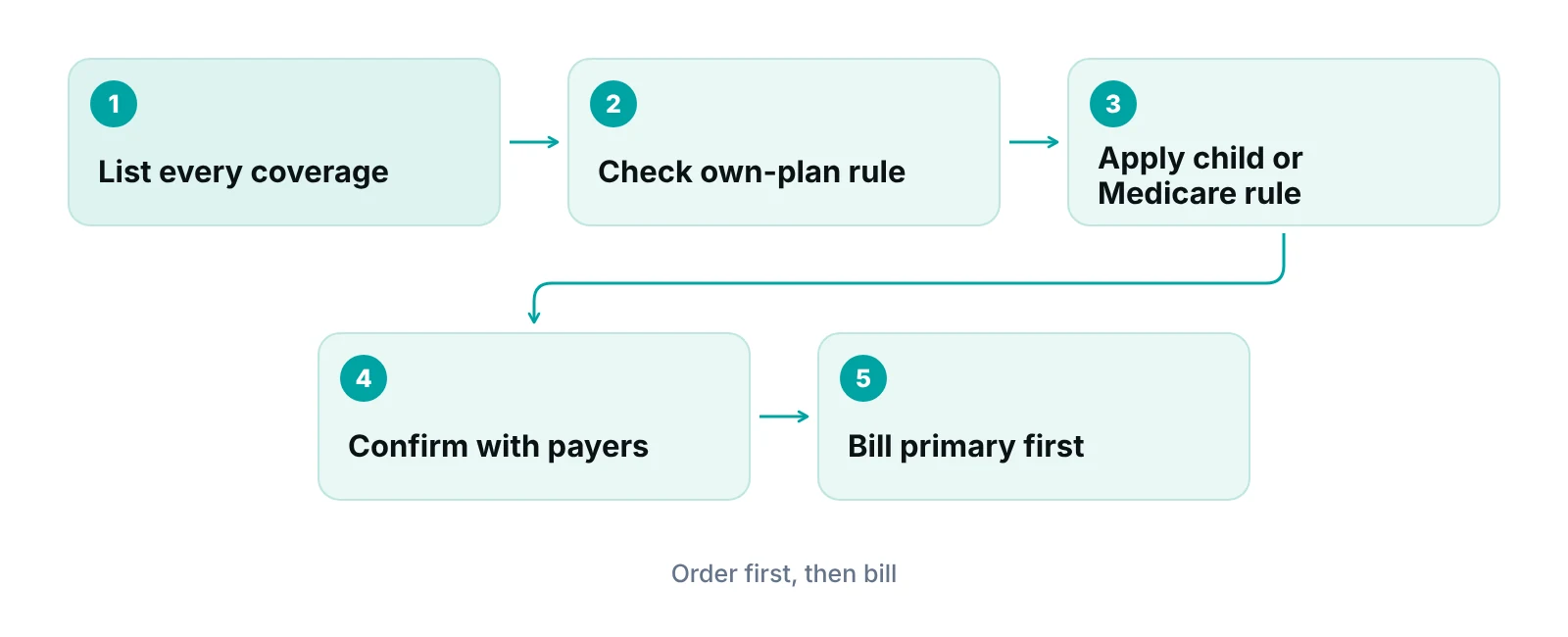
Medicaid works differently. Under 42 CFR 433.139, when a state Medicaid agency has established probable third-party liability at the time a claim is filed, it generally rejects the claim and returns it to the provider to determine the liable party’s amount. The agency then pays only the portion above what the third party pays. A short list of services, including prenatal care and preventive pediatric services, can be paid first and recovered later. State programs add their own billing rules, so confirm with your state Medicaid provider manual.
Check the date of service
Coverage that was primary last year may not be primary today. Always evaluate payer order on the date of service, not on the date you are posting the claim.
How to fix a CO-22 denial, step by step
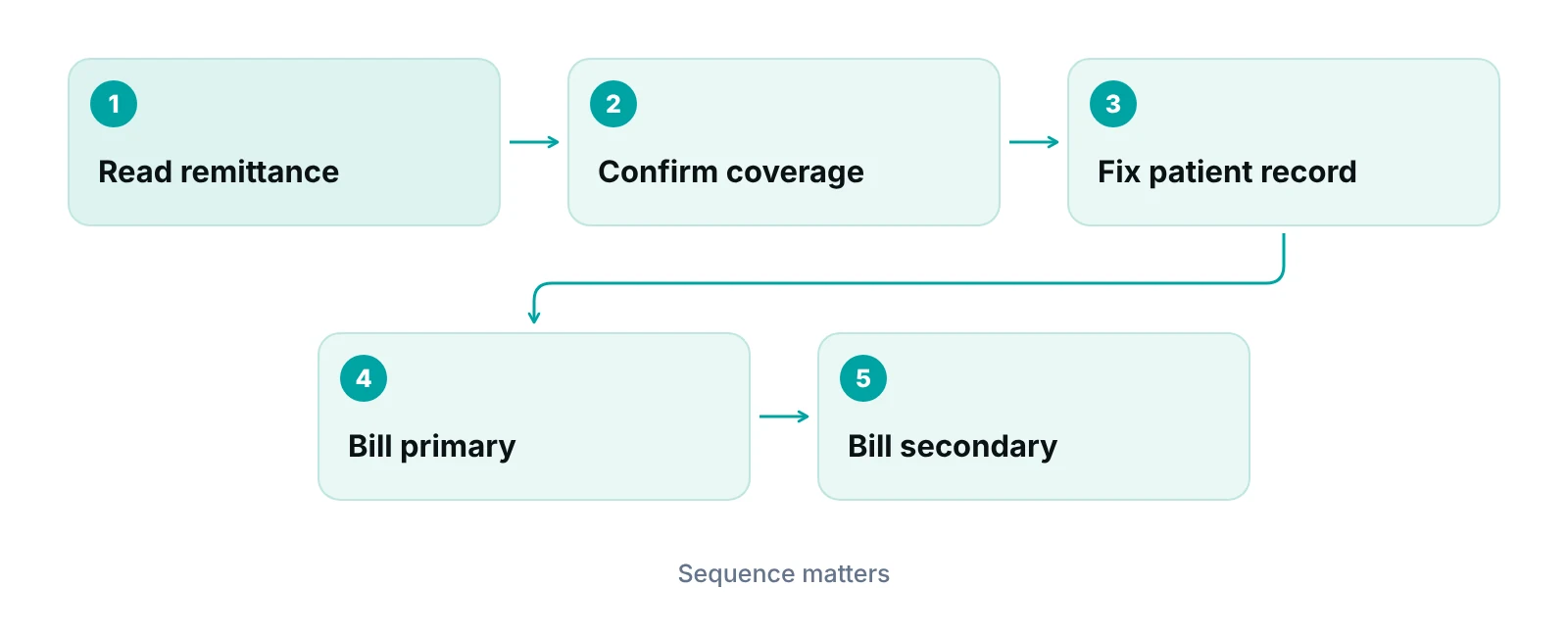
Fix it by finding the correct payer order, then billing in that order with the right proof attached. Do not rebill the same claim to the same payer unchanged.
- Pull the remittance. Note the group code, reason code, remark codes and any payer name or policy detail in the remarks.
- List every coverage on file. Include commercial, Medicare, Medicaid, and any liability, workers’ compensation or no-fault coverage tied to the visit.
- Confirm order with the patient and the payers. Ask the patient about other coverage and recent job or status changes. Call or use the payer portal to confirm which plan the payer shows as primary.
- Update the registration record. Correct the payer sequence in the patient’s file so the next claim goes out right.
- Bill the correct primary payer first. If you billed the wrong plan first, ask whether the payer wants a corrected claim or a new one. Rules vary by payer.
- Bill the secondary payer with the primary’s response. Attach or transmit the primary payer’s payment or denial information as that payer requires.
- Track the secondary claim. Do not close the account until the second payer has processed its share.
- Record the cause. Tag the denial as COB-sequence, unknown coverage or plan change, so you can see the pattern later.
Watch the filing limits. Each payer sets its own timely filing window, and the clock on the secondary claim can run out while you chase the first one. We do not quote a single deadline here because it varies by payer and contract. Check the one in your contract and write it on the account.
Not sure where your coordination-of-benefits denials come from?
A free practice audit looks at your denial reports and shows which causes repeat. There is no obligation.
How to stop CO-22 denials before they happen
Most CO-22 denials are preventable at registration. The goal is for each claim to leave with the correct payer order already confirmed.
- Ask the same questions at every visit. “Do you have any other insurance? Has anything changed since your last visit?” Cover work, spouse, parent and any injury-related reason for the visit.
- Scan and compare. Scan the cards (front and back) each time and compare them with what is in the system.
- Flag high-risk patients. Patients near age 65, new to Medicare, recently changed jobs, or seen for an injury deserve a second look.
- Capture injury details. For an accident or work injury, record the date, the type and the claim contact before the first bill goes out.
- Review by denial reason. A short monthly count of CO-22 denials by front-desk step shows where the gap sits.
- Give staff a payer-order cheat sheet. Use the table above and your own plan notes as a one-page reference.
Eligibility checks catch some of this, but they do not replace asking the patient. A payer’s response shows its own coverage, not what the patient has elsewhere. See our post on insurance verification in the revenue cycle for how the two work together. Our virtual medical assistant service can also take on intake calls and coverage checks when your front desk is stretched.
Where CO-22 shows up most in specialty practices
Injury-related care raises the chance of a payer-order dispute because more than one party may owe payment. Pain and injury practices see this when a patient is hurt in a car accident or at work and the first bills could go to health insurance, an auto policy or workers’ compensation. For Medicare patients, the MSP manual puts workers’ compensation, liability and no-fault insurers ahead of Medicare to the extent they pay or can be expected to pay. Our pain management billing page explains how we handle this kind of mixed-payer claim work.
| Cause | Where it starts | Who fixes it | Evidence to collect |
|---|---|---|---|
| Unknown other coverage | Registration | Front desk or billing | Patient statement, card scans, payer response |
| Wrong order on the claim | Claim setup | Billing | Confirmation of primary from payer or portal |
| Plan or status change | Patient life event | Front desk | Updated card, MSP questionnaire for Medicare |
| Missing primary response | Secondary billing | Billing | Primary payment or denial information |
| Injury-related coverage | Intake | Front desk and billing | Date of injury, claim contact, claim number |
Source: RCM Finder working checklist (no external statistics).
Commercial auto and no-fault rules differ by state and by policy, so treat the table above as a starting point. If a patient reports an injury, find out who is handling the injury claim before you decide where the first bill goes.
“One strong front-desk habit is asking about other coverage at every visit, not only the first one. The denial usually starts the day the card is scanned.”
Track secondary claims so they do not fall through
A CO-22 fix creates a second claim, and second claims are easy to lose. Someone needs to own each one until it pays. A practice management system that tracks claims by stage lets you see which claims are waiting on a primary response, which are with the secondary payer and who is responsible. Even a spreadsheet works if every claim has a stage and an owner. What matters is that no secondary claim sits unwatched.
Review a short list weekly: claims where the primary has paid but the secondary has not been billed, and claims where the secondary was billed but no response has come. These two groups hide the most unbilled money.
To see how much a leak like this could cost your own practice, you can estimate it with our revenue calculator. It uses your numbers, not industry averages.
Our recommendations
- Verify payer order at every visit. We recommend one standing question at check-in: has any coverage changed? It takes seconds and catches most of the drift.
- Treat CO-22 as a sequence problem. We recommend routing it to a COB step in your work queue, not to the general appeals pile. An appeal will not fix a wrong payer order.
- Separate it from look-alike denials. We recommend tagging 18, 27, 197, 16 and 242 differently from 22 in your denial log so trends are honest.
- Name an owner for every secondary claim. We recommend that each secondary claim has one person and one stage until it pays or is written off.
- Write down your timely filing windows. We recommend keeping a short payer-by-payer list of filing limits, taken from your contracts, next to the work queue.
- Count denials by cause each month. We recommend a simple monthly count by reason code and by front-desk step. Fix the biggest cause first.
Secondary claims need a stage and an owner.
RCM Finder’s portal tracks each claim by stage with a named owner, so a claim waiting on a secondary payer stays visible until it pays.
See how the RCM Finder portal works · Create a portal account
Disclosure: RCM Finder builds and sells this portal. It is a practice management system, not an EHR.
Bottom line
A CO-22 denial is a signal that your payer order is wrong or incomplete, and the fix is to confirm coverage, correct the record and bill in sequence. If denials like this keep coming back, it is worth looking at where your front-end process lets them through. Our denial management services and medical billing services are built for that work, and we start with a free practice audit.
Frequently asked questions
What does the CO-22 denial code mean?
It means the payer believes another payer should pay first. The standard description is “This care may be covered by another payer per coordination of benefits.” The fix is to confirm payer order, then bill the primary and secondary payers in the correct sequence.
Is CO-22 always the practice’s mistake?
Not always. The payer may hold newer information than you do, or the patient may not have reported other coverage. Either way, the claim needs correct payer-order information before it can be paid. Review your registration steps if it happens often.
Does the birthday rule apply between spouses?
No. Under the NAIC model regulation, the birthday rule applies to a child covered under both parents’ plans. A spouse’s own employer plan is normally primary for that spouse, and the other spouse’s plan is secondary. State rules and plan documents can differ, so confirm with the payer.
How do I fix CO-22 on a Medicare claim?
Check the patient’s Medicare Secondary Payer status, collect an MSP questionnaire, and find out if another primary payer exists. If one does, bill it first and send Medicare the claim after the primary’s determination. If Medicare’s record is wrong, the patient contacts the Medicare MSP contractor.
Can I just resubmit the same claim?
Only if you have confirmed that the payer was in fact primary on the date of service. If the payer order was wrong, resubmitting the same claim to the same payer repeats the denial. Correct the order first, then ask the payer how it wants corrections sent.
How long do I have to bill the secondary payer?
It depends on the payer and your contract. Each sets its own timely filing limit, and the clock can run while you work the primary claim. Look up the limit for each payer you bill and record it in your work queue so secondary claims are not lost.
Get your free practice audit
Tell us about your practice. We will contact you using the details you give.
- A review of your recent claims, denials and A/R aging
- Where your front desk and prior authorizations slow payment
- A prioritized fix list you keep, whether or not you hire us
Pricing is quoted after the audit, based on your volume and the services you choose. Prefer to talk? Call +1 (302) 556-2288.
Sources
- Tips to prevent claim adjustment reason code (CARC) CO 22 — First Coast Service Options (Medicare Administrative Contractor) (2026)
- CARC Code Memo (Denied & Adjusted CARCs) — MassHealth SENDPro (2025)
- Medicare Secondary Payer Manual, Chapter 2 — CMS (2026)
- Coordination of Benefits Model Regulation (Model 120) — NAIC (2026)
- 42 CFR 433.139 Payment of claims — eCFR / US government (reproduced text) (2026)
Disclaimer: This article is general education for practice owners and billing staff. It is not legal, coding or compliance advice. Payer rules, state laws and plan terms vary, so confirm the details with the payer or your own advisers before acting.
