
A chiropractic billing specialist verifies benefits, checks codes and modifiers, submits claims, works denials and follows up on unpaid balances, so doctors and front desk stay with patients. It pays off most when Medicare rules, visit limits and denials are eating staff time. Compare in-house, outsourced and hybrid models before you decide.
Chiropractic claims carry rules that general billing staff often learn the hard way: a narrow Medicare benefit, an active-treatment modifier, limits on visits and a signed notice for care Medicare will not pay. This guide explains what a specialist handles, which rules matter most, what to confirm before the first visit and how to choose a model. For deeper coding detail, see our guides to Medicare billing for chiropractors and chiropractic CPT codes and modifiers. It replaces an earlier version of this post that quoted payment-speed, denial and salary figures without a primary source.
Key takeaways
- A chiropractic billing specialist covers verification, claim submission, denials, A/R follow-up and reporting, but cannot fix a clinical note that does not support the service.
- Medicare Part B pays only for manual manipulation of the spine to correct a subluxation, and active-treatment claims need the AT modifier.
- Verify benefits with the carrier before the first visit, record visit limits and authorization, and re-check on a schedule.
- In-house, outsourced and hybrid models each fit a different practice; compare tasks, backup coverage and reporting, not just a fee.
- Ask any vendor for a signed business associate agreement, chiropractic experience and reports you can read before you hand over claims.
What a chiropractic billing specialist does
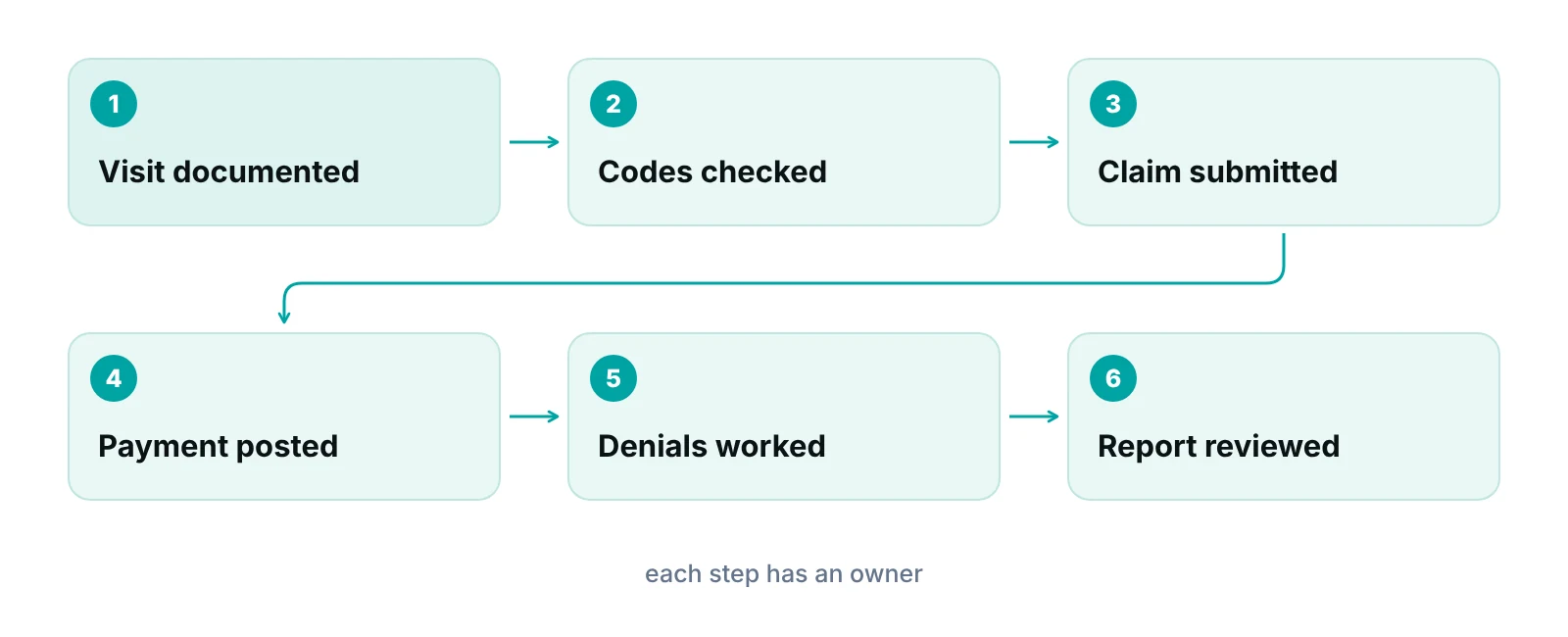
A chiropractic billing specialist owns the work between the visit and the payment: checking coverage, building the claim, sending it, posting what comes back and chasing what does not. The role can be one employee, a person at an outside company or a shared task list split between both.
- Before the visit: benefit and eligibility checks, authorization requests where a plan requires them, and recording visit limits.
- At charge entry: checking that the codes, modifiers, diagnoses and regions treated agree with the note.
- After the visit: claim submission, payment posting and reconciling remittances against what the payer should have paid.
- When payment stalls: denial review, corrected claims, appeals and aging follow-up.
- Reporting: a regular view of claims, denials and open balances by payer so the owner can see what is stuck.
What stays with the practice is documentation. A specialist can query a missing diagnosis or an unsigned note, but only the treating chiropractor can supply the clinical record that supports the service. If you want outside help on the billing side, our medical billing services cover charge entry, claims and coding support, and our chiropractic specialty page explains how that work is set up for chiropractic offices.
Why chiropractic claims need specialist knowledge
Chiropractic claims differ because Medicare covers a very narrow service and commercial plans each set their own limits. A biller who treats chiropractic like general office visits will miss the details that decide payment.
| Rule | What it means at the billing desk | Where it comes from |
|---|---|---|
| Narrow covered service | Medicare Part B pays for a chiropractor’s manual manipulation of the spine to correct a subluxation. It does not pay for X-rays or other diagnostic or therapeutic services the chiropractor furnishes or orders. | 42 CFR 410.21 (eCFR) |
| CMT codes by region | Manipulation is reported with 98940, 98941 or 98942, chosen by the number of spinal regions treated, up to five. One contractor describes 98940 as covering one or two regions. | Medicare Coverage Database LCD attachment |
| AT modifier | Medicare claims for active or corrective treatment must carry the AT modifier. A CMT claim without it is treated as maintenance and denied. AT alone does not prove medical necessity. | Noridian Part B (JF); LCD attachment |
| Two diagnoses per region | One contractor’s guidance asks for a primary subluxation diagnosis at the level treated (ICD-10-CM M99.00 to M99.05) and a secondary diagnosis for the cause. Other contractors may differ. | LCD attachment |
| Maintenance care | Maintenance chiropractic care is not considered reasonable and necessary under Medicare. With a signed ABN the claim carries GA; without a signed ABN, GZ. Do not add AT to maintenance services. | Noridian Part B (JF); LCD attachment |
| Timely filing | Medicare fee-for-service claims must be submitted within 12 months (1 calendar year) of the date of service, with limited exceptions. | CMS Claims Processing Manual, Ch. 1, 70.4 |
Source: eCFR, 42 CFR 410.21; Noridian Healthcare Solutions, Chiropractic Claim Submission Requirements (accessed 2026-10-17); CMS Medicare Coverage Database LCD attachment, Coding Guidelines for Chiropractic Services; CMS Pub. 100-04, Ch. 1 (Transmittal 12909, 2024).
Medicare contractors and commercial plans differ
The table mixes federal regulation with the wording of one contractor’s guidance. Your Medicare Administrative Contractor may require different diagnosis pairing or documentation, and commercial plans set their own codes, limits and authorization rules. Check the policy for your contractor and each major payer. Our ABN billing guide covers when a notice is needed.
Documentation is where many of these rules turn into denials. The same contractor guidance says an X-ray is not required to demonstrate a subluxation, and that without one the record can show it through physical examination findings, with at least two of four listed criteria. It also says that if more than two regions are billed, the record must explain why the other regions were treated. A specialist who knows these rules can flag a chart before the claim goes out.
“A claim is only as strong as the note behind it. Billing staff can chase the payer, but only the clinical record can prove the service.”
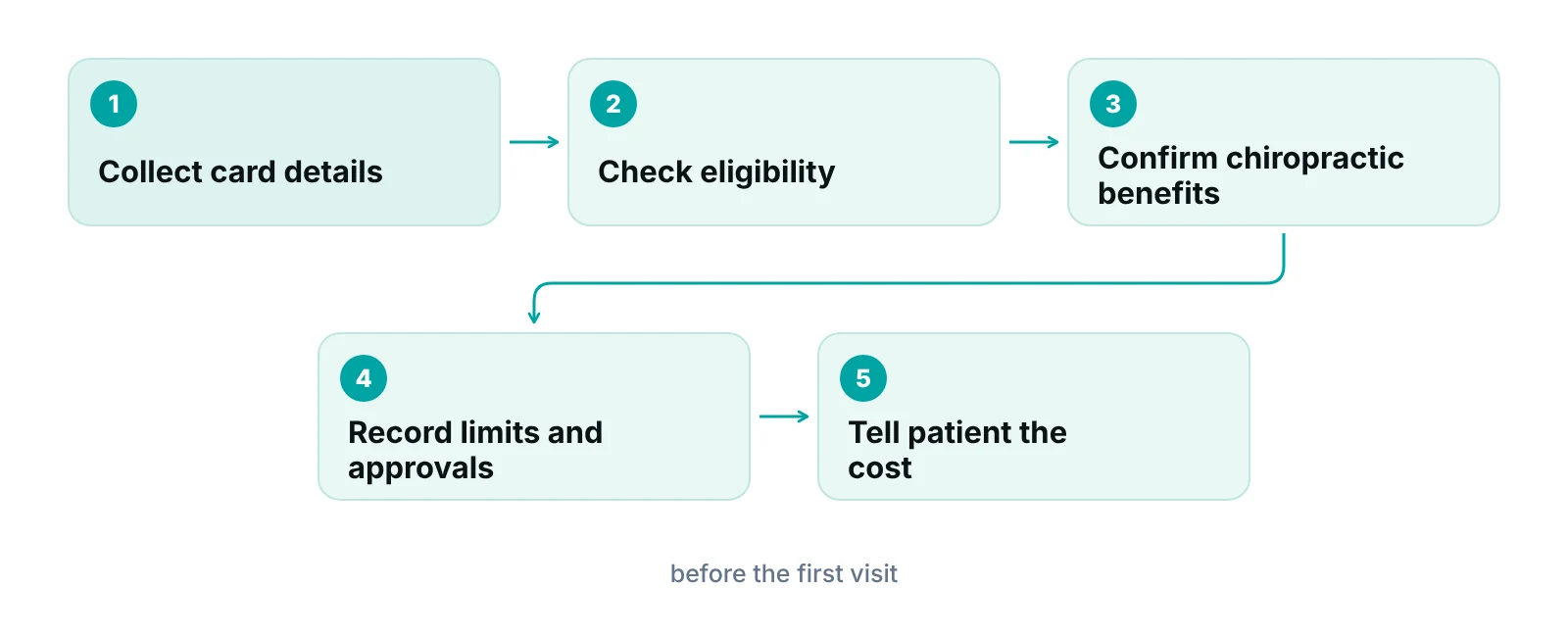
Chiropractic insurance verification: what to confirm before the first visit
Verification means confirming that coverage is active and learning what the plan actually pays for chiropractic care. Do it before treatment, and check with the carrier directly: one chiropractic liability insurer warns that patients often repeat what they heard from the carrier and may not fully understand their benefits.
Much of the first check can run electronically. The eligibility inquiry (270) and response (271) are HIPAA-adopted standards, and CAQH CORE operating rules align with them to help automate inquiries between providers, insurers and clearinghouses. A response that is unclear on chiropractic limits still needs a call or portal check.
| Item to confirm | Why it matters |
|---|---|
| Panel or network status, and any out-of-panel provision | Decides which fee schedule and patient share apply |
| Chiropractic maximum benefit and percentage of allowed amount paid | Sets what the plan pays and what the patient owes |
| Deductible: met or not, and calendar or fiscal year | Changes what you collect at the visit |
| Visit limit per year, visits used and visits remaining | The most common reason a plan stops paying mid-treatment |
| Exclusions or limits on services and diagnoses | Avoids billing something the plan never covers |
| Pre-authorization requirement and authorization number | Missing approvals lead to rejected claims |
| Copay amount | To be collected when the visit is complete |
| Auto or workers’ compensation cases: claim details, adjuster and state rules | Benefits for these cases vary by state, so the plan rules do not apply the same way |
Source: FindACode, Verification of Insurance Coverage form; NCMIC, Insurance Coverage Verification (accessed 2026-10-17).
A verification is a snapshot, not a promise
One verification form notes that coverage can change without any notice to the provider. We recommend re-checking at set points, such as the start of a plan year, after a gap in care or when the patient reports a change. For the general process, see our patient insurance verification guide.
What a specialist handles after the visit
After the visit, the specialist’s job is to get a correct claim out quickly and to treat every denial as information. The earlier a problem is caught, the cheaper it is to fix.
Claims and denials
Chiropractic-specific checks are worth building into charge entry. Each one below follows from the rules in the table above:
- AT modifier present on active-treatment CMT lines, and absent on maintenance care.
- Subluxation diagnosis at the right level, paired with the secondary diagnosis your contractor expects.
- Regions billed match the regions documented, with a reason in the note if more than two are treated.
- Signed ABN on file before maintenance care is billed with GA.
- Visit count checked against the verified plan limit.
- Claim sent well inside the filing limit of the payer.
When a claim is denied, the specialist reads the reason, fixes what is fixable, resubmits or appeals, and records the cause so staff can stop repeating it. If denials are piling up, a dedicated denial management service can sit alongside your billing team.
Reporting you should be able to read
Ask for a regular report that shows claims submitted, paid, denied and still open by payer, plus the top denial reasons. Two common measures are the denial rate (denied claims divided by claims submitted in the period) and days in A/R (open receivables divided by average daily charges). Set your own baseline from your last few months rather than borrowing a target, and watch the direction. If you want one place to see this, a practice management system that tracks claims by stage gives each claim an owner and shows where it is stuck.
In-house, outsourced or hybrid: how to choose
No single model wins for every chiropractic office. The right one depends on how many claims you send, how many payers you deal with, how much Medicare and personal-injury work you carry and how much backup you have when a biller is out.
| Model | Fits best when | Watch for |
|---|---|---|
| In-house biller or front desk | Low claim volume, few payers and a trained person with a backup | Single point of failure during leave; training on payer and Medicare changes falls to you |
| Outsourced billing company | Growing volume, multiple payers or no one with chiropractic billing experience | Reporting depth, who owns payer logins and records, how denials are worked, and exit terms |
| Hybrid | Front desk verifies and collects; an outside team handles claims, denials and A/R | Clear hand-off rules so nothing sits between the two teams |
| Doctor does the billing | Very small or new practice | Billing time comes out of patient time, and errors surface late |
To compare cost fairly, list everything the in-house route requires: wages and benefits, training, billing software, clearinghouse fees and the cost of coverage during absences. Then ask each vendor how its fees are calculated and to put the answer in writing. Pricing is not discussed in public posts; we quote it after a free practice audit. Our guide to questions to ask when choosing a medical billing company has a longer vendor checklist.
See what your billing is costing you
Use the revenue calculator to estimate how much revenue your current process may be leaving behind, then compare it against your options.
What to ask before you hire a chiropractic billing specialist
Ask for evidence of process, not promises of results. A good answer names the step, the owner and the report that shows it happened.
- Chiropractic experience: how do they handle the AT modifier, ABN, GA and GZ for Medicare, and personal-injury and workers’ compensation cases?
- Verification process: do they check visit limits and authorization, or only whether the policy is active?
- Denial workflow: who reads each denial, how fast, and how are causes fed back to your front desk?
- Reporting: what do you see weekly or monthly, and can you open it without asking?
- Access and ownership: who holds the payer portal logins, and do you keep your claim and payment data if you leave?
- Data protection: will they sign a business associate agreement before touching patient data, and what access controls and audit trails do they use?
- Staffing: who works your account, in which time zone, and what is the backup?
Want a second look at your chiropractic billing?
Book a free practice audit and we will review how verification, coding and follow-up work in your office today, then outline the options.
Where billing meets the patient
Patients feel billing most when a visit limit or deductible surprises them. Verification results give the front desk what it needs to explain cost before care starts, and a signed ABN, where one is appropriate, sets expectations for care Medicare will not pay. Fewer surprises mean fewer awkward conversations and fewer unpaid patient balances. Keeping billing questions with a specialist also leaves your clinical team more time for the patient in front of them.
How to decide: a four-step check
- List the tasks: write down who verifies, codes, submits, posts and follows up today, and where the gaps are.
- Review your last few months of denials: sort them by reason and note which are chiropractic-specific, such as missing AT, diagnosis or ABN.
- Pick a model: use the table above to decide between in-house, outsourced or hybrid.
- Test the plan: ask vendors the questions above, or request a free practice audit to see how your current process compares.
Our recommendations
- Fix verification first. Whoever owns billing, make visit limits, deductible status and authorization part of every new-patient check. Outsourcing a weak front-end process does not remove the problem.
- Track denials by reason. Sort denials for a few months by cause. If missing AT, diagnosis pairing or ABN keeps appearing, the fix is a charge-entry rule, not more follow-up.
- Write a one-page rule sheet. List the AT, ABN, GA and GZ rules and your contractor’s diagnosis pairing in one page that staff and any vendor can follow.
- Re-verify on a schedule. Set trigger points, such as the start of the plan year or a gap in care, so coverage changes do not surface as denials.
- Keep access to your own data. Hold your payer portal logins and confirm in writing that you keep your claim and payment records if you change vendors.
- Ask for a business associate agreement. Ask any vendor that will handle patient data to sign a business associate agreement before access is granted.
Our practice management system tracks each claim by stage with an owner, so stuck claims are easy to see.
It applies specialty-aware billing logic, runs data-completeness checks before submission and flags underpayments against expected amounts. Role-based permissions and an audit log control who can change what.
See how the RCM Finder portal works · Create a portal account
Disclosure: RCM Finder builds and sells this portal. It is a practice management system, not an EHR.
Bottom line
A chiropractic billing specialist earns their place by catching rule-driven problems early: coverage limits before the visit, modifiers and diagnoses at charge entry, and denials after. Whether the person sits in your office or outside it, make sure verification, documentation and reporting each have an owner. If you want help, see our medical billing services and denial management services, or start with a free practice audit. Questions? Contact us.
Frequently asked questions
What does a chiropractic billing specialist do?
A chiropractic billing specialist checks coverage, enters charges with the right codes and modifiers, submits claims, posts payments, works denials and follows up on unpaid balances. They also report on what is stuck. They cannot create clinical documentation; the treating chiropractor must supply the notes that support each billed service.
Does Medicare cover chiropractic care?
Medicare Part B pays for a chiropractor’s manual manipulation of the spine to correct a subluxation, under 42 CFR 410.21. It does not pay for X-rays or other diagnostic or therapeutic services the chiropractor furnishes or orders. Coverage details vary by Medicare contractor, so check your contractor’s policy.
What is the AT modifier in chiropractic billing?
AT marks active or corrective treatment on a Medicare chiropractic claim. Medicare treats CMT claims without it as maintenance care and denies them. The AT modifier alone does not show medical necessity, and it should not be added to maintenance services, which are handled with an ABN and the GA or GZ modifier.
How often should chiropractic insurance be verified?
There is no single rule we can cite, but coverage can change without notice to the provider. We recommend verifying before the first visit, at the start of each plan year, after any gap in care and whenever the patient reports a change. Record visit limits and authorization each time.
Does a verification guarantee the claim will be paid?
No. A verification shows what the plan reported at that moment. The claim is still judged on documentation, coding, authorization and plan limits. Patients may also misreport their benefits, which is why a direct check with the carrier is better than relying on the patient alone.
Should a small chiropractic office outsource billing?
It depends on volume, payer mix and backup coverage. A small office with a trained biller and a backup may do well in-house, while an office with growing volume or no chiropractic billing experience may prefer outsourcing or a hybrid split. Compare tasks, reporting and exit terms, not only the fee.
Get your free practice audit
Tell us about your practice. We will contact you using the details you give.
- A review of your recent claims, denials and A/R aging
- Where your front desk and prior authorizations slow payment
- A prioritized fix list you keep, whether or not you hire us
Pricing is quoted after the audit, based on your volume and the services you choose. Prefer to talk? Call +1 (302) 556-2288.
Sources
- 42 CFR 410.21 Chiropractors' services — eCFR / Code of Federal Regulations (Current (accessed 2026-10-17))
- Chiropractic Claim Submission Requirements — Noridian Healthcare Solutions (Medicare Part B, JF) (Accessed 2026-10-17)
- Coding Guidelines for Chiropractic Services (LCD attachment) — CMS Medicare Coverage Database (Accessed 2026-10-17)
- Medicare Claims Processing Manual, Ch. 1, 70.4 (Transmittal 12909) — CMS (2024)
- Eligibility and Benefits Standards and Operating Rules — CAQH (Accessed 2026-10-17)
- Insurance Coverage Verification — NCMIC (Accessed 2026-10-17)
- Verification of Insurance Coverage (form) — FindACode (Accessed 2026-10-17)
Disclaimer: This article is educational and is not legal, coding, billing or compliance advice. CPT is a trademark of the American Medical Association. Payer and Medicare contractor rules vary and change; check your contractor's current policy and each payer's rules before you bill.
