
ASC dental surgery billing usually splits into separate claims: the dentist's treatment goes to the dental plan on CDT codes, while the facility and anesthesia bill the medical plan on CPT and HCPCS codes. Which plan pays depends on medical necessity, the member's contract and each payer's policy.
A dental group books a patient for surgery under general anesthesia at your center. Three parties will bill, two plans may be involved, and nobody has yet confirmed which code set goes on which claim.
This guide is for ASC managers, billing teams and oral surgery groups deciding how to handle that case. It covers who bills what, CDT versus CPT, when a medical plan pays and what to check before the date is booked. It focuses on the claim mechanics, not on whether any treatment is clinically appropriate.
Key takeaways
- An ASC dental case usually means separate dental, facility and anesthesia claims.
- Dental plans expect CDT codes; medical plans expect CPT and HCPCS codes, and payers differ on exceptions.
- Medical plans pay for facility and anesthesia only when their own criteria are met.
- The real limits are annual maximums, frequency limits, waiting periods and medical-necessity criteria, not “billing caps”.
- Original Medicare excludes most dental care, with narrow exceptions.
What does ASC dental surgery billing involve?
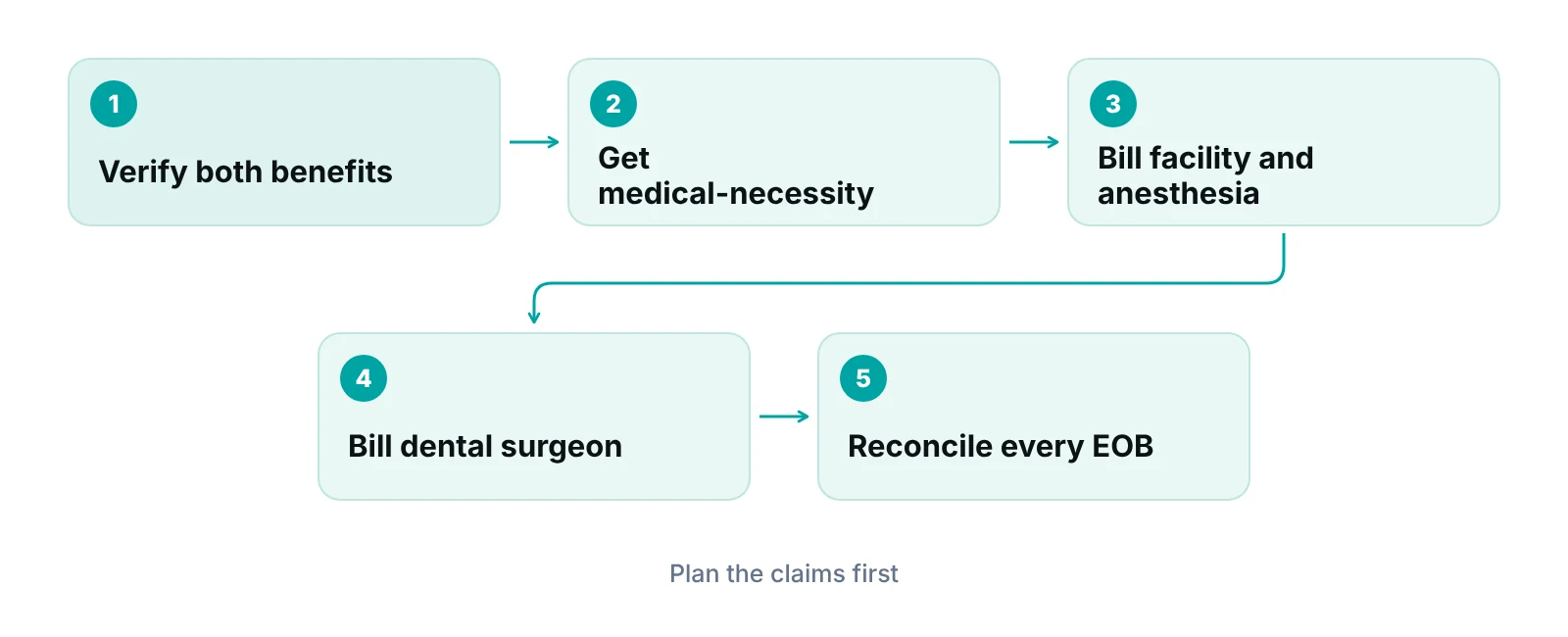
Most ASC dental cases produce three separate bills, not one: the dentist or oral surgeon’s professional fee, the ASC’s facility fee and the anesthesia provider’s fee. Each can go to a different plan, on a different claim form, under a different code set. That is why the billing plan has to exist before the surgery date is booked.
The earlier version of this post used the phrase “dental billing caps”. That is not a standard billing term. The limits that actually stop payment on these cases are annual maximums, frequency limits, waiting periods and each payer’s medical-necessity criteria, and this guide covers all four. If your center serves dental and oral surgery groups, our page on billing support for dental practices shows how we approach the dental side.
Where this guide fits
This post is about the claim mechanics of a dental case done in an ambulatory surgery center. For how ASC and hospital outpatient billing differ in general, see our guides on ASC versus hospital billing services and ASC versus HOPD billing.
Who bills what on an ASC dental case?
Three parties bill, and each follows a different rule. Dental services are reported with CDT codes on a dental claim. Facility and anesthesia services usually go to the medical plan with CPT or HCPCS codes, when the plan’s criteria are met. The table shows the typical split, with one payer’s published policy as the example.
| Claim part | Who bills it | Code set and claim | Usual payer path |
|---|---|---|---|
| Dental treatment | Dentist or oral surgeon | CDT codes on a dental claim (837D or ADA claim form) | Dental plan, unless a medical-benefit policy applies |
| Facility fee | The ASC | HCPCS or CPT facility code on a professional claim; one example is G0330, facility services for dental rehabilitation needing monitored anesthesia and an operating room | Medical plan, when its criteria are met |
| Anesthesia | Anesthesia professional | CPT anesthesia code such as 00170 (intraoral procedures), or a CDT sedation code such as D9223, depending on the plan | Medical plan when criteria are met; dental plan for some sedation |
| Unlisted dental procedure on a medical claim | Surgeon, when the plan treats it as a medical service | CPT 41899 (unlisted dentoalveolar procedure) with a narrative and chart notes | Medical plan, for covered medical services only |
Sources: 45 CFR 162.1002; CMS Medicare Claims Processing Manual ch. 14; CMS Medicare dental coverage page; Premera Administrative Guideline 10.01.503 (effective Feb. 1, 2026). Payer policies differ.
For Original Medicare, the ASC bills its contractor on the 837 professional claim format with place of service 24, and the procedure must be on the ASC covered procedures list (CMS Claims Processing Manual, chapter 14). The SG modifier is no longer required on Medicare ASC facility claims. Commercial payers set their own rules, so always check the payer’s policy for the specific case.
CDT, CPT or HCPCS: which code set goes on which claim?
Dental plans expect CDT codes; medical plans expect CPT and HCPCS codes. The federal code-set rule names the ADA’s dental code set for dental services and a combination of HCPCS and CPT-4 for physician services and other health care services (45 CFR 162.1002). Many billing mistakes on these cases come from putting the right code on the wrong kind of claim.
Payers also differ on what they accept. Some health plans allow CDT codes on a medical claim, while others require CPT codes, and not every CDT code has a direct CPT equivalent (eAssist). Treat any published crosswalk as a starting point, not a rule. Our guide to HCPCS versus CPT explains how the two code sets relate.
Unlisted codes need a narrative
CPT 41899 is the unlisted dentoalveolar procedure code, and one commercial policy asks for a narrative, chart notes, a treatment plan and a diagnosis with it (Premera). A Medicare Advantage policy goes further: it says not to use 41899 to bill hospital and anesthesia services generically, that each provider bills separately for its own services, and that unlisted codes for non-covered services will be denied (Providence Health Plan). An unlisted code without documentation is a denial waiting to happen.
Code sets change every January
CDT changes take effect each January 1. The ADA’s 2026 update had 60 changes, including 31 new codes, 14 revisions, six deletions and nine editorial changes, along with a “sweeping overhaul of anesthesia codes” (ADA News, 2025). One payer’s summary of the 2026 changes lists new general anesthesia codes with an advanced airway, D9224 and D9225 (UnitedHealthcare Dental). Anesthesia is exactly the area an ASC dental case touches, so check every code against the current CDT code book, not an old blog list.
Do not rely on a code list from a blog post
CDT descriptors belong to the ADA, and the codes change yearly. We removed the periodontal code table from the earlier version of this post because we could not confirm its descriptors against the current code book. Use your CDT book or encoder, and your payer’s fee schedule, as the source of truth.
When does the medical plan pay for an ASC dental case?
A medical plan pays only when its own criteria are met, and it usually covers the facility and anesthesia rather than the dental treatment itself. One published example shows the pattern. It treats outpatient facility care with general anesthesia as medically necessary when a physician decides the member’s medical condition would make treatment in a dental office unsafe, or when the severity and extent of the dental condition prevent office treatment (Premera, effective February 2026).
- General anesthesia and monitoring can also qualify for a member with a physical or mental disability who cannot be managed with local anesthesia or sedation, or for a child for whom other management methods failed or are contraindicated.
- General anesthesia must be given by a licensed anesthesia professional other than the dentist or physician doing the treatment.
- The policy does not pay professional fees for dental care under the medical benefit unless the member’s contract says so.
- It recommends a pre-service review request before treatment begins.
This is one payer. Others set different age limits, diagnoses and authorization steps, so the policy for the specific plan always governs. Our prior authorization guide covers how to organize that step.
What Original Medicare does and does not pay
Original Medicare excludes most dental care, with narrow exceptions. The table summarizes the rules we verified. They apply to Original Medicare, not to Medicare Advantage plans, which may offer supplemental dental benefits.
| Topic | Rule | Source |
|---|---|---|
| General exclusion | Care, treatment, filling, removal or replacement of teeth, or structures directly supporting the teeth, is excluded | 42 CFR 411.15(i)(1) |
| Inpatient exception | Inpatient hospital services for dental procedures are covered when the patient’s medical condition or the severity of the procedure requires hospitalization | 42 CFR 411.15(i)(2) |
| Linked services | Dental services inextricably linked to a covered medical service can be covered. CMS gives examples such as exams and infection treatment before organ transplant or cardiac valve procedures | CMS Medicare dental coverage page |
| Ancillary services | Ancillary services and supplies furnished with covered dental services, such as anesthesia and x-rays, are not excluded | 42 CFR 411.15(i)(3); Benefit Policy Manual |
| Claim requirements | From July 1, 2025, dental claims for linked services must carry the KX modifier and an ICD-10 code on the 837D or ADA form; care coordination must be documented in the medical record | CMS Medicare dental coverage page |
| Not covered | Extraction of an impacted tooth, and dental services related to other non-covered services | CMS Medicare dental coverage page |
Sources: 42 CFR 411.15 (eCFR text via Cornell LII); CMS Medicare dental coverage page; CMS Medicare Benefit Policy Manual, Transmittal 13029 (Dec. 31, 2024).
Confirm Medicare ASC cases with your MAC
The sources we checked set out the Medicare dental rules above, but not a separate ASC-specific dental rule. For any Medicare case, confirm coverage, the covered-procedures list and the required modifiers with your Medicare Administrative Contractor before the date is booked.
Need prior authorization handled before the surgery date?
Dental cases that depend on medical-necessity review need the paperwork finished first. See how our team handles prior authorization requests for practices and surgery centers.
What limits actually apply: annual maximums, frequency limits and waiting periods
The dental side of the case is governed by plan limits, not “billing caps”. The four that cause most surprises are annual maximums, frequency limits, waiting periods and the plan’s fee schedule. The table shows what each means for the claim.
| Limit | What it means | What it does to the claim | What to check |
|---|---|---|---|
| Annual maximum | A yearly cap on what the dental plan pays; one trade article cites examples of $500, $750 and $1,000, and possibly more | A large surgical case can use up the remaining balance, leaving the patient responsible | The remaining balance, before the date is booked |
| Frequency limit | Caps how often a procedure is covered; once met, the insurer no longer covers the treatment | Claim is denied and the patient pays the fee | Prior service dates, and whether the period is a calendar year or any 12 months |
| Waiting period | A delay before a benefit class, such as major services, becomes payable | Patient may owe the full fee instead of the usual share | Plan start date and the waiting period for the service class |
| Fee schedule or allowed amount | Plans pay a percentage of an allowable fee or pay per a fee schedule | The difference between the billed fee and the allowed amount is an adjustment | The contract and network status |
| Medical-necessity criteria | Conditions a medical plan sets for facility and anesthesia payment | Denial when documentation does not meet the policy | The payer’s policy and pre-service review |
Sources: Dental Products Report; dentalbilling.com (eAssist); KYT Dental Services; Premera Administrative Guideline 10.01.503. Limits vary by plan.
Frequency limits are the easiest to miss. Typical preventive limits are two cleanings a year, and plans differ on whether a year means a calendar year or any 12 months (Dental Products Report). Some limits run for years: one dental office lists crowns and dentures at every 5 to 7 years (KYT Dental Services). Perio maintenance can only be billed after scaling and root planing or osseous surgery, and many plans require an 8 to 12 week gap before it (eAssist).
If a service exceeds the limit, the treatment still happens, but the insurer denies the claim and the patient pays the full fee. Exceptions may be possible with pre-authorization and documentation (KYT Dental Services). That is why benefits are checked before surgery, not after.
“A denial on a surgery-center dental case is rarely a coding problem. It is usually a benefits question nobody asked before the date was booked.”
— Awais Afzal, Healthcare Operations & Data Analyst
When the patient has two plans
For medically necessary dental treatment, the claim generally goes to the patient’s medical insurance first. After the medical plan processes it, the practice can send the claim to the dental plan with a copy of the medical EOB (eAssist). Our guide to coordination of benefits in medical billing explains how to sequence two payers.
A pre-case checklist before you book the surgery date
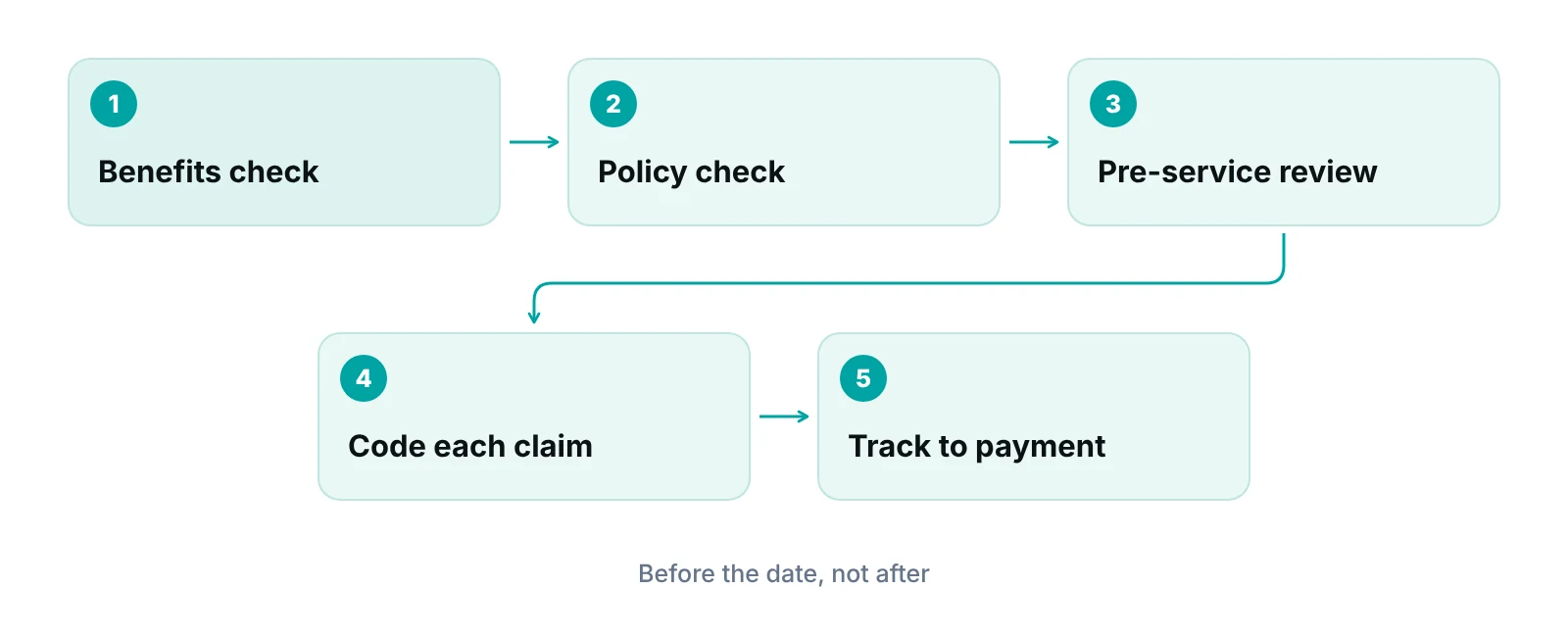
The cheapest time to fix a dental surgery claim is before the case. This checklist is the order we work in when a surgery center, a dental group or a billing team asks us to review a case.
- Confirm the patient’s medical and dental coverage in writing, including the dental annual maximum remaining and any waiting period.
- Read the medical plan’s policy on facility and anesthesia services for dental treatment, including age, diagnosis and provider rules.
- Request pre-service review or prior authorization where the plan recommends it, with a clinical narrative, chart notes and a treatment plan.
- Decide which codes go on which claim: CDT on the dental claim, CPT or HCPCS on the facility and anesthesia claims, and a payer-specific crosswalk for anything else.
- Check prior service dates against frequency limits for each CDT code.
- Submit the facility, anesthesia and dental claims in the right sequence, and keep the medical EOB for the dental plan.
- Track all three claims to payment together, so an underpayment on one is not hidden by a payment on another.
If you want to see how much revenue sits in cases like these, our revenue calculator gives a first estimate. Our medical billing services cover charge entry, claim submission and follow-up, and our team works inside your existing EHR (for example PrognoCIS, eClinicalWorks or athenahealth).
Want a second set of eyes on your ASC dental claims?
Our free practice audit reviews a sample of your claims, denials and payer rules, and shows where dental surgery cases are slipping through. Pricing is quoted only after the audit.
Our recommendations
- Plan three claims before the date is booked. We write down the dental, facility and anesthesia claims for each case, with the payer, code set and form for each, before scheduling. It stops a facility fee from being sent to a dental plan by mistake.
- Verify both benefits in writing. We check the medical benefit and the dental benefit separately, and we record the annual maximum remaining, waiting periods and frequency history. A verbal answer from a payer line is not enough for a surgical case.
- Ask for the payer's medical policy first. We read the specific policy for dental anesthesia and facility services before anything else, and we ask for pre-service review when the policy recommends it. The criteria vary by payer, so we do not reuse another payer’s rules.
- Keep a payer-by-payer crosswalk and review it each January. We keep a short crosswalk of which payers accept CDT on a medical claim and which require CPT, and we recheck it when the new CDT code set takes effect.
- Send documentation with unlisted codes. When an unlisted code is the only option, we attach a clear narrative, chart notes, the treatment plan and the diagnosis, as the policies we reviewed ask.
- Reconcile all remittances together. We match the facility, anesthesia and dental remittances for each case, so an underpayment or denial on one claim is visible against the rest.
Bottom line
ASC dental surgery billing works when the dental, facility and anesthesia claims are planned separately, coded for the right payer and backed by a benefits check and the medical plan’s own policy. Start with the limits, then the policy, then the codes. For help setting this up, see our medical billing services and prior authorization services, or contact us to talk it through.
Frequently asked questions
What is ASC dental surgery billing?
It is the process of billing a dental surgical case done in an ambulatory surgery center. Usually that means separate claims for the dentist’s treatment (CDT codes, dental plan), the facility fee and anesthesia (CPT or HCPCS codes, medical plan when criteria are met). Each payer sets its own rules.
Are "dental billing caps" a real thing?
Not as a standard term. The limits that matter are annual maximums, frequency limits, waiting periods, fee schedules and a medical plan’s medical-necessity criteria. Each plan sets its own, so check the specific plan and policy for the patient before the case.
Does medical insurance cover dental surgery at an ASC?
Sometimes, and usually only the facility and anesthesia. One published commercial policy covers outpatient facility care with general anesthesia when a medical condition or the severity of the dental condition prevents office treatment, but not professional dental fees unless the contract says so. Policies differ by payer.
Should an ASC bill CDT or CPT codes for a dental case?
Dental claims use CDT codes. Facility and anesthesia claims to a medical plan use CPT and HCPCS codes. Some health plans accept CDT on a medical claim and others require CPT, so check the payer’s policy rather than assuming a crosswalk applies.
Does Original Medicare pay for dental surgery at an ASC?
Original Medicare excludes most dental care. Exceptions include inpatient hospital services when hospitalization is required, and dental services inextricably linked to a covered medical service. We found no separate ASC dental rule in the sources checked, so confirm with your Medicare Administrative Contractor.
How often do CDT codes change?
Every year, with changes effective January 1. The ADA’s 2026 update included 60 changes, among them 31 new codes and a large overhaul of the anesthesia codes. Review your dental and anesthesia codes each January against the current CDT code book.
Get your free practice audit
Tell us about your practice. We will contact you using the details you give.
- A review of your recent claims, denials and A/R aging
- Where your front desk and prior authorizations slow payment
- A prioritized fix list you keep, whether or not you hire us
Pricing is quoted after the audit, based on your volume and the services you choose. Prefer to talk? Call +1 (302) 556-2288.
Sources
- 45 CFR 162.1002 Medical data code sets — Cornell LII (eCFR text) (current)
- Medicare Claims Processing Manual, Chapter 14 Ambulatory Surgical Centers — CMS (HHS guidance copy) (current copy)
- 42 CFR 411.15 Particular services excluded from coverage — Cornell LII (eCFR text) (current)
- Medicare Dental Coverage — CMS (current)
- Medicare Benefit Policy Manual (Transmittal 13029) Chapter 15 section 150 — CMS (HHS guidance copy) (2024)
- General Anesthesia and Facility Services Related to Dental Treatment, Administrative Guideline 10.01.503 — Premera (2026)
- Dental Anesthesia Services, Medicare Medical Policy 328 — Providence Health Plan (2026)
- 60 changes coming to CDT Code in 2026 — ADA News (2025)
- ADA CDT code changes 2026 — UnitedHealthcare Dental (2026)
- Medical-Dental Cross-Coding: CDT vs CPT vs ICD — eAssist Dental Billing (n/d)
- Introducing Dental Frequency Limits — eAssist Dental Billing (n/d)
- 7 ways to help patients understand their dental plan — Dental Products Report (n/d)
- Dental insurance: frequency limits — KYT Dental Services (n/d)
Disclaimer: This article is general educational information about billing operations. It is not legal, coding, billing-compliance, clinical or financial advice. Payer policies, benefit plans, CDT and CPT code sets and Medicare rules change and vary by plan. Confirm requirements with the payer, your Medicare Administrative Contractor, current code books and qualified advisors before acting.
