
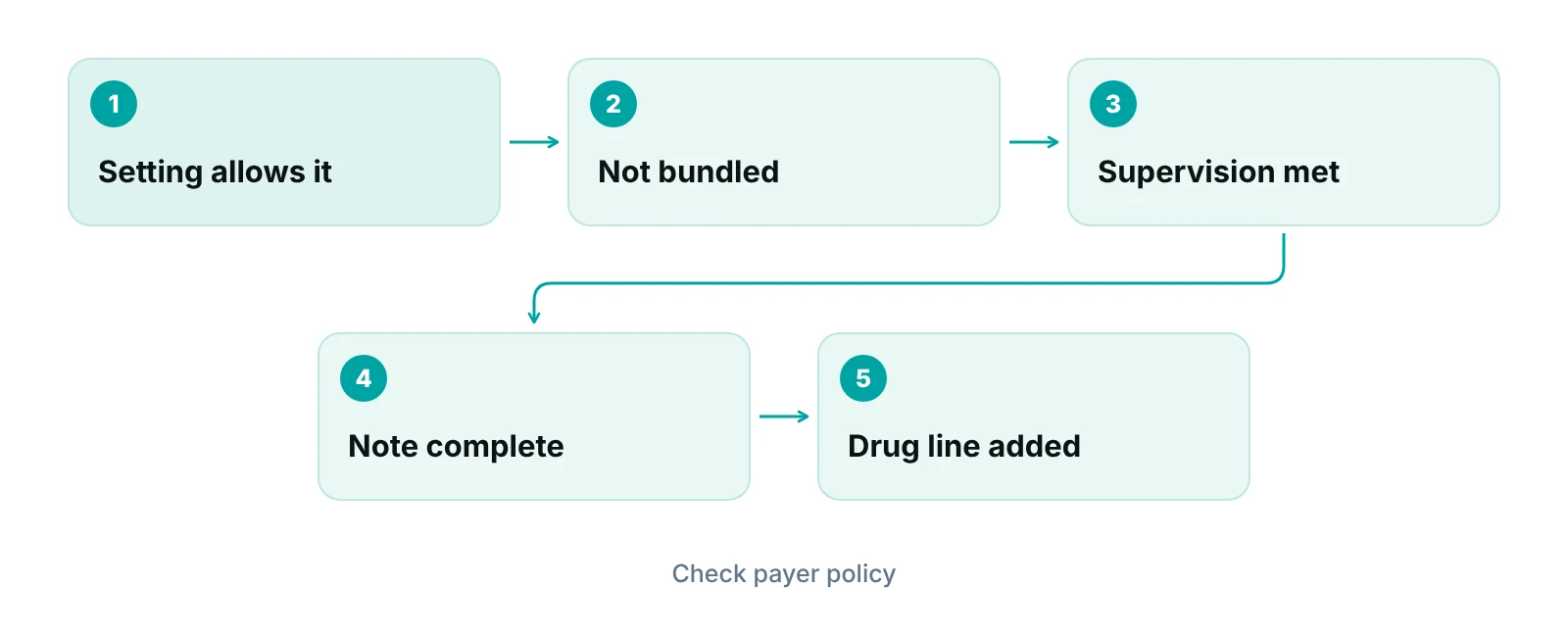
The 96372 CPT code reports the administration of one injection under the skin or into the muscle, and it is billable only when the setting allows drug administration codes and the injection is not part of another service. The drug goes on its own line, and the note must show drug, dose, route and site.
The code looks small on a fee schedule, yet it draws steady denials. The reasons are rarely the injection. They are the pairing with an E/M visit, a missing drug line, the wrong JW or JZ modifier, or a note that leaves out the site. The steps below follow the order a claim should be checked in.
Key takeaways
- Check the setting first: drug administration codes are for office services, not facility services, under the Medicare NCCI manual.
- An E/M on the same day needs modifier 25 and separate, documented work.
- The drug is billed on its own line, with JW or JZ for single-dose Part B drugs.
- The note needs indication, drug, dose, route, site, time and who gave it.
- Payer and state rules vary, so confirm supervision and bundling for each payer.
What does the 96372 CPT code cover?
It covers the work of giving one injection of a drug under the skin (subcutaneous) or into the muscle (intramuscular). The code pays for the administration. It does not pay for the drug itself, which goes on its own claim line. The AMA owns the official CPT wording, so check the exact descriptor in your current CPT book. In plain terms, a Texas workers’ compensation fee-dispute decision describes it as a therapeutic injection of a drug or substance under the skin or into the muscle (Texas Department of Insurance, 2024).
Two points shape every claim. First, the code belongs to the family of drug administration codes (96360 to 96379), and the Medicare NCCI manual treats that whole family as reportable in a physician’s office but not in a facility setting (CMS NCCI Policy Manual, Chapter 11, 2026). Second, the injection is often given on a visit where something else is happening: an E/M visit, a procedure, or an infusion. Most denials come from that pairing, not from the injection itself.
Typical office examples are an antibiotic given in the muscle, a subcutaneous medication given on a schedule, or a pain or rehabilitation visit where the clinic gives a medication by injection. For pain practices that bill injections often, our pain management billing page shows how the rest of the claim fits around them.
What 96372 is not
It is not a payment for the drug, and it is not a way to bill a procedure that already includes the injection. If the injection is part of something else, the drug administration code usually has nothing to add.
When is 96372 billable, and when is it not?
It is billable when a covered injection is given in a setting where the payer allows drug administration codes, and the injection is not already part of another service on the claim. Three tests decide most cases: the setting, the bundling and who gave it.
Test 1: the setting
The Medicare NCCI manual says the drug administration codes in the 96360 to 96379 range are reportable for services in physicians’ offices and are not reported by providers or suppliers for services in a facility setting. A hospital outpatient facility may report drug administration separately when appropriate (CMS, 2026). A private payer policy repeats the same split (Johns Hopkins Health Plans policy RPC.027, 2023). Check the place of service on the claim before anything else.
Test 2: the injection is not integral to something else
The NCCI manual says drug administration services are not reported for anesthesia provided by the physician who performs a medical or surgical service, and that under the Medicare global surgery rules they are not separately reportable by the physician performing the related procedure. Post-operative pain management is not separately payable to the operating physician, with a narrow exception for services unrelated to the procedure (CMS, 2026).
The same logic appeared in the Texas decision cited above. The reviewer found the injection was integral to the E/M visit that was billed and awarded $0 on that claim (Texas Department of Insurance, 2024). That was one workers’ compensation dispute, not a Medicare rule, but it shows how a reviewer reads a thin note.
Test 3: who gave it and under what supervision
Medicare pays for services furnished by a physician, a practitioner with incident-to benefits, or auxiliary personnel. For incident-to billing the general rule is direct supervision, the services must be furnished in a noninstitutional setting, and only the supervising practitioner bills (42 CFR 410.26). First Coast explains that the supervising practitioner historically had to be in the office suite and immediately available, and that under the CY2026 Physician Fee Schedule final rule CMS permanently allows that immediate availability through real-time audio and video, but not audio-only, with an exclusion for services with a 010 or 090 global surgery indicator (First Coast Service Options, page dated March 2026). Commercial payers and states may set their own rules, so the old shortcut of assuming a nurse injection is always billable under any physician is unsafe. Our guide to Medicare incident-to billing goes deeper on that rule.
How does 96372 work with an E/M visit or other injections on the same day?
Pairing is where claims fail. An E/M visit can be reported on the same day only when it is a significant, separately identifiable service, and the other administration codes follow a set order. The table summarizes the sourced rules.
| Situation | What the sources say | What to do |
|---|---|---|
| E/M visit and an injection | A non-facility E/M code other than 99211 is separately reportable with modifier 25 if the physician provides a significant, separately identifiable service. 99211 is not reportable with drug administration. | Report the E/M with modifier 25 only when the note shows work beyond the injection. |
| Visit is only the injection | The E/M carries no separate work to bill. A Texas reviewer called the injection integral to the E/M in one dispute. | Bill the administration and the drug. Do not add an E/M for the check-in. |
| Injection with an infusion or IV push | One ‘initial’ service code per encounter unless separate IV access sites. A payer policy sequences infusions, then injections and IV pushes, then hydration. | Pick the initial code by the sequence rules. Do not assume 96372 can be the initial code. |
| Hydration with other drug administration | Hydration concurrent with other drug administration is not separately reportable. | Leave hydration off unless the manual’s exceptions apply. |
| Injection with a surgical or anesthesia service | Not separately reportable by the physician performing the related service under global surgery rules. | Treat it as part of the procedure. |
| Facility setting | Drug administration codes are not reported by providers or suppliers for facility services. | Check the place of service and the facility’s own billing. |
Source: CMS NCCI Policy Manual, Chapter 11 (2026); Johns Hopkins Health Plans policy RPC.027 (2023); Texas Department of Insurance MFDR decision (2024).
The NCCI manual’s list of ‘initial’ codes does not include 96372. That is why the injection usually follows the infusion or push on a mixed visit rather than leading it. The manual excerpt we reviewed does not address every pairing, so the NCCI edit table and your payer’s policy have the final word. For the E/M side of the claim, see our 99213 CPT code guide and our explainer on modifier 25 versus modifier 59.
When the claim does need a procedural modifier, the NCCI manual describes a PTP-associated modifier for a service that is unrelated to the procedure and performed in a non-facility site. See modifier 59 essentials before you append one. Do not use a modifier to force a line through. It must reflect what the note shows.
How do the drug line, JW and JZ work with 96372?
The drug is billed on its own line with its own billing code, and for separately payable Part B single-dose drugs the line also carries JW or JZ. The 96372 line pays for the act of giving the shot. The drug line pays for the drug.
CMS says providers and suppliers that buy and bill separately payable Part B drugs must use the modifiers, including physician offices. JW has been required since January 1, 2017 when part of a single-dose container is discarded. JZ became available on January 1, 2023 and was required no later than July 1, 2023 when nothing is discarded. Claims without the right modifier may be returned as unprocessable starting October 1, 2023 (CMS JW Modifier FAQs; CMS Transmittal R12067CP).
| Case | Claim lines | Notes |
|---|---|---|
| Part of a single-dose vial is discarded | Line 1: administered units, no modifier. Line 2: same drug code, JW, discarded units. | JW is not used for overfill. |
| Nothing discarded | One line: drug code, JZ, administered units. | Applies to single-dose or single-use drugs. |
| Dose is less than the billing unit | Bill the full unit with JZ. | JW is not used when one billing unit covers the dose plus the discard. |
| Multiple-dose container | Neither modifier applies. | Based on FDA-approved labeling. |
| Mass-immunizer vaccines | Excluded from the policy. | Section 1861(s)(10) of the Act. |
Source: CMS JW Modifier FAQs and Transmittal R12067CP (effective January 1, 2023).
A payer policy adds one more point: routine supplies are not separately reimbursed when reported with injection and infusion services (Johns Hopkins Health Plans, 2023). Commercial payers may handle JW and JZ differently from Medicare, so confirm each contract. Rural health clinics and FQHCs are outside the JW and JZ policy.
What should the note say to support a 96372 claim?
The note should let a reviewer see why the injection was given, what was given, how, where and when, and who gave it. The Texas decision lists the elements it expected: indication and medical necessity, drug, dosage and route, injection site, date and time, and the provider’s signature. It found the record lacked the site, route and indication (Texas Department of Insurance, 2024). A payer policy says plainly that documentation must support the codes billed (Johns Hopkins Health Plans, 2023).
- Diagnosis or reason that supports the drug.
- Drug name, dose, route (subcutaneous or intramuscular) and, for single-dose drugs, units given and units discarded.
- Injection site, date, time and the name and credentials of whoever gave it.
- The supervising practitioner, where incident-to rules apply.
- Whether a separate E/M was done, with its own work written out.
“An injection line is only as strong as the note behind it. Drug, dose, route, site and time should be readable without opening the chart again.”
Do not copy the note forward
A repeated note across several visits invites a medical necessity review. Each injection needs its own date, dose and site.
Why do 96372 claims get denied, and how do you fix them?
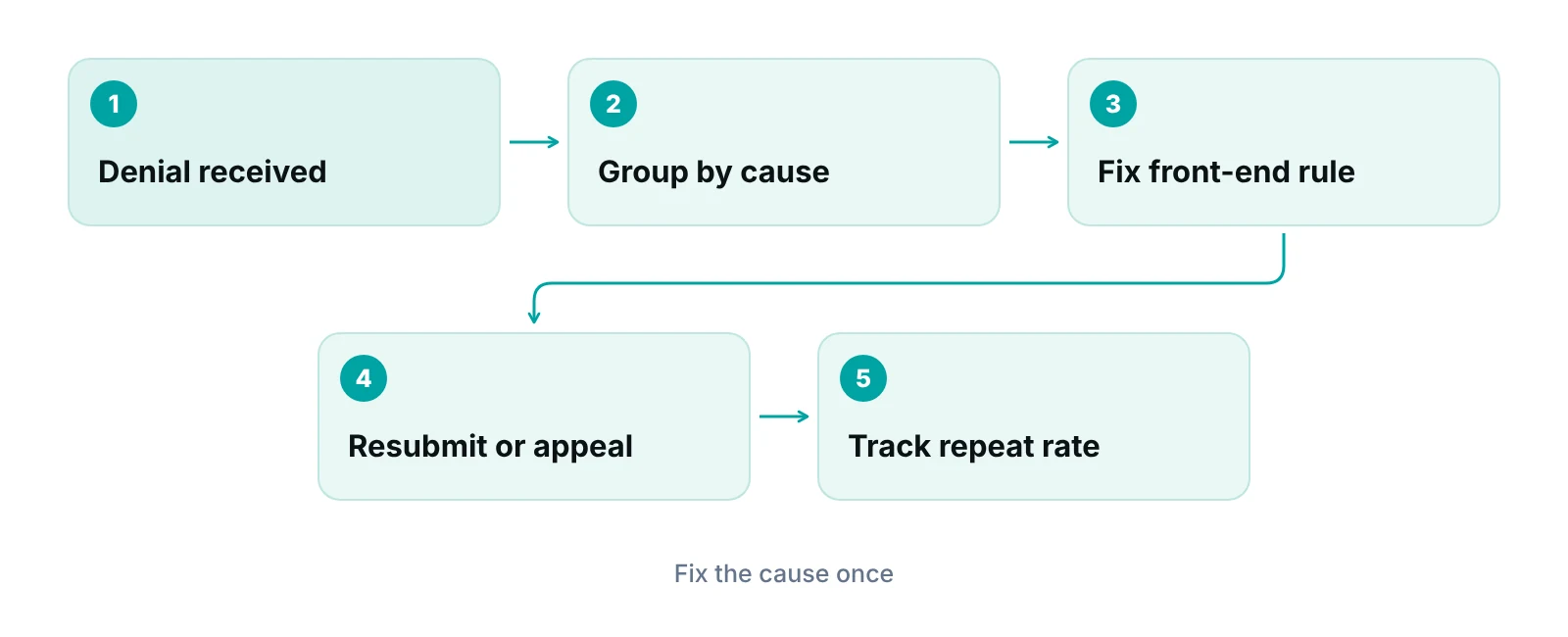
Most denials trace back to setting, bundling, a missing drug or modifier, or a thin note. Fixing them is mostly a front-end checklist, not a long appeal.
| Cause | What it looks like | First check |
|---|---|---|
| Wrong setting | Facility place of service on a drug administration line | Confirm the place of service matches the payer’s rule |
| Bundled or integral | Injection billed with a procedure or as part of an E/M | Read the NCCI edit and the payer policy for the pair |
| E/M with modifier 25 not supported | Check-in note with no separate work | Show the separate work in the E/M note or drop the E/M |
| Missing or wrong JW/JZ | Drug line returned or flagged | Match the modifier to the vial and the units on the claim |
| Missing drug line | Administration with no drug code | Add the drug billing code and units |
| Supervision not met | Incident-to rules unmet or not documented | Record the supervising practitioner and check the payer’s rule |
| Thin documentation | No site, route or indication | Use a standard injection note template |
Source: CMS NCCI Policy Manual, Chapter 11 (2026); CMS JW Modifier FAQs; 42 CFR 410.26; Texas Department of Insurance MFDR decision (2024).
Track denials by cause for a month. If bundling or modifier problems dominate, the fix is a front-end rule, such as a claim check before submission. Our clean claims guide covers that discipline, and the home infusion and IVIG coding essentials post covers the infusion side of drug administration. When a pattern continues, outside denial management support can work the backlog.
What is a 96372 line worth, and how should a practice plan around it?
The administration payment is small. It differs by payer, locality and setting, so use the current figure from the CMS Physician Fee Schedule look-up tool and your own contracts instead of a rule of thumb. The old figures in circulation for this code are not safe to reuse without checking them against the current year.
What matters more is volume and leakage. A practice that gives many injections can lose revenue by missing drug lines, missing the JZ or JW modifier, or letting small claims age without a follow-up. The same principle applies to small balances: they are cheap to fix on day one and costly to chase later. Use the revenue calculator to see what a few percent of leakage on injection claims means for your practice, then decide whether to fix the process in-house or hand it off to medical billing services.
Want to see what injection denials cost you?
Put your own volumes and denial rate into the revenue calculator before you decide where to fix the process.
Our recommendations
- Build a one-page injection checklist. We recommend one page covering setting, bundling, supervision, drug line and note fields, kept at the front desk and in the billing queue.
- Use a standard injection note. Make drug, dose, route, site, time, indication and discarded units required fields in the template.
- Match the vial to the modifier. Train billing staff to read the vial type and units given before choosing JW or JZ.
- Decide your E/M rule in advance. Write down when a visit supports an E/M with modifier 25 and when it is only an injection visit.
- Confirm supervision rules by payer. List which payers accept incident-to injections and under what supervision, and review it yearly.
- Review denials by cause every month. Group by cause, fix the top one at the front end, then measure the repeat rate.
Bottom line
The 96372 CPT code pays little per line, but errors multiply across volume. Check the setting, the bundling and the supervision, add the drug line with the right modifier, and write a complete note. If injection claims keep coming back, our denial management services team can review a sample, and you can talk to our team about it.
Frequently asked questions
What is the 96372 CPT code used for?
It reports the administration of one injection of a drug under the skin or into the muscle. It pays for giving the injection, not for the drug. The drug goes on a separate line with its own billing code. Check the exact descriptor in your current CPT book, because the AMA owns the wording.
Can I bill 96372 with an E/M visit?
Sometimes. The NCCI manual says a non-facility E/M code other than 99211 is separately reportable with modifier 25 when the physician provides a significant, separately identifiable service. If the visit was only for the injection, there is usually no E/M to add. The note must show the extra work.
Do I need JW or JZ with 96372?
The modifiers go on the drug line, not the 96372 line. For separately payable single-dose Part B drugs, JW marks discarded units and JZ confirms none were discarded. CMS made JZ required no later than July 1, 2023. Commercial payers may differ, so check each contract.
Can a nurse give the injection and the practice still bill 96372?
Under Medicare incident-to rules, auxiliary personnel can furnish the service under direct supervision, and the supervising practitioner bills. Payer and state rules vary, and the setting must be non-institutional. Confirm the supervision rule for each payer before you rely on this.
Can 96372 be billed in a hospital or facility?
The NCCI manual says the drug administration codes are not reported by providers or suppliers for facility services. A hospital outpatient facility may report drug administration when appropriate under its own billing rules. Check the place of service on the claim first.
How much does Medicare pay for 96372?
The amount varies by locality, year and setting. Use the CMS Physician Fee Schedule look-up tool for the current year and compare it with your payer contracts. We do not quote a figure here because an old number is not safe for budgeting.
Get your free practice audit
Tell us about your practice. We will contact you using the details you give.
- A review of your recent claims, denials and A/R aging
- Where your front desk and prior authorizations slow payment
- A prioritized fix list you keep, whether or not you hire us
Pricing is quoted after the audit, based on your volume and the services you choose. Prefer to talk? Call +1 (302) 556-2288.
Sources
- Medicare NCCI Policy Manual, Chapter 11 (Medicine) — CMS (2026)
- JW Modifier FAQs — CMS
- Transmittal R12067CP (JW/JZ) — CMS (2022)
- 42 CFR 410.26 Incident-to services and supplies — eCFR / GovInfo (2024)
- Incident-to guidelines — First Coast Service Options (2026)
- Injection and Infusions, Professional (RPC.027) — Johns Hopkins Health Plans (2023)
- MFDR Findings and Decision M4-24-2469-01 — Texas Department of Insurance, Division of Workers' Compensation (2024)
Disclaimer: This article is educational. It is not legal, coding or compliance advice. CPT is owned by the AMA, and payer and state rules vary, so confirm each rule in your current code book and payer policy before billing.
