
The 8-minute rule is how Medicare turns the total minutes of timed therapy codes on one date of service into billable units: 8 minutes earns one unit, 23 earns two, 38 earns three, and each further unit needs 15 more minutes. Medicare Part B follows it. Other payers may count each code separately, so check the contract.
Most unit errors come from two habits: giving every unit to one code, and mixing up Medicare’s total-minutes method with the per-code method some other payers use. This guide gives you the CMS chart, five worked examples, the assistant (CQ/CO) rule and the Medicare-versus-midpoint comparison. It is written for billers, front-office leads and owners of physical and occupational therapy practices. Every Medicare rule below links to the CMS source, and we last checked those sources on October 14, 2026.
Key takeaways
- Medicare adds the minutes of all timed codes for the day, then reads the unit chart: 8 to 22 minutes is 1 unit, 23 to 37 is 2, 38 to 52 is 3, and so on in 15-minute steps.
- Each code gets a unit for every full 15 minutes. Leftover units go to the code with the most leftover minutes.
- A service of less than 8 minutes cannot be billed on its own when it is the only service that day.
- CQ or CO applies when a PTA or OTA provides more than 10 percent of a service, not ‘at least’ 10 percent. Apply the 8-minute rule first.
- The AMA midpoint rule some payers use works code by code, so the same session can produce a different unit count. Check each payer’s policy and contract.
What the 8-minute rule is and where it comes from
The 8-minute rule is Medicare’s method for counting units of timed therapy codes. You add the minutes of every timed service a patient received on one date, find that total in a chart, and bill that many units. The method is set out in Section 20.2 of the Medicare Claims Processing Manual, Chapter 5, under counting minutes for timed codes in 15-minute units.
The point of the rule is fairness in both directions. A therapist who spends 20 minutes on one code and 20 on another has provided 40 minutes of care, and the chart pays for three units, not two. A therapist who gives three services of 7 minutes each has provided 21 minutes and can bill one unit. The chart sets the ceiling for the whole visit, and the manual then tells you which codes receive the units.
It applies to timed codes, which are defined in 15-minute units. A code defined as untimed is reported as one unit. If your clinic treats speech-language patients as well, our speech-language pathology billing guide covers which speech codes are untimed.
The Medicare minutes-to-units chart
Total your timed minutes, then read the units from this chart. The manual says the total minutes, not the number of services, decide how many timed units you can bill.
| Total timed minutes | Units you can bill |
|---|---|
| 8 to 22 | 1 |
| 23 to 37 | 2 |
| 38 to 52 | 3 |
| 53 to 67 | 4 |
| 68 to 82 | 5 |
| 83 to 97 | 6 |
| 98 to 112 | 7 |
| 113 to 127 | 8 |
Source: CMS, Medicare Claims Processing Manual, Chapter 5, Section 20.2 C. The manual says the pattern continues for treatment longer than 2 hours.
Two limits in the manual are worth memorizing. When only one service is provided in a day, do not bill for less than 8 minutes of it. And you may not bill 4 units for less than 53 minutes, however many services were performed.
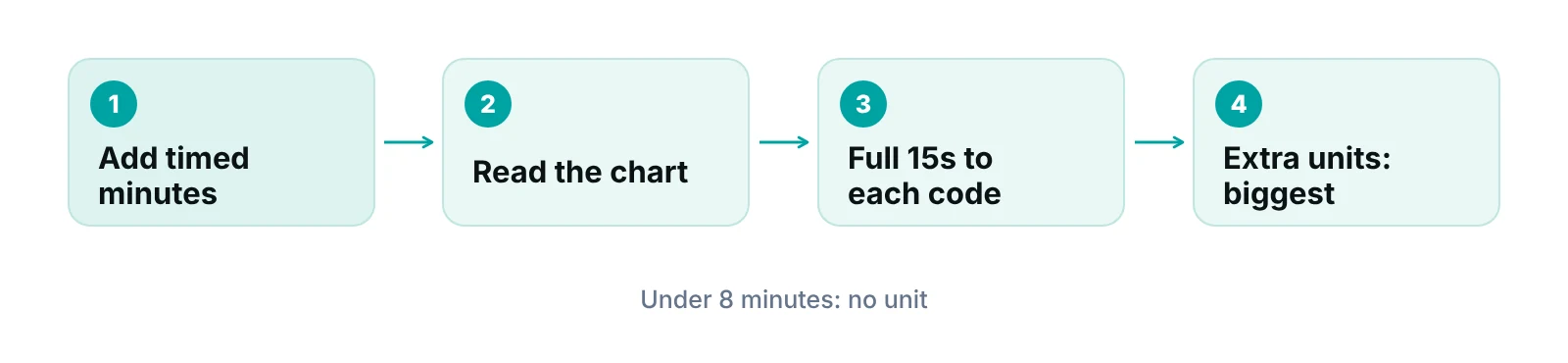
How to calculate units, step by step
Work the total first and the code split second. That order stops most mistakes.
- Add the minutes of every timed code on the date of service. Leave out untimed codes.
- Find the total in the chart above. That gives the maximum number of timed units for the day.
- Give each code one unit for every full 15 minutes it took.
- If units remain, give them to the code with the most leftover minutes. If leftover times are tied, either code may take the unit.
- If every service ran 7 minutes or less but together they total 8 or more, bill one unit for the service with the most minutes.
Five worked examples
The first three examples follow the CMS manual’s own approach. The last two show the remainder step that trips up most teams.
Example 1: 33 minutes of 97110 and 7 minutes of 97140
The total is 40 minutes, so the chart allows 3 units. The first 30 minutes of 97110 earn 2 units. The 3 minutes of 97110 left over are less than the 7 minutes of 97140, so 97140 receives the third unit. Bill 2 units of 97110 and 1 unit of 97140. This is one of the examples in the manual.
Example 2: 7 minutes each of three timed codes
The total is 21 minutes, which is 1 unit. Every service ran the same time, so you pick one of the three codes for that single unit. You cannot bill one unit for each. This is also from the manual.
Example 3: 20 minutes of each of two codes
The total is 40 minutes, so 3 units. The times are equal, so one code gets 2 units and the other gets 1. You may not bill 3 units of either code. The manual uses this case as well.
Example 4: 15 minutes of 97110, 8 minutes of 97530 and 5 minutes of 97140
The total is 28 minutes, which is 2 units. The 15 minutes of 97110 earn one full unit. That leaves 8 minutes of 97530 and 5 minutes of 97140, and one unit still to assign. It goes to 97530, the code with the most leftover minutes. Bill 1 unit of 97110 and 1 unit of 97530. The 5 minutes of 97140 are not billed separately. The second unit is allowed because the day’s total reaches 23 minutes, not because any one leftover reaches 15.
Example 5: 35 minutes of 97110 and 33 minutes of 97530
The total is 68 minutes, which is 5 units, the first total in the 5-unit row. Each code has 2 full 15-minute blocks, so 4 units are assigned. The fifth goes to 97110, which has 5 leftover minutes against 3 for 97530. Bill 3 units of 97110 and 2 units of 97530.
“If two people on your team get a different unit count from the same note, the note is usually missing minutes per code, not the chart.”
— Awais Afzal, Healthcare Operations & Data Analyst
Which codes count: timed and untimed
Only timed codes go into the minute total. Each of the codes below is described in 15-minute units in the sources we checked. Descriptions are our own plain-language summaries, not the AMA’s wording, so confirm in the current CPT book before you build a charge master.
| Code | What it reports | Timed? | Where we confirmed it |
|---|---|---|---|
| 97110 | Exercise to build strength, motion or endurance | Timed, 15-minute units | CMS manual examples |
| 97112 | Retraining movement, balance, coordination or posture | Timed, 15-minute units | CMS manual examples |
| 97116 | Walking (gait) training | Timed, 15-minute units | CMS manual examples |
| 97140 | Hands-on manual techniques | Timed, 15-minute units | CMS manual examples |
| 97530 | Functional, task-based therapeutic activities | Timed, 15-minute units | Arizona physical medicine guidelines |
| 97032 | Electrical stimulation with the clinician attending | Timed, 15-minute units | Arizona physical medicine guidelines |
| 97035 | Ultrasound | Timed, 15-minute units | CMS manual examples; Arizona guidelines |
| Any code defined as untimed | Service reported once per session | Report 1 unit | CMS manual, Section 20.2 B |
Source: CMS, Medicare Claims Processing Manual, Chapter 5 (2026 access); Arizona Industrial Commission, Physical Medicine Guidelines, 2021-2022 fee schedule. The Arizona document is a state workers’ compensation guide, so use it only as a cross-check.
This is a short list, not the full code set. For evaluation and re-evaluation codes, see our physical therapy evaluation and treatment CPT guide, and for the wider PT code family see the physical therapy CPT codes guide. Our physical therapy billing units guide shows how units flow into the claim form.
When a PTA or OTA helps: the CQ and CO modifiers
Use the CQ modifier for physical therapy services furnished in whole or in part by a physical therapist assistant, and CO for occupational therapy assistants. The modifier applies when the assistant’s minutes for a service exceed 10 percent of the total minutes for that service (CMS, billing examples). Exactly 10 percent does not trigger it. Our earlier version of this post said ‘at least 10 percent’. That was wrong.
Always apply the 8-minute rule first. CMS says the final unit is billed without CQ or CO when the therapist furnished 8 or more minutes of it. For example, if an assistant works 22 minutes and a therapist works 23 minutes on the same code (45 minutes, 3 units), only 1 unit carries CQ and 2 units do not. Services with the modifier are paid at 85 percent of the otherwise applicable amount, effective January 1, 2022, under section 1834(v) of the Social Security Act.
CMS 8-minute rule vs the AMA midpoint rule
Not every payer uses the Medicare chart. The CPT manual’s time convention is that the midpoint of an interval must be passed before a timed unit can be reported. For a 15-minute unit, that point is 7 minutes and 31 seconds, and it is applied to each service, not to the day’s total (APTA). Some payers follow this method, usually called the rule of 8s. Medicare requires the CMS method, and APTA notes that a payer’s own contract can override either standard.
| Question | CMS 8-minute rule (Medicare) | AMA midpoint rule (some payers) |
|---|---|---|
| How minutes are counted | Adds all timed minutes, then reads the chart | Looks at each code on its own |
| 10 minutes of 97110 and 10 minutes of 97116 | 20 minutes in total: 1 unit | 1 unit for each code: 2 units |
| 7 minutes each of three timed codes | 21 minutes in total: 1 unit | No code passes the midpoint: 0 units |
| Who must use it | Required for Medicare claims | Optional for non-Medicare plans, only if the contract supports it |
| What to check | Section 20.2 of the CMS manual | Payer policy and contract language |
Source: CMS Medicare Claims Processing Manual, Chapter 5; APTA, Coding for Timed Codes (2026); WebPT Help Center, 8-Minute Rule vs the Rule of 8s. The 0-unit row is our arithmetic from the midpoint convention.
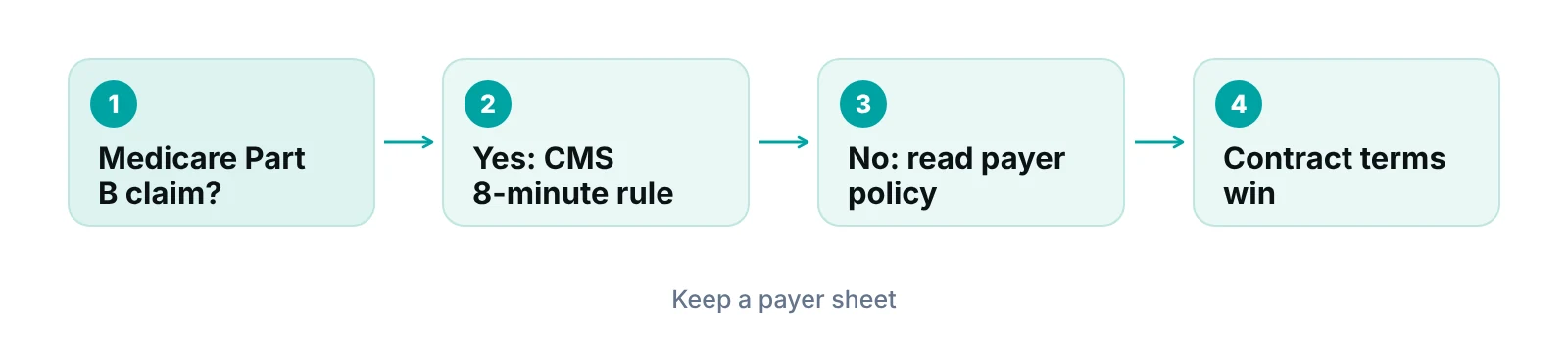
Do not assume other federal or state programs follow Medicare’s method just because they are public. We could not verify a blanket rule for Medicaid or other programs, so treat each as a payer to check. A written payer-by-payer sheet is the cheapest fix we know.
2026 rules that sit next to the 8-minute rule
These Medicare rules do not change the chart, but they affect what a unit is worth or how the claim is submitted.
- KX threshold: for 2026, CMS lists $2,480 for PT and SLP services combined and $2,480 for OT (CMS therapy services page; transmittal R13437CP). It is a calendar-year amount, so recheck it each January.
- Targeted medical review threshold: CMS lists $3,000 for PT and SLP combined and for OT. The page says that amount applies each year until 2028, when it will be indexed annually.
- Multiple procedure payment reduction: since April 1, 2013, Medicare pays the unit with the highest practice-expense value in full and 50 percent of the practice expense for later units and procedures on the same day. More units therefore add less than the first.
- Telehealth: CMS’s FAQ, updated October 8, 2026, says an extended range of practitioners, including PTs, OTs and SLPs, may bill Medicare telehealth services through December 31, 2027. Check the FAQ again before you rely on this date.
Check the number each January
CMS sets these amounts by calendar year. Use the figure on the CMS therapy services page for the year of the date of service.
Mistakes that cost units, and how to catch them
Each of these follows directly from the rules above.
- Giving all units to one code when time was split across codes.
- Counting minutes of an untimed service toward the timed total.
- Billing a single service that lasted under 8 minutes.
- Applying CQ or CO at exactly 10 percent instead of above it.
- Using the Medicare method for a payer whose contract uses the per-code midpoint, or the reverse.
When a claim comes back with a missing-information or inconsistent-data reason, our CO-16 denial code guide explains how to read it. Catching errors before submission is cheaper, which is the idea behind a claim scrubbing guide checklist. If you want a place to hold a claim for review, a practice management system that tracks claims by stage can assign an owner to each one.
See what a unit error is worth
Run your own claim volume through the calculator. It takes a few minutes and needs no account.
Our recommendations
- Record minutes per timed code, not just visit time. The remainder step needs minutes for each code. A total of 40 minutes cannot tell you whether 97140 or 97110 gets the last unit. Add a minutes field per service to your note template.
- Keep the chart and the three tie-break rules on the coder's desk. The chart is easy. The rules for equal times, for services under 8 minutes and for leftover minutes are what people forget.
- Write a payer sheet: Medicare method, midpoint method, or contract terms. List each payer you bill, which method its policy or contract uses, and where you found it. Update it when a contract renews.
- Spot-check a small sample of claims each month. Pull a few timed-code claims, recompute the units from the note, and compare. Look at the pattern by therapist, not just by clinic.
- Train assistants and coders on the 'more than 10 percent' wording. CQ and CO depend on the assistant’s share of a service. Show people the 8-minute step first, then the percentage test.
- Check the KX amount and telehealth date every January. Both are published by CMS and may change. Put them on a short annual checklist so nobody relies on an old blog figure.
Hold a therapy claim for a unit check before it goes out.
Our portal tracks each claim by stage with an assigned owner, and workflow rules can flag a claim for review or hold it at a stage. The unit math itself stays with your clinicians and coders.
See how the RCM Finder portal works · Create a portal account
Disclosure: RCM Finder builds and sells this portal. It is a practice management system, not an EHR.
Bottom line
The 8-minute rule is mechanical once you separate two steps: the chart sets the number of units for the day, and the manual’s tie-break rules decide which codes carry them. The real risk is assuming every payer counts that way. If you want a second reader on your therapy claims, see how our medical billing services and denial management services work, or ask for a free practice audit.
Frequently asked questions
What is the 8-minute rule in simple terms?
It is Medicare’s way of counting units for timed therapy codes. You add the minutes of all timed services for the day and read the units from the CMS chart. Eight minutes earns the first unit, and the next units start at 23, 38 and 53 minutes.
How many minutes do I need for two, three or four units?
Twenty-three minutes for two units, 38 for three and 53 for four, counted across all timed codes that day. The manual also says you may not bill four units for less than 53 minutes. The chart continues in 15-minute steps beyond that.
Can I bill a service that lasted only five minutes?
Not by itself. When only one service is provided in a day, the manual says not to bill for less than 8 minutes of it. If several services each run 7 minutes or less but together reach 8 or more, you can bill one unit for the one with the most minutes.
Does the 8-minute rule apply to commercial insurance?
Not necessarily. Medicare requires it. Some commercial plans use the AMA midpoint rule, which looks at each code on its own, and a payer’s contract can override either standard. Read each payer’s policy and keep a sheet that records which method it uses.
When do I add the CQ or CO modifier?
When a physical therapist assistant or occupational therapy assistant provides more than 10 percent of a service. Exactly 10 percent is not enough. Apply the 8-minute rule first: if the therapist furnished 8 or more minutes of the final unit, that unit is billed without the modifier.
Which code gets the extra unit when minutes are split?
The code with the most leftover minutes after full 15-minute blocks are assigned. If the leftover times are equal, the manual allows either code to take the unit. Never give a code more units than the total-minutes chart allows.
Get your free practice audit
Tell us about your practice. We will contact you using the details you give.
- A review of your recent claims, denials and A/R aging
- Where your front desk and prior authorizations slow payment
- A prioritized fix list you keep, whether or not you hire us
Pricing is quoted after the audit, based on your volume and the services you choose. Prefer to talk? Call +1 (302) 556-2288.
Sources
- Medicare Claims Processing Manual, Chapter 5 (Sections 10.7 and 20.2) — CMS (2026 (accessed 2026-10-14))
- Therapy services (KX and targeted review thresholds, CQ/CO, MPPR) — CMS (2026)
- Billing examples using CQ/CO modifiers for services furnished in whole or in part by PTAs and OTAs — CMS (2026)
- Transmittal R13437CP: 2026 annual update of per-beneficiary threshold amounts — CMS (2025)
- Medicare telehealth FAQ (updated October 8, 2026) — CMS (2026)
- Coding for timed codes — APTA (2026)
- 8-Minute Rule vs the Rule of 8s — WebPT Help Center (2026)
- Physical Medicine and Rehabilitation Guidelines, 2021-2022 fee schedule — Arizona Industrial Commission (azica.gov) (2021)
Disclaimer: This article is educational and is not legal, coding, billing or compliance advice. CPT is a trademark of the American Medical Association, and the code descriptions here are our own summaries. Payer rules and contracts vary, and CMS may update the figures cited. Check current CMS, AMA and payer sources before you bill.