
Therapist insurance credentialing means getting verified and contracted by each insurance plan before you can bill it as in-network. You need a license and NPI, a current CAQH profile, then a separate application per plan. Timelines are set by each plan, so start months before your first insured client.
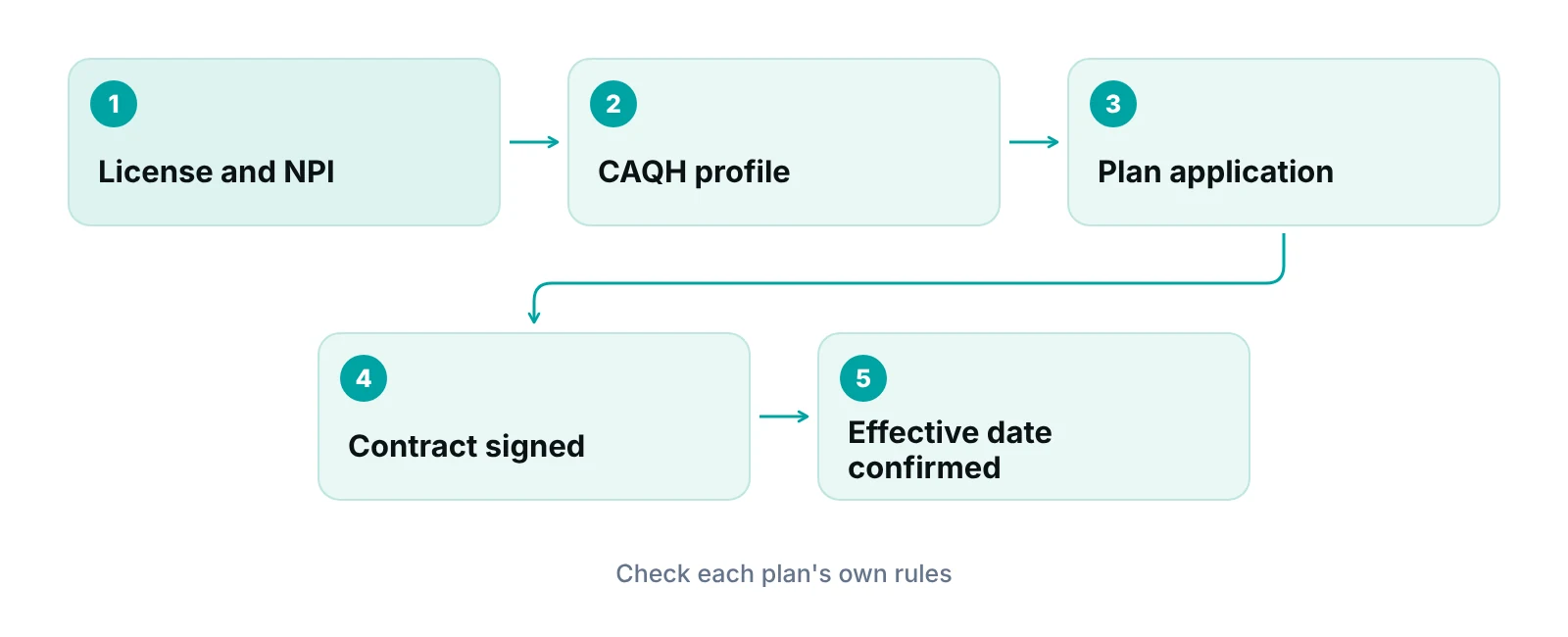
Credentialing looks like one task but is really several: identifiers, a shared CAQH profile, a plan-by-plan application and a contract. This guide gives the order, the fixed rules we could verify from CMS and CAQH, and where plans differ. For a solo therapist, the aim is a short, deliberate panel list and clean paperwork. This is general information, not legal or compliance advice.
Key takeaways
- Credentialing (verification) and contracting (rates and terms) are separate steps; you can bill in-network only after your effective date.
- Your NPI, license and CAQH profile feed almost every application, so make them match.
- CAQH ProView is free and needs re-attestation every 120 days (180 in Illinois).
- Medicare and Medicaid are separate enrollments; MFTs and MHCs have been payable by Medicare since January 1, 2024.
- No official timeline exists; plan for months and ask each plan for its current processing time.
What therapist insurance credentialing involves
Credentialing is the payer checking that you are who you say you are: license, education, work history and standing. Contracting is the separate step where you agree to rates and terms. You are only in-network once both are done and the plan gives you an effective date.
Two things are worth knowing before you start. First, there is no single application. Each plan, each state Medicaid program and Medicare run their own, and each sets its own timeline. Second, almost every application draws on the same core data: your license, your NPI and your CAQH profile. Getting those right once saves the most rework. If you want a wider view of how panels differ, see our guide to insurance panels for therapists.
Credentialing is not the same as billing
Credentialing lets you be paid by a plan. Billing is what you do afterward, claim by claim. If your claims fail for coding or eligibility reasons, that is a billing problem, not a credentialing one. We cover that side in our mental health CPT code guide.
What to have ready before you apply
Start with the identifiers every payer asks for: a full state license and an individual NPI. The NPI is a federal requirement for covered health care providers, who must obtain one, use it on standard transactions and tell the NPI system about changes within 30 days, according to 45 CFR 162.410. You apply through NPPES, and CMS says the online application is the fastest route to an NPI.
Clinicians use an individual (Type 1) NPI. If you practice through an LLC or professional corporation, the organization can have its own NPI too, and Medicare asks for both in some cases. Our NPI Type 1 vs Type 2 guide explains which applies when.
Then build a short document file you can reuse on every application:
- State license number, issue and expiration dates, and any supervised-hours documentation your license requires.
- Individual NPI, and the entity NPI and tax ID if you practice through an LLC, PC or other entity.
- Degree and graduate school details, plus a work history with no unexplained gaps.
- Proof of professional liability coverage. Plans set their own limits, so read each application rather than assuming one number.
- Your practice address, phone, hours and the telehealth states you serve, written the same way every time.
Matching matters. A payer checks your details against your license board and NPI record. A suite number written two ways, or an old address still on your NPI record, is a common reason applications stall. Fix mismatches at the source before you submit anything.
Set up and maintain your CAQH ProView profile
CAQH ProView is the shared online profile many commercial plans use to pull your credentialing data. It is free to providers, and only you decide which plans can see it, according to CAQH’s ProView quick reference.
The part that catches people out is re-attestation. CAQH requires providers to re-attest their information every 120 days (180 days in Illinois), per the same quick reference. After you update the profile you must attest again, or the plans you authorized cannot view the new version, as the CAQH provider user guide explains. An expired attestation can hold up an application or a re-credentialing, so put the date in your calendar.
- Complete every section, including work history and malpractice coverage, before you authorize any plan.
- Upload current copies of your license and insurance certificate.
- On the Authorize page, add each plan you are applying to. Not every plan uses CAQH, so confirm per plan.
- Re-attest on schedule, and again whenever your address, license or coverage changes.
The credentialing process, step by step
The order below avoids the most common rework. Choose target plans first, then collect documents, then apply. Each plan’s own application is the final authority, so treat this as a map and not a rulebook.
| Step | What you do | Where | Watch for |
|---|---|---|---|
| 1. Pick target plans | Check which plans your local clients use and which have open panels for your license type. | Plan provider-relations pages; local referral sources | Some panels are closed for your specialty or area. Ask before spending hours on forms. |
| 2. Get your identifiers | Confirm license, apply for or verify your NPI, and set up entity details if needed. | State licensing board; NPPES | Update NPPES within 30 days of any change. |
| 3. Build your CAQH profile | Complete it, upload documents, attest, then authorize plans. | CAQH ProView | Attestation is due every 120 days (180 in Illinois). |
| 4. Submit each plan’s application | Use the plan’s own form or portal. Request a contract at the same time if the plan allows. | Each plan’s credentialing portal or provider-relations team | Answer follow-up requests quickly. Missing items restart the clock. |
| 5. Review and sign the contract | Check rates, services covered, telehealth terms and the effective date. | Plan contracting team | Credentialing approval and the contract effective date can differ. |
| 6. Verify before you bill | Confirm your effective date and that you are loaded in the plan’s system before sending claims. | Plan provider portal or phone line | Do not book in-network clients ahead of your effective date. |
Source: Authors’ summary of CMS NPI rules (45 CFR 162.410), CAQH ProView quick reference and SimplePractice credentialing guidance (see sources).
Medicare and Medicaid are separate enrollments
Enrolling with a state Medicaid program does not enroll you in Medicare, and the reverse is also true. CMS says so directly in its MFT and MHC enrollment FAQ: enrolling in Medicaid does not automatically enroll you in Medicare.
Medicare
Individual practitioners generally enroll with the CMS-855I, ideally through PECOS, and need an NPI first, per CMS enrollment guidance and CMS’s NPI and enrollment fact sheet. Physicians and non-physician practitioners do not pay a Medicare enrollment application fee. If you want a group to bill for you, you reassign your benefits to it, and both you and the group must be enrolled.
Marriage and family therapists (MFTs) and mental health counselors (MHCs) are newer Medicare practitioner types. Medicare payment for their services began January 1, 2024, and CMS will not grant an effective date earlier than that, per the CMS FAQ. To qualify, they need a qualifying master’s or doctoral degree, at least two years or 3,000 hours of post-degree supervised clinical experience, and a state license or certification. CMS also notes that a separate CMS-855I is needed in each state where you practice.
Timing matters in Medicare. For physicians and non-physician practitioners, a 2019 CMS enrollment presentation describes the effective date as the later of your application receipt date or the date you began seeing patients at the location, with up to 30 days of retroactive billing before the receipt date (CMS, 2019). Confirm the current rule with your Medicare contractor before you rely on it. Medicare also requires revalidation, generally every five years for physicians and non-physician practitioners, and reporting of practice changes within 30 or 90 days depending on the change (CMS).
Medicaid
Medicaid is run state by state. States must screen participating providers under federal rules, and for Medicaid managed care plans the state must screen and enroll network providers too, per CMS’s Medicaid Provider Enrollment Compendium (November 2025). In practice that can mean two steps: enroll with the state, then contract with each managed care organization. Forms, timelines and which therapist license types are accepted differ by state. Our Medicaid credentialing guide covers the process in more detail.
How long credentialing takes, and what we can and cannot say
There is no official, universal timeline. Each plan sets its own, and published figures are mostly estimates from vendors and practitioners. The only fixed dates come from your side: the 120-day CAQH attestation cycle and Medicare’s 30-day lookback on effective dates.
One widely used practice-management vendor, SimplePractice, tells therapists to expect roughly 60 to 120 days per payer, to start three to four months before their first client, and to expect that large commercial plans and Medicaid managed care can run past 120 days (SimplePractice). Treat that as a planning range and ask each plan for its current processing time.
| Enrollment | Who controls the timeline | What is documented | What to do |
|---|---|---|---|
| NPI (NPPES) | CMS enumerator | Online application is CMS’s fastest route; changes must be reported within 30 days | Apply online; keep the record current |
| CAQH ProView | You | Re-attest every 120 days (180 in Illinois); free to providers | Calendar the date; authorize each plan |
| Medicare | Your Medicare contractor (MAC) | Form CMS-855I; no application fee; revalidate about every 5 years; effective date tied to application receipt | Apply through PECOS; ask your MAC for current processing times |
| Medicaid (state) | State Medicaid agency | States must screen and enroll providers; managed care network providers must be enrolled too | Check your state’s provider enrollment page |
| Commercial plans | Each plan | No standard timeline; vendor guidance suggests about 60 to 120 days | Start early; ask for a status contact and follow up regularly |
Source: CMS (2023-2025), CAQH quick reference, CMS Medicaid Provider Enrollment Compendium (2025), SimplePractice (vendor estimate).
Do not bill in-network before your effective date
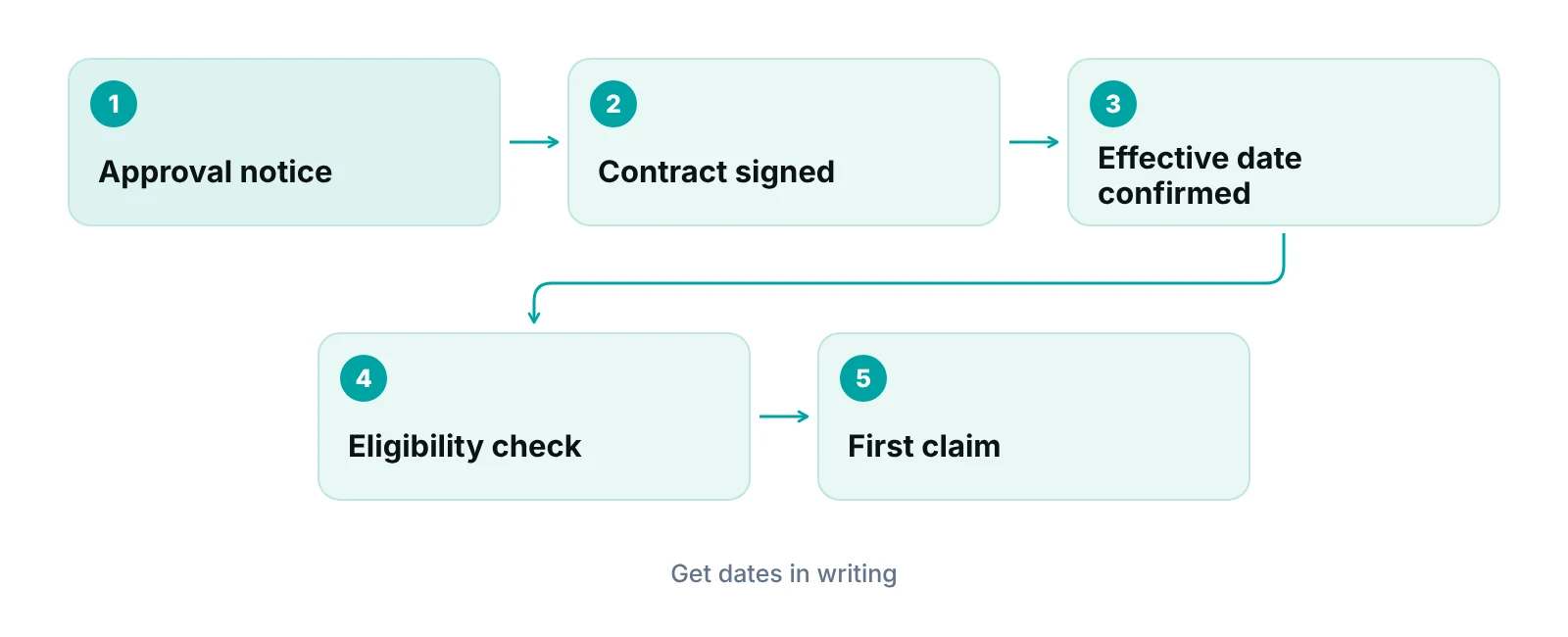
Credentialing approval and your contract effective date can be different dates. SimplePractice suggests holding claims for about 30 days after the contract goes active so the plan can load your information. Until you are loaded, you can see clients as an out-of-network provider, but you cannot bill the plan as in-network. Ask the plan for your effective date in writing.
Is joining insurance panels right for your practice?
It depends on your client mix, your capacity and how much administrative work you can carry. Joining a panel gives you access to clients who use insurance and a directory listing. It also means contracted rates, claims, eligibility checks and payer audits. We have not seen reliable public evidence that in-network therapists earn more overall, so be cautious of any guide that says they do.
| Model | How clients pay | What you take on | Often a fit when |
|---|---|---|---|
| In-network with chosen plans | Copay or coinsurance to you; plan pays contracted rate | Credentialing, contracts, eligibility checks, claims, denials, recredentialing | You want steady referrals from plans your area uses heavily |
| Out-of-network (superbill) | Client pays you; may seek reimbursement from their plan | Provide itemized receipts; clients handle claims | You want fewer payer rules and have a private-pay client base |
| Hybrid | Some plans in-network, the rest private or out-of-network | Both sets of work, plus clear policies on who is covered | You want to test one or two panels without a full commitment |
Source: Authors’ summary; payer rules and plan benefits vary.
This choice is specific to your market. Ask each plan for its fee schedule for the codes you use before you sign. Read the contract terms rather than assuming flexibility.
If you run a group or behavioral health practice rather than a solo office, our behavioral and mental health RCM operations page explains how credentialing connects to intake, eligibility and billing across providers.
Where applications stall, and how to prevent it
Most delays come from small mismatches and missed follow-ups.
- Inconsistent details. Your name, address and license number should match across your license board record, NPI record and CAQH profile.
- An expired CAQH attestation. Plans may be unable to view your updated profile until you re-attest.
- Starting late. Begin well before your first scheduled insurance client. Plan on months, not weeks, and expect some plans to take longer.
- No follow-up. Log the date you applied, the person you spoke to and the reference number for every plan. Check status on a regular schedule.
- Booking clients before your effective date. A claim for a date of service before your effective date can be denied.
- Ignoring eligibility at intake. A credentialed provider can still have a claim denied if the client’s coverage is inactive. See our behavioral health eligibility verification guide.
After approval: effective date, then claims
Approval is not the finish line. Confirm the contract is signed, the effective date is written down and you are loaded in the plan’s system. Then run an eligibility check on the first client before you submit the first claim.
When it makes sense to get help
Get help when applications are piling up, when you are adding clinicians, or when you are tracking recredentialing dates across several providers and payers.
Our team handles payer enrollment and credentialing follow-up as a service, working with your existing documents and tracking each application to completion. See our credentialing services for how it works. We quote after a free audit, not before.
Not sure which plans to apply to first?
Send us your license type, state and the plans your clients use. We will look at what your panel list would involve and where the paperwork is likely to slow you down.
Our recommendations
- Choose two or three plans first. We would start with the plans your current inquiries and referral partners actually use. A short, deliberate list is easier to track than a long one, and you can add more later.
- Build one master file. Keep a single folder with your license, NPI confirmation, liability certificate, work history and practice details written exactly as they appear on your NPI record. Reusing it reduces mismatches.
- Put CAQH dates in your calendar. Set reminders for the 120-day attestation (180 in Illinois), plus a separate reminder for any license or insurance renewals. An expired attestation is an avoidable delay.
- Log every contact. Record who you spoke to, when, and any reference number. When a plan says it never received something, a log is how you move forward.
- Get the effective date in writing. Do not assume approval means you can bill. Confirm your effective date and that you are loaded in the plan’s system before your first in-network claim.
- Test eligibility before the first visit. Verify coverage and behavioral health benefits before the intake session. Credentialing gets you paid by a plan, but only if the client is covered that day.
Bottom line
Credentialing rewards preparation: match your details, keep CAQH current, apply to a few plans on purpose, and confirm your effective date before billing. If you would rather hand off the paperwork and tracking, our credentialing services cover enrollment follow-up, and our medical billing services take over once claims start. You can also use the revenue calculator to see what delayed enrollment may cost, or contact our team with questions.
Frequently asked questions
How long does therapist insurance credentialing take?
There is no official timeline. Each plan sets its own. One practice-management vendor suggests planning for roughly 60 to 120 days per payer, and some large commercial or Medicaid managed care plans run longer. Start three to four months before your first insured client and ask each plan for its current processing time.
Do I need an NPI to get credentialed?
Yes. Payers and Medicare expect an individual NPI on your application, and covered health care providers are required to obtain one under federal rules. You apply through NPPES. If your license, address or taxonomy changes, update your NPI record within 30 days so it matches your other applications.
Is CAQH free, and how often do I re-attest?
CAQH ProView is free to providers. You must re-attest your profile every 120 days (180 days in Illinois), and again after you make updates, so the plans you authorized can see the current version. You choose which plans can view your data, and not every plan uses CAQH.
Can I see insurance clients while I wait for credentialing?
You can see clients as an out-of-network provider, but you cannot bill the plan as in-network until your effective date. Some therapists give clients an itemized receipt (superbill) for their own reimbursement. Ask each plan for your effective date in writing, and do not book in-network clients ahead of it.
Do licensed counselors and MFTs get paid by Medicare?
Medicare began paying marriage and family therapists and mental health counselors on January 1, 2024. They need a qualifying degree, at least two years or 3,000 hours of supervised experience and a state license. You enroll with the CMS-855I, preferably in PECOS, and need a separate enrollment in each state. Medicaid enrollment does not cover Medicare.
Can I negotiate rates with a plan?
You can ask, and the contract is a negotiation in principle. In practice many solo and small practices are offered a standard fee schedule. Before signing, request the fee schedule for the codes you bill, check telehealth terms and compare it with your costs. Avoid relying on any claim that in-network therapists earn more.
Get your free practice audit
Tell us about your practice. We will contact you using the details you give.
- A review of your recent claims, denials and A/R aging
- Where your front desk and prior authorizations slow payment
- A prioritized fix list you keep, whether or not you hire us
Pricing is quoted after the audit, based on your volume and the services you choose. Prefer to talk? Call +1 (302) 556-2288.
Sources
- CAQH ProView quick reference — CAQH (2024)
- CAQH provider user guide — CAQH (2024)
- 45 CFR 162.410 – Implementation specifications: Health care providers — eCFR / HHS (2025)
- How to Apply (NPI) — CMS (2025)
- Medicare Provider Enrollment for physicians and non-physician practitioners (MLN) — CMS (2025)
- Medicare Provider Enrollment of Individuals and NPI — CMS (2024)
- Marriage and Family Therapists and Mental Health Counselors FAQ — CMS (2024)
- Provider Enrollment Changes to the Medicare Program Integrity Manual (MM13331) — CMS (2024)
- Important new changes to improve access to behavioral health in Medicare — CMS (2023)
- Medicare Effective Dates (National Provider Enrollment Conference) — CMS (2019)
- Medicaid Provider Enrollment Compendium (MPEC) — CMS / Medicaid.gov (2025)
- How long does credentialing take? — SimplePractice (2025)
Disclaimer: This page is general educational information for practice owners and clinicians. It is not legal, coding, billing-compliance or financial advice. Payer rules, timelines and state requirements vary and change; confirm current requirements with each payer, your state Medicaid agency, your Medicare contractor and a qualified advisor before acting.