

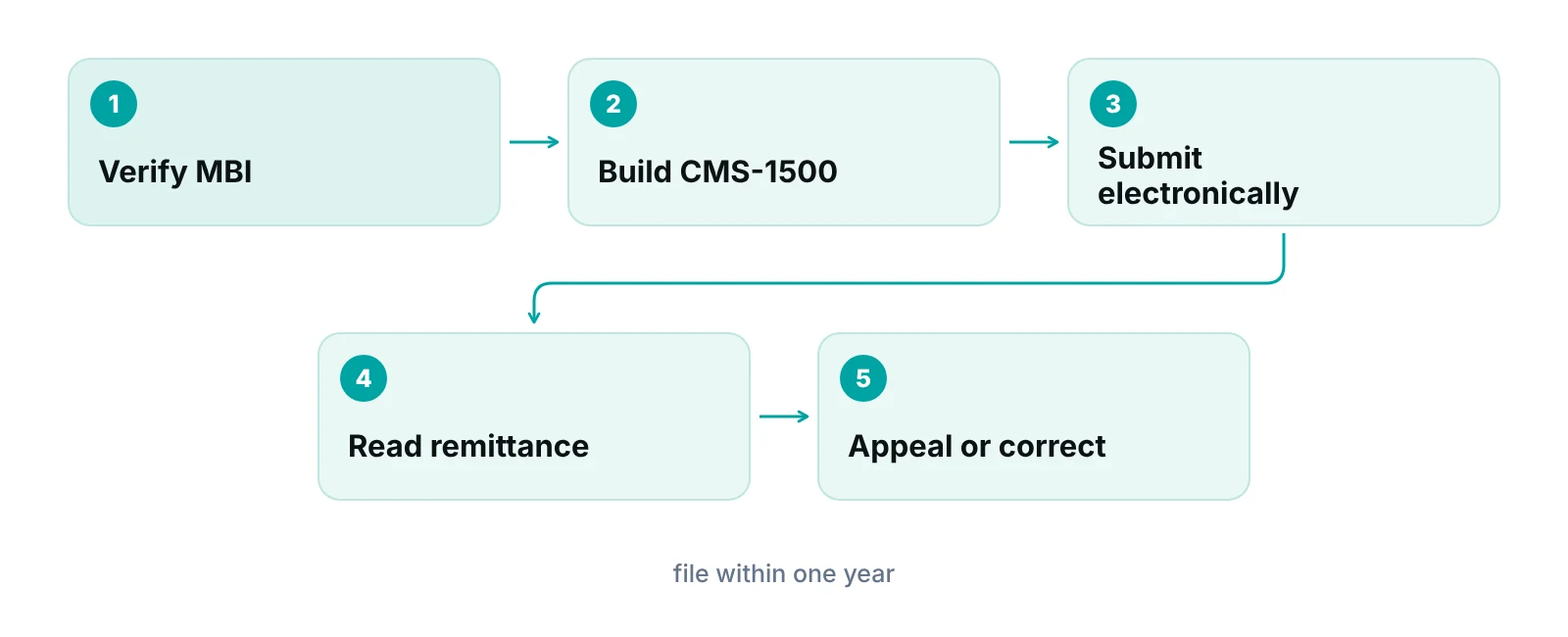
This Medicare billing guide follows an Original Medicare Part B claim in order: confirm the patient's MBI, send the professional claim electronically, file within one calendar year of the service date, then work the remittance and appeal what is denied. Medicare's share of an allowed Part B amount is 80%, and the patient's share is 20%.
Medicare billing goes wrong in a few predictable places: a wrong identifier, a missed filing date, a participation choice nobody revisited and denials that sit unworked. The rules behind each one are public, but they are spread across contractor pages, manuals and booklets.
This guide puts them in one path and says what to check at each step. It covers Original Medicare (Parts A and B) fee-for-service claims. Medicare Advantage plans set their own claim rules, so read each plan’s provider manual. For two topics that deserve their own page, see our guide to Medicare sequestration and CARC 253 and Medicare billing for chiropractors.
Key takeaways
- Original Medicare claims need the patient’s 11-character MBI; claims without it have been rejected since January 1, 2020.
- Physicians and suppliers must submit Part B claims for their Medicare patients, assigned or not, and may not charge the patient to file.
- Claims must be filed within one calendar year of the date of service, with narrow exceptions.
- Participating status sets the allowed amount and whether you can bill above it; review it before January 1 each year.
- A redetermination request is due 120 days from receipt of the remittance, so denials need an owner and a date.
How does Medicare billing work?
A Medicare claim moves through five stages: identify the patient with the right number, build the claim, submit it to your Medicare Administrative Contractor (MAC), read the remittance and appeal or correct what is denied. Problems tend to start at the edges of that path, not in the middle.
Your MAC is the contractor that processes Original Medicare claims for your region. The steps below apply to professional (Part B) claims. Hospitals and other institutions file institutional claims, which Noridian says count the one-year filing period from the claim’s “through” date rather than the “from” date used for physician and supplier claims (Noridian Medicare).
If you want the coding side in depth, our guide to billing and coding of Medicare fee-for-service claims covers it. This page is the process map.
Step 1: Which patient number does Medicare require?
Medicare requires the Medicare Beneficiary Identifier (MBI). It is 11 characters, random, and uses only numbers and uppercase letters. The letters S, L, O, I, B and Z are never used (Noridian Medicare).
The old Social Security-based number (HICN) is gone for claims. Noridian states that claims not submitted with the MBI as of January 1, 2020 are rejected. Enter the MBI on the claim without spaces or dashes. If a patient does not have the card, MACs offer a look-up tool in their provider portal, and the patient must confirm identifying details.
- Ask for the Medicare card at every new-patient visit and scan it.
- Check the MBI against your portal look-up before the first claim, not after a rejection.
- Confirm that Medicare is the right payer. Our post on verifying Medicare coverage lists what to check at the front desk.
Step 2: Which claim form and enrollment do you need?
Professional services are billed on the CMS-1500, or its electronic 837 Professional equivalent. CMS contractor guidance calls the CMS-1500 the prescribed form for claims prepared and submitted by physicians or suppliers, whether or not the claim is assigned (CGS Medicare).
The claim also depends on the practice’s Medicare enrollment being active. Federal rules restrict newly enrolled suppliers from billing for services furnished before their Medicare billing privileges became effective (42 CFR 424.44(e) points to 42 CFR 424.520 and 424.521). A start date is not the same as an effective date, so confirm both before you schedule Medicare patients with a new provider.
Check the effective date
Do not assume a provider can bill Medicare from the day they join. Get the written effective date first and hold claims for earlier dates of service for review.
Step 3: How and when must you submit Medicare claims?
Submit electronically, submit every claim and submit within one calendar year of the service date. Each of those three has a rule behind it.
You must file the claim
Under the Social Security Act, physicians and suppliers must submit claims for all their Medicare patients’ covered services. Noridian says you may not charge the patient for preparing or filing the claim, and filing does not require you to accept assignment. CMS contractor guidance adds that both assigned and nonassigned Part B claims must be submitted, and that a supplier that does not file can face a civil monetary penalty of up to $2,000 per violation (Noridian Medicare, CGS Medicare).
Electronic filing is the rule
The Administrative Simplification Compliance Act (ASCA) bars Medicare from covering paper claims, except in limited situations. A Medicare contractor’s ASCA guidance lists the exceptions, including small providers with fewer than 10 full-time employees for Part B, and says providers whose documentation does not support an exception can have paper claims denied with no appeal rights (Palmetto GBA, Railroad Medicare; CMS describes ASCA in Claims Processing Manual, Chapter 24). Plan to file electronically unless you have written confirmation of an exception.
One calendar year from the date of service
For services furnished on or after January 1, 2010, a claim must be filed no later than the close of the period ending one calendar year after the date of service (42 CFR 424.44). The regulation allows longer periods only in narrow cases, such as an administrative error by a Medicare contractor or retroactive Medicare entitlement. For physician and supplier claims with date spans, Noridian counts from the “from” date.
A rejected claim never enters processing, so it must be corrected and resubmitted inside the same window. That is why a rejection worked in month 11 is a problem and a rejection worked in week 2 is not.
Participating or nonparticipating: what changes on the claim?
Participating providers accept assignment on every claim and are paid 100% of the fee schedule amount. Nonparticipating providers are paid 95% of it and choose assignment claim by claim. In both cases the Medicare share of an allowed amount is 80%, and the patient’s share is 20% (ASHA).
| Feature | Participating | Nonparticipating |
|---|---|---|
| Assignment | Must accept assignment | Chooses per claim |
| Base allowed amount | 100% of the fee schedule amount | 95% of the fee schedule amount |
| Most the patient can be charged | Medicare allowed amount only; no balance billing | Limiting charge: 109.25% of the fee schedule amount |
| Example: Medicare pays | $80 | $76 (80% of $95) |
| Example: patient owes | $20 | $33.25 if you charge the limiting charge |
Source: ASHA, Calculating Medicare Fee Schedule Rates. The examples ignore the Part B deductible.
A nonparticipating provider who does not accept assignment collects the full charge from the patient, and Medicare pays the patient. That adds collection work and patient-balance risk. The status is a business decision with a yearly review date, not a default. If you are a new practice, decide it during enrollment.
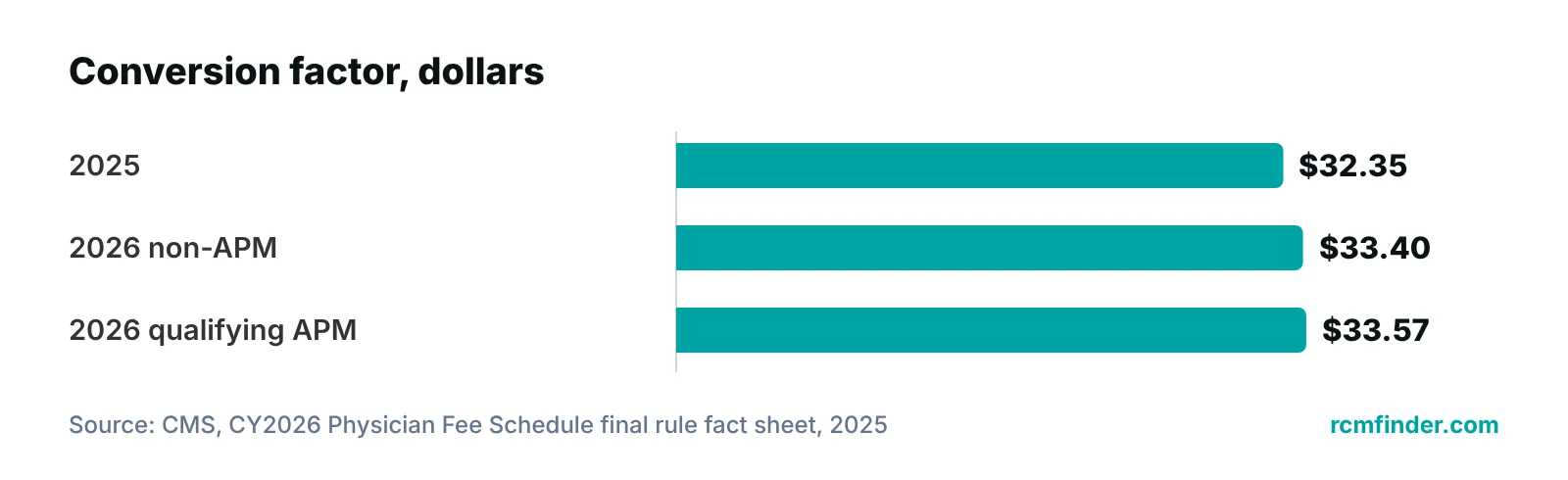
Medicare’s payment rate itself moves each year. For CY2026, CMS finalized a physician fee schedule conversion factor of $33.40 for non-qualifying APM participants and $33.57 for qualifying APM participants, up from $32.35 in 2025. CMS says the update includes a one-year 2.50% increase stipulated by statute, and it applied a negative 2.5% efficiency adjustment to non-time-based services (CMS CY2026 fee schedule final rule fact sheet).
A second adjustment sits on top of the fee schedule. If a remittance shows a Medicare payment reduction labeled sequestration, it has its own rules. Read our guide to Medicare sequestration and CARC 253 rather than treating the short payment as an error.
What should you check before every Medicare claim goes out?
Check five things before submission: identifier, form, enrollment, channel and deadline. Each maps to a rule cited above, so the checklist can sit in your claim scrubber or your front-desk handbook.
| Check | What the rule says | Where it is cited |
|---|---|---|
| MBI present and valid | 11 characters; claims without the MBI are rejected | Noridian Medicare (MBI page) |
| Right claim form | CMS-1500 or the 837 Professional equivalent for physician and supplier claims | CGS Medicare (Part B guidance) |
| Enrollment effective for the date of service | Billing restricted before billing privileges are effective | 42 CFR 424.44(e) |
| Filed electronically | Paper claims not covered unless an ASCA exception applies | Palmetto GBA; CMS Claims Processing Manual, Chapter 24 |
| Inside the filing window | One calendar year after the date of service | 42 CFR 424.44 |
Sources: Noridian Medicare, CGS Medicare, Palmetto GBA, eCFR text of 42 CFR 424.44.
Add your own front-end checks, such as diagnosis-to-service logic, missing rendering provider data and place-of-service mismatches. A good scrubber catches them before the payer does. Our post on clean claims explains how.
What do you do when Medicare denies or underpays a claim?
Read the remittance advice, decide whether the problem is a correction or an appeal, and act inside the deadline. A formal redetermination request is due 120 days from receipt of the remittance advice, so the clock starts when the remittance arrives, not when you post it.
Medicare fee-for-service has five appeal levels. The first two have no minimum amount in controversy; levels three and five do. The booklet does not give a dollar figure, so check the current threshold with your MAC (CMS MLN006562, Medicare Parts A & B Appeals Process, September 2025).
| Level | Who decides | Deadline to request | Typical decision time |
|---|---|---|---|
| 1. Redetermination | MAC staff not involved in the first decision | 120 days from receipt of the remittance advice | Generally 60 days |
| 2. Reconsideration | Qualified Independent Contractor | 180 days from receipt of the redetermination notice | Generally 60 days |
| 3. OMHA decision | Administrative law judge or attorney adjudicator | 60 days from receipt of the reconsideration decision | 90 days |
| 4. Medicare Appeals Council | Council within HHS | 60 days from receipt of the OMHA decision | Generally 90 days (180 if escalated) |
| 5. Federal district court | U.S. District Court | 60 days from receipt of the Council decision | No statutory limit listed |
Source: CMS, MLN006562, Medicare Parts A & B Appeals Process (September 2025).
Send the request in writing on the Medicare Redetermination Request Form (CMS-20027) or another written document with the required elements, to the address on the remittance or through your MAC’s electronic option. Attach support and keep a copy of everything you send.
Set up a denial routine
- Give each denial an owner and a due date on the day the remittance is posted.
- Separate correctable claims (data fixes, resubmission) from appeals (medical necessity, documentation).
- Log denial reasons by code so repeat causes show up in your weekly review.
- Never let an appeal deadline depend on one person remembering it.
If your denials are not being worked consistently, a written routine is the first fix, and our denial management services (linked below) can run it for you.
“In my view, Medicare billing is won at the front desk and lost at the filing deadline. The claim form is the easy part.”
— Awais Afzal, Healthcare Operations & Data Analyst
Should you run Medicare billing in-house or outsource it?
Keep it in-house if you have a trained biller, a claim scrubber and a weekly denial review. Consider outsourcing or a hybrid model if any of those three is missing, or if Medicare is a large share of your visits and your filing and appeal dates are tracked by memory.
- In-house fits when you have a trained biller, a backup and a scrubber. Watch for a single point of failure when one person is out.
- Hybrid fits when you keep charge entry and a partner works denials and A/R. Watch for clear hand-offs and one owner per denial.
- Outsourced fits when you want the full claim path covered by a team. Watch for access to your data, reporting and a Business Associate Agreement.
Whichever model you choose, ask for the same things: written filing-window tracking, denial reporting by reason, role-based access and an audit log of who touched each claim. Ask whether the vendor will put a Business Associate Agreement in place before it sees patient data. Practices that see many Medicare patients, such as internal medicine practices, feel these rules most.
Our team works inside your existing EHR (for example PrognoCIS, eClinicalWorks or athenahealth) on medical billing services that cover charge entry, claim scrubbing, submission and follow-up. We quote pricing after a free audit, so you can compare it with the cost of your current process. You can also model the gap with the revenue calculator.
See where your Medicare claims leak
We review a sample of your Medicare claims and remittances against the checklist in this guide, then tell you what we would fix first.
Our recommendations
- Put the filing deadline on the claim record. We would track the one-calendar-year date for every claim that has not been paid, and report claims approaching it in a weekly review.
- Verify the MBI before the first claim. We would use the MAC’s look-up tool at registration, so a rejection never comes from a mistyped number.
- Review participating status every autumn. We would revisit participation each autumn, before the new year, and record the reasoning.
- Give every denial an owner and a date. We would use the remittance receipt date to set the 120-day redetermination deadline and assign one person to each denial.
- Keep a written ASCA position. We would document why the practice files electronically, or which exception applies, so a contractor review letter has an answer ready.
- Read sequestration out of your underpayment queue. We would treat the sequestration reduction as expected, so real underpayments are not buried under it.
Bottom line
The Medicare billing process is a handful of rules applied in order: the right MBI, the right form, electronic filing, a one-year deadline, a deliberate participation choice and a fast response to denials. Get those right and most of the rest is routine. If denials are the weak point in your office, start with our denial management services, or talk to our team about a free audit of your Medicare workflow.
Frequently asked questions
What is the Medicare Beneficiary Identifier (MBI)?
The MBI is the number Medicare uses to identify a beneficiary on claims. It has 11 characters, uses numbers and uppercase letters, and never uses S, L, O, I, B or Z. Noridian states that claims without the MBI have been rejected since January 1, 2020. Enter it on the claim without spaces or dashes.
How long do I have to file a Medicare claim?
One calendar year after the date of service, for services on or after January 1, 2010 (42 CFR 424.44). Narrow exceptions exist, such as an administrative error by a Medicare contractor or retroactive entitlement. A rejected claim must be corrected and resubmitted within the same window, so work rejections quickly.
Do I have to submit claims for Medicare patients myself?
Yes. Physicians and suppliers must submit Part B claims for their Medicare patients’ covered services, assigned or not, and may not charge the patient for preparing or filing them. Contractor guidance notes a possible civil monetary penalty of up to $2,000 per violation for failing to file. Patient-filed claims are limited exceptions.
Can I still send paper claims to Medicare?
Generally not. ASCA bars Medicare from covering paper claims except in limited situations, such as small providers with fewer than 10 full-time employees for Part B. Providers who cannot document an exception can have paper claims denied with no appeal rights. Get written confirmation of any exception from your MAC.
What does Medicare pay on a Part B claim?
Medicare’s share of an allowed Part B amount is 80%, and the patient’s share is 20%. Participating providers are paid 100% of the fee schedule amount; nonparticipating providers are paid 95%. These examples ignore the Part B deductible, and any payment adjustments.
How do I appeal a denied Medicare claim?
Request a redetermination from your MAC in writing within 120 days of receiving the remittance advice, using form CMS-20027 or an equivalent document. Later levels are reconsideration (180 days), OMHA (60 days), the Appeals Council (60 days) and federal court (60 days). Each deadline runs from the prior decision.
Get your free practice audit
Tell us about your practice. We will contact you using the details you give.
- A review of your recent claims, denials and A/R aging
- Where your front desk and prior authorizations slow payment
- A prioritized fix list you keep, whether or not you hire us
Pricing is quoted after the audit, based on your volume and the services you choose. Prefer to talk? Call +1 (302) 556-2288.
Sources
- 42 CFR 424.44: Time limits for filing claims — eCFR / Cornell LII (current)
- Timely Filing — Noridian Medicare (JE Part B) (current)
- Mandatory Claim Submission — Noridian Medicare (JE Part B) (current)
- Medicare Beneficiary Identifier (MBI) — Noridian Medicare (JE Part B) (current)
- Chapter 6: CMS-1500 claim form guidance — CGS Medicare (Part B) (current)
- Mandatory Electronic Submission of Medicare Claims — Palmetto GBA (Railroad Medicare) (current)
- Medicare Claims Processing Manual, Chapter 24 — CMS (current)
- Calculating Medicare Fee Schedule Rates — ASHA (current)
- CY 2026 Medicare Physician Fee Schedule Final Rule (CMS-1832-F) fact sheet — CMS (2025)
- MLN006562: Medicare Parts A & B Appeals Process — CMS (2025)
Disclaimer: This page is general educational information for practice owners and managers. It is not legal, coding, billing-compliance or medical advice. Medicare rules, payment rates and contractor policies change, and Medicare Advantage plans set their own claim rules. Confirm current requirements with CMS, your Medicare Administrative Contractor and a qualified advisor before acting.
