
Good patient billing communication means telling patients what they may owe before the visit, sending one clear statement after insurance pays, and giving them a named person and phone number for questions. Use plain words, one name for each document, and check the federal rules on privacy, language access and disputes.
Most billing problems that reach your front desk are communication problems first. The patient did not know a balance was coming, could not read the statement, or could not reach anyone who could explain it. This guide covers the conversation side of the revenue cycle: what to say, in what order, through which channel, and what to avoid. For statement layout and the rules around it, see our guide to patient-friendly billing statements. For the internal side, such as handoffs between front desk, coders and billers, see overcoming communication barriers in healthcare RCM.
Key takeaways
- Contact patients at five points, not only when a statement goes out.
- Plain words, one name per document and a printed phone number remove most avoidable calls.
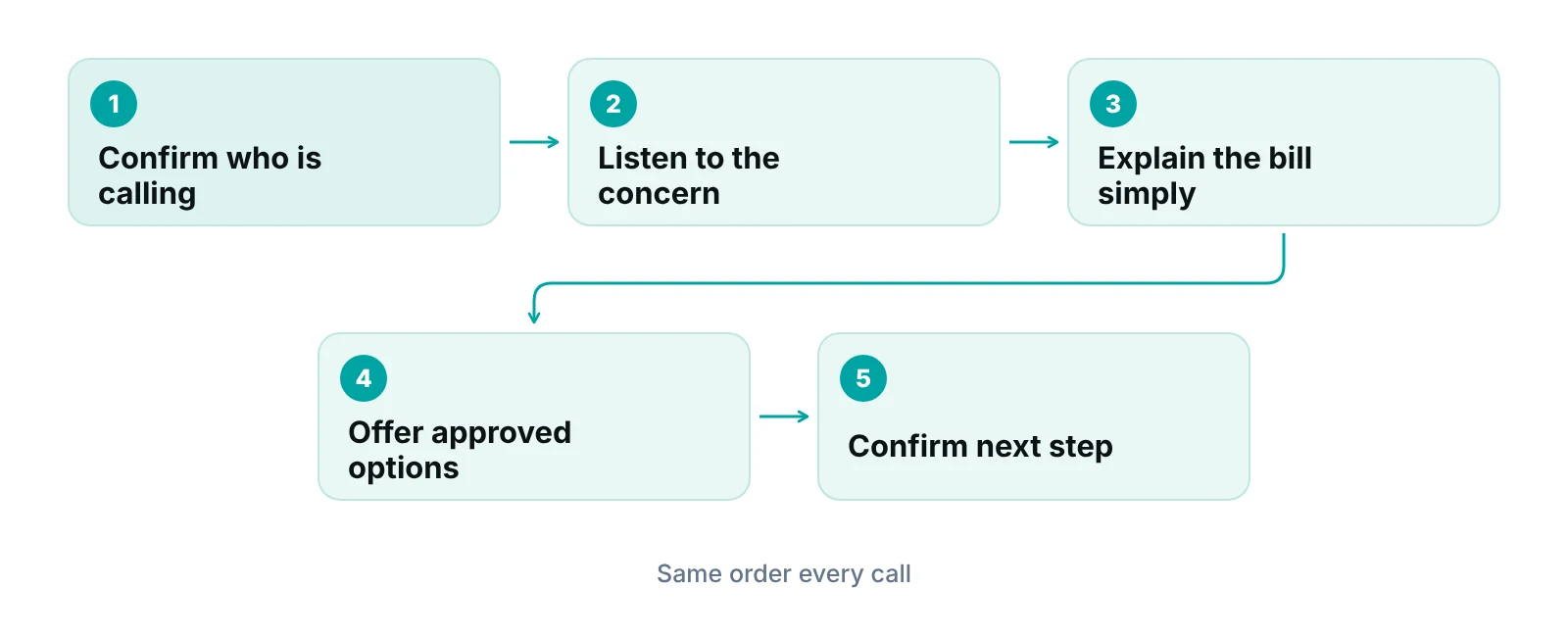
- Use a fixed order on billing calls: confirm, listen, explain, offer options, confirm next step.
- Keep balances out of unencrypted email, record each patient’s preferred channel and check language access duties.
- Name one owner and log every question with a reply date.
What is patient billing communication, and why does it matter?
Patient billing communication is every message a patient gets about money: the estimate before a visit, the request for a copay at check-in, the statement, the reminder, the phone call and the answer to a dispute. It matters because patients often cannot tell whether a bill is right, and when they cannot tell, they call, delay or ignore it. Each of those costs your staff time or your practice cash.
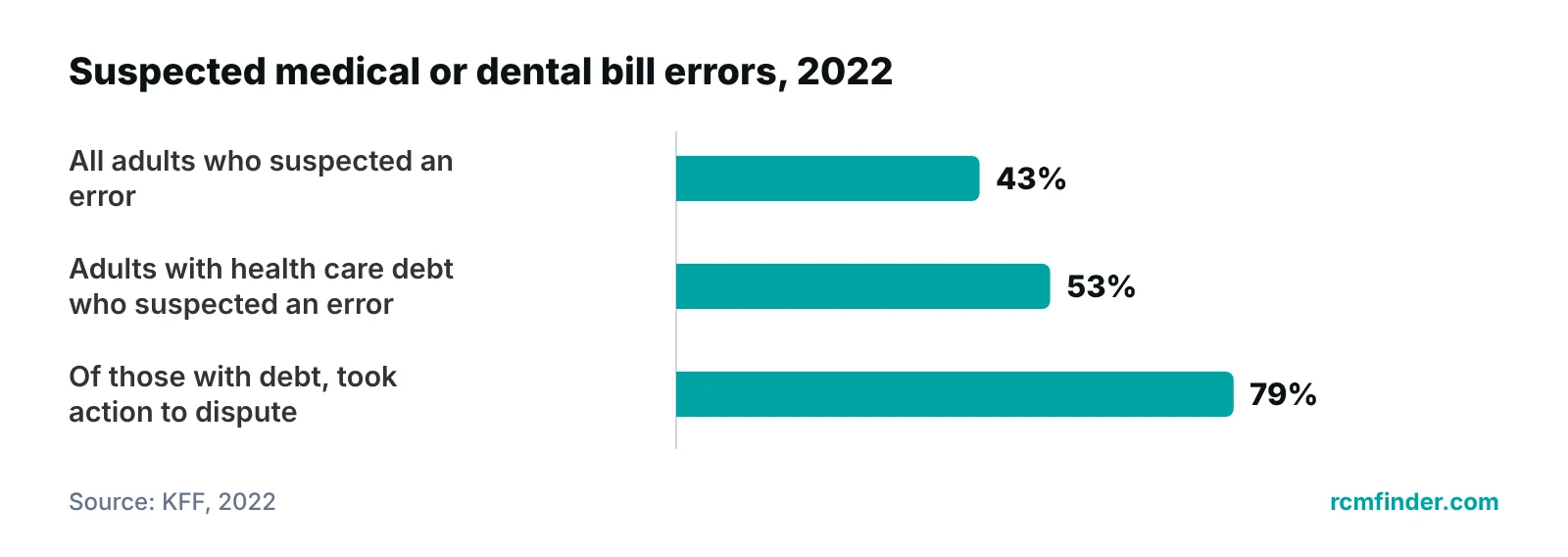
The scale of the confusion is documented. In the KFF Health Care Debt Survey, fielded in early 2022, 43% of all adults said they had received a medical or dental bill in the past five years that they thought contained an error. Among adults with health care debt, the figure was 53%. Of those with debt who suspected an error, 79% took some action to dispute it with their insurer or provider. Those are patient-reported suspicions, not confirmed errors, but they show how many people open a bill expecting a problem.
Clear communication does not fix a wrong bill. It does make the right bill easier to accept, and it makes a wrong bill easier to catch before it becomes a complaint. For more on why the patient owes what they owe, see patient responsibility in medical billing.
“A patient who understands a balance before it arrives rarely needs to be chased for it.”
When should you contact a patient about money?
Contact patients at five points: before the visit, at the visit, after the insurer processes the claim, when a balance stays open, and whenever a question or dispute is open. The mistake to avoid is silence until the first statement. Table 1 shows what each message should do.
| Stage | What the message should do | Usual channel | Common mistake |
|---|---|---|---|
| Before the visit | Give the likely patient share if you can estimate it, the payment options, and who to call with billing questions | Phone call, portal or visit reminder | Quoting an estimate as if it were a final price |
| At check-in or check-out | State what is due today, give a receipt, and name the billing contact | In person | Collecting without explaining what the payment covers |
| After the insurer processes the claim | Send one statement that matches the insurer’s explanation of benefits | Mail or e-statement | Sending before the claim is processed, so the balance changes later |
| Balance still open | Remind the patient of the same balance, a new due date and how to get help | Statement, text, call | Re-sending the same page with no new information |
| Later notices | Show growing urgency in a respectful tone and offer a payment plan with a named contact | Letter and phone call | Threatening language or vague deadlines |
| Question or dispute open | Acknowledge it, say who owns it and when the patient will hear back | Phone first, then written confirmation | No reply date, so the patient calls again |
Practical guidance from the stages above. Timing norms vary: the Patient Friendly Billing brochure (HFMA, MGMA and AHA task force, 2001) notes that experts disagree on when to send the first statement.
On timing, the 2001 brochure from the Patient Friendly Billing project says experts disagree. Some favor sending statements sooner, while others warn about paperwork overload. It describes one clinic that waits until the insurer has processed the claim or 45 days have passed (HFMA et al., 2001). The brochure is old, so treat it as a reminder of the trade-off rather than a rule. We recommend choosing one policy for your practice, writing it down and applying it the same way to every patient.
The brochure also advises telling patients about financial obligations before major episodes of care, mailing statements daily instead of in batches, and making sure enough staff are available to take calls after statements go out. Those three habits still apply. A large mailing on Monday with a single person on the phones guarantees long hold times by Wednesday.
Self-pay patients need a different first message because there is no insurer in the middle. See self-pay patient billing guidelines for that workflow.
How do you write billing messages patients can understand?
Write at about a junior high reading level, use everyday words and short sentences, and avoid acronyms. That is the advice in the Patient Friendly Billing brochure (HFMA et al., 2001), and it holds for every channel. A patient who has to decode “contractual adjustment” or “deductible applied” will pick up the phone instead.
- Say what the message is for in the first line. For example: “You owe a balance of this amount for your visit on this date.”
- Use one name for each document. The brochure points out that switching between “bill” and “invoice” confuses people. Pick a term and use it on statements, the website and scripts.
- Replace jargon. Write “the amount your plan did not cover” where staff would say “patient responsibility”, and explain “allowed amount” in one sentence the first time it appears.
- Print the phone number, the person or department, and calling hours on everything the patient receives. The brochure also suggests considering evening or weekend billing hours.
- Give one next step. Pay online, call this number, or reply with this form. Three options with no ranking read as none.
Tone matters as much as vocabulary. State the balance, the due date and the help available. Leave out blame, such as “you failed to pay”, and warnings that you cannot back up. If you have not decided what happens after the due date, do not imply a consequence.
What should staff say on a billing call?
On a billing call, listen first, confirm who you are speaking with, explain the bill in plain words, offer the options you are authorized to offer, and end by confirming the next step and date. Scripts help new staff keep that order. Table 2 gives sample wording for common situations. Adapt it to your policies and have a manager approve it.
| Situation | Try saying | Avoid |
|---|---|---|
| Patient did not expect a balance | “Let me walk through it with you. Here is what was billed, what insurance covered and what remains.” | “It was on the form you signed.” |
| Patient thinks the bill is wrong | “I will note your question on the account and tell you by this date what we found.” | “That is what your insurance says.” |
| Insurance has not paid yet | “We are following up with your insurer. I will tell you what we learn and when.” | Guessing why the claim has not paid |
| Patient cannot pay in full | “What amount would work each month? Here are the options we offer.” | Pressing for full payment or promising terms no one has approved |
| Patient is upset | “I understand why this is frustrating. Let me find out what happened.” | Arguing about policy before the patient has been heard |
| Voicemail | Practice name, your name, a call-back number and hours | Stating the balance or services on a message |
Practical script wording. The brochure from HFMA et al. (2001) recommends written call scripts for staff who follow up by phone; the wording above is ours.
Keep a note on every contact
Record who called, what was asked, what was promised and by when. Without a note, the next staff member repeats the explanation and the patient hears two different answers. This is the same discipline that supports a clean A/R follow-up queue; see strategies for improving patient collections for how notes connect to follow-up.
Which channels and federal rules apply to billing messages?
Email, text, phone, mail and portal can all work, but each needs a privacy check, and patients who speak limited English need help in a language they understand. Table 3 summarizes the federal points most practices should check with their compliance lead.
| Topic | What the source says | What it means for billing messages |
|---|---|---|
| Email safeguards | HHS says providers may email patients if they take reasonable precautions against accidental disclosure, such as confirming the address first, and should limit the amount and type of information in unencrypted email | Keep balances and service detail out of unencrypted email; point to a secure portal instead |
| Patient channel requests | HHS says providers should accommodate reasonable requests to be contacted by other means or at other locations. If unencrypted email is unacceptable to the patient, offer secure electronic methods, mail or phone | Record each patient’s preferred channel and honor it |
| Language access | 45 CFR 92.201 requires covered entities to take reasonable steps to give people with limited English proficiency meaningful access, at no cost to them, with qualified interpreters and translators. Machine translation of critical or complex material needs qualified human review | Translate statements and key notices, and use qualified interpreters on billing calls, if your practice is a covered entity |
| Disputes for uninsured and self-pay patients | CMS says that during a patient-provider dispute, providers may not send the bill to collections or threaten to, must pause existing collections, and cannot charge late fees. The process covers bills at least $400 above the good faith estimate | Flag disputed accounts so reminders and collection steps stop |
Sources: HHS (FAQ 570, undated); eCFR, 45 CFR 92.201 (current text, fetched October 2026); CMS, Providers: payment resolution with patients (2026). The HHS FAQ addresses treatment-related email, so apply it to billing messages with compliance review.
HHS’s guidance concerns email in a treatment setting, so the safest course for billing is to apply the same logic: say less in unencrypted channels and offer a secure alternative. Also, 45 CFR 92.201 applies to “covered entities”, a term defined elsewhere in Part 92. Ask counsel whether your practice is covered rather than assuming it is not.
Sensitive specialties need extra care. A therapy practice, for example, may have patients who do not want any mail about visits delivered to a shared home. Our behavioral health billing and RCM operations page covers the billing patterns in that setting. Whatever the specialty, ask patients at registration how they want to be reached about money, and record the answer.
How should you handle billing questions, disputes and hardship?
Treat every question as a possible error until it is checked, answer by a stated date, and offer payment options early. Because many patients suspect errors (see Figure 1), a fast, calm review protects both trust and cash.
- Acknowledge and log it. Tell the patient you have recorded the question, who owns it and the date they will hear back.
- Check the account against the explanation of benefits. Compare dates of service, charges, adjustments and payments. If the patient is right, correct the account and say so plainly.
- Hold routine reminders while you review, if your policy allows. For uninsured and self-pay patients with a qualifying good faith estimate dispute, CMS says collections and late fees must stop during the process (CMS).
- Explain the outcome in plain words, in writing if the bill changed.
- Offer help with payment. If the patient cannot pay in full, give the person to contact and the options. The Patient Friendly Billing brochure suggests putting payment plan policies in writing and avoiding plans that stretch unreasonably long (HFMA et al., 2001).
Plan design has its own legal and operational checks. For those, see payment plan best practices for healthcare providers.
See where billing messages break down in your practice
A free practice audit looks at how balances reach patients and how questions are handled, then shows where follow-up stalls.
Who should own patient billing communication?
One named owner should run it, whether that is a billing lead, an office manager or an outside billing team. Split ownership is the usual cause of the two-answers problem. The front desk may collect at the visit, the biller may send statements and a manager may handle complaints, with no shared record of what the patient was told. The impact of front desk staff on revenue cycle management shows how the first conversation shapes the rest.
- In-house: works when one person has the time and the training, and calls can be answered within the same business day.
- Shared between front desk and billing: works if both use the same scripts and the same account notes.
- Outsourced: works when volume or turnover outpaces your team. Ask any vendor to sign a Business Associate Agreement, to show how they handle patient calls, and to report on unanswered questions. Medical billing services and A/R follow-up services are the two that most directly handle patient-facing balances.
Tools help the owner keep the record. A practice management system that tracks claims by stage can assign each claim an owner, apply workflow rules that flag accounts for review, and keep an audit log, so that the next person to pick up an account can see its history. It is a claim-centred system, not an EHR.
Our recommendations
- Name one owner for patient billing communication. Give one person authority over scripts, templates and escalations. Everyone else follows their wording.
- Send the first money message before the visit. Give an estimate when you can, label it as an estimate and tell the patient who to call. Patients who are warned are less surprised.
- Write scripts for the six hardest calls. Cover the surprise balance, the disputed bill, the unpaid claim, the hardship request, the angry caller and the voicemail. Review them with staff twice a year.
- Record each patient's preferred channel. Ask at registration, store the answer where billing staff can see it and honor reasonable requests.
- Keep sensitive detail out of unencrypted channels. Use a secure portal link for balances and service detail, and ask compliance to approve your text and email templates.
- Track and answer every question by a stated date. Log each question with an owner and reply date. Review the open list weekly.
- Match call staffing to statement runs. Schedule more phone coverage in the days after statements go out, and send statements daily if you can rather than in large batches.
Keep every patient balance question with a named owner.
The RCM Finder portal tracks claims by stage with an owner, applies workflow rules that flag accounts for review, and keeps an audit log. It also offers client portals and reporting dashboards.
See how the RCM Finder portal works · Create a portal account
Disclosure: RCM Finder builds and sells this portal. It is a practice management system, not an EHR.
Bottom line
Patient billing communication works when patients know what to expect, can read what you send and can reach someone who can fix a problem. Start with one owner, one document name and a short set of approved scripts. If balances are aging while your team is busy on calls, A/R follow-up services and our revenue calculator can help you size the gap, and a free practice audit will show where messages break down.
Frequently asked questions
What is billing communication in healthcare?
It is every message a patient receives about money: estimates, statements, reminders, calls and answers to disputes. Good billing communication is clear, timely and consistent, and it names a person patients can contact. It is separate from the clinical conversation and from internal handoffs among staff.
How soon after a visit should you send a patient statement?
No single timing is proven best. The 2001 Patient Friendly Billing brochure says experts disagree and describes one clinic that waits until the insurer processes the claim or 45 days pass. Pick one policy, avoid sending before the claim is processed, and apply it consistently.
Can you email patients about their bills?
HHS says providers may email patients with reasonable safeguards, such as confirming the address, and should limit the information in unencrypted email. Patients can ask for other contact methods, and you should honor reasonable requests. Many practices send a portal link instead of balance details. Ask your compliance lead to approve templates.
What should you say when a patient cannot pay?
Listen first, then ask what amount would be workable and explain the options your practice has approved. Do not promise terms no one has authorized. The Patient Friendly Billing brochure suggests naming a contact for payment plans and putting plan policies in writing.
Do billing statements need to be translated?
If your practice is a covered entity under 45 CFR 92.201, you must take reasonable steps to give people with limited English proficiency meaningful access, using qualified interpreters and translators. Machine translation of critical material needs qualified human review. Ask counsel whether the rule applies to you.
Should billing calls follow a script?
Yes, as a guide. The Patient Friendly Billing brochure recommends written call scripts for staff who follow up by phone. A script gives new staff a consistent order: confirm the caller, listen, explain, offer options and confirm the next step. Staff should still respond to the patient’s actual question.
Get your free practice audit
Tell us about your practice. We will contact you using the details you give.
- A review of your recent claims, denials and A/R aging
- Where your front desk and prior authorizations slow payment
- A prioritized fix list you keep, whether or not you hire us
Pricing is quoted after the audit, based on your volume and the services you choose. Prefer to talk? Call +1 (302) 556-2288.
Sources
- Could consumer assistance be helpful to people facing medical debt? — KFF (2022)
- Patient Friendly Billing brochure — HFMA, MGMA and AHA task force (Patient Friendly Billing project) (2001)
- Does HIPAA permit health care providers to use email to discuss health issues with patients? — HHS (n.d.)
- 45 CFR 92.201 Meaningful access for individuals with limited English proficiency — eCFR (2026 (current text))
- Providers: payment resolution with patients — CMS (2026)
Disclaimer: This article is general educational information for medical practice operations. It is not legal, compliance or coding advice. Federal rules are described as of October 2026, and state law, payer contracts and rules on calls and texts vary. Have a healthcare attorney review your templates, scripts and collection steps before use.
