
ICD-10 R53.1 is the symptom code for weakness, with asthenia NOS as an inclusion term, and it fits when the provider documents weakness without a more specific cause. An Excludes1 note bars it from being reported with R54, M62.81 or M62.84. Choose the code the provider's wording supports.
Many articles on R53.1 treat it as a catch-all for anything that sounds like weakness. It is not. This guide explains what the code covers, why three codes are barred from sitting beside it, and how documentation decides the choice.
It also corrects points older guides get wrong, including where chronic fatigue syndrome belongs and how U09.9 is sequenced. For related reading, see our posts on chest pain ICD-10 codes and back pain ICD-10 codes.
Key takeaways
- R53.1 is a symptom code. It fits weakness with no more specific cause documented.
- Its Excludes1 note bars R54, M62.81 and M62.84 from the same claim.
- Chronic fatigue syndrome belongs to G93.32, not R53.1.
- U09.9 carries a code-first note and is not a primary code for post-COVID weakness.
- The provider’s own words decide the code. Query when the note is vague.
What does ICD-10 R53.1 cover?
ICD-10 R53.1 is titled “Weakness” and carries the inclusion term “asthenia NOS” in the ICD-10-CM tabular list. It sits in the R53 family of malaise and fatigue codes, which belong to the chapter for symptoms and signs. In plain terms, it is the code a coder reaches for when a provider writes that a patient is weak and does not name a more specific cause or condition.
That sounds simple, but the neighbors cause the trouble. Several nearby codes describe weakness in a narrower way: muscle weakness, weakness from aging, loss of muscle mass, or fatigue. Each one has its own rules, and R53.1 is blocked from sitting on the same claim as three of them. The table below lines up the codes people confuse most.
| Code | Title in the tabular list | Wording that points to it | Relationship to R53.1 |
|---|---|---|---|
| R53.1 | Weakness | Weakness, asthenia NOS | The symptom code for generalized weakness with no more specific cause documented |
| M62.81 | Muscle weakness (generalized) | Provider documents generalized muscle weakness | Excludes1 note: do not report with R53.1 |
| M62.84 | Sarcopenia | Provider documents sarcopenia | Excludes1 note: do not report with R53.1 |
| R54 | Age-related physical debility | Frailty, old age, senescence, senile asthenia, senile debility | Excludes1 note: age-related weakness and senile asthenia go to R54, not R53.1 |
| R53.81 | Other malaise | Malaise NOS, debility NOS, chronic debility, general physical deterioration | Sibling code in the same R53 family |
| R53.83 | Other fatigue | Fatigue NOS, lack of energy, lethargy, tiredness | Sibling code for fatigue rather than weakness |
Source: ICD-10-CM tabular list, R53 and R54 (Skyscape-hosted tabular edition). Confirm against the current-year CDC/NCHS tabular file before relying on it.
What does the Excludes1 note on R53.1 mean?
An Excludes1 note means the two codes are never reported together for the same condition. The FY 2027 ICD-10-CM Official Guidelines for Coding and Reporting call a type 1 Excludes note “a pure excludes note” that means “NOT CODED HERE!” The guidelines are effective October 1, 2026 through September 30, 2027.
R53.1 lists four Excludes1 entries: age-related weakness (R54), muscle weakness (generalized) (M62.81), sarcopenia (M62.84) and senile asthenia (R54). If the provider’s note supports one of those, that code replaces R53.1. It does not add to it.
A claim that carries both codes
Pairing R53.1 with M62.81, M62.84 or R54 on the same encounter contradicts the tabular list. Edits in many claim scrubbers flag the pair. Even where none does, the pair is a coding error that an audit can find. Fix the code choice before submission rather than after a rejection.
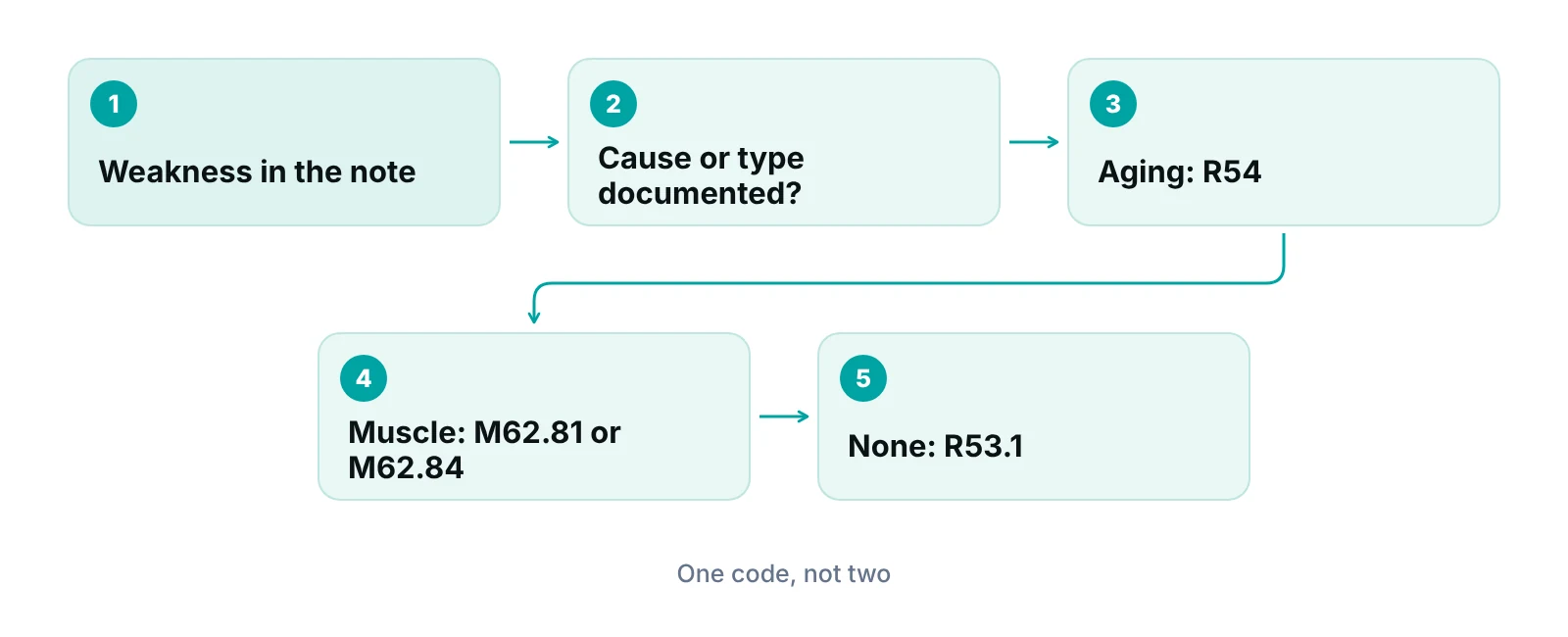
How do you choose between R53.1, M62.81, M62.84 and R54?
Choose by what the provider documented, not by what the word “weakness” suggests. The guidelines state that “the assignment of a diagnosis code is based on the provider’s diagnostic statement that the condition exists” (Section I.A.19). A coder cannot upgrade a vague note to a more specific diagnosis, and should not default to the vaguest code when the note is specific.
| What the note says | Code to check | Why |
|---|---|---|
| Generalized weakness, no cause or diagnosis stated | R53.1 | Symptom code for weakness when nothing more specific is documented |
| Generalized muscle weakness | M62.81 | Named in the R53.1 Excludes1 list |
| Sarcopenia | M62.84 | A diagnosis, and named in the R53.1 Excludes1 list |
| Frailty, senile asthenia or age-related debility | R54 | Inclusion terms under R54; R53.1 excludes senile asthenia |
| Tiredness, lethargy or lack of energy | R53.83 | Fatigue terms are inclusion terms under R53.83 |
| Weakness with a stated, specific cause | The code for that cause | Symptom codes give way to a definitive diagnosis where one is established |
Source: ICD-10-CM tabular list, R53 and R54; ICD-10-CM Official Guidelines FY 2027, Sections I.A.19 and I.B.4.
For practices that see many older patients, this is where documentation habits matter most. A geriatric visit note that says “frail” points to R54, while the same visit with “generalized muscle weakness” points to M62.81. Our geriatrics billing and revenue cycle page covers how age-related care changes the documentation a practice needs.
“The code a coder can defend is the one the provider’s own words support. If the words are vague, the fix is a query to the provider, not a guess in the coding screen.”
When is it correct to report weakness as a symptom?
Report a symptom code when the provider has not established a related diagnosis. The guidelines say symptom and sign codes “are acceptable for reporting purposes when a related definitive diagnosis has not been established (confirmed) by the provider” (Section I.B.4). Section I.B.18 repeats the idea for encounters where no definitive diagnosis exists by the end of the visit.
The opposite rule matters just as much. Section I.B.5 says signs and symptoms that are associated routinely with a disease process should not be assigned as additional codes. If weakness is an expected part of a confirmed diagnosis, adding R53.1 on top of that diagnosis usually adds nothing and may invite a question from the payer.
- Weakness is the reason for the visit and no cause is documented: R53.1 can describe the encounter.
- The work-up establishes a diagnosis: report the diagnosis the provider documents, and review whether the weakness is routinely part of it.
- The provider documents a narrower weakness term: use the narrower code and drop R53.1.
- The note is unclear: query the provider before coding. Do not assume.
Chapter 18 of the guidelines has its own subsections on using symptom codes alone, with a definitive diagnosis, and in combination codes. Staff who code symptom-heavy specialties should read that chapter directly. For related symptom-code examples, see our posts on chest pain ICD-10 codes and back pain ICD-10 codes.
Is chronic fatigue syndrome coded to R53.1?
No. Chronic fatigue syndrome is not reported with R53.1. The tabular list sends chronic fatigue syndrome and myalgic encephalomyelitis to G93.32, postviral fatigue syndrome to G93.31 and other post infection and related fatigue syndromes to G93.39. Those entries appear as Excludes1 notes under R53.82, chronic fatigue, unspecified.
Older articles, including an earlier version of this post, listed chronic fatigue syndrome as a use for R53.1. That was wrong. If a patient has a documented fatigue syndrome, go to the G93.3 family. If the provider documents only fatigue, tiredness or lethargy, R53.83 is the family member that carries those terms.
What are the most common R53 family coding mistakes?
Most errors in this code family come from three habits: reaching for the first weakness-sounding code, copying a code forward from a prior visit, and treating a symptom code as if it were a diagnosis. Each is easy to catch if a reviewer knows what to look for.
- Defaulting to R53.1: the note says “muscle weakness” or “frail,” but the claim carries R53.1. The narrower code should have been used.
- Pairing excluded codes: R53.1 appears next to M62.81, M62.84 or R54 on one encounter, against the Excludes1 notes.
- Misfiling fatigue syndromes: chronic fatigue syndrome or postviral fatigue is placed in the R53 family instead of the G93.3 family.
- Stale symptom codes: the diagnosis was established at a prior visit, yet the symptom code keeps being reported.
- Sequencing U09.9 first: the post-COVID code is listed ahead of the specific related condition it is meant to follow.
None of these requires special software to fix. They need a clear reference sheet, a habit of reading the provider’s exact wording, and a short feedback loop between coders and clinicians. If your team handles claims for many providers, the loop is worth building early, because the same phrasing habits tend to repeat across a template.
It also helps to remember what a symptom code cannot do. It describes why the patient came in; it does not tell the payer what the condition is. If a payer policy ties a service to a specific diagnosis, a symptom code may not meet that policy, and the practice should check the payer’s own coverage rules rather than assume. That check belongs in front-end review, before the claim goes out.
How should post-COVID weakness be coded?
U09.9 is not a stand-alone primary code for post-COVID weakness. Its tabular note, as shown on AAPC’s code page, tells coders to code first the specific condition related to COVID-19 if known. The FY 2027 guidelines add that U09.9 should not be assigned for manifestations of an active, current COVID-19 infection.
| Code | What it is | Rule to check |
|---|---|---|
| U09.9 | Post COVID-19 condition, unspecified | Code first the specific related condition if known. Not for manifestations of active COVID-19. |
| U07.1 | COVID-19 | Used for the current infection. The guidelines allow U09.9 with U07.1 to identify that the patient also has a condition from a prior infection. |
| R53.1 or another weakness code | Symptom or muscle code | Report only if the provider documents it and the Excludes1 rules still permit it. Query the provider if the link to COVID-19 is unclear. |
Source: ICD-10-CM Official Guidelines FY 2027, Section I.C.1.g.1; AAPC U09.9 code page. Confirm the U09.9 note in the current tabular file.
Two points correct common errors. U07.1 is the code for COVID-19 itself, not a label for “ongoing infections.” And U09.9 does not give coders permission to add R53.1 by default. The provider has to document the link and the symptom.
What documentation keeps weakness claims clean?
A clean weakness claim shows who documented what and when. Because R53.1 is a symptom code, it is the one a reviewer asks about first: why was no cause established, and is the narrower code a better fit? A short, specific note answers both questions before they are asked.
- State the type of weakness in the provider’s own words: generalized, muscle, age-related, or fatigue.
- Record onset, duration and any work-up ordered, so a reviewer can see why a symptom code was used.
- Update the diagnosis when the work-up ends. A symptom code carried forward after a diagnosis is made is a common mismatch.
- Avoid copy-forward text that repeats “weakness” across visits when the clinical picture has changed.
Coding errors surface as rejections, edits and denials that cost staff time. A practice that sees repeated diagnosis-related returns can start with our guides to clean claims and CO-16 denials, and use medical billing services support for coding review. A recurring code-pair check also belongs in any medical coding audit.
Want a second set of eyes on your diagnosis coding?
A free practice audit looks at where diagnosis coding, edits and denials may be costing your practice time and revenue.
Our recommendations
- Build a code-pair check for the R53 family. We recommend adding a scrubber or review rule that flags R53.1 on the same encounter as M62.81, M62.84 or R54, since the tabular list excludes those pairs.
- Give coders a short provider-query template. When a note says only “weakness,” a one-line query asking for the type, cause or diagnosis is faster than a rework later.
- Fix old reference sheets. Search internal cheat sheets for chronic fatigue syndrome listed under R53.1 or U09.9 listed as a primary code. Both are wrong and should be replaced.
- Review symptom codes after the work-up ends. We recommend a rule that a symptom code is revisited when a diagnosis is established, so R53.1 does not ride along after the cause is known.
- Sample audit each quarter. Pull a small sample of weakness encounters and compare the note to the code. Track the findings by provider so training stays targeted.
Bottom line
ICD-10 R53.1 is the symptom code for weakness, and it gives way to R54, M62.81 or M62.84 whenever the provider documents one of those. Check the note, apply the Excludes1 list, and query the provider when the wording is vague. If coding mismatches keep turning into returned claims, our denial management services can trace them to the cause, you can estimate the stakes with the revenue calculator, or you can talk to our team or request a free practice audit.
Frequently asked questions
What is ICD-10 R53.1 used for?
R53.1 is the ICD-10-CM symptom code titled Weakness, with asthenia NOS as an inclusion term. It describes generalized weakness when the provider has not documented a more specific cause or a narrower code applies. It is not a diagnosis of any condition. Check the provider’s wording and the Excludes1 list before reporting it, and query the provider when the note only says weakness without context.
Can R53.1 and M62.81 be billed together?
No. The tabular list carries an Excludes1 note under R53.1 for muscle weakness (generalized), M62.81. Excludes1 means the codes are not reported together, so choose the one that matches the provider’s wording. Query the provider if the note is unclear, and fix the code pair before the claim is submitted rather than after a rejection or audit finding.
Which code applies to weakness in an older adult, R53.1 or R54?
It depends on the documentation. R54, age-related physical debility, carries inclusion terms such as frailty, senile asthenia and senile debility, and R53.1 excludes age-related weakness and senile asthenia. If the note documents those terms, R54 applies instead of R53.1. If the note instead says generalized muscle weakness, M62.81 is the code to check, and sarcopenia goes to M62.84.
Is chronic fatigue syndrome coded to R53.1?
No. The tabular list directs chronic fatigue syndrome to G93.32, postviral fatigue syndrome to G93.31 and other post infection fatigue syndromes to G93.39. Plain fatigue, tiredness or lethargy goes to R53.83, not R53.1. Older guides that list chronic fatigue syndrome under R53.1 are out of date and should be corrected in any reference sheet.
Should U09.9 be listed first for post-COVID weakness?
Generally no. U09.9 carries a code-first note for the specific condition related to COVID-19, if known, and it is not assigned for manifestations of active infection. The provider has to document the link before weakness is attributed to COVID-19. When the note is unclear, send the provider a query.
What should a practice do when the note only says weakness?
Send the provider a short query asking for the type of weakness, any cause or diagnosis, and whether it is muscle-related or age-related. If the answer stays vague, R53.1 may be the code the documentation supports. Keep the query and the reply in the record so the choice can be explained later.
Get your free practice audit
Tell us about your practice. We will contact you using the details you give.
- A review of your recent claims, denials and A/R aging
- Where your front desk and prior authorizations slow payment
- A prioritized fix list you keep, whether or not you hire us
Pricing is quoted after the audit, based on your volume and the services you choose. Prefer to talk? Call +1 (302) 556-2288.
Sources
- ICD-10-CM Official Guidelines for Coding and Reporting, FY 2027 (October 1, 2026) — CDC / National Center for Health Statistics (2026)
- ICD-10-CM tabular list, R53 Malaise and fatigue and R54 (Skyscape-hosted tabular edition) — Skyscape (reproduction of the ICD-10-CM tabular list)
- U09.9 Post COVID-19 condition, unspecified — AAPC
- ICD-10-CM FY 2027 files directory — CDC / National Center for Health Statistics (2026)
Disclaimer: This article is educational and is not legal, coding, billing, clinical or compliance advice. ICD-10-CM code sets and guidelines are updated each October, and payer policies vary. Verify current requirements against the official code set, your payers and qualified counsel before you act.