
The two-midnight rule is a Medicare payment standard: inpatient admission is generally appropriate when the admitting physician expects medically necessary hospital care to cross two midnights, and that expectation is documented. Shorter stays are usually outpatient, which includes observation, unless an exception applies.
This post corrects common misreadings, including how time of admission works and which procedures are inpatient-only. It is written for practice owners, billing managers and hospital-facing teams who need to know why status decisions turn into denials, and what to document before a claim leaves.
Key takeaways
- The benchmark depends on the physician’s documented expectation, plus a valid inpatient order.
- Observation is outpatient care, and stays under two midnights are generally outpatient.
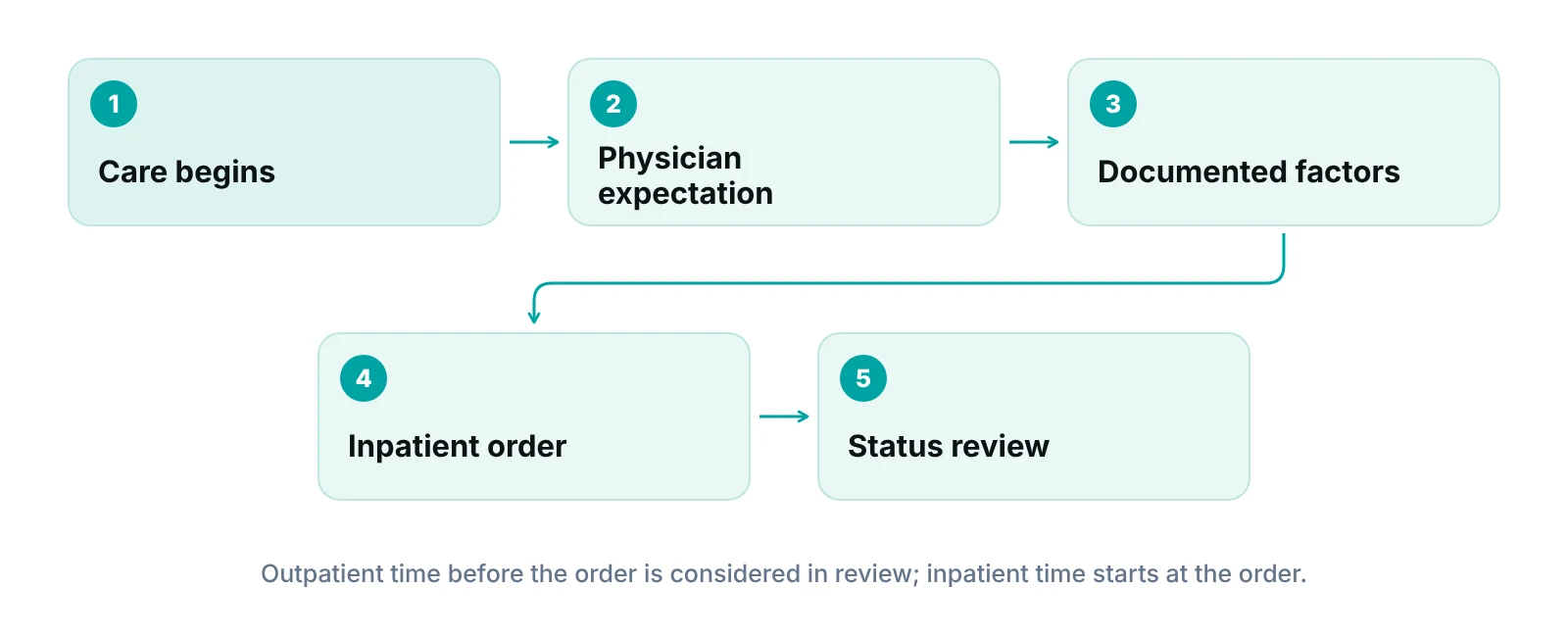
- Outpatient ED and observation time after care begins is considered in review; inpatient time starts at the order.
- Exceptions exist, but each depends on the record.
- The IPO list is being phased out, so check the current list for each date of service.
What the two-midnight rule actually says
It is a Medicare Part A payment test, not a clock rule. Under 42 CFR 412.3(d), an inpatient admission is generally appropriate for Part A payment when the admitting physician expects the patient to need hospital care that crosses two midnights. The physician bases that expectation on complex medical factors, and the factors must be documented in the medical record.
CMS adopted the benchmark for admissions on or after October 1, 2013, replacing an earlier 24-hour benchmark, according to its standards-for-admission summary. The same document describes the expectation as one part of a complex medical judgment, not a stopwatch.
Three details trip people up. First, the rule turns on the physician’s expectation at the time of the admission decision, not on how the stay turned out. Second, it measures midnights crossed, not total hours. Third, it is a hospital inpatient payment standard. Your professional (physician fee) claims follow separate rules, so ask your coder how your payers treat them.
What counts as a physician order
Inpatient status also needs a formal order. The regulation requires an order for inpatient admission from a qualified, licensed practitioner with admitting privileges, and the order must be in place at or before the time of admission (42 CFR 412.3). A chart that describes an admission but lacks a valid order is a payment risk on its own.
Inpatient vs observation: what really separates them
Observation is outpatient care. The Medicare Benefit Policy Manual defines observation as a set of short-term services used to decide whether a patient needs admission or can go home, and it says the patient’s status is that of an outpatient (Chapter 6, section 20.6). So “under two midnights means observation” is too narrow. A short stay is generally outpatient, and observation is one kind of outpatient service.
| Question | Inpatient | Observation (outpatient) |
|---|---|---|
| Patient status | Inpatient, only after a formal admission order | Outpatient. The patient stays an outpatient while observed |
| Basis for the decision | Physician expects medically necessary hospital care to cross two midnights, documented in the record | Time to decide whether admission is needed or discharge is safe |
| Typical length | Expected to cross two midnights (exceptions below) | Usually under 24 hours; only rarely beyond 48 hours |
| What the record must show | The factors behind the expectation, plus the order at or before admission | Why short-term assessment was needed before a decision |
Source: 42 CFR 412.3 (eCFR text, amended through 2025); CMS Medicare Benefit Policy Manual, Chapter 6, section 20.6
Notice what the table does not say. It does not say inpatient pays more or observation pays less. Payment depends on the claim type, the payer and the services, so we do not quote average payment figures here.
How the midnights are counted (and why an 11:59 PM vs 12:01 AM example misleads)
The clock does not start at the admission order, and it does not depend on a clock time of admission. In CMS’s 2013 question-and-answer document, reviewers count time the patient spends receiving hospital outpatient services, such as ED care and observation, toward the benchmark. The count starts when the patient starts receiving medically necessary services after arrival. Waiting time and triage before that do not count (CMS Q&A, Q4).
CMS gives a simple illustration: a patient still waiting in the ED at midnight has not yet crossed a first midnight, while a patient already receiving ED services at midnight has. Inpatient time, by contrast, begins only once the patient is formally admitted on a physician’s order.
A common example says a 26-hour stay is inpatient if admitted at 11:59 PM and observation if admitted at 12:01 AM. That mixes up two things. The admission order time decides when inpatient status starts. The care already delivered, and the physician’s documented expectation for what remains, decides whether the benchmark is met.
Do not backdate or reverse-engineer
If the expectation changed during the stay, the record should show when and why. Writing an order that implies an earlier decision than the chart supports invites a denial and a harder audit.
Exceptions: when a stay under two midnights can still be inpatient
Several exceptions exist. The main ones appear in 42 CFR 412.3(d) and in CMS’s standards summary. Some summaries also list a mechanical-ventilation exception; we could not find it in either source, so check any payer-specific rule before relying on it.
| Situation | What the rule says | Where it comes from |
|---|---|---|
| Unforeseen event shortens the stay | A death, transfer or similar event after a reasonable two-midnight expectation can still support inpatient payment | 42 CFR 412.3(d)(1)(ii) |
| Inpatient-only surgical procedure | Inpatient admission is generally appropriate regardless of expected duration | 42 CFR 412.3(d)(2) |
| Case-by-case exception | Physician expects a shorter stay but documents complex medical factors that justify inpatient care | 42 CFR 412.3(d)(3); effective January 1, 2016 |
| Early improvement or leaving against advice | May qualify if the original expectation was reasonable and documented | CMS 2013 Q&A, Q11 to Q13 |
Source: 42 CFR 412.3 (eCFR text); CMS Two-Midnight standards summary; CMS Q&A (November 2013)
Every exception depends on documentation. If the record does not show the expectation, the factors and the reason things changed, a reviewer has little to work with.
The inpatient-only list is changing, and older examples are out of date
CMS is phasing out the inpatient-only (IPO) list over three years. The calendar year 2026 outpatient final rule starts with 285 procedures, mostly musculoskeletal, so Medicare can pay for them in the outpatient setting when clinically appropriate (CMS CY 2026 OPPS/ASC fact sheet).
Older guides often list knee replacement, spinal fusion, heart valve replacement and organ transplant as inpatient-only examples. We could not confirm those examples against a current CMS source, so we do not repeat them. Before you treat any procedure as inpatient-only, check the current list for the date of service.
CMS has also exempted procedures removed from the IPO list from certain two-midnight medical review activities, and it continues that exemption for 2026 and later until a procedure is more commonly done in outpatient settings (same fact sheet). Orthopedic groups should watch this most closely; see how orthopedic billing and revenue cycle support handles status and site-of-service questions.
| Date | Change | Why a practice cares |
|---|---|---|
| October 1, 2013 | Two-midnight benchmark adopted for admissions on or after this date | Replaced the earlier 24-hour benchmark |
| January 1, 2016 | Case-by-case exception begins | Shorter stays can be inpatient with strong documentation |
| 2024 plan year | CMS Medicare Advantage rule applies the benchmark to MA plans | Same documentation standard with MA payers |
| Calendar year 2026 | Phase-out of the IPO list starts with 285 procedures | Site-of-service and status questions shift for removed procedures |
Source: CMS Two-Midnight standards summary; CMS CY 2026 OPPS/ASC final rule fact sheet; American Hospital Association summary of CMS Medicare Advantage FAQs (2024)
Medicare Advantage plans now follow the benchmark too
Since the 2024 plan year, Medicare Advantage (MA) plans must follow the same inpatient admission benchmark. CMS issued FAQs on the final rule (CMS-4201-F) covering coverage criteria and utilization management, as summarized by the American Hospital Association. A health plan’s own summary of the rule says MA plans must cover and pay for an inpatient admission when the physician expects care to cross two midnights with documented complex medical factors, and that plans may use prior authorization or concurrent review to confirm those factors are documented (Pennsylvania Health and Wellness, citing 88 Fed. Reg. 22120).
A law-and-accounting firm’s review also reports that plans can no longer retrospectively deny inpatient status when unforeseen events such as death or leaving against medical advice shorten a stay (Forvis Mazars). Treat the plan-side details as a lead to check against your payer contracts and the Federal Register text, not as the final word.
For a billing team, the practical point is this: the habit of keeping one documentation standard for Medicare and a looser one for MA no longer holds up. Build one standard and apply it to every Medicare-based payer.
Where status errors turn into denials and audits
Most status problems are documentation problems. CMS says admission decisions are subject to medical review, and the expectation must be supported by the record (CMS standards summary). The usual failure points are easy to list.
- No documented reason for the expected length of care, only a diagnosis.
- An inpatient order that is missing, late, or signed by someone without admitting privileges.
- An expectation that changed mid-stay with no note explaining why.
- Outpatient time in the ED or observation that never appears on the inpatient claim, so the reviewer cannot see the full picture. CMS notes that inpatient claims report only inpatient time (Q15).
“The rule is simple to state and hard to prove after the fact. If the reason is not in the chart on the day, it will be argued about for months.”
When a status denial or audit request arrives, the response is a documentation exercise. Our guides to RAC audits and medical coding audits explain how reviews generally run, and denial management covers how to track and appeal what comes back.
Want a second set of eyes on your denials?
A free practice audit looks at where claims are being held up, including status-related denials, and what your team can fix first.
A workflow that keeps status clean
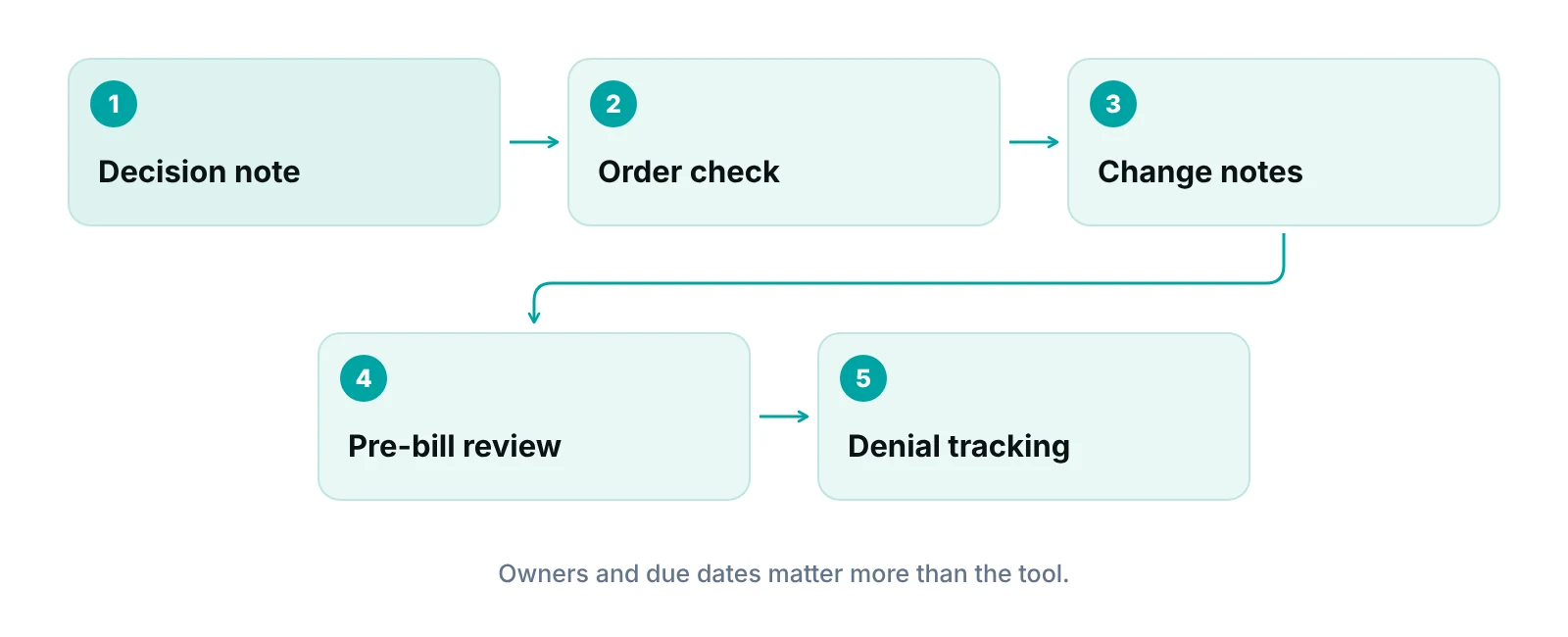
Put the status check before the claim, not after the denial. The steps below are a general process, not a legal standard. Your compliance officer and your payer contracts set the final rules.
- Capture the expectation at the decision point. The admitting physician records the expected course and the specific factors behind it: history, comorbidities, severity of signs and symptoms, current needs and risk of an adverse event.
- Confirm the order. Check that a valid inpatient order exists from a practitioner with admitting privileges, and that it was written at or before admission.
- Record changes as they happen. If the plan changes, a short note should say what changed and why, in the same shift.
- Reconcile before billing. Billing compares the order, the notes and the dates of service. Mismatches go back to the clinician before the claim leaves.
- Work the denials by reason. Track status denials separately, so patterns point to training or process gaps.
Many teams run this reconciliation by hand. If you outsource part of it, look for medical billing services that will say, in writing, who checks the order and who handles the appeal. Our team works with the EHR you already use, so the checks happen where your records already live.
Who needs to care about the two-midnight rule
It matters most to hospitals, hospitalist groups and billing teams that support them. Smaller practices feel it indirectly, for example when a specialist admits patients, when a procedure moves between settings, or when a referral lands in a short hospital stay.
If your practice does joint or spine work, the shifting IPO list also touches how procedures are coded and billed; our guide to joint replacement billing and coding covers the practice side. For wider Medicare billing rules, start with the Medicare fee-for-service billing and coding guide and the medical billing compliance guide.
Put a number on what denials cost you
The revenue calculator gives a rough view of what unresolved denials and slow follow-up may be costing. It is an estimate, not a quote.
Our recommendations
- Teach the expectation, not the clock. We would train clinicians to write why they expect a stay to cross two midnights, in specific clinical terms. A time stamp alone does not carry the argument.
- Make the order check a hard stop. Before billing releases a claim, someone confirms the order, its author and its timing. This is a thirty-second check that prevents a long dispute.
- Document changes in the moment. Add a brief note when the plan shifts. Late addenda are weaker than same-shift notes.
- Review the IPO list on each date of service. The list is being phased out in stages. Do not rely on last year’s list or on any static table.
- Use one standard across Medicare and MA. Since the 2024 plan year, MA plans follow the same benchmark. Confirm the details in each plan’s contract and provider manual.
- Track status denials as their own category. A separate denial reason lets you see whether the cause is training, process or payer behavior.
Bottom line
The two-midnight rule is easy to state and easy to get wrong: the physician’s documented expectation and a valid order matter far more than the clock time on an admission. If status errors keep turning into denials, start with documentation, then with a clear appeal process. Our denial management services are built for that follow-up, and you can talk to our team about what a review of your own denials would look like.
Frequently asked questions
What is the two-midnight rule in simple terms?
It is a Medicare standard saying inpatient admission is generally appropriate for Part A payment when the admitting physician expects medically necessary hospital care to cross two midnights and documents the reasons. Stays expected to be shorter are usually outpatient, such as observation, unless an exception applies.
Is observation the same as outpatient?
Observation is a type of outpatient service. Medicare’s manual says an observation patient’s status is that of an outpatient, and the purpose is to decide whether the patient needs admission or can be discharged. It usually lasts under 24 hours and only rarely extends beyond 48 hours.
Does the time of admission decide the status?
No. The inpatient order starts inpatient status, but the benchmark looks at the physician’s documented expectation and counts medically necessary care already received, including ED and observation time after care begins. Waiting and triage time before care starts does not count, per CMS’s 2013 Q&A.
Can a stay under two midnights still be inpatient?
Yes, in some cases. The regulation recognizes unforeseen events like death or transfer, inpatient-only procedures, and a case-by-case exception in which the physician documents complex medical factors. The record has to support the decision, and payer review can still apply.
Do Medicare Advantage plans have to follow the rule?
Since the 2024 plan year, CMS’s Medicare Advantage rule requires plans to follow the benchmark for inpatient admissions. Plan-side details, such as review process and prior authorization, vary by plan, so check each contract and provider manual.
Is the inpatient-only list still in use?
Yes, but CMS is phasing it out over three years, starting with 285 procedures in calendar year 2026. Always check the current list for the date of service before assuming a procedure must be inpatient. Procedures removed from the list fall back under the standard two-midnight rules, so documentation of the physician’s expectation matters for them too.
Get your free practice audit
Tell us about your practice. We will contact you using the details you give.
- A review of your recent claims, denials and A/R aging
- Where your front desk and prior authorizations slow payment
- A prioritized fix list you keep, whether or not you hire us
Pricing is quoted after the audit, based on your volume and the services you choose. Prefer to talk? Call +1 (302) 556-2288.
Sources
- 42 CFR 412.3 Admissions — eCFR / Cornell LII (2025)
- Standards for Medicare inpatient admission (two-midnight rule) — CMS (2024)
- Two-midnight Q&As — CMS (2013)
- CY 2026 OPPS/ASC final rule fact sheet — CMS (2025)
- Medicare Benefit Policy Manual, Chapter 6 — CMS (2013)
- CMS FAQs on the 2024 Medicare Advantage rule — American Hospital Association (2024)
- CMS Two Midnight Rule (provider notice) — Pennsylvania Health and Wellness (2024)
- Medicare two-midnight rule requirements for MA plans — Forvis Mazars (2024)
Disclaimer: This article is educational. It is not legal, coding or compliance advice, and payer rules vary. Confirm current rules with CMS, your Medicare Administrative Contractor, your payer contracts and your compliance officer before acting.