
Patient billing statements should show the services, charges, insurance payments and adjustments, the amount the patient owes, a due date and a billing phone number. Send the first one after the insurer has processed the claim. No federal rule we reviewed sets how often to send them, so set a schedule and check state law.
A patient opens your statement, cannot tell what insurance paid, and calls the front desk. Multiply that by every account in a month. The fix is rarely a nicer template. It is a statement that is correct, sent at the right time and written in words the patient uses.
This guide is for practice owners and billing managers deciding how to run patient statements. It replaces guesses about frequency with what the primary sources say and do not say. For payment plan setup, see our patient payment plans guide.
Key takeaways
- Show services, charges, insurance activity, patient payments, amount due, due date and a help number.
- Send the first statement after the insurer has processed the claim, then follow a set series.
- No federal rule reviewed here sets a statement schedule; payer contracts and state law may.
- Self-pay accounts should be checked against the good faith estimate before a statement goes out.
- Email a notice and a secure link rather than account detail.
What is a patient billing statement, and how is it different from an EOB?
A patient billing statement is the document your practice sends to show what was billed, what insurance paid or adjusted, and what the patient still owes. It comes from you. An explanation of benefits (EOB) comes from the insurer and explains how the claim was processed. The two should tell the same story. When they do not, the patient calls your front desk.
An industry brochure from the Patient Friendly Billing project, produced by a task force that included HFMA, MGMA and the AHA, made a small point that still holds: use one consistent name for each document. Calling the same page a bill in one place and an invoice in another confuses patients (Patient Friendly Billing brochure, 2001). Pick one term, and use it on the statement, the website and the phone script.
This guide covers the statement itself: what to put on it, when to send it, which federal rules touch it and who should run the process. For the insurer’s side of the story, see our guide to understanding an EOB. For how the patient share is worked out, see patient responsibility in medical billing.
What should a patient billing statement include?
A good statement lets the patient answer three questions without calling: what was this for, what did insurance do, and what do I owe now. The 2001 Patient Friendly Billing brochure lists the same core pieces: a description of services, total charges, amounts paid by insurers and patients, the amount still owed, and clear instructions on what the patient needs to do (HFMA et al., 2001).
| Element | What to show | Common mistake |
|---|---|---|
| Who and when | Practice name and billing address, patient name, account number, statement date | No account number, so staff cannot find the account fast |
| Services | Date of service, plain-language description, treating provider and location | A procedure code with no description |
| Charges | Charge for each service and the total | One lump sum with no line detail |
| Insurance activity | Insurer name, amount paid, contractual adjustment, date processed | Statement sent before the insurer has processed the claim |
| Patient payments | Copays and earlier payments, applied by date | A payment taken at check-in that does not appear |
| Amount due now | Patient balance, due date, ways to pay | Due date buried in small print |
| Help | Billing phone number and hours, how to ask a question, payment plan or financial assistance note | No phone number, or only a general office line |
Source: Patient Friendly Billing brochure (HFMA, MGMA, AHA task force, 2001) for the core elements; the mistakes column is our operating experience and judgment.
Write it in plain language
The same brochure advises writing for the general public with common words and simple sentences, avoiding acronyms and medical jargon, offering larger print where patients need it and considering other languages based on the patients you serve (HFMA et al., 2001). It is dated guidance, not law, but we would apply it today without changes.
- Describe the service in words first, then add the code if you want to show it.
- Say “Insurance paid” and “You owe” rather than “adjudicated” and “patient responsibility”.
- Use an account number on mailed statements instead of full date of birth. That is our practice recommendation to limit what a lost letter reveals.
- Keep the amount due and the due date in the top third of the first page.
If the patient is self-pay, the statement also has to be read against the good faith estimate you gave them. That is covered in the rules section below. If you are deciding how to present a payment plan option on the same page, we cover plan design and legal checks in our patient payment plans guide, so this post does not repeat them.
How often should you send patient billing statements?
The federal rules reviewed for this post, the No Surprises Act provisions in 45 CFR 149.430 and 149.610, do not set a statement schedule. So frequency is your own policy, shaped by payer contracts and state law. We recommend sending the first statement once the insurer has processed the claim and the patient balance is final, then sending follow-ups on a fixed series.
The 2001 brochure points the same way. It advises mailing statements daily rather than in one monthly batch, and using a series of escalating statements and letters for patients who owe money instead of resending the same page (HFMA et al., 2001). Daily mailing spreads the call volume across the month.
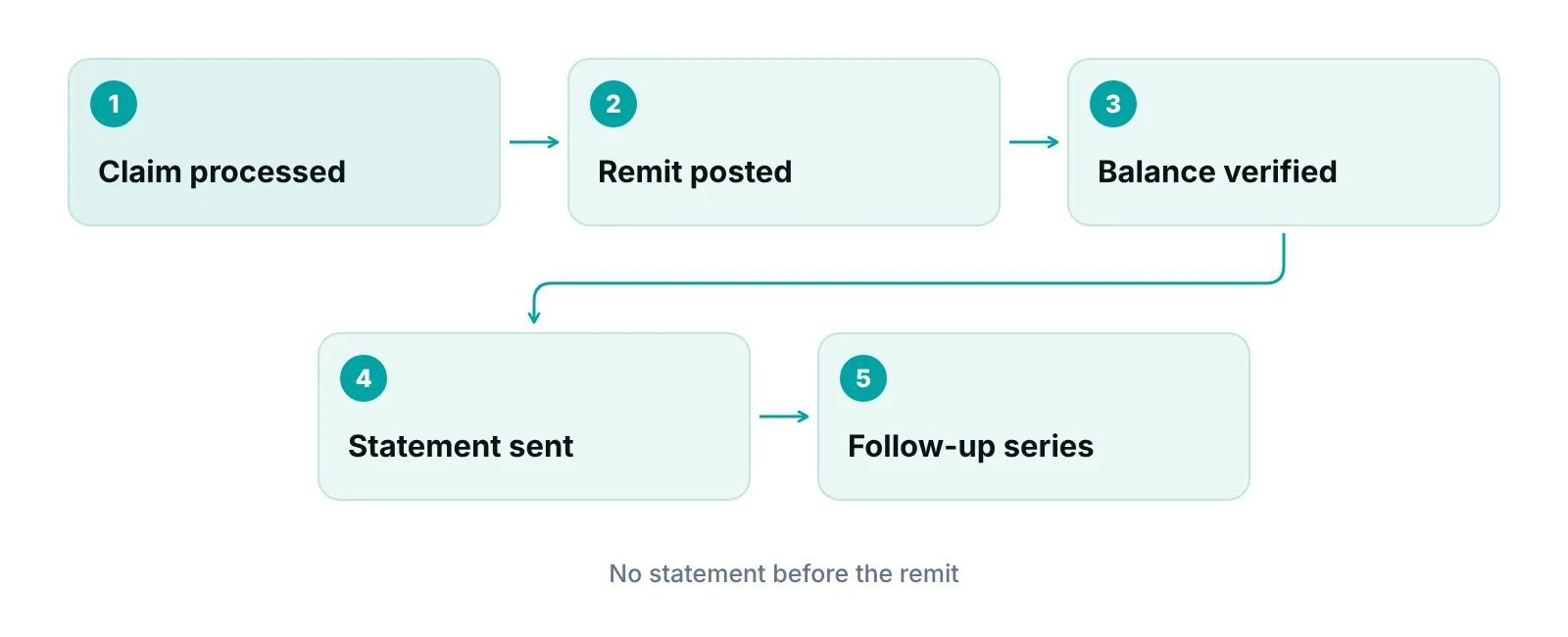
An example follow-up series
This is a sketch, not a rule. Set the intervals to fit your payer mix and your state’s requirements.
- First statement: sent after the remit is posted. Neutral tone, full detail, a clear “how to pay” and “how to ask a question” box.
- Second statement: a reminder with the due date and a mention of payment plan options.
- Third statement: a firmer notice that the account needs attention, with a direct phone number for the person who can help.
- Final notice: reviewed by a person before it goes out, and held if the account is in a dispute or the patient is on a plan.
We do not recommend weekly statements for every account. We could not find a primary source showing that a faster cycle improves collections, and a high frequency adds mail cost and patient calls. Test any change on a small group of accounts first. If balances are already aging past the series, our guide to improving patient collections and our A/R guide cover what to do next.
Which federal rules affect patient billing statements?
No single federal rule tells a physician practice what a statement must look like. Three sets of rules touch it: the No Surprises Act disclosure notice, the good faith estimate for self-pay patients, and HIPAA’s rules on how you reach the patient. Table 2 summarizes each from the primary text.
| Rule | Who it applies to | What it means for statements | Source |
|---|---|---|---|
| Surprise billing disclosure, 45 CFR 149.430 | Providers and facilities serving patients with coverage. A provider that does not furnish items or services at a facility, or in connection with a facility visit, need not comply. | A one-page notice, in print no smaller than 12-point, given by the date and time you request payment, or by claim submission if you do not request payment. Delivery in person, by mail or by email, as the patient chooses. | eCFR |
| Good faith estimate, 45 CFR 149.610 | Uninsured or self-pay patients, including insured patients who do not want a claim submitted | Written estimate with itemized expected charges. Deadlines run from 1 to 3 business days after scheduling or request. Part of the medical record; copies on request for 6 years. | eCFR |
| Patient-provider dispute resolution | Self-pay patients billed at least $400 more than the estimate | Patient may start a dispute; you must not send the bill to collections or threaten to, must pause existing collections, and must not charge late fees on the unpaid amount. | CMS |
| HIPAA communication requests | Covered health care providers | HHS says providers may communicate electronically with reasonable safeguards, and patients may request alternative means of communication, which should be accommodated. | HHS |
Sources: eCFR 45 CFR 149.430 and 149.610 (current text, applicable January 1, 2022); CMS provider payment resolution page; HHS HIPAA FAQ 570.
The disclosure notice and your payment request
The text of the rule ties the notice to the moment you ask the patient for payment (45 CFR 149.430). A statement asks for payment. Our reading is that if the rule applies to your practice, the notice should already be in the patient’s hands by the time the first statement or payment request goes out. That is our interpretation, so confirm it with your healthcare attorney. Many practices that only treat patients in their own office may fall under the exemption, but a practice that also sees patients at a hospital or surgery center should check whether the facility is handling the notice under a written agreement, which the rule allows.
Self-pay patients: the estimate is the benchmark
For a self-pay patient, the estimate you gave is the reference point for the statement. CMS says a bill must be at least $400 more than the expected charges on the estimate before the patient can use the federal dispute process (CMS). The 2021 CMS patient guidance adds that eligibility is judged separately for each provider or facility on the estimate, and that the patient must start the process within 120 calendar days of receiving the initial bill (CMS patient guidance, December 2021). So the statement for a self-pay account should be checked against the estimate before it goes out, and an account in a dispute should be held out of the collection letters. Our self-pay billing guide covers the rest of the self-pay workflow.
What this post does not cover
Interest, installment terms, Truth in Lending and credit reporting depend on how you structure a plan and on state law. We cover those in our payment plans guide. Have counsel review your statement templates and collection letters.
Not sure your statements pass a plain-language check?
We will review a sample of your statements and your send timing in a free practice audit and tell you what we would change.
How do you keep patient billing statements accurate before they go out?
Run a short pre-send check on every statement batch. Accuracy matters because patients do notice mistakes. In KFF’s 2022 Health Care Debt Survey, 43% of all adults said they had received a medical or dental bill in the past five years that they thought contained an error (KFF, 2022).
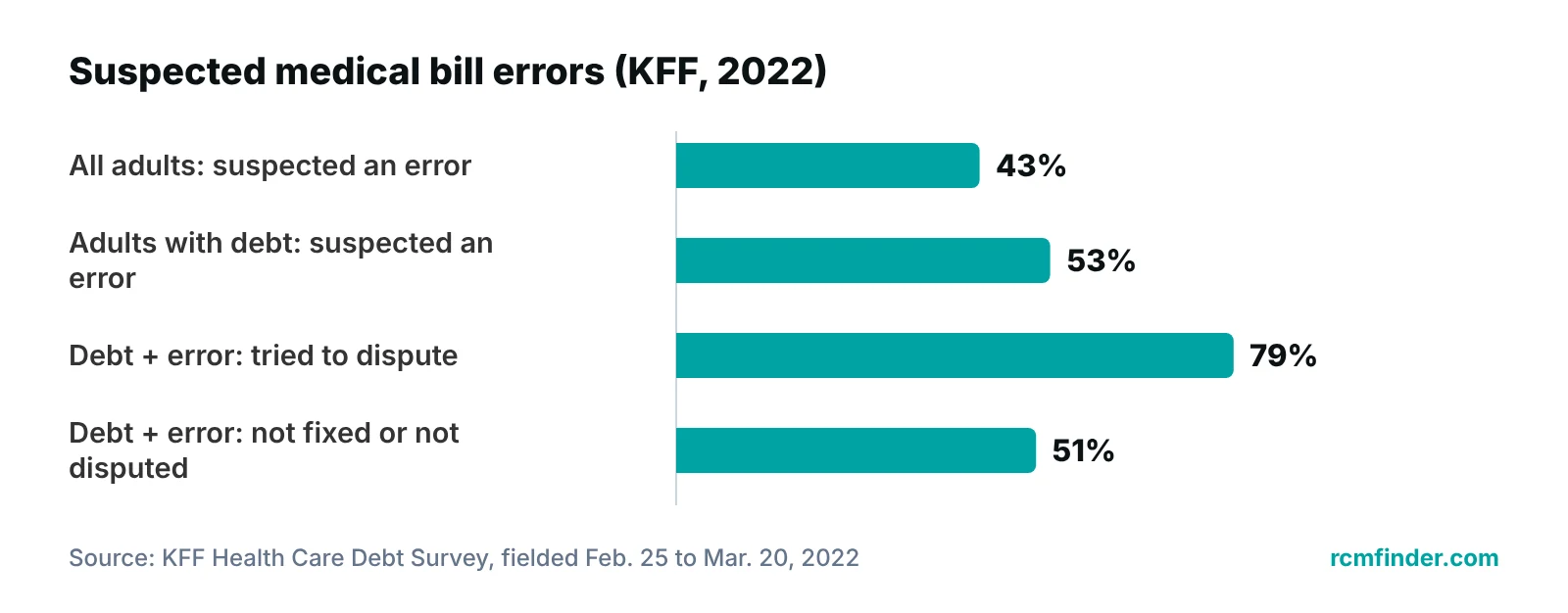
The same survey found that 79% of adults with health care debt who got a suspected erroneous bill took action to dispute it, while 51% of that group either could not fix the problem or did not try. Those are consumer figures about all medical bills, not about physician practices alone, so read them as a reason to check your own work, not as a benchmark.
A pre-send checklist
- The remit is posted. The insurer’s payment and adjustment are on the account, and the balance matches the EOB. See payment posting steps.
- The contractual adjustment is applied. The patient is not shown a balance that includes an amount the contract writes off.
- Secondary insurance is billed. A balance that a second payer may cover should not go to the patient yet.
- Payments and credits are applied. Copays collected at the visit appear by date.
- The account is not on hold. No pending appeal, dispute or payment plan that changes what the statement should say.
- The address and delivery choice are current. Returned mail goes back to a person, not a pile.
“A statement is often the first thing a patient reads from us after the visit. If it is wrong, they stop believing the rest.”
— Awais Afzal, Healthcare Operations & Data Analyst
Where one visit can create a large patient balance, a wrong statement costs more. Our specialty-specific billing support shows how we group specialties by billing pattern so the balance logic fits the service. For more on trust and clear pricing, see our post on billing transparency.
Should patient billing statements go out on paper or electronically?
Offer both and let the patient choose. Paper still reaches patients who have no portal login, and electronic delivery is faster. We found no primary-source survey we could cite on which format patients prefer, so we leave that number out and recommend asking each patient at registration.
Electronic delivery needs care about what goes in the message. HHS says covered providers may communicate electronically if they apply reasonable safeguards, and it names limiting the amount or type of information in an unencrypted email as one such safeguard. It also says patients may ask for alternative means of communication, and that if a patient finds unencrypted email unacceptable, the provider should offer something else, such as a more secure electronic method, mail or the phone (HHS HIPAA FAQ 570). That FAQ is about treatment-related email, so ask your compliance advisor how it applies to billing messages.
- Send a short email or text that says a statement is ready, with a link to a secure portal. Do not put the account detail in the message body.
- Record each patient’s delivery choice on the account, and honor it for every future statement.
- Keep a paper path for patients who ask for it, including a different mailing address if they request one.
- Review your overall privacy controls against our HIPAA compliance checklist for medical practices.
Who should run your patient statements: your office, a mail vendor or a billing partner?
Run statements in-house when volume is low and one person owns the follow-up. Add a print-and-mail vendor when production is the bottleneck. Use a billing partner when the real problem is the aging balance, not the printing. Table 3 compares the three.
| Option | Best when | Watch for | What your team still does |
|---|---|---|---|
| In-house from your PM or EHR | Low volume and a named owner for patient balances | Statements go out late when the owner is out; templates rarely get reviewed | Everything: posting, statements, calls |
| Print-and-mail vendor | Production and postage take too much staff time | The vendor prints what you send, so wrong balances still go out wrong | Posting, balance checks, patient calls |
| Billing partner for statements and A/R follow-up | Aged patient balances and unanswered statements pile up | Confirm who owns patient questions, template changes and held accounts | Front-desk collection, clinical questions |
Whichever route you choose, ask three questions. Who checks the balance before the statement prints? How are disputed or plan accounts held? And can you see every statement that was sent, with its date? Our A/R management services cover patient-balance follow-up, and our medical billing services cover the claims and posting that feed the statement.
See what unpaid patient balances are costing your practice
Use the calculator for a rough estimate from your own numbers, then bring it to a free audit.
Our recommendations
- Hold the first statement until the remit is posted. A statement sent before the insurer has processed the claim shows a balance that will change. We would build a rule that blocks it.
- Write a one-page statement standard. Use Table 1 as the starting point: required elements, one name for the document and a plain-language review before any template change.
- Put a help box on every page-one. A direct billing phone number, hours and how to ask a question. The 2001 brochure also recommends a clearly stated support process on printed communications.
- Mention payment options on the first statement. Tell the patient a plan exists and whom to call. Set the plan terms using our payment plans guide.
- Check the notice and estimate workflows with counsel. Confirm whether 45 CFR 149.430 applies to you and who delivers the notice, and that self-pay estimates are stored and compared with bills.
- Compare a handful of statements to the EOBs each month. Pull a few and check every line. Fix the cause, not just the statement.
- Ask each patient how they want to receive statements. Record the choice at registration and honor it.
Bottom line
A patient billing statement works when it is accurate, written in plain words and sent after the insurer has paid. Build a one-page standard, check balances before each batch, and have counsel confirm the notice and estimate rules for your practice. If statements are going out but balances still age, our A/R management services and medical billing services can take over the posting, statements and follow-up, and you can contact our team with questions about your process.
Frequently asked questions
What should a patient billing statement include?
Practice and patient identifiers, the date of service, a plain-language description, charges, insurance payments and adjustments, patient payments, the amount due now, a due date, ways to pay, and a billing phone number. See Table 1. Keep a consistent name for the document and write in simple words.
How often should we send patient billing statements?
No federal rule we reviewed sets a schedule, so it is your policy, subject to payer contracts and state law. We suggest a first statement after the insurer processes the claim, then a short series of follow-ups at intervals you set. Ask your attorney about state requirements.
Do we have to send the No Surprises Act notice with every statement?
The rule requires the one-page notice by the date and time you request payment, or by claim submission if you do not request payment, delivered in person, by mail or by email as the patient chooses. A provider that does not furnish services at a facility or in connection with a facility visit is exempt. Ask counsel how it applies to you.
Can we email patient statements?
HHS allows covered providers to communicate electronically with reasonable safeguards and says patients may ask for alternative means. We suggest emailing only a notice with a secure portal link, not the account detail, and offering mail to anyone who prefers it.
What if a self-pay patient's bill is much higher than the estimate?
CMS says a bill at least $400 above the good faith estimate for a provider qualifies the patient to start dispute resolution, and CMS patient guidance gives 120 calendar days from the initial bill. While a dispute is pending, do not send the bill to collections or threaten to, and do not charge late fees.
Should we send a statement before insurance pays?
We recommend not to. The balance can change when the insurer processes the claim, and the patient then holds two different numbers. Wait for the remit, check the balance against the EOB, then send the statement. Exceptions, such as a known self-pay balance, are a policy call.
Get your free practice audit
Tell us about your practice. We will contact you using the details you give.
- A review of your recent claims, denials and A/R aging
- Where your front desk and prior authorizations slow payment
- A prioritized fix list you keep, whether or not you hire us
Pricing is quoted after the audit, based on your volume and the services you choose. Prefer to talk? Call +1 (302) 556-2288.
Sources
- 45 CFR 149.430 Provider and facility disclosure requirements — eCFR (2026 (current text))
- 45 CFR 149.610 Requirements for good faith estimates for uninsured or self-pay individuals — eCFR (2026 (current text))
- Providers: payment resolution with patients — CMS (2026)
- Good faith estimate and patient-provider dispute resolution process for uninsured or self-pay individuals — CMS (CCIIO) (2021)
- Patient Friendly Billing brochure — HFMA, MGMA and AHA task force (Patient Friendly Billing project) (2001)
- Could consumer assistance be helpful to people facing medical debt? — KFF (2022)
- Does HIPAA permit health care providers to use email to discuss health issues with patients? — HHS (n.d.)
Disclaimer: This article is general educational information for medical practice operations. It is not legal, compliance or coding advice. Federal rules summarized here are described as of October 2026, and state law and payer contracts vary. Have a healthcare attorney review your statement templates, notices and collection letters before use.
