
Modifier 24 is appended to an E/M code when the same physician sees the patient during a postoperative period for a problem that is unrelated to the surgery. The record must show the visit was unrelated, because the global surgical package already covers routine follow-up.
Many surgical procedures come with a global period during which routine follow-up visits are already paid for. When the surgeon sees the same patient for something else, such as a cold or a blood pressure problem, the visit should be billable. Modifier 24 is how the claim says so.
This guide explains where modifier 24 fits, what the medical record has to show, and how it differs from modifiers 25, 57 and 79. Medicare contractors and commercial payers differ in the details, so check your own payers before you bill.
Key takeaways
- Modifier 24 goes on an E/M service during a postoperative period when the problem is unrelated to the surgery.
- The global package covers routine post-op care, so a visit for a complication or a normal follow-up is not billable with 24.
- Medicare contractors say the record must show the visit was unrelated; a diagnosis on the claim that supports it can satisfy the contractor without extra documents.
- Modifier 25 is for a significant, separate E/M on the same day as a procedure. Modifier 24 is for the postoperative window. Do not swap them.
What does modifier 24 mean?
Modifier 24 is described as an unrelated evaluation and management service by the same physician or qualified health professional during a postoperative period. It exists because the global surgical package already includes the usual follow-up care. Without the modifier, the payer reads a post-op E/M as part of that package and denies it.
Medicare’s own training material lists modifier 24 among the modifiers used with global surgery, alongside 25, 57, 58, 78 and 79, and marks documentation as required for it. A typical contractor example is a minor procedure with a 10-day global period, followed by a visit during those days for a respiratory infection. The E/M is billed with the infection diagnosis and modifier 24.
How do global periods set the window?
Each surgical code carries a global period. The length tells you how many days the surgeon’s package covers after the procedure.
| Indicator | Period | What it means for post-op visits |
|---|---|---|
| 000 | No pre- or post-operative period | Endoscopies and minor procedures with no follow-up days built in |
| 010 | 10-day post-operative period | Visits in those days are in the package unless unrelated |
| 090 | 90-day post-operative period, plus the day before surgery | Major procedures with the longest package |
Periods follow the Medicare global surgery booklet (MLN). Your payer may use a different convention.
Check the global days for the exact code, not the family of codes. The count starts from the day of surgery, and a pre-op visit the day before a major procedure sits inside the 90-day package.
When is modifier 24 the right choice?
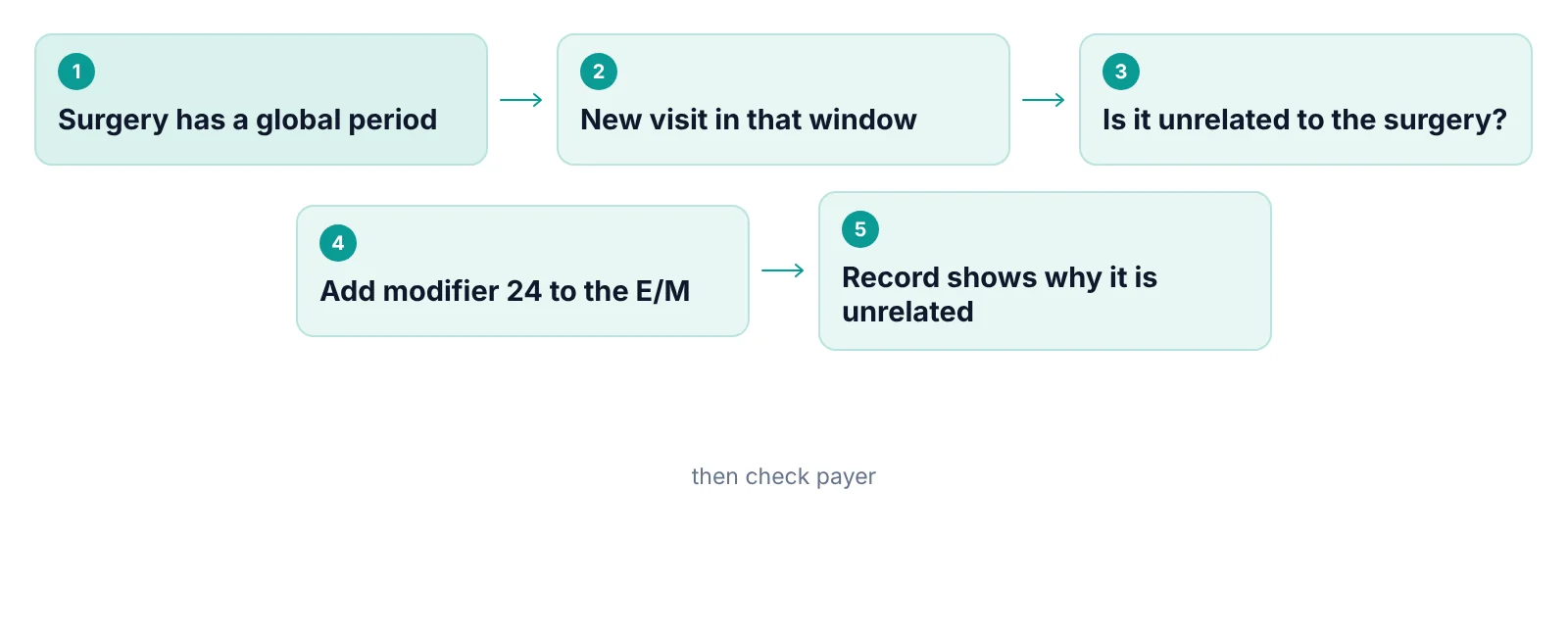
Use it when three things are true: the same physician is billing, the visit falls inside the postoperative period, and the problem being treated is not related to the surgery.
- A patient with a 10-day global procedure is seen for an unrelated respiratory infection. Bill the E/M with the infection diagnosis and 24.
- A patient two weeks into a 90-day global comes in for uncontrolled diabetes managed by the same surgeon. Bill the E/M with the diabetes diagnosis and 24.
- A different physician in another group sees the patient. Modifier 24 is not needed because the global package belongs to the surgeon’s group.
If a different surgeon in the same group and specialty sees the patient, many payers treat the two as one provider. See our guide to co-managing post-op care for how transfer of care works.
What should you not use modifier 24 for?
Contractors list several situations where 24 is wrong. The global package covers care for complications that do not need a return to the operating room, normal post-op visits and pain management by the surgeon.
| Situation | Why 24 does not apply | Better path |
|---|---|---|
| Routine follow-up visit | Part of the global package | Do not bill separately |
| Visit for a complication of the surgery | Related to the surgery and covered by the package, unless it needs a return to the OR | If a return to the OR is needed, see modifier 78 |
| Unrelated procedure in the post-op window | 24 is for E/M, not procedures | Use modifier 79 on the procedure |
| E/M on the day of a minor procedure | Not a postoperative visit | Modifier 25 may apply |
| Decision to perform a major procedure | Not a post-op visit | Modifier 57 on the E/M |
Check payer policy for how each is handled. See the related modifier guides below for the details of 25, 57 and 79.
Our guides to modifier 79 and modifiers 25 and 59 cover the neighbouring rules.
What must the record show?
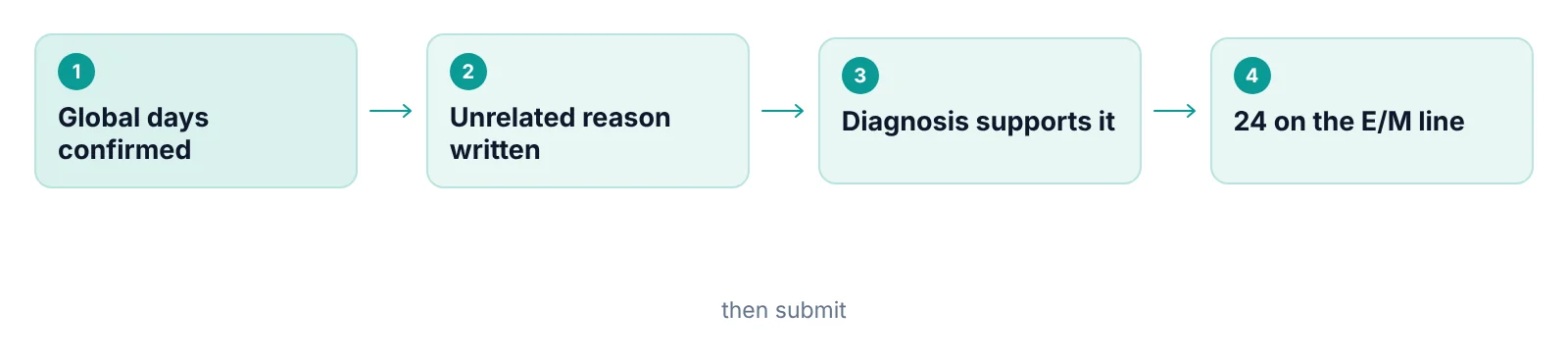
Contractor guidance says the medical record must show the visit was unrelated to the surgery. When the diagnosis on the claim supports that, extra documents are usually not needed. A note that treats a different condition with its own history, exam and plan is the strongest support.
- State the reason for the visit and the diagnosis in the provider’s own words.
- Show the problem is separate from the surgical site and the surgical recovery.
- Link the claim diagnosis to the unrelated problem, not the surgical diagnosis.
- Keep the date of the procedure and the global days in the chart so billing can verify the window.
Want a second pair of eyes on your claims?
Send us your recent denials and we will show where the same issue repeats. The audit is free and the fix list is yours to keep.
Strong notes also help in an audit. Our guide to clear documentation shows what reviewers look for.
How does 24 compare with 25, 57 and 79?
| Modifier | Applies to | Core test |
|---|---|---|
| 24 | E/M in the postoperative period | Visit is unrelated to the surgery |
| 25 | E/M on the day of a procedure | Significant, separately identifiable service |
| 57 | E/M the day of or before major surgery | Visit led to the decision for surgery |
| 79 | Procedure in the postoperative period | Procedure is unrelated to the first surgery |
Meanings are summarized from Medicare global surgery training material. Always check the current CPT manual.
The common thread: each modifier answers the payer’s question, “Why is this not part of the package?” Modifier 24 answers it for E/M visits after the operation.
What about the day of surgery and edge cases?
Contractor guidance describes modifier 24 for visits during the postoperative period, not on the day of the procedure. Some payers and coding references handle same-day edge cases differently, so write down how each of your main payers handles them rather than guessing.
Where there is doubt, send a short query to the payer or the Medicare contractor and file the answer. A written answer beats memory in an appeal.
Where modifier 24 sits among related modifiers
Modifier 24 is one of several tools for work that falls inside a global package. For reduced or stopped procedures, read modifier 52. For a return to the operating room, see modifier 91 and the broader view in CPT codes in medical billing.
Our recommendations
- Store global days in the charge master. A visible global indicator prevents post-op visits from being billed without thought.
- Add a “related to surgery?” question to post-op visit templates. The answer drives both coding and documentation.
- Hold E/M claims in the window for review. A quick check catches missing modifiers before the payer does.
- Match the claim diagnosis to the visit problem. A surgical diagnosis on an unrelated visit invites denial.
- Track 24 denials by payer. Use root cause analysis to see whether the issue is documentation or payer policy.
- Keep a payer policy sheet. One page per major payer on how they treat 24 saves repeated research.
Bottom line
Modifier 24 is a narrow tool. Use it for an E/M in the postoperative period when the problem is clearly unrelated, and make the record say so. Anything else belongs in the global package or under a different modifier. If your post-op claims keep denying, our medical billing services team can review the pattern with you.
Frequently asked questions
What is modifier 24 used for?
Modifier 24 marks an evaluation and management visit by the same physician during a postoperative period when the problem is unrelated to the surgery. It tells the payer the visit is not part of the global surgical package. The medical record needs to show the visit was unrelated, and the claim diagnosis should match the unrelated problem.
Does modifier 24 apply to procedures?
No. Modifier 24 is for E/M services only. A procedure during the postoperative period that is unrelated to the first surgery is usually reported with modifier 79 on the procedure code. Using 24 on a procedure line is a common error that leads to a denial, so check the code type before you add the modifier.
Can I bill modifier 24 for a complication?
Generally no. Care for complications of the surgery that does not require a return to the operating room is part of the global package under Medicare rules. Modifier 24 is for problems unrelated to the surgery. If a return to the operating room is needed, a different modifier applies, so review the payer policy.
Do I need to send documents with modifier 24?
Medicare contractor guidance says the record must show the service was unrelated, but a diagnosis on the claim that supports it can satisfy the contractor without extra documents. Keep the note ready in case of a request. Commercial payers vary, so check each payer’s policy before assuming no records will be requested.
Is modifier 24 different from modifier 25?
Yes. Modifier 25 is for a significant, separately identifiable E/M on the same day as a procedure. Modifier 24 is for an unrelated E/M in the postoperative period. Mixing them up can cause denials, because each modifier answers a different question about why the visit is not part of the surgical package.
How do I know the length of the global period?
Look up the procedure code in the Medicare Physician Fee Schedule, which lists a global indicator for each code, such as 000, 010 or 090. The indicator sets the length of the postoperative window. Commercial payers may follow Medicare or use their own rules, so confirm with each payer you bill.
Get your free practice audit
Tell us about your practice. We will contact you using the details you give.
- A review of your recent claims, denials and A/R aging
- Where your front desk and prior authorizations slow payment
- A prioritized fix list you keep, whether or not you hire us
Pricing is quoted after the audit, based on your volume and the services you choose. Prefer to talk? Call +1 (302) 556-2288.
Sources
- Modifier 24 — Noridian Healthcare Solutions (Medicare Administrative Contractor) (2026)
- Global Surgery Booklet (MLN907166) — Centers for Medicare & Medicaid Services (2025)
- Medicare Claims Processing Manual, Chapter 12 (Physicians/Nonphysician Practitioners) — Centers for Medicare & Medicaid Services (2026)
- NCCI Policy Manual for Medicare Services — Centers for Medicare & Medicaid Services (2026)
- Modifier 24 overview — JF Part B, Noridian Healthcare Solutions (2026)
- Medicare Physician Fee Schedule look-up tool — Centers for Medicare & Medicaid Services (2026)
Disclaimer: This article is educational and is not legal, coding, billing, medical or compliance advice. CPT codes and modifier descriptions are owned by the AMA, and code meanings, Medicare contractor policies and payer rules change and vary by payer, contractor and state. Verify current requirements with the official CPT manual, your payers and your counsel before you act.
