
Modifier 52 tells the payer a service was partly reduced or eliminated at the physician's discretion, while the CPT code stays the same. Use it only when no code describes what was done, document the reason, and never use it with E/M codes. If a procedure was stopped for safety, modifier 53, 73 or 74 may apply instead.
Modifier 52 is a payment modifier. It tells the payer you did less than the code describes, and most payers cut the payment when they see it. That makes it easy to get wrong in two directions: leaving it off when the service was reduced is an overbilling risk, and using it when a more precise code exists loses money. This guide covers the definition, the line between 52, 53, 73 and 74, claim reporting, documentation and payer differences, each tied to a source your coder can open.
Key takeaways
- Modifier 52 reports a service the physician reduced or eliminated in part, at the physician’s discretion, without changing the code.
- Modifier 53 is for a procedure stopped because of extenuating circumstances or a threat to the patient; 73 and 74 are facility modifiers for outpatient hospital and ASC procedures that involve anesthesia.
- Medicare physician claims put the words “reduced services” in Item 19 of the CMS-1500 with a brief reason; payers publish their own rules.
- Several published payer policies pay 52 at 50% of the contracted amount, but amounts and exclusions differ, so read each policy.
- Do not use 52 on E/M codes, or when a code already describes the work that was done.
What does modifier 52 mean?
Modifier 52 means a service or procedure was partially reduced or eliminated at the physician’s discretion. The basic service keeps its CPT code, so the payer can still see what was planned. Noridian’s Part B modifier page, Priority Health’s billing manual and a Commonwealth Care Alliance payment policy all restate the CPT wording this way: the modifier reports the reduction without disturbing the identification of the basic service.
We could not fetch the AMA CPT manual in this session, which owns the official wording, so we describe the definition in our own words from these pages. Your coder should read the modifier appendix in the current CPT book before you set a policy.
The key word is discretion. The physician chose to do less. That separates 52 from 53, where the procedure was stopped because circumstances demanded it. Table 1 lays out all four modifiers.
| Modifier | Plain meaning | Who reports it | Anesthesia line |
|---|---|---|---|
| 52 | Service reduced or partly eliminated at the physician’s discretion | Physician or facility, per payer policy | Services where anesthesia is not planned (Noridian; Priority Health) |
| 53 | Procedure started, then stopped because of extenuating circumstances or a threat to the patient | Physician claims; CMS says not approved for outpatient hospital services | Often anesthesia already started |
| 73 | Outpatient hospital or ASC procedure stopped after prep and transfer to the procedure room, before anesthesia | Facility | Before anesthesia |
| 74 | Outpatient hospital or ASC procedure stopped after anesthesia was given or the procedure had started | Facility | After anesthesia or start |
Source: CMS Transmittal 442 (2005); Noridian JF Part B; Commonwealth Care Alliance policy (effective 1 July 2026); Priority Health billing manual.
CMS defines anesthesia broadly for outpatient hospital billing. In Transmittal 442, it includes local, regional block, moderate sedation, deep sedation and general anesthesia. If your facility uses local anesthesia, that can move a stopped procedure out of 52 and into 73 or 74.
When is modifier 52 the right choice?
Use 52 when the service was reduced on purpose and no CPT code describes the lesser service. The clearest example comes from Noridian: fundus photography with interpretation (92250) done on one eye only. The code is allowed at a bilateral rate, so the practice reports 92250-52 and does not add RT or LT.
A second pattern is a reduced scope of a surgical or diagnostic service. A 2015 Physicians Practice article cites a CPT Assistant example: a laparoscopic pelvic lymphadenectomy (38572) where all nodes except the internal iliac nodes were removed. That article is dated, so treat the example as an illustration of the rule and not as current payer policy.
- Planned reduction: the physician decides before starting to do part of what the code describes.
- Reduction found at the time: the physician learns during the service that part is not needed, and chooses not to do it. An older AAPC article says the reduction does not have to be planned.
- A bilateral code done on one side: when the code carries a bilateral payment rate and no unilateral code exists, 52 is the usual choice (Noridian’s example).
Check for a better code first. Commonwealth Care Alliance’s policy says not to use 52, 53, 73 or 74 when a code already exists for the completed portion of the intended procedure. Priority Health says not to use 52 when a CPT code accurately describes the service performed. If a lesser code exists, report that code with no modifier.
How do you choose between 52, 53, 73 and 74?
Ask why the service was less than planned, who is billing, and where it happened. If the physician chose to do less, think 52. If the physician had to stop because of a threat to the patient, think 53 on a physician claim. If an outpatient hospital or ASC stopped a procedure that involves anesthesia, the facility uses 73 or 74.
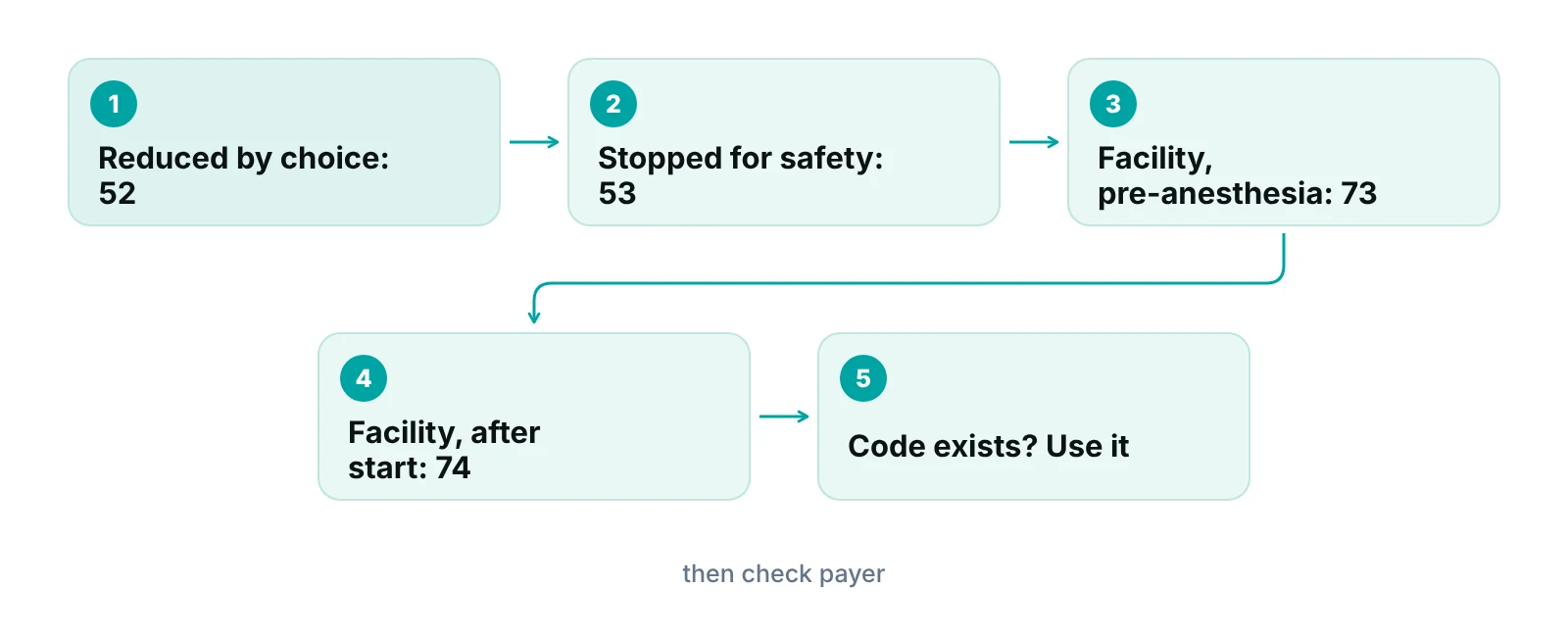
For facility claims, CMS Transmittal 442 (OPPS, 2005) says 73 applies once the patient has been prepared and taken to the procedure room but before anesthesia, and 74 applies after anesthesia or after the procedure has started, such as scope insertion or incision. CMS says to pay 73 at 50% of the OPPS amount and 74 at the full amount. If the procedure stopped before the patient reached the procedure room, it should not be reported. Elective cancellations are not reported.
Radiology is a special case. Transmittal 442 says 73 and 74 may not be used for discontinued radiology procedures, and that 52 applies to radiology procedures and other services that do not require anesthesia.
Colonoscopy is where 52 and 53 collide most often. A 2015 Physicians Practice article says the CPT book points to modifier 52 for an incomplete colonoscopy while CMS wants 53. CMS settled the Medicare side in MLN Matters MM10937: incomplete colonoscopies (codes 44388, 45378, G0105 and G0121) are reported with modifier 53 and paid at half the value of the inputs, effective 1 April 2019. A First Coast page dated August 2026 repeats the 53 instruction and asks for a narrative of how far the scope advanced. Other payers may follow CPT, so check. Our follow-up colonoscopy coding guide shows where this sits in screening claims.
How do you report modifier 52 and what must the record say?
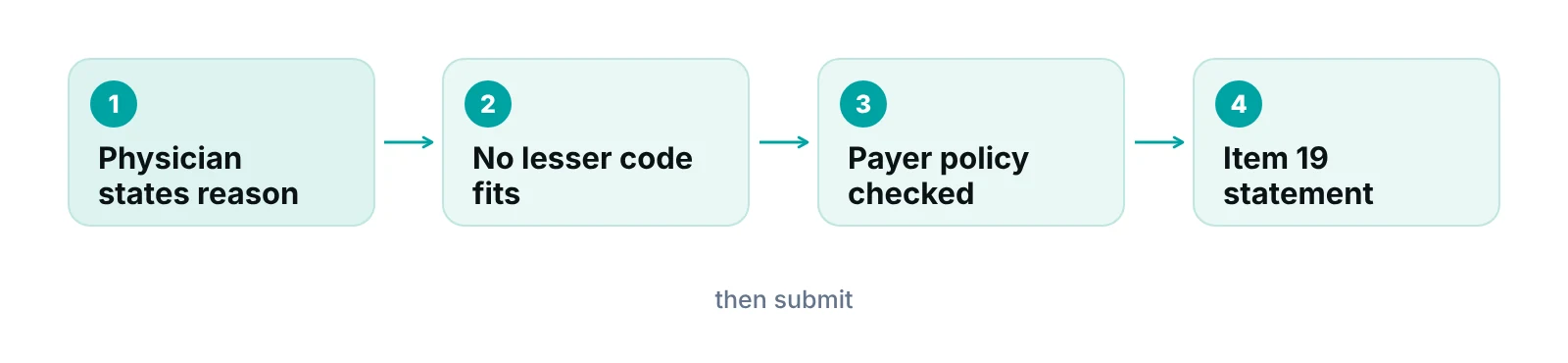
For Medicare physician claims, Noridian says to enter “reduced services” in Item 19 of the CMS-1500 (or the electronic equivalent), add a brief reason, and keep the complete reason in the patient record. Our CMS-1500 guide covers the form fields.
- What was planned: the code and the work it describes.
- What was done and what was left out: in plain words, such as “right eye only” or “left side not performed.”
- Why: the physician’s reason, in the physician’s own note, not the biller’s.
- The extent: an estimate of the share performed, when the payer asks for it. An older AAPC article advises documenting that estimate.
- Date and signature: so the note stands up in a review.
Documentation is the defense. Blue Cross Vermont’s policy says submitting the modifier indicates documentation exists and that records must be given promptly on request. Noridian says to send a short statement plus the operative report or chart notes when you ask for a redetermination.
There is a real disagreement on charges. Noridian’s example tells providers to reduce the charge by the percentage of the service not performed. The 2015 Physicians Practice piece advises leaving your normal fee and letting the payer decide. Pick one rule per payer, write it in your fee policy and apply it every time.
How do payers treat modifier 52?
Payers differ on percentage, on exclusions and on whether a facility or physician may report it. The table shows what the policies we read say. These are examples, not a national rule, and a policy can change on its next review date.
| Policy | Payment treatment | Notable limits |
|---|---|---|
| Noridian JF Part B (Medicare) | Contractors apply a 50% reduction to discontinued radiology and other no-anesthesia procedures from 1 Jan 2008; Medicare pays the lower of charge or fee schedule | Not for E/M codes; Item 19 statement required |
| Blue Cross Vermont (effective 1 Jan 2026) | Lesser of 50% of the contracted amount or allowed charges | Lab panel codes with 52 denied; 52 denied if the same service was already paid; modifier 50 removed when billed with 52 on one line |
| Commonwealth Care Alliance (effective 1 Jul 2026) | 50% of the contracted amount | Not for E/M; one procedure code; not for elective cancellations before anesthesia induction or surgical prep |
| Priority Health (page updated Jun 2025) | 50% of the base fee schedule | Not when a CPT code accurately describes the service; not for E/M; notes may be requested |
| Blue Cross ND (archived Oct 2021) | 50% of fee schedule; 80% for dates before 1 Oct 2019 | Not with time-based or E/M codes; policy now archived |
Source: Noridian; Blue Cross Vermont CPP_22; Commonwealth Care Alliance; Priority Health; Blue Cross ND policy NDRP-GC-004 (archived).
Treat any 50% figure as a statement about that policy only. We did not find a Medicare rule that sets 50% for every 52. Noridian ties its figure to discontinued radiology and other no-anesthesia procedures. Never quote a payment amount to a patient or a physician from a policy page without checking the payer’s fee schedule and your contract.
Policies also change the exclusions. Blue Cross Vermont denies lab panel codes with 52 and expects the individual tests, while Commonwealth Care Alliance limits 52 to a single procedure code per claim line. A payer grid that lists modifier handling for your top ten payers prevents most of these denials. Our claim scrubbing guide shows where to put that grid.
What should you not use modifier 52 for?
Do not use 52 to describe a bad day, a short visit or a coding preference. The table lists the mistakes we see most and the first check for each.
| Mistake | Why it fails | First check |
|---|---|---|
| 52 on an E/M code | Noridian, Priority Health and Commonwealth Care Alliance all list E/M as an incorrect use | Use the E/M level that fits the documented work |
| 52 when a code already fits | Payers say not to use it if a code describes what was done | Search the code set for the lesser service |
| 52 for a safety stop | The service was stopped by circumstances, not discretion | Consider 53 on a physician claim, or 73/74 on a facility claim |
| 52 for an elective cancellation | Policies exclude elective cancellations before prep or anesthesia | Do not report a procedure that never began |
| 52 with no note in the chart | The modifier signals a record exists; reviewers ask for it | Add the physician’s reason before the claim goes out |
| Both 52 and a lowered fee, without a rule | The payer may reduce again, or you may under-collect | Apply one written fee rule per payer |
Source: Noridian; Priority Health; Commonwealth Care Alliance; Blue Cross Vermont; Physicians Practice (2015).
Modifier 52 can also draw an audit if it appears on every claim for a code. A pattern of 52 on one procedure may signal that the code does not fit your service, or that you need a different code. Review 52 use by physician and by code each quarter. Our down-coding guide covers the payer side of the same issue.
Worked example and how to stay consistent
Example only (made-up, de-identified)
An ophthalmology practice sees a patient who needs a retinal photograph with interpretation in one eye only. The code is allowed at a bilateral rate. The physician documents “right eye only; left eye not indicated.” The practice reports 92250-52, enters “reduced services” and the reason in Item 19, and does not add RT or LT.
Before the claim goes out, the biller checks that the physician’s note states the reason, that no lesser code applies and that the payer’s policy allows 52 on this code. If the payer is Medicare, the biller also expects the 50% type of reduction Noridian describes for no-anesthesia procedures, and does not promise the practice a payment amount.
“Modifier 52 is a sentence in the chart before it is two characters on a claim. If the physician cannot say why the service was less, we should not report it.”
— Awais Afzal, Healthcare Operations & Data Analyst
Are claims with modifier 52 paying as expected?
Send us a sample of claims with reduced-service modifiers and the notes behind them. A free practice audit shows whether the issue is the modifier, the note or the payer policy.
Where modifier 52 sits among related modifiers
Modifier 52 is one of several that change how a claim is read. For modifiers that mark a separate visit or procedure, see modifiers 25 vs 59. For work during a global period, see our modifier 79 guide and our modifier 91 guide. If anesthesia is part of the claim, our anesthesia billing guide covers that side. If denials are the bigger problem, our denial management services page describes how we work through them.
Our recommendations
- Write a one-page modifier 52 policy. Define when your physicians and coders may use 52, who approves it and what the note must contain.
- Search for a lesser code first. Add a coder step to look for a code that matches the reduced service before any 52 is applied.
- Keep a payer grid. List percentage, exclusions and claim-field rules for 52, 53, 73 and 74 for your top payers, and date each entry.
- Train the physician on one sentence. Ask for a line in the note that says what was not done and why. That sentence supports the claim.
- Set one fee rule per payer. Decide whether you lower the charge or leave it to the payer, and apply it the same way every time.
- Review 52 use each quarter. Run a report by code and physician. A cluster of 52 on one code is a reason to re-check the code choice.
Bottom line
Use modifier 52 when the physician chose to do less than the code describes, no lesser code fits and the chart says why. Use 53, 73 or 74 when the reason is a stopped procedure. If reduced-service claims keep denying or paying unpredictably, a review of your medical billing services workflow can show where the gap is, and you can ask for a free practice audit.
Frequently asked questions
What is the difference between modifier 52 and modifier 53?
Modifier 52 reports a service the physician chose to reduce or partly eliminate. Modifier 53 reports a procedure stopped because of extenuating circumstances or a threat to the patient. Reason matters more than result. Medicare also wants 53, not 52, for an incomplete colonoscopy.
Does modifier 52 always cut payment by 50%?
No. Several published payer policies pay 52 at 50% of the contracted amount, and Noridian describes a 50% reduction for discontinued radiology and other no-anesthesia procedures. Other payers set their own rules, and older policies paid more. Read each payer’s policy and contract, and keep the findings in a payer grid so billers do not have to guess.
Can I use modifier 52 with an E/M code?
Noridian, Priority Health and Commonwealth Care Alliance all list E/M as an incorrect use of 52. If the visit was shorter than usual, code the level supported by the documentation instead.
Where do I explain modifier 52 on the claim?
For Medicare physician claims, Noridian says to enter “reduced services” in Item 19 of the CMS-1500 with a brief reason, and to keep the full reason in the record. Other payers may ask for an attachment, or for the notes on request, so the physician’s reason should be in the chart before the claim leaves.
When do I use 73 or 74 instead of 52?
Use 73 or 74 only on outpatient hospital or ASC facility claims for procedures that involve anesthesia. 73 is before anesthesia, after prep and transfer to the procedure room. 74 is after anesthesia or after the procedure started. Radiology without anesthesia stays with 52.
Does modifier 52 apply to an incomplete colonoscopy?
For Medicare, CMS says to report modifier 53 on an incomplete colonoscopy (MM10937). A 2015 article says the CPT book pointed to 52 for incomplete colonoscopy, and some payers follow CPT, so confirm the current CPT text and each payer’s policy before you choose.
Get your free practice audit
Tell us about your practice. We will contact you using the details you give.
- A review of your recent claims, denials and A/R aging
- Where your front desk and prior authorizations slow payment
- A prioritized fix list you keep, whether or not you hire us
Pricing is quoted after the audit, based on your volume and the services you choose. Prefer to talk? Call +1 (302) 556-2288.
Sources
- Modifier 52 (JF Part B) — Noridian Healthcare Solutions (2026 (page as read))
- Transmittal 442 (CR 3507): OPPS use of modifiers 52, 73 and 74 — CMS (2005)
- OPPS: Use of Modifiers 52, 73 and 74 for Reduced or Discontinued Services — HHS guidance repository (2005)
- MLN Matters MM10937: Incomplete colonoscopy payment — CMS (2018)
- Incomplete colonoscopy billing requirements — First Coast Service Options (2026)
- Payment Policy CPP_22: Modifiers 52, 53, 73, 74 — Blue Cross and Blue Shield of Vermont (2026)
- Reduced Services and Discontinued Procedures Payment Policy — Commonwealth Care Alliance (2026)
- Modifier 52, reduced services — Priority Health (2025)
- Modifiers 52, 53, 73 and 74 (archived policy NDRP-GC-004) — Blue Cross Blue Shield of North Dakota (2021)
- Applying Modifier 52 and Modifier 53 — Physicians Practice (2015)
- Modifiers: get straight on modifiers 52 and 53 — AAPC (undated)
Disclaimer: This article is educational and is not legal, coding, billing, medical or compliance advice. CPT codes and modifier descriptions are owned by the AMA, and code meanings, Medicare contractor policies and payer rules change and vary by payer, contractor and state. Verify current requirements with the official CPT manual, your payers and your counsel before you act.
