
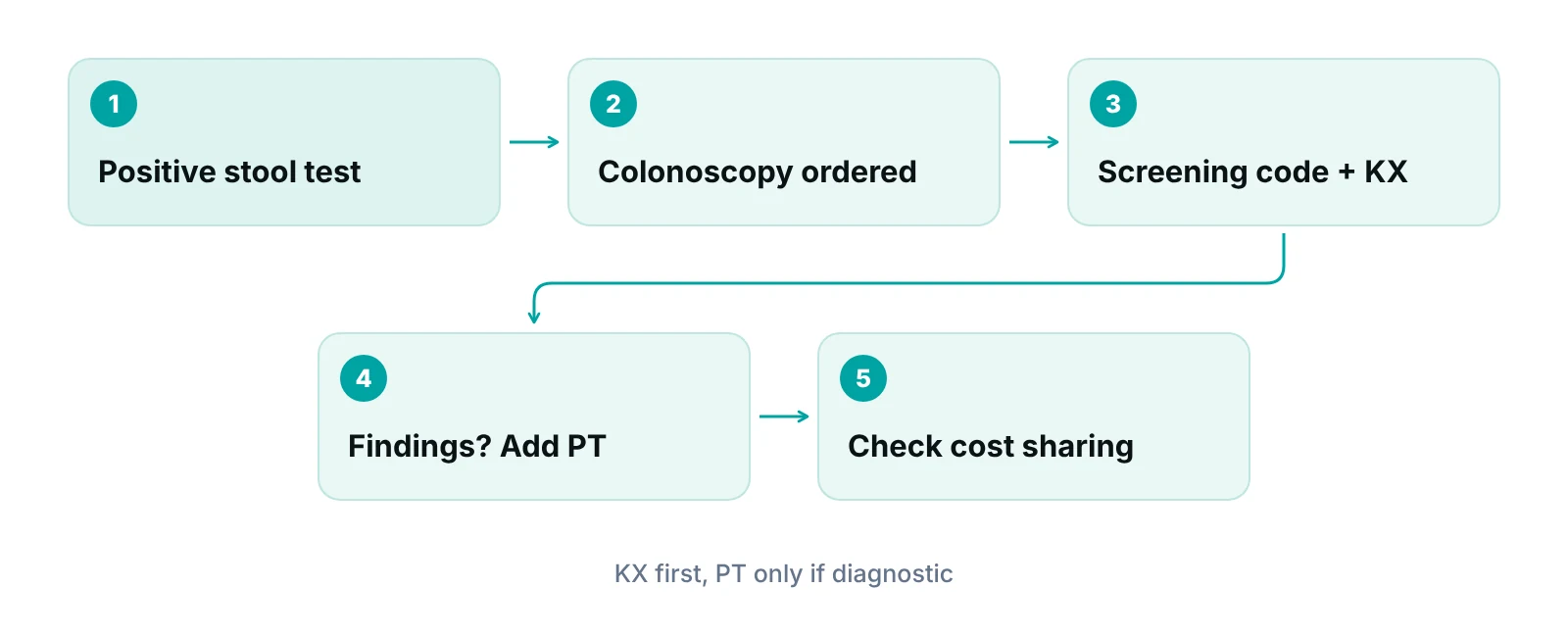
For positive cologuard icd 10 coding, report the screening diagnosis first (Z12.11 for colon) and R19.5 for the abnormal stool result, as ASGE suggests. For Medicare, bill the follow-on colonoscopy as screening (G0121 or G0105) with the KX modifier. Add PT if a biopsy or polyp removal makes it diagnostic.
A positive Cologuard result is not a diagnosis. It is a screening result that sends the patient to colonoscopy, and since 2023 Medicare treats that colonoscopy as the second half of one screening. The coding detail is where practices lose money: a missing KX modifier, a wrong first-listed diagnosis or a PT modifier applied without thinking about cost sharing. This guide covers the codes, the modifiers and the cost-sharing rules, and it says where the published sources stop.
Key takeaways
- Medicare covers a follow-on screening colonoscopy after a positive stool-based test with no cost sharing, and the practitioner must put the KX modifier on that claim.
- The screening diagnosis (Z12.11 or Z12.12) stays first; the abnormal result, such as R19.5, is secondary. ASGE recommends R19.5, but CMS does not require it.
- If a biopsy or polyp removal turns the exam diagnostic, PT is added to the procedure code, and Medicare coinsurance is 15% in CY 2026 and 10% for CY 2027 to 2029 on plain screening-turned-diagnostic claims.
- Commercial plans vary on modifiers 33, PT and KX. Read the plan policy before you copy the Medicare pattern.
- Document the stool test, its date and result in the colonoscopy record so the claim ties back to it.
Which ICD-10 codes go on a colonoscopy after a positive Cologuard?
Use a screening code first and add the abnormal result as a secondary code. Cologuard is a multi-target stool DNA test, and Noridian’s Part B guidance lists Z12.11 (colon) and Z12.12 (rectum) as the diagnoses for the test itself. The follow-on colonoscopy keeps the screening code as its main diagnosis, because Medicare treats the stool test and the colonoscopy as one screening continuum.
There is no code that means “positive Cologuard.” The code most often suggested for the abnormal result is R19.5, other fecal abnormalities. The FY 2027 code listing on a secondary reference site shows R19.5 as billable and includes occult blood in feces among its inclusion terms, with an Excludes1 note for melena (K92.1). The ASGE April 2023 Practical Solutions column recommends G0121-KX with Z12.11 and R19.5 for a normal exam after a positive Cologuard. ASGE also says Medicare had received no clinical examples of KX use, so treat that pairing as expert advice and not as a CMS rule.
| Code | What it reports (our wording) | When it fits |
|---|---|---|
| Z12.11 | Encounter to screen the colon for cancer | First-listed diagnosis for a screening colonoscopy; also on the Cologuard claim |
| Z12.12 | Encounter to screen the rectum for cancer | Used when the screening is documented for the rectum; CMS lists it beside Z12.11 for Cologuard |
| R19.5 | Other fecal abnormalities, including occult blood in stool | Secondary code for the abnormal stool result, as ASGE suggests; not a CMS requirement |
| Z80.0 | Family history of digestive-organ cancer | Only if documented and the patient is high risk; supports G0105 |
| G0121 | Screening colonoscopy, patient not at high risk (Medicare) | Follow-on colonoscopy after a positive stool test, with KX |
| G0105 | Screening colonoscopy, patient at high risk (Medicare) | Same, for a documented high-risk patient, with KX |
| 81528 | Cologuard multi-target stool DNA test | The stool test claim; Cologuard Plus is 0464U in CMS materials |
Source: CMS Transmittal 13248 (2025); CMS NCD 210.3 coding list (2025); Noridian JF Part B; ASGE (2023); icd-10codes.com (FY 2027 display, secondary).
Do not assume a code is valid because a lookup site shows it. The ICD-10-CM code set changes each 1 October, and FY 2027 took effect on 1 October 2026. The FY 2027 Official Guidelines confirm that effective date, and your encoder should confirm each code against the FY 2027 Tabular List.
How does Medicare treat a colonoscopy after a positive stool-based test?
Medicare covers it as screening. In MLN Matters MM13017 (effective 1 January 2023), CMS said a follow-on screening colonoscopy after a positive non-invasive stool-based test is part of a complete colorectal cancer screening. Patient cost sharing does not apply to the stool test or the follow-on colonoscopy. The frequency limits in 42 CFR 410.37(g) also do not apply to that colonoscopy.
The practitioner must apply the KX modifier to the screening colonoscopy claim. The document says claims without KX are processed under the prior policy for ordinary screening colonoscopy, which means the usual frequency limits and cost sharing can apply. The Benefit Policy Manual language is in transmittal R12299BP, Chapter 15, section 280.2.2.
Which stool tests count
MM13017 names gFOBT, iFOBT and Cologuard (multi-target stool DNA). CMS Transmittal 13248 (May 2025) extends the follow-on language to Cologuard Plus (0464U) and, for blood-based biomarker tests, to a positive result that leads to a follow-on screening colonoscopy. Blood-based tests are outside this post.
Age matters for the stool test, not for the colonoscopy. MM13017 lowered the minimum age for Cologuard and several other screening tests from 50 to 45, and says screening colonoscopy has no minimum age. For the practice, that means front-desk eligibility checks belong on the stool test order as well as on the colonoscopy. Our guide to insurance verification covers the intake side.
When does the exam become diagnostic, and what do PT and 33 do?
The colonoscopy becomes diagnostic or therapeutic when the physician takes a biopsy, removes a polyp or otherwise goes beyond looking. Then you report the CPT code for what was done and append PT. Noridian says the primary diagnosis stays the screening code and a secondary diagnosis shows the abnormal finding. A55069, a Palmetto GBA billing article for converted colonoscopies, lists only PT and says to use a screening diagnosis such as Z12.11; it does not mention KX or 33. That article is a Palmetto GBA contractor article, and its current version took effect 1 October 2025 (the version we read was superseded), so read the live article for your own MAC.
| Case | Procedure line | Diagnosis order | Note |
|---|---|---|---|
| Normal exam after positive stool test | G0121-KX (or G0105-KX if high risk) | Z12.11, then R19.5 (ASGE) | Screening throughout; no cost sharing per CMS |
| Biopsy or polyp removal during that exam | CPT code for the work done, with PT and KX (ASGE example: 45380-PT/KX) | Z12.11, R19.5, then the polyp or lesion code | Confirm cost-sharing treatment with your MAC; see text |
| Screening exam with no earlier positive stool test, then a finding | CPT code with PT | Screening code first, finding second | Coinsurance phase-in applies; KX does not |
| Scope cannot be completed | Screening code with 53 (MLN Matters MM10937) | Same as the planned exam | CMS pays half the value of the inputs; document how far the scope went |
Source: CMS Transmittal 13248 (2025); Noridian JF Part B; CMS MM10937 (2018); ASGE Practical Solutions (2023).
The cost-sharing schedule is the part billers get wrong. For a plain screening colonoscopy that becomes diagnostic, CMS Transmittal 13248 sets a reduced coinsurance and waives the deductible: 15% for CY 2023 to 2026, 10% for CY 2027 to 2029, and none from 1 January 2030. We are in CY 2026 now, so a patient seen today is on the 15% rate and one seen from 1 January 2027 is on the 10% rate.
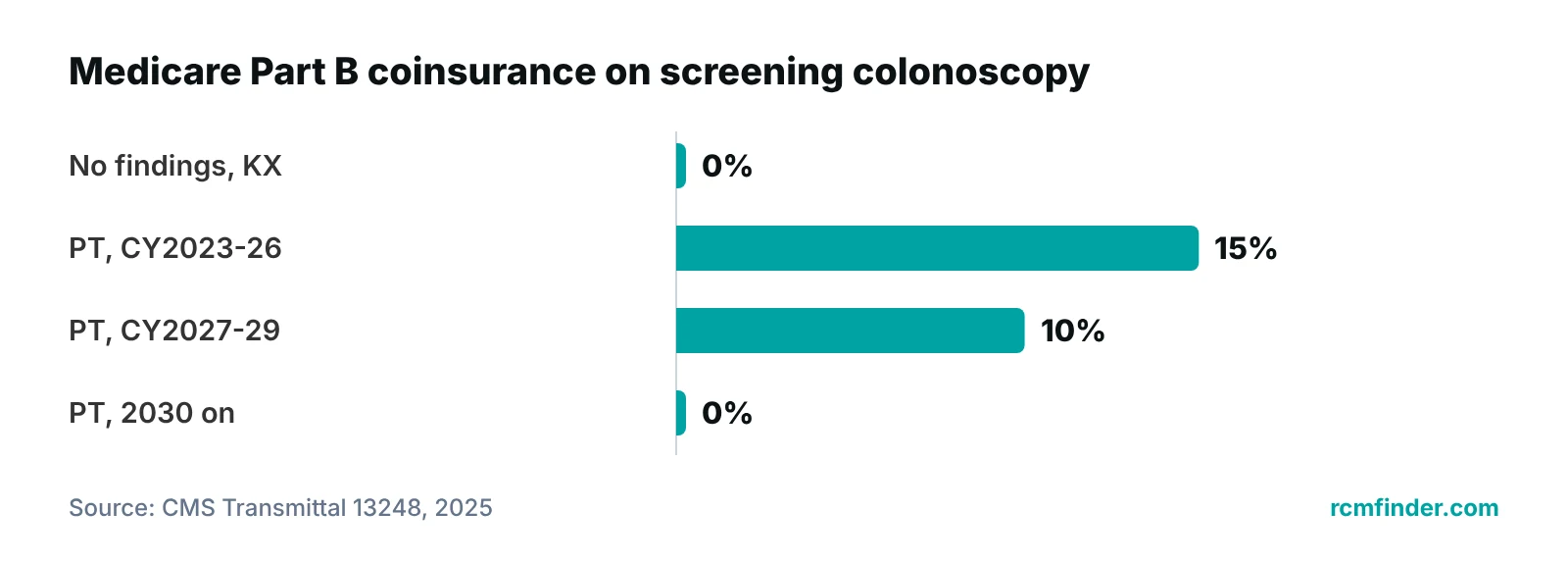
One gap needs saying out loud. The sources we read do not say how the PT coinsurance phase-in works when a polyp is removed during a follow-on colonoscopy that also carries KX. MM13017 says cost sharing does not apply to the follow-on screening colonoscopy, and Transmittal 13248 says the same about KX, but neither text works through a polyp-removal example. Ask your MAC in writing before you tell a patient what they will owe.
Sedation and anesthesia follow their own rules. Noridian lists anesthesia code 00812 for a screening colonoscopy as exempt from coinsurance and the deductible, while 00811 with PT waives only the deductible. Transmittal 13248 says moderate sedation (G0500 or 99153) reported with modifier 33 on a screening colonoscopy has the deductible and coinsurance waived. PT and 33 are not used on lab or pathology services, and lab work tied to a diagnostic colonoscopy should use a non-screening diagnosis.
What does the record need to say?
The colonoscopy note must tie the exam to the stool test. A reviewer should be able to see that the stool test was positive, when it was done and which test it was. Without that, the KX modifier has nothing behind it.
- The stool test: the name of the test (for example Cologuard), the date and a copy of the result in the chart.
- The reason for the colonoscopy: a line such as “follow-up colonoscopy after positive stool DNA test,” written by the ordering or performing provider.
- Risk status: whether the patient is at high risk, and why, if you bill G0105 and Z80.0.
- What was done: biopsy, polypectomy or neither, so the coder can decide on PT.
- Completeness: how far the scope advanced and why it stopped, if the exam was incomplete.
- Pathology: the final report, because polyp and adenoma codes should follow it, not the endoscopist’s impression.
For the abnormal result, make sure the diagnosis you list is supported by something in the record. The FY 2027 guidelines say symptom and sign codes are acceptable when the provider has not confirmed a related definitive diagnosis, and that signs routinely part of a disease are not coded separately. A positive stool test is a laboratory finding, so R19.5 is a reporting choice, not a diagnosis. Apply it the same way on every claim and confirm that your main payers accept it as a secondary code.
Why do these claims deny, and what about commercial plans?
Most denials trace to a missing modifier, a diagnosis that reads as diagnostic, or a frequency edit. CMS says claims returned with CARC 16 and RARC N822 or N823 may need to be reprocessed, and it tells practices to contact their MAC. Our CO-16 denial guide covers the general CARC 16 workflow.
| Edit or denial | Likely cause | First check |
|---|---|---|
| Frequency limit hit (Medicare) | KX missing, so the claim was priced as ordinary screening | Add KX, confirm the stool test date is in the record, resubmit or request reprocessing |
| CARC 16 with N822 or N823 | Claim returned for missing or incorrect information | Compare the claim to MM13017 and call the MAC |
| Patient billed coinsurance on a plain follow-on exam | Claim sent with PT but no findings, or cost share applied in error | Check the procedure note: was anything biopsied or removed? |
| Screening diagnosis denied as not medically necessary | Diagnosis list led with R19.5 or a finding code | Put Z12.11 first for the screening exam |
| Lab or pathology claim paid at patient cost share | Screening diagnosis used on a pathology claim | Use a non-screening diagnosis on the lab line, per Noridian |
Source: CMS MM13017; CMS Transmittal 13248; Noridian JF Part B.
Commercial plans are less uniform. The Departments of Labor, Health and Human Services, and the Treasury issued ACA FAQs Part 51 on 10 January 2022, and OPM told Federal Employees Health Benefits carriers in a March 2022 letter that plans must cover a follow-up colonoscopy after a positive non-invasive stool-based test without cost sharing from contract year 2023. That letter covers FEHB carriers only. Whether another plan wants modifier 33, PT, KX or none of them, and which diagnosis it expects first, is set in that plan’s own policy. Build a short payer grid and keep it with the claim-scrubbing rules; our guide to claim scrubbing shows how edits like these are set up.
Worked example: a Medicare patient with a positive Cologuard
Example only (made-up, de-identified)
A 62-year-old Medicare patient has a positive Cologuard result dated three weeks earlier. The gastroenterologist documents “follow-up colonoscopy after positive stool DNA test; no family history.” The exam is complete. One 4 mm polyp is removed and sent to pathology.
The practice bills the procedure line under the CPT code for the polyp removal performed, with PT and KX, following the ASGE example of 45380-PT/KX for a biopsy. The first diagnosis is Z12.11. R19.5 follows, then the polyp code once pathology comes back. Anesthesia, if used, follows the PT or 00812 rule above. If the pathology report names an adenoma, the coder replaces the symptom-level reasoning with the definitive code, as ASGE does in its D12.0 example.
Before the claim goes out, the biller checks three things: the stool test result is in the chart, KX is on the line, and the patient estimate reflects what the MAC has said about cost sharing for this exact case. If the exam had found nothing and no biopsy was taken, the line would be G0121-KX with Z12.11 and R19.5, and there would be no PT.
“The Medicare rule is simple on paper. The denials come from the chart that cannot show the stool test, so the KX modifier has nothing behind it.”
— Awais Afzal, Healthcare Operations & Data Analyst
Are screening colonoscopies paying as screening?
Send us a sample of follow-on colonoscopy claims, with the notes behind them. A free practice audit shows whether the edit comes from the modifier, the diagnosis order or the payer policy.
Where this fits with the rest of your coding work
Digestive-system claims share a few habits: symptom codes until a diagnosis is confirmed, Excludes1 checks and a clear first-listed diagnosis. If your team also codes upper-GI visits, see our gastritis ICD-10 guide. For a colon condition that is a diagnosis in its own right, see the stercoral colitis coding guide. If a scope is stopped early and you are deciding between modifiers, our modifier 52 guide explains how 52 and 53 differ. For modifier habits in general, see modifiers 25 vs 59. For gastroenterology claim support, see our gastroenterology page.
Our recommendations
- Add a stool-test field to the colonoscopy order. Make the ordering screen capture the test name, date and result, so the note and the KX modifier have the same support.
- Put KX on the charge rule, not on memory. Build a rule that suggests KX on G0121 or G0105 whenever the order reason is a positive stool test. We would rather a rule catch it than a person.
- Decide PT from the procedure note. Have coders look for a biopsy or removal before adding PT. Do not add it by default.
- Keep the screening diagnosis first. Lock Z12.11 or Z12.12 as the first diagnosis on screening claims and add the finding as secondary.
- Write down the CY 2026 and 2027 rates. The PT coinsurance moves from 15% to 10% on 1 January 2027. Update patient estimate scripts before then.
- Ask your MAC the polyp-removal question. Get the answer about KX and PT together in writing and file it with your billing policies.
- Build a commercial payer grid. List modifiers 33, PT and KX, and the diagnosis expectation, for each of your top payers, and review it each January.
Bottom line
Code the screening diagnosis first, add the abnormal result, put KX on the Medicare screening colonoscopy and add PT only when the exam turns diagnostic. If follow-on colonoscopies keep denying or patients keep getting surprise bills, a review of your revenue cycle management process can show where the claim breaks, and you can ask for a free practice audit.
Frequently asked questions
Is there an ICD-10 code for a positive Cologuard?
No code means “positive Cologuard” itself. The screening code Z12.11 or Z12.12 stays first, and ASGE suggests R19.5 (other fecal abnormalities) for the abnormal result. Check that each payer accepts R19.5 as a secondary code, apply it the same way on every claim, and confirm the code in the FY 2027 Tabular List before you add it to a template.
What modifier goes on a colonoscopy after a positive stool test?
For Medicare, KX goes on the screening colonoscopy claim (G0121 or G0105). If the exam turns diagnostic because of a biopsy or removal, PT is added to the procedure code. Commercial plans may use 33, PT, KX or none of them, so read each plan’s policy and keep the answer in a payer grid your billers can see.
Does the patient pay anything for the follow-on colonoscopy under Medicare?
CMS says cost sharing does not apply to a follow-on screening colonoscopy after a positive stool-based test, if KX is on the claim. If the exam becomes diagnostic with PT, a coinsurance phase-in applies on standard conversions. The sources we read do not work through a polyp removal, so ask your MAC how it is handled before you quote a patient.
What if the colonoscopy is for symptoms, not for a positive stool test?
Then it is not a screening exam, so the symptom or finding is the reason for the visit and the follow-on KX rule does not apply, because KX is for the follow-on screening colonoscopy. A screening exam that finds something is a different case: it is handled with PT and a screening diagnosis first.
Does the age of 45 apply to the colonoscopy?
No. MM13017 lowered the minimum age to 45 for Cologuard and several other screening tests, and says screening colonoscopy has no minimum age. Check the age rule on the stool test order, not on the colonoscopy order, and confirm the plan’s own age rule for commercial patients.
Do commercial plans follow the Medicare KX rule?
Not necessarily. Federal ACA guidance (FAQs Part 51) addresses coverage of follow-up colonoscopy after a positive stool test, and OPM applied it to FEHB carriers. Modifier and diagnosis requirements differ by plan, so read each plan’s policy.
Get your free practice audit
Tell us about your practice. We will contact you using the details you give.
- A review of your recent claims, denials and A/R aging
- Where your front desk and prior authorizations slow payment
- A prioritized fix list you keep, whether or not you hire us
Pricing is quoted after the audit, based on your volume and the services you choose. Prefer to talk? Call +1 (302) 556-2288.
Sources
- MLN Matters MM13017: Removal of NCD 160.22 and expansion of CRC screening coverage — CMS (2023)
- Transmittal 13248 (CR 14031): CY 2025 CRC screening and hepatitis B updates — CMS (2025)
- Transmittal R12299BP: Benefit Policy Manual, Ch. 15 section 280.2.2 — CMS (2023)
- Colorectal Cancer Screening (JF Part B) — Noridian Healthcare Solutions (2026 (page as read))
- Practical Solutions, April 2023: answers to your coding questions — ASGE (2023)
- NCD 210.3 Colorectal Cancer Screening ICD-10-CM codes (DV 2025-07-14) — CMS (2025)
- Billing and Coding: Screening Colonoscopy Converted to Diagnostic (A55069) — CMS Medicare Coverage Database (Palmetto GBA) (2023)
- ICD-10-CM Official Guidelines for Coding and Reporting FY 2027 — CDC/NCHS (2026)
- FEHB Carrier Letter 2022-07: Colonoscopies after positive screening tests — OPM (2022)
- MLN Matters MM10937: Incomplete colonoscopy payment — CMS (2018)
- R19.5 Other fecal abnormalities (FY 2027 display) — icd-10codes.com (secondary reference) (2026)
- Diagnosis coding for screening colonoscopy — CodingIntel (secondary) (2024)
Disclaimer: This article is educational and is not legal, coding, billing, medical or compliance advice. CPT codes are owned by the AMA, and code meanings, Medicare contractor policies and payer rules change and vary by payer, contractor and state. Verify current requirements with the official CPT manual, the ICD-10-CM Tabular List, your payers and your counsel before you act.
