
Down coding means a service is reported or paid at a lower level than the visit note supports. It happens two ways: a practice under-codes its own claim, or a payer reduces an E/M level it received, often without reading the note. The fix differs. Correct the process in the first case; confirm, document and appeal in the second.
Most pages define down coding only as a provider error. That misses the question many practices are asking now: why did the insurer pay a 99214 as a 99213 when the note supported the higher level? This guide covers both meanings, what is publicly documented about payer programs, and the steps to take. For the opposite problem, billing higher than documented, see our guide to upcoding in medical billing.
Key takeaways
- Down coding has two sources: your own under-coding and a payer lowering the level you billed.
- Payer down coding is documented for named commercial E/M policies, and professional societies dispute whether claim-based rules follow CPT.
- Since 2021, office visit level is set by medical decision making or total time, not by history and exam.
- Confirm a reduction on the remittance first, then send the full note with a short MDM or time summary.
- Track level mix by provider and payer so a pattern is caught before it costs a quarter of revenue.
What down coding means: two different problems
**Down coding is a claim that ends up at a lower service level than the documentation supports.** The cause matters, because the owner of the fix changes. If your coder chose a lower level, the fix is internal. If a payer repriced the level you billed, the fix is a payer conversation and often an appeal.
| Provider-side (under-coding) | Payer-side (down coding) | |
|---|---|---|
| Who lowers the level | Your coder, biller or provider at charge entry | The payer, after the claim is submitted |
| Typical trigger | Fear of audits, vague notes, templates that do not capture decision making, unfamiliarity with current rules | A payer rule that adjusts higher E/M levels, often from claim data rather than the chart |
| How you see it | Only in a coding audit comparing notes to billed levels | A paid level lower than billed on the remittance advice or explanation of benefits |
| Where the fix lives | Training, templates, pre-bill review | Remit review, documentation packet, reconsideration or appeal |
| Money impact | Lost revenue you never billed | Reduced payment on a claim you did bill |
Source: RCM Finder summary of the two usages; payer-side programs are documented below.
Down coding is also different from a denial. A denial pays nothing and carries a reason code. A down-coded claim pays, but at a lower level, so it is easy to miss unless someone compares billed and paid codes. Our guide to medical billing denials covers the denial side.
How payer E/M down coding works
**Payer down coding is an insurer lowering the billed E/M level, in the cases described publicly, by one level.** The American Medical Association (AMA) describes insurers reducing payment “one level below what physicians bill” based on internal review, including when visits were documented to AMA E/M guidelines. The AMA text was a resolution submitted for its 2025 interim meeting, so it states a position and does not prove any payer’s method.
The best-documented example is Cigna’s “Evaluation and Management Coding Accuracy” policy, R49. The American Academy of Family Physicians (AAFP) reports that it took effect October 1, 2025 and applies to office visit codes 99204, 99205, 99214 and 99215, plus consultation codes 99244 and 99245. It says Cigna may downcode when a clinician consistently reports those levels while the primary diagnosis and other claim-based criteria do not support them.
| Payer | Policy as reported | Reported date | Source |
|---|---|---|---|
| Cigna | E/M Coding Accuracy (R49); higher office and consult levels may be lowered by one level when claim patterns do not support them | Effective October 1, 2025 | AAFP; AMA resolution |
| Cigna (California) | Policy paused in California after the state medical association questioned its legality with regulators | 2025 | AAFP; AAOS |
| Aetna | Claim and Code Review Program, named in the AMA resolution as an E/M downcoding program | Described in a March 2023 provider update | AMA resolution |
| Blue Cross Blue Shield of Massachusetts | Announced a downcoding program aimed at clinicians who often bill high-level visits | Announced 2025 | AAOS action guide |
Source: AAFP (2025), AMA resolution I-25 PPPS 9 (2025), AAOS downcoding action guide (2026). Payer policies change; read the current policy before relying on this table.
Medicare is different. Medicare Administrative Contractors review specific claims against the record. The Medicare Claims Processing Manual treats medical necessity as the overarching criterion for payment and says a higher E/M level than warranted is not medically necessary. That is record-based review, not a claim-pattern rule.
What is still uncertain
The AMA opposes using software or algorithms, rather than manual review of the record, to downcode E/M services based only on codes, modifiers or diagnoses, according to its resolution. Whether a given payer program meets that standard is contested. We have not read each payer’s full policy text for this post, so check the current policy and your contract before you respond.
How to confirm a claim was down coded
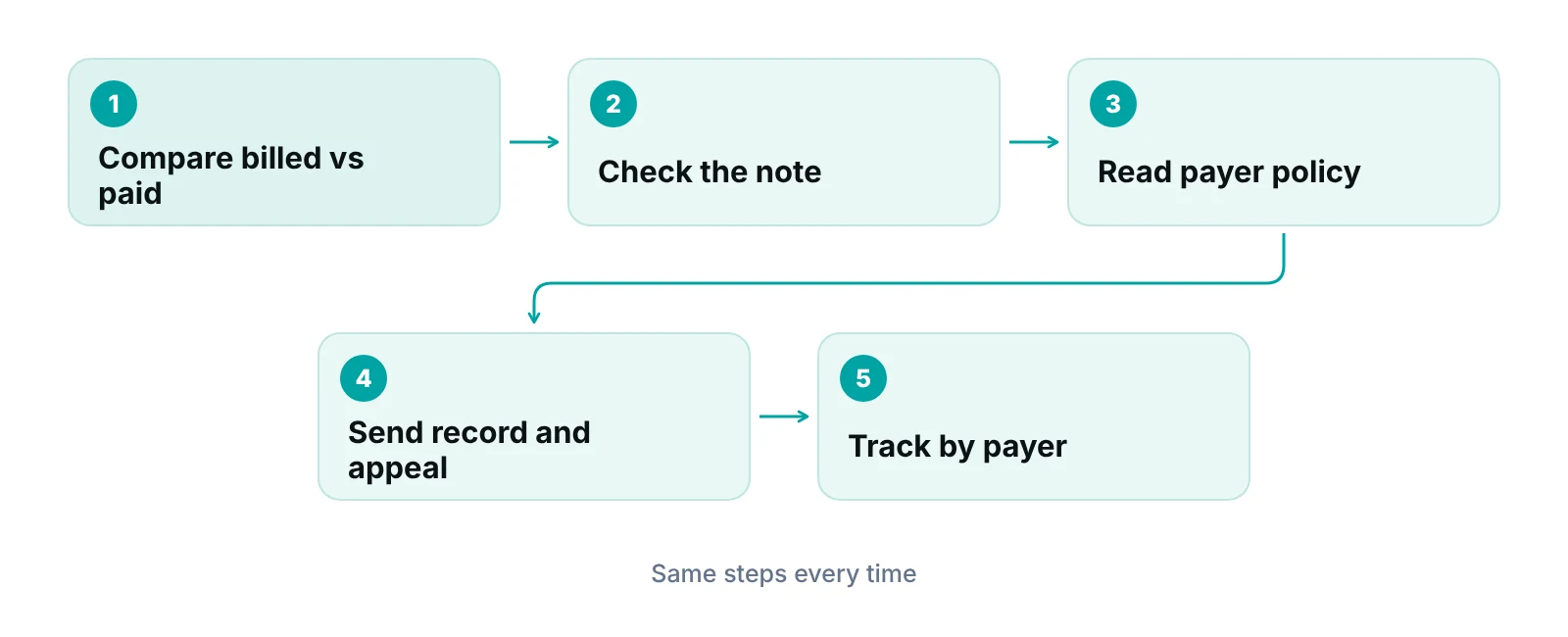
**You confirm down coding by comparing the billed code to the paid code on the remittance, line by line.** Most practice systems post the payment without flagging a level change, so the comparison has to be deliberate.
- Pull remittances for the payer and period in question and list every E/M line where the paid code differs from the billed code.
- Record the adjustment reason text or code the payer used. Keep the remit image with the claim.
- Group by provider, code pair (for example billed 99215, paid 99214) and diagnosis. A pattern points to a payer rule, a single claim points to a one-off review.
- Pull the visit notes for a sample and check them against the level billed using the current MDM or time rules (next section).
- Read the payer’s current policy and provider bulletin. Note any exception or review process it offers.
Also check the other direction. A coding audit can show your own providers billing a level below what the note supports. Our post on medical coding audits explains how to sample and score notes. If you only audit for over-coding, under-coding stays invisible.
What a note must show to support the billed level
**For office and outpatient visits, the level is chosen by medical decision making (MDM) or by total time on the date of the encounter.** Per the AMA, the documented history and exam no longer factor into choosing the level. MDM has three elements: problems addressed, data reviewed and analyzed, and the risk of management. Time counts the clinician’s own face-to-face and non-face-to-face work on the date of service. Both are described in the AMA’s E/M guidance.
| Element | What to show in the note | Common gap |
|---|---|---|
| Problems addressed | Each condition assessed, its status (stable, worsening, new) and the plan for it | Problem list copied forward, but only one problem actually addressed in the plan |
| Data reviewed and analyzed | Tests ordered, outside records reviewed, independent historian, and what the clinician concluded | Results listed with no interpretation or decision attached |
| Risk of management | Medication decisions, procedures, referrals, and why the option chosen was needed | Prescription written but the risk reasoning is not stated |
| Total time (if used) | Total minutes on the date of the encounter and the activities counted | Time stated with no link to tasks, or time that includes separately reported services |
Source: AMA, Regulatory myths about documentation and coding of E/M (2021 office visit revisions).
If a note supports a higher level than was billed, correcting the template or training the provider closes the gap. If it supports the level billed and a payer lowered it, the note is your appeal evidence. For single-code detail, see our 99213 CPT code guide and the post on clear documentation in medical billing.
Why practices under-code their own claims
**Practices usually under-code for process reasons, not intent: unclear notes, outdated rules and caution after an audit scare.** Each has a fix you control.
- Old habits. Staff still count history and exam elements and settle on a lower level that the 2021 office E/M rules no longer require.
- Notes that hide the thinking. The decision making happened, but the note shows a list of findings. A coder cannot code what is not written.
- Audit caution. After an audit or a warning letter, coders default low. That trades one risk for steady lost revenue.
- Time not captured. Long visits dominated by counseling or record review are billed by MDM at a lower level because the clinician did not record total time.
- Modifier uncertainty. When a separately identifiable E/M is billed with a procedure, uncertainty about modifier 25 can lead to dropping the E/M or leaving it low. See our post on modifier 25 vs 59.
“The goal is the accurate level, not the safe one. Coding low out of caution is still a coding error, and it is the one nobody reviews.”
Primary care and other high-volume E/M specialties feel this most, because office visit levels make up most of their revenue. Our family practice billing and revenue cycle page covers the billing and revenue cycle needs of that mix.
How to respond to a payer that lowered the level
**Respond with the full visit note and a one-page summary tying it to the level billed.** Ask for a specific outcome, and file within the payer’s deadline.
- Cite the claim, the billed code, the paid code and the payer policy by name.
- Attach the complete visit note, not an excerpt.
- Add a short MDM summary: the problems addressed, the data reviewed and the risk of management, each pointing to where it sits in the note.
- If the level rested on time, include a time statement listing the activities and the total minutes on the date of the encounter.
- Ask in writing for the claim to be reprocessed at the billed level and for the basis of the adjustment.
- Calendar the appeal deadline and the payer’s response window. Do not wait for a pattern to build before filing.
Some programs have a broader exit. The AAFP reports that Cigna told clinicians with five or more downcoded claims who believe they bill according to AMA guidelines to email a bypass request. Cigna then reviews documentation for a subset of claims, and the AAFP says a bypass is granted if at least 80 percent of those were billed appropriately. Confirm the current process with the payer before using it.
For Medicare Part B, one contractor, CGS, states that a redetermination request is due within 120 days of receiving the notice of initial determination and that it has 60 days to process it. Other contractors publish their own pages, so check yours. For commercial payers, the contract and the payer’s provider manual set the deadline.
Not sure whether your reduced E/M levels are a pattern?
A free practice audit compares billed and paid levels by payer and provider and shows where revenue is slipping. Pricing, if you decide to go further, is quoted after the audit.
Prevent it: monitor levels and catch patterns early
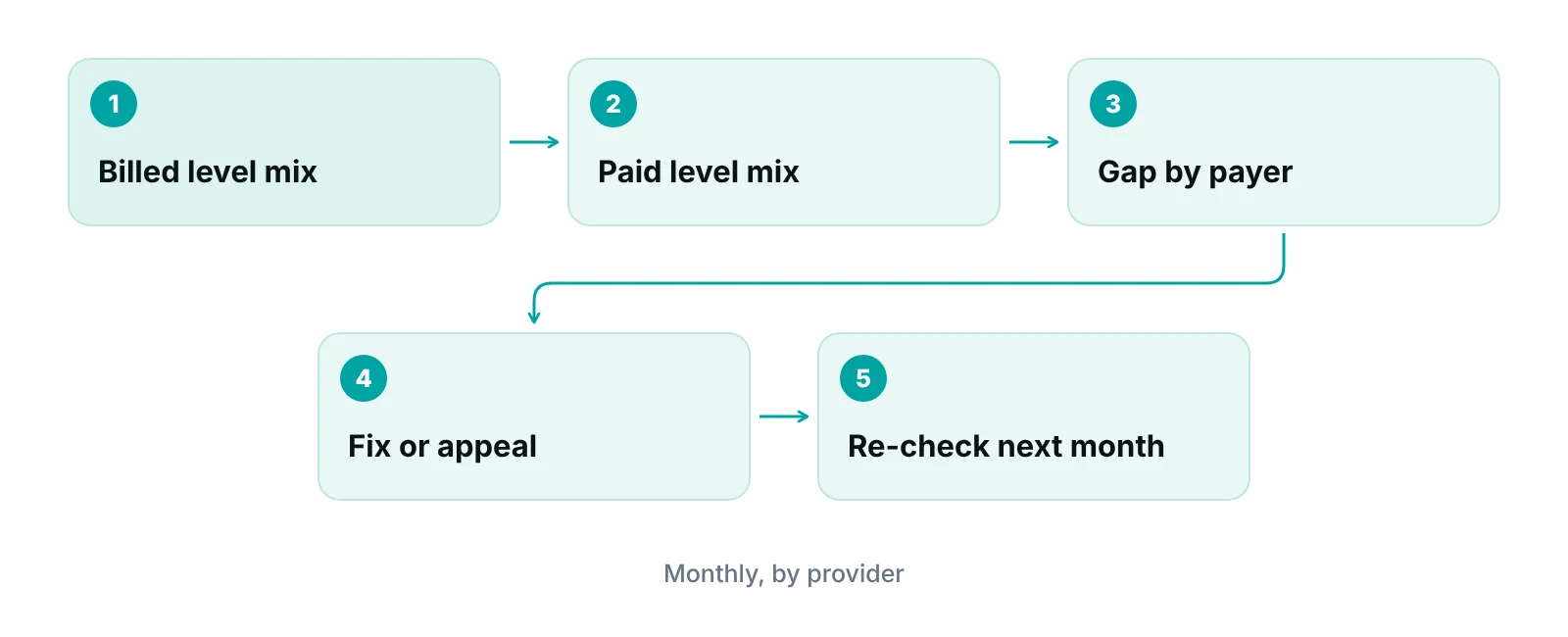
**The reliable defense is monitoring the billed-versus-paid level by payer and provider every month.** A payer rule shows up as a shift in paid level mix long before anyone notices a revenue gap.
- Report billed level mix and paid level mix side by side for each provider.
- Flag any E/M line where the paid code is not the billed code and assign an owner.
- Run pre-bill checks that the note contains the MDM elements or a time statement for the level selected.
- Compare each payer’s paid amounts against what the contract should pay, so reductions stand out.
Software helps here when it follows claims by stage and flags payments that come in under the expected amount. A practice management system that tracks claims by stage with underpayment flags and audit logs can surface a reduced level quickly, and our medical billing services team can review the remits for you if staff time is the constraint. Every payer rule still needs a person to read it.
Some state-level action exists, but it is uneven. The AAOS action guide notes a pending New York bill (S4833) that would treat downcoding as an adverse determination, and a Tennessee law from 2024 that covers dental plans only. Check your own state with your medical society. Our denial management guide and the CO-45 adjustment code guide help you read what the remit is telling you.
Our recommendations
- Compare billed and paid E/M codes monthly. We recommend a standing report of billed versus paid code for every E/M line, by payer and provider. It is the only way payer down coding gets seen.
- Audit for under-coding as well as over-coding. Sample notes against current MDM and time rules and record both directions of error. Lost revenue from low coding is real and rarely tracked.
- Retire history and exam counting for office visits. Update templates, cheat sheets and training for the 2021 office E/M rules so coders select the level on MDM or total time.
- Make decision making visible in the note. Ask providers to state what was decided and why, and to record total time when time sets the level.
- Keep an appeal packet template ready. A standard cover page, MDM summary and time statement shortens the response and keeps the argument consistent across claims.
- Read payer bulletins and policies on a schedule. Assign one person to check each major payer’s policy and bulletin updates every month and log changes.
See billed versus paid E/M levels without a spreadsheet.
The RCM Finder portal tracks each claim by stage with an owner, flags payments that come in under the expected amount, and keeps an audit log. That helps a practice spot a reduced level early and assign the follow-up.
See how the RCM Finder portal works · Create a portal account
Disclosure: RCM Finder builds and sells this portal. It is a practice management system, not an EHR.
Bottom line
Down coding is either a gap in your own coding or a payer repricing a level you billed, and the fix depends on which. Compare billed and paid levels, check the note against the current rules, and appeal with a clear packet. If you want help with the follow-up, our denial management services cover appeals and payer follow-up, and a free practice audit shows where your levels are slipping.
Frequently asked questions
What is down coding in medical billing?
Down coding is when a service is reported or paid at a lower level than the documentation supports. It may be the practice’s own under-coding, or a payer lowering the level you billed, such as paying a 99215 as a 99214. The first is fixed in your process, the second through confirmation, documentation and appeal.
Is down coding the same as undercoding?
Not always. Undercoding is the practice choosing a lower code than the record supports. Down coding is broader and is also used for a payer reducing the billed code. When a claim pays lower than billed, check the remittance to see who made the change.
Can an insurance company change the E/M level I billed?
Payers can apply policies that reduce the level they pay, and some have done so for higher office visit levels, as reported by medical societies. Whether a specific policy is allowed depends on your contract, state law and the payer’s own rules. Read the policy and ask for the basis of the adjustment in writing.
How do I know if a claim was down coded?
Compare the billed procedure code with the paid procedure code on the remittance advice or explanation of benefits. Practice systems often post the payment without flagging the change, so run a report of E/M lines where the two codes differ and review the adjustment reason.
How do I appeal a down-coded claim?
Send the complete visit note, a short summary of the problems, data and risk that support the level, a time statement if time set the level, and a written request to reprocess at the billed code. File within the payer’s deadline, which comes from its manual or your contract.
Is down coding the opposite of upcoding?
Yes, in direction. Upcoding bills a higher level than the service supported. Down coding is a lower level than supported. Accurate coding means neither: the code follows the documentation. Read our upcoding guide for the other side.
Get your free practice audit
Tell us about your practice. We will contact you using the details you give.
- A review of your recent claims, denials and A/R aging
- Where your front desk and prior authorizations slow payment
- A prioritized fix list you keep, whether or not you hire us
Pricing is quoted after the audit, based on your volume and the services you choose. Prefer to talk? Call +1 (302) 556-2288.
Sources
- Resolution 9 (I-25): Opposition to unilateral downcoding of E/M services — American Medical Association (2025)
- Cigna's downcoding policy gets pushback from physician groups — American Academy of Family Physicians (FPM) (2025)
- Downcoding action guide — American Academy of Orthopaedic Surgeons (2026)
- Regulatory myths: documentation and coding of E/M — American Medical Association (2021)
- Medicare Claims Processing Manual Ch. 12 transmittal R10742CP — CMS (2021)
- Level 1 appeals (redetermination) — CGS Administrators (Medicare Administrative Contractor) (2026)
Disclaimer: This article is educational and is not legal, coding, billing or compliance advice. CPT codes are owned by the AMA. Payer policies, state laws and federal rules change and vary by payer and state, so verify current requirements with the official CPT manual, your payers and your counsel before you act.