
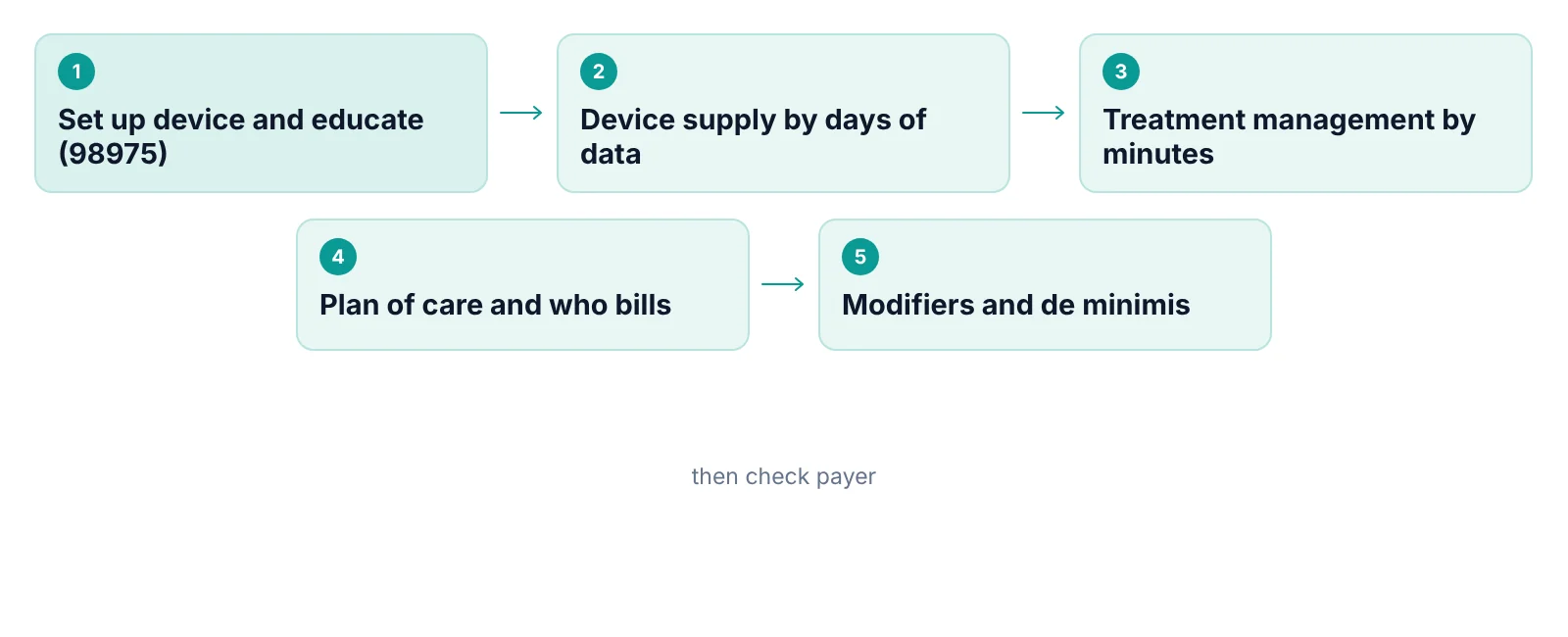
Remote therapeutic monitoring (RTM) CPT codes cover set-up (98975), device supply by days of data (98976, 98977, 98984, 98985) and monthly treatment management (98979, 98980, 98981). For 2026, Medicare added 2 to 15 day device supply codes and a 10-minute management code, and revised 98976 and 98977 to cover 16 to 30 days.
Remote therapeutic monitoring tracks non-physiologic data, such as exercise adherence or respiratory device use, and a clinician reviews it to manage care. Until 2026 the codes only worked for patients who generated 16 days of data a month. The 2026 changes opened the door to shorter periods and a short management code.
This guide lists the codes, summarizes the 2026 Medicare changes, and covers who can bill and what documentation to keep. Payer rules vary, so confirm details with each payer and the current CPT book.
Key takeaways
- 98975 is the one-time set-up and education code. Device supply codes depend on days of data in a 30-day period.
- For Medicare in 2026, 98984 and 98985 cover 2 to 15 days, and 98976 and 98977 cover 16 to 30 days.
- 98979 is a new 10-minute management code requiring at least one real-time interactive communication in the month; 98980 and 98981 are the longer 20-minute codes.
- Therapists bill with GP, GO or GN under a plan of care, and assistants use the CQ or CO modifier under the de minimis standard.
What are RTM CPT codes?
RTM codes report remote monitoring of non-physiologic data. They include the device supply and the clinician time to review data and manage treatment. They differ from remote physiologic monitoring, which covers physiologic readings such as blood pressure. For physiologic and care-management programs see chronic care management and cardiology telehealth.
Which codes are in the family?
| Code | Short description | 2026 note |
|---|---|---|
| 98975 | Initial set-up and patient education on the monitoring device | One-time; subject to de minimis (CQ or CO) |
| 98976 | Device supply, respiratory system monitoring | Revised to 16 to 30 days of data |
| 98977 | Device supply, musculoskeletal system monitoring | Revised to 16 to 30 days of data |
| 98984 | Device supply, respiratory system monitoring | New: 2 to 15 days of data in 30 days |
| 98985 | Device supply, musculoskeletal system monitoring | New: 2 to 15 days of data in 30 days |
| 98979 | Treatment management, first 10 minutes | New; requires at least one real-time interactive communication in the month |
| 98980 | Treatment management, first 20 minutes | Existing; subject to de minimis |
| 98981 | Treatment management, each additional 20 minutes | Existing; subject to de minimis |
Descriptors are paraphrased. Read the AMA CPT descriptors and CMS Transmittal 13431 for the exact wording. CPT also has other RTM codes, such as for cognitive behavioral therapy devices; check the CPT book.
The 2026 list came from CMS Transmittal 13431 (issued 25 September 2025, effective 1 January 2026). Because CPT changes yearly, see our 2027 CPT changes checklist for the next update cycle.
Who can bill RTM and under what conditions?
Medicare’s therapy code list identifies which practitioners may furnish the codes. Therapists furnish them under a therapy plan of care and add the GP, GO or GN modifier. Physicians, physician assistants, nurse practitioners and clinical nurse specialists bill under their own rules; for them the musculoskeletal device codes 98977 and 98985 must be furnished under a plan of care.
| Item | What to check |
|---|---|
| Plan of care | Required for therapists; also for 98977 and 98985 when billed by physicians and similar practitioners |
| Modifiers | GP, GO or GN for therapy services; CQ or CO when an assistant furnishes part of the service |
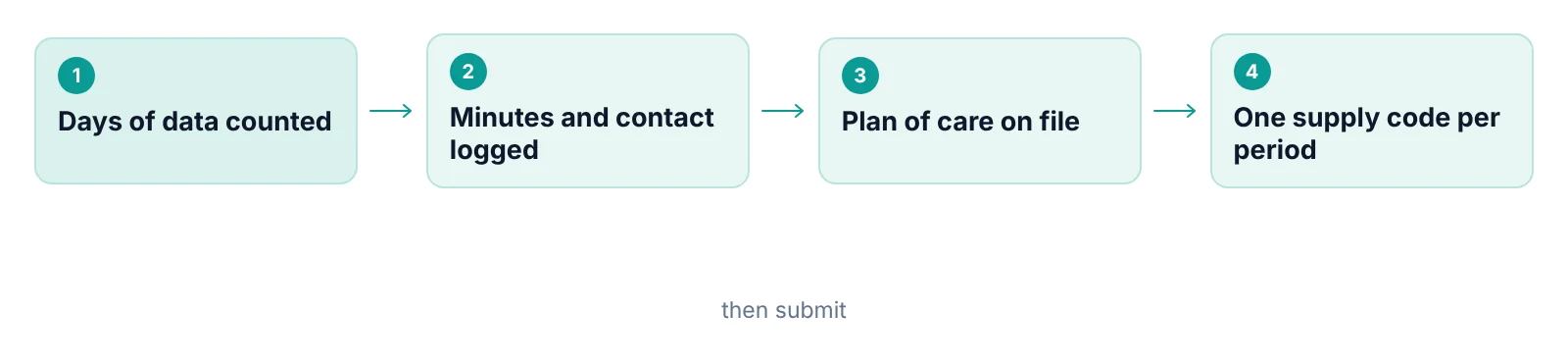
| One supply code per period | Device supply codes are not additive in the same 30-day period |
| One base management code per month | Use the add-on only after the base code threshold |
| Pricing | Physician fee schedule, except outpatient hospital TOB 13x which uses OPPS |
Summarized from the CMS therapy code list update. Verify with your Medicare contractor.
Supervision and billing under another provider are covered in our incident-to guide and physical therapy billing units guide.
What documentation supports RTM claims?
- Order or plan of care that names the condition and the monitoring.
- Date the device was set up and the education given (98975).
- Days of data collected in each 30-day period so the right supply code is chosen.
- Minutes of treatment management and the date of each real-time interactive contact (98979).
- Patient consent and the clinician’s review notes.
Want a second pair of eyes on your claims?
Send us your recent denials and we will show where the same issue repeats. The audit is free and the fix list is yours to keep.
Use the checks in clean claim guidelines before you submit, and keep a monthly log for each patient.
What RTM billing mistakes are most common?
| Error | Result | Fix |
|---|---|---|
| Counting calendar days instead of days with data | Wrong supply code | Count days with data transmitted |
| Billing two supply codes in one period | Denial | Bill one device supply code per 30-day period |
| Management minutes not logged | Cannot support 98979 to 98981 | Log time and contacts at the point of care |
| No plan of care | Denial where required | Document it before billing |
| Assuming commercial payers follow Medicare | Unexpected denials | Check each payer policy |
RTM rules continue to evolve, so re-check your policies each quarter.
Where RTM fits in remote care billing
RTM is one of several remote care programs. For virtual visits see telehealth billing, and for how hypertension and other conditions are coded see hypertension ICD-10 codes. Our medical billing services team can help set up monthly RTM workflows.
Our recommendations
- Count days with data, not calendar days. This decides the supply code.
- Log minutes and contacts at the time. Reconstruction is weak evidence.
- Put a plan of care on file first. Required in several situations.
- Check pricing rules by setting. Hospital outpatient departments price differently.
- Verify payer policies. Not every payer covers RTM or follows Medicare.
- Audit a sample every quarter. Look at day counts and minutes.
Bottom line
RTM codes split into set-up, device supply and management. The 2026 changes added shorter supply periods and a 10-minute management code, so the day count and the minutes decide the code. Document both and confirm each payer’s rules before you bill.
Frequently asked questions
What are the RTM CPT codes?
The RTM family includes 98975 for set-up and education, 98976, 98977, 98984 and 98985 for device supply, and 98979, 98980 and 98981 for treatment management. CPT also has other RTM codes for specific uses. Check the current CPT book and your payer policy for the exact descriptors.
What changed for RTM in 2026?
For Medicare, new codes 98984 and 98985 cover 2 to 15 days of data in a 30-day period, and 98976 and 98977 now cover 16 to 30 days. A new code, 98979, covers the first 10 minutes of treatment management with at least one real-time interactive communication. Changes took effect 1 January 2026.
Who can bill RTM codes?
Medicare lists therapists, physicians, physician assistants, nurse practitioners and clinical nurse specialists, each with conditions. Therapists use GP, GO or GN under a plan of care. Assistants use CQ or CO under the de minimis standard. Check your Medicare contractor and each payer for specifics.
Can I bill two device supply codes in one month?
Not in the same 30-day period. The supply codes are not additive, so choose the one that fits the days of data collected. Similarly, bill one base treatment management code per month and use the add-on only when it applies. Confirm each rule in the CPT guidance and payer policy.
Is RTM the same as remote patient monitoring?
No. Remote patient monitoring covers physiologic data such as blood pressure or glucose. RTM covers non-physiologic data such as exercise adherence or respiratory device use. The codes, documentation and billing conditions differ, so use the right family for the monitoring you provide.
Will the RTM codes change in 2027?
CPT changes each year, and CMS can update the therapy code list. Review the 2027 CPT code set and the next CMS annual therapy update before the new year, and compare them with your current workflow. Do not assume that 2026 rules carry over unchanged.
Get your free practice audit
Tell us about your practice. We will contact you using the details you give.
- A review of your recent claims, denials and A/R aging
- Where your front desk and prior authorizations slow payment
- A prioritized fix list you keep, whether or not you hire us
Pricing is quoted after the audit, based on your volume and the services you choose. Prefer to talk? Call +1 (302) 556-2288.
Sources
- Therapy Code List, 2026 Annual Update (MM14250, Transmittal 13431) — Centers for Medicare & Medicaid Services (2025)
- Annual therapy update — Centers for Medicare & Medicaid Services (2026)
- CY 2026 Physician Fee Schedule final rule (CMS-1832-F) — Federal Register (2025)
- Medicare Physician Fee Schedule look-up tool — Centers for Medicare & Medicaid Services (2026)
- Medicare Claims Processing Manual, Chapter 5 (Part B Outpatient Rehabilitation and CORF/OPT Services) — Centers for Medicare & Medicaid Services (2026)
- Remote Therapeutic Monitoring in 2026: the codes, the rates, and the rules — Mindbowser (industry summary) (2026)
Disclaimer: This article is educational and is not legal, coding, billing, medical or compliance advice. CPT codes and modifier descriptions are owned by the AMA, and code meanings, Medicare contractor policies and payer rules change and vary by payer, contractor and state. Verify current requirements with the official CPT manual, your payers and your counsel before you act.
