RHC billing and reimbursement is built on a per-visit all-inclusive rate (AIR): Medicare pays 80% of the AIR, capped at $165 per visit for most clinics in 2026. Care management, vaccines and telehealth sit outside that bundle and follow separate codes that changed in 2025 and 2026. Check each claim type against current CMS instructions.
Rural Health Clinics (RHCs) are paid differently from a standard physician office. Instead of billing a fee for each service, the clinic bills a visit, and Medicare pays a bundled, cost-based rate. That model is simple on a normal primary care day and easy to get wrong around the services that fall outside it. This guide explains how the rate works, what is paid separately, and which code and rule changes from 2025 and 2026 your billing team should know. It is written for administrators and billers, and it points to the CMS Medicare Learning Network booklet for RHCs and the transmittals behind each rule.
Key takeaways
- Medicare pays 80% of a clinic-specific per-visit AIR, capped at $165 for most RHCs in 2026.
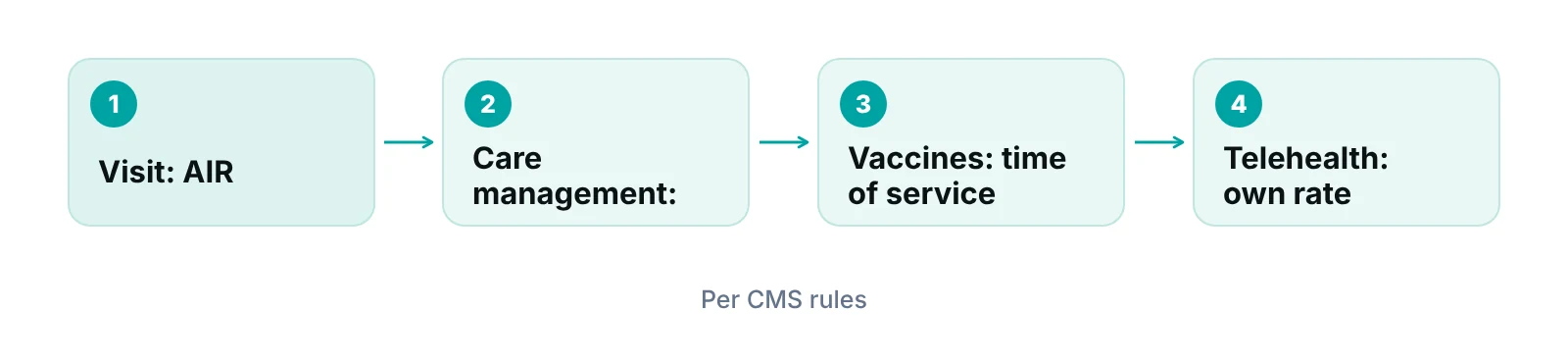
- Care management, vaccines, IOP and distant-site telehealth are paid outside the AIR.
- G0511 is terminated; RHCs report individual care management codes and APCM codes G0556-G0558.
- Telehealth coding changes for dates of service from October 1, 2026: G2025 is replaced by individual codes with modifier 93 or 95.
- Always confirm current rules with your MAC; CMS updates RHC limits and codes every year.
What counts as a billable RHC visit
An RHC is a clinic in a non-urbanized area that has a qualifying shortage designation and meets Medicare certification rules. According to the CMS RHC booklet (January 2026), it must employ at least one nurse practitioner or physician assistant, and a nurse practitioner, physician assistant or certified nurse-midwife must work at least half of the clinic’s operating hours. A federally qualified health center (FQHC) cannot also be an RHC.
A billable visit must be medically necessary and must be a medical or mental health visit, a qualifying preventive visit, or a face-to-face visit with an RHC practitioner. Visits that take place in a hospital inpatient or outpatient department do not count. If a patient is seen more than once in a day, Medicare generally treats it as one visit. The exceptions in the booklet include a return for a new illness or injury, a medical visit combined with a mental health visit, and an intensive outpatient program (IOP) service or a dental visit on the same day as a medical visit.
Because RHCs are primary care sites, the front-end habits that protect revenue are the same as in any family practice billing and RCM workflow: correct patient and payer details, a documented reason for the visit and a clear record of who saw the patient. The difference is that one missed detail can change whether the visit is paid at the AIR at all.
How the all-inclusive rate and payment limit work
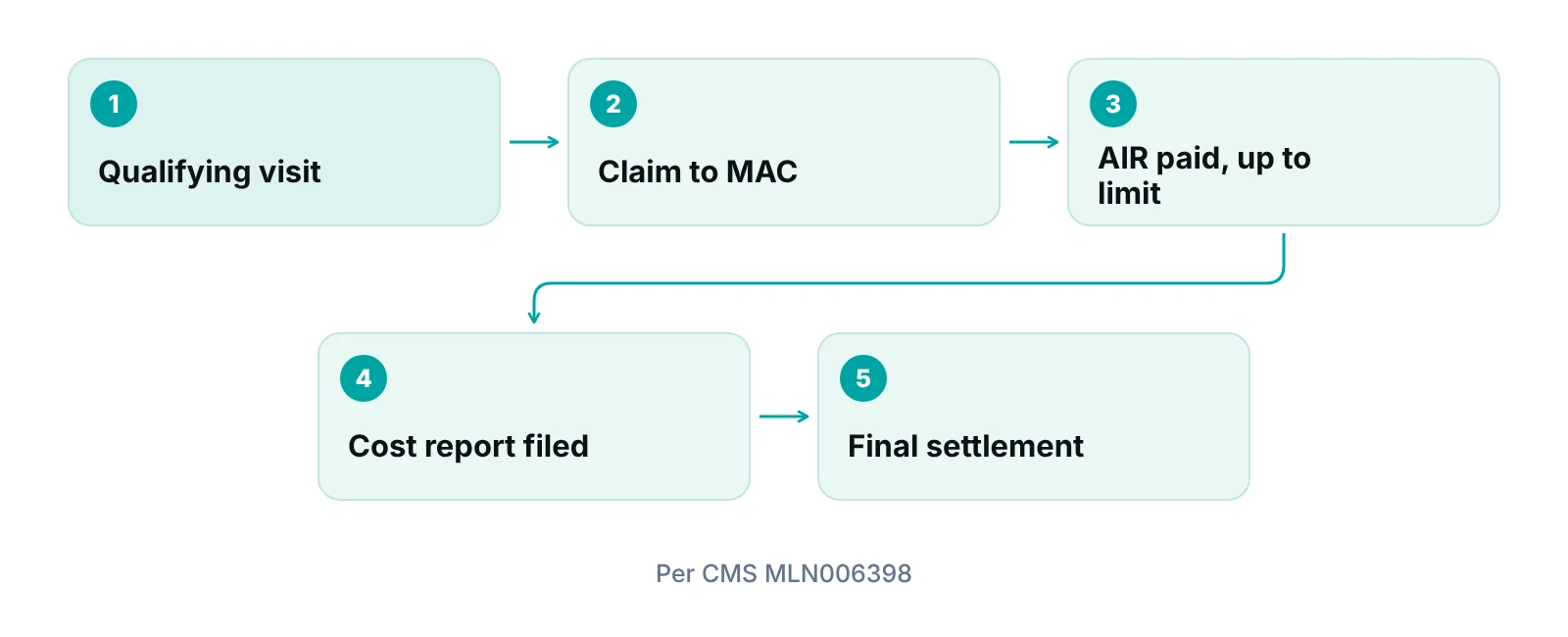
The AIR is a single payment for a qualifying visit. Per the CMS booklet, the Medicare Administrative Contractor (MAC) sets the clinic’s rate by dividing allowable costs by actual visits, then reconciles total payments at year end through the cost report. Independent RHCs file Form CMS-222-17. Provider-based RHCs complete the M series of worksheets on Form CMS-2552-10.
Medicare Part B pays 80% of the AIR, and the AIR is subject to a per-visit limit, as CMS explains for calendar year 2026. The limit is $165 for independent RHCs and for provider-based RHCs in hospitals with 50 or more beds. Some older provider-based RHCs keep a higher limit: the greater of their 2025 limit increased by 2.7% or $165. The CMS booklet lists the limit as $178 for 2027.
| Item | 2026 amount or rule | Why it matters |
|---|---|---|
| Per-visit payment limit (independent RHCs and provider-based RHCs in hospitals with 50 or more beds) | $165 | Caps the AIR for each qualifying visit |
| Per-visit payment limit, specified provider-based RHCs | Greater of the 2025 limit plus 2.7%, or $165 | Older provider-based clinics may sit above the standard cap |
| Per-visit payment limit, 2027 | $178 (per the CMS booklet) | Plan next year’s budget now |
| IOP services, 3 or fewer per day | $319.38 | Paid outside the AIR |
| IOP services, 4 or more per day | $418.45 | Paid outside the AIR |
| Telehealth originating site fee | $31.85 | Applies when the clinic hosts a patient for a distant provider |
Source: CMS Change Request 14303 / Transmittal 13505 (December 2025); CMS MLN006398, Information for Rural Health Clinics (January 2026).
Limits change every year
The $165 figure applies to calendar year 2026 dates of service. CMS publishes the limit each year in a transmittal to MACs, so confirm it before you update budgets or fee schedules.
What Medicare pays outside the AIR
Not everything an RHC does is bundled into the visit rate. Four categories follow their own payment path, and mixing them up is a common source of underpayment. For the wider picture on Medicare and Medicaid claims, see our Medicare and Medicaid billing tips.
| Service | How it is paid | Cost sharing |
|---|---|---|
| Qualifying visit (medical, mental health, preventive) | AIR, up to the per-visit limit | Part B 80% payment; patient owes the balance |
| Care coordination (care management) | National non-facility Physician Fee Schedule rate, in addition to the AIR | Deductible and 20% coinsurance apply |
| Preventive vaccines and administration | Paid at time of service, then reconciled on the cost report | Coinsurance and deductible waived |
| Intensive outpatient program | Fixed daily rate by number of services | Check your MAC’s instructions |
| Distant-site telehealth (non-behavioral) | Its own rate, not part of the AIR calculation | Deductible and coinsurance apply unless the service is preventive |
Source: CMS MLN006398 (January 2026); CMS Transmittal 12958 (November 2024); CMS MM13923 (2025); CMS Transmittal 14468 (2026).
“If a service is not part of a qualifying visit, it probably has its own code, its own rate and its own claim line.”
Care management codes after G0511
G0511 no longer works for care management claims. The CY 2025 Physician Fee Schedule final rule told RHCs to report individual CPT and HCPCS codes for care coordination, with a transition period of at least until July 1, 2025. Noridian later told clinics they could keep billing G0511 through September 30, 2025 if they needed time to update systems. The CMS FQHC/RHC news page now states that G0511 is terminated and not billable under the CY 2026 Physician Fee Schedule final rule.
Care coordination is paid at the national non-facility Physician Fee Schedule rate, in addition to the AIR, and the rate is based on the fee schedule regardless of the charge, as CMS Transmittal 12958 explains. For RHC claims (type of bill 71X), the deductible and coinsurance apply. The transmittal lists chronic care management codes 99487, 99490 and 99491 among the covered care coordination services. For how those codes work in a regular practice, see our chronic care management coding and billing guide.
Advanced primary care management (APCM)
The 2025 final rule also brought advanced primary care management into RHCs. Per CMS, G0556 applies to a patient with one chronic condition, G0557 to a patient with two or more, and G0558 to a patient with two or more who is also a Qualified Medicare Beneficiary. These codes are reported separately from the other care management codes and are paid at the national non-facility rate in addition to the AIR.
Codes that ended on January 1, 2026
The CMS RHC booklet says G0512, which RHCs used for psychiatric collaborative care, was discontinued as of January 1, 2026. Clinics report the individual codes instead: 99492, 99493, 99494 or G2214. CMS also lists G0071 as no longer reportable from the same date, so individual component codes are billed in its place.
Preventive vaccines are billed at the time of service
Since July 1, 2025, RHCs can bill Medicare for pneumococcal, influenza, hepatitis B and COVID-19 vaccines and their administration when they are given, rather than waiting for the cost report. CMS payment instructions set the vaccine product at 95% of average wholesale price and the administration at the national Part B vaccine administration fee schedule. The clinic then reconciles what it received against actual costs on the annual cost report, which reimburses at 100% of reasonable cost.
Medicare waives the patient’s coinsurance and deductible for these vaccines. Hepatitis B vaccine has been paid this way since January 1, 2025. The point for billing teams: a vaccine given during a visit needs its own claim line, not a mention in the visit note.
Telehealth billing in 2026
The telehealth rules changed again this fall, so check your MAC’s current guidance before billing. The January 2026 CMS booklet said RHCs could use G2025 for non-behavioral distant-site telehealth through December 31, 2026. A later CMS notice, Transmittal 14468, changes that for dates of service on or after October 1, 2026: RHCs stop using G2025 and bill the individual CPT or HCPCS code for the service, with modifier 93 for audio-only or modifier 95 for audio and video.
The same notice says the distant-site authority now runs through January 1, 2028 under section 6209(c) of the Consolidated Appropriations Act, 2026. CMS guidance dated May 28, 2026 adds that the cost of these services is excluded when setting the RHC all-inclusive rate. For mental health visits delivered by telehealth, the CMS booklet says to use revenue code 0900 with a qualifying mental health code and the CG modifier, plus modifier 95 for audio-video or 93 or FQ for audio-only. The in-person visit requirement for mental health telehealth has been delayed to 2028. For payer-by-payer telehealth coding outside RHCs, see our telehealth billing guide.
Do not assume G2025 still works
Claims with modifier 93 or 95 on a code that is not a telehealth service can be returned to the provider under the Transmittal 14468 edits. Confirm the code list with your MAC before the next billing batch.
Lab and productivity rule changes
Two operating rules changed in the CY 2025 rule. First, productivity standards were removed for cost reporting periods starting on or after January 1, 2025, according to the CMS CY 2025 fact sheet. Clinics are no longer measured against those standards in the cost report.
Second, CMS survey memo QSO-25-27-RHC, dated September 26, 2025, removed hemoglobin and hematocrit testing and stool testing for occult blood from the required on-site lab list. RHCs must still be able to do urine chemical exams, blood glucose and pregnancy tests, and they must collect specimens for culturing and send them to a certified lab instead of culturing on site. The same memo states that an RHC must provide primary care services.
Where RHC claims go wrong
Most problems fall into a few patterns. The table below turns the rules above into checks a biller can run before a claim is submitted.
| Problem | Why it happens | Check before submitting |
|---|---|---|
| G0511 or G0512 on a 2026 claim | Old charge master entries | Replace with the individual component codes in your billing system |
| G2025 on telehealth dated October 1, 2026 or later | Template not updated | Use the individual telehealth code with modifier 93 or 95 per Transmittal 14468 |
| Vaccine given but not billed | Treated as part of the visit | Create a separate vaccine and administration line at the time of service |
| Care management billed without a record | Time or consent not documented | Confirm the documentation each code requires before you bill it |
| Visit location not qualifying | Service done in a hospital department | Confirm the site of care on every visit |
Source: derived from CMS MLN006398 (January 2026), CMS Transmittal 14468 (2026) and CMS MM13923 (2025).
A practice management system that tracks claims by stage, with an owner for each claim, makes these checks routine. RCM Finder’s practice management portal supports data-completeness checks before submission and workflow rules that flag claims for review. A claim for a vaccine or a care management service can then be held until the missing detail is entered. It is also useful to review the clean claim basics and the billing compliance guide alongside these RHC-specific rules.
Not sure your RHC claims use the 2026 codes?
Our free practice audit reviews how your clinic bills visits, care management, vaccines and telehealth, and shows where claims may be stuck or underpaid.
Our recommendations
- Update the charge master first. We recommend removing G0511, G0512 and G2025 from active charge entries and replacing them with the individual codes your MAC instructs. Old codes are the easiest errors to prevent.
- Confirm every rule with your MAC. CMS transmittals set the national rule, and your MAC applies it. Check the MAC’s current article before changing billing for telehealth, care management or vaccines.
- Separate the payment paths in your workflow. Train staff to ask four questions on every encounter: was there a qualifying visit, was there a care management service, was a vaccine given, and was it telehealth. Each answer maps to a different claim line.
- Reconcile at cost report time. Keep a running record of vaccine and administration payments received at the time of service. The cost report reconciles those against actual costs, and gaps are expensive to rebuild later.
- Review the per-visit limit every January. Budget with the current year’s limit and watch for the next one. The CMS booklet lists $178 for 2027, which changes revenue projections for high-volume clinics.
- Document care management at the time of service. Each code has its own documentation requirements. Make sure consent, the care plan and the time or activity record are in the chart before the claim goes out.
A claim-tracking system can keep RHC payment paths separate.
The RCM Finder portal tracks claims by stage with an owner and runs data-completeness checks before submission, so a vaccine or care management claim can be held until its details are entered.
See how the RCM Finder portal works · Create a portal account
Disclosure: RCM Finder builds and sells this portal. It is a practice management system, not an EHR.
Bottom line
RHC billing and reimbursement comes down to knowing which of four payment paths a service follows, and keeping codes current as CMS changes them. If your billing team needs help with this, see our medical billing services and denial management services, or estimate what stuck claims cost with the revenue calculator.
Frequently asked questions
What is the all-inclusive rate for a Rural Health Clinic?
The all-inclusive rate (AIR) is a per-visit payment that covers a qualifying visit. The MAC sets it by dividing the clinic’s allowable costs by its actual visits and reconciles it on the cost report. Medicare pays 80% of the AIR, up to the per-visit limit, which is $165 for most RHCs in 2026.
Can RHCs still bill G0511?
No. CMS told RHCs to move to individual care management codes in 2025, allowed a transition through September 30, 2025, and now lists G0511 as terminated under the CY 2026 final rule. Use the individual CPT or HCPCS codes, such as 99490 for chronic care management, per your MAC.
Are vaccines paid separately from the AIR?
Yes. Since July 1, 2025, RHCs bill pneumococcal, influenza, hepatitis B and COVID-19 vaccines and their administration at the time of service. The vaccine is paid at 95% of average wholesale price and administration at the national fee schedule. The clinic reconciles on the cost report. Patients owe no coinsurance or deductible.
How do RHCs bill telehealth after October 1, 2026?
Under CMS Transmittal 14468, for dates of service on or after October 1, 2026, RHCs stop using G2025 for non-behavioral distant-site telehealth. They bill the individual CPT or HCPCS code with modifier 93 for audio-only or 95 for audio and video. Confirm the details with your MAC.
What happened to RHC productivity standards?
CMS removed them for cost reporting periods starting on or after January 1, 2025. The agency called them outdated and redundant with the payment limit provisions of the Consolidated Appropriations Act, 2021.
What type of bill do RHCs use?
CMS instructions refer to type of bill 71X for RHC claims, and revenue code 0900 for mental health telehealth lines. Care coordination and vaccine services are also reported on 71X claims. Your MAC’s billing instructions set the line-level details, so confirm them before changing templates.
Get your free practice audit
Tell us about your practice. We will contact you using the details you give.
- A review of your recent claims, denials and A/R aging
- Where your front desk and prior authorizations slow payment
- A prioritized fix list you keep, whether or not you hire us
Pricing is quoted after the audit, based on your volume and the services you choose. Prefer to talk? Call +1 (302) 556-2288.
Sources
- Information for Rural Health Clinics (MLN006398) — CMS (2026)
- RHC AIR Payment Limit and IOP Payment Rates CY 2026 (Transmittal 13505, CR 14303) — CMS (2025)
- MM14303: RHC and IOP Payment Rates CY 2026 Update — CMS (2025)
- Payment for Medicare Part B Preventive Vaccines and Their Administration in RHCs (MM13923) — CMS (2025)
- RHC Changes in Regulations for Primary Care Services and Laboratory Requirements (QSO-25-27-RHC) — CMS (2025)
- CY 2025 Medicare Physician Fee Schedule Final Rule fact sheet — CMS (2024)
- Updates to Billing for Care Coordination Services for RHCs and FQHCs (Transmittal 12958, CR 13581) — CMS (2024)
- CMS extends G0511 billing until September 30, 2025 — Noridian Healthcare Solutions (Medicare MAC) (2025)
- FQHC/RHC News and Announcements — CMS (2026)
- Transmittal 13776 (CR 14468): RHCs and FQHCs Billing for Distant Site Telehealth — CMS (2026)
- MM14468: RHCs and FQHCs Billing Distant Site Telehealth Services — CMS (via HHS guidance) (2026)
Disclaimer: This article is for education only. It is not legal, coding, billing or compliance advice. Medicare rules, payment limits and codes change, and your Medicare Administrative Contractor applies them to your clinic. Confirm current requirements with your MAC and CMS before changing billing.