
CPT 99221, 99222 and 99223 are initial hospital inpatient or observation care codes. Since 2023 the level is chosen by medical decision making or total time on the date of the encounter: 99221 is straightforward or low MDM or 40 minutes, 99222 is moderate MDM or 55 minutes, and 99223 is high MDM or 75 minutes.
Hospital E/M coding changed in 2023, when the AMA aligned it with office visits. History and exam no longer drive the level. MDM or time does. Many practices still teach the old rules, and that shows up in downcoded or denied claims.
This guide explains the levels, who bills them, and how consultants and admitting practitioners differ. Thresholds follow the current CPT hospital E/M guidelines as summarized by the AAFP and other sources. Check your payer, because Medicare adds its own rules.
Key takeaways
- 99221, 99222 and 99223 are chosen by MDM or total time, not by history and exam.
- Time thresholds: 40, 55 and 75 minutes for the three levels, which must be met or exceeded.
- These codes apply to inpatient and observation status, which are reported with the same code family.
- Admission status and place of service must match the stay.
What do the three initial hospital codes mean?
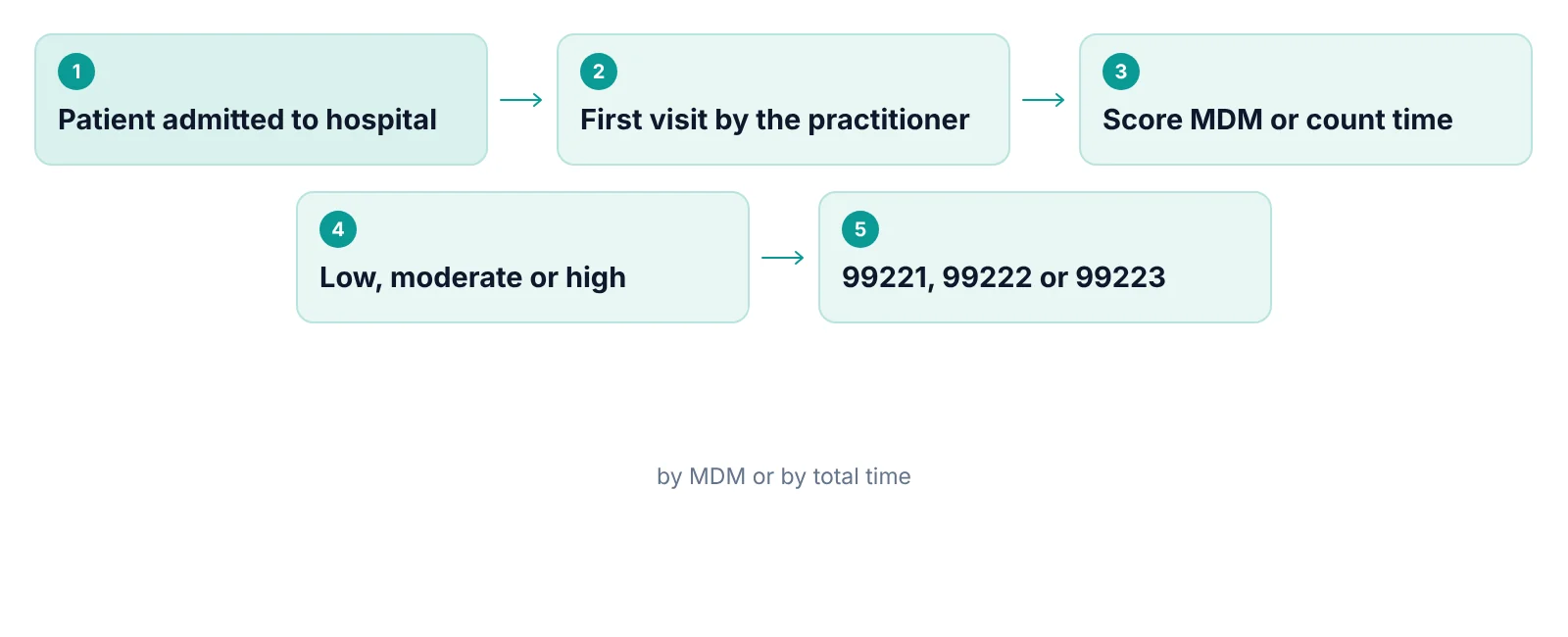
The three codes describe the first visit by a practitioner during an inpatient or observation stay. The level depends on MDM or total time.
| Code | MDM level | Total time on the date of the encounter |
|---|---|---|
| 99221 | Straightforward or low | 40 minutes must be met or exceeded |
| 99222 | Moderate | 55 minutes must be met or exceeded |
| 99223 | High | 75 minutes must be met or exceeded |
Thresholds as described in AAFP and other summaries of the 2023 CPT hospital E/M guidelines.
How does MDM set the level?
MDM uses the same three elements as office visits: problems, data, and risk. Two of three must meet the level. The inpatient setting often supports higher risk, such as a decision about escalation of care, but the note must show it.
| Element | What meets high | Example |
|---|---|---|
| Problems | Severe exacerbation, or a threat to life or bodily function | Acute condition needing close monitoring |
| Data | Extensive review or independent interpretation | Tests reviewed plus discussion with another clinician |
| Risk | High, such as intensive drug monitoring or a decision about escalation of care | Decision to move to a higher level of care |
Summarized from the AMA MDM table as reproduced in AAFP guidance. See our guide to 99215 for the same logic in the office.
For time, count the practitioner’s own work on the date of the encounter, including review, exam, counseling, orders and documentation. Do not count separately reported services.
Who bills initial hospital care and what about consultants?
Any qualified practitioner who provides the first inpatient or observation visit can report these codes, including consultants where the payer allows. Medicare does not recognize consultation codes, so a consultant bills the initial hospital codes. Medicare also uses modifier AI to identify the admitting physician of record, a point to confirm with your contractor.
| Role | Typical code | Note |
|---|---|---|
| Admitting physician | 99221 to 99223 with AI on Medicare | Principal physician of record |
| Consultant | 99221 to 99223 on Medicare | No consult codes on Medicare |
| Subsequent days | Subsequent hospital care codes | Different code family |
Confirm modifier AI and consultant rules with your Medicare contractor and each commercial payer.
Want a second pair of eyes on your claims?
Send us your recent denials and we will show where the same issue repeats. The audit is free and the fix list is yours to keep.
How do inpatient and observation status affect billing?
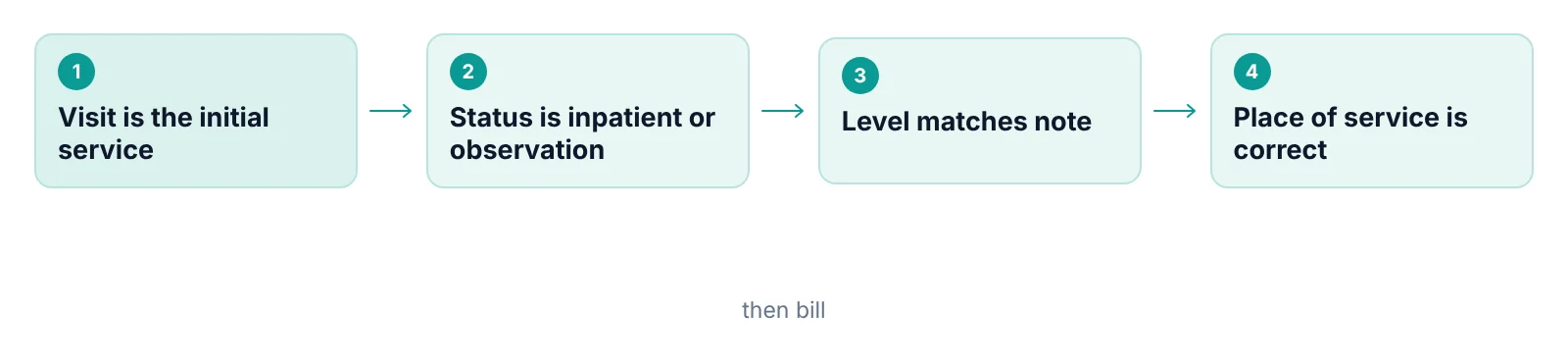
The same code family covers inpatient and observation care, but the facility claim differs and Medicare rules on status matter. See our guide to inpatient versus observation and the two-midnight rule. For the place of service on the professional claim, read POS 21.
| Check | Why | Where to look |
|---|---|---|
| Patient status | Affects facility billing | Admission order |
| Place of service | Must match the stay | Claim form. See POS codes |
| Date of service | First visit versus later visit | Visit note |
Registration and the practitioner should agree on status before billing.
What are the common hospital E/M mistakes?
| Mistake | Why it fails | Fix |
|---|---|---|
| Using history and exam to set the level | Not the rule since 2023 | Use MDM or time |
| Billing consult codes to Medicare | Medicare does not accept them | Use initial hospital codes |
| Wrong place of service | Does not match the stay | Check status and POS |
| Time with no activities | Cannot be tested | Add the activities |
See critical care billing when the patient is critically ill, because that has its own rules.
A coding audit of hospital E/M by practitioner will show where notes fall short.
Related hospital and E/M guides
For the office side of the same logic, see 99214. For facility versus professional billing, read hospital versus professional billing. For documentation habits, see clear documentation.
Our recommendations
- Retrain on 2023 rules. Make sure no one still uses history and exam for hospital levels.
- Use time statements. Total and activities every time.
- Confirm status and POS. Align registration and billing.
- Know the payer rules. Medicare and commercial payers differ on consults.
- Audit by practitioner. Compare level mix with peers.
- Flag critical care. Use the right code when care is critical.
Bottom line
Initial hospital care codes follow MDM or time, and the note should show which. Retrain on the 2023 rules, confirm status and place of service, and audit by practitioner. For billing support, see our medical billing services.
Frequently asked questions
How many minutes for 99223?
Seventy-five minutes of total practitioner time on the date of the encounter must be met or exceeded when you choose by time. 99222 is 55 minutes and 99221 is 40 minutes. Only the billing practitioner’s own work counts. Record the total and the activities so the figure can be tested.
What is the difference between 99221, 99222 and 99223?
They are the three levels of initial hospital care. 99221 is straightforward or low MDM or 40 minutes, 99222 is moderate MDM or 55 minutes, and 99223 is high MDM or 75 minutes. The level depends on the MDM or total time documented, not on how long the patient stays.
Do these codes apply to observation patients?
Yes. Since 2023, the initial hospital inpatient or observation care codes are one family, so the same codes are used for both statuses. The facility claim and Medicare rules differ by status, so confirm the patient’s status and place of service before billing.
Can a consultant bill 99223 to Medicare?
Medicare does not recognize consultation codes, so a consultant bills initial hospital care codes when providing the first visit during the stay. Some commercial payers still accept consult codes. Check each payer, and confirm modifier requirements with your Medicare contractor.
Does history and exam still matter?
A medically appropriate history and exam are still required, but they no longer set the level. Since 2023, the level is chosen by MDM or total time. A long history without matching MDM does not raise the level, and a focused one with high MDM does not lower it.
What is modifier AI?
Modifier AI identifies the principal physician of record, usually the admitting physician, on Medicare claims for initial hospital care. It helps Medicare tell the admitting physician from consultants who also bill initial hospital codes. Confirm its use with your Medicare contractor, because contractor rules and payer rules can differ.
Get your free practice audit
Tell us about your practice. We will contact you using the details you give.
- A review of your recent claims, denials and A/R aging
- Where your front desk and prior authorizations slow payment
- A prioritized fix list you keep, whether or not you hire us
Pricing is quoted after the audit, based on your volume and the services you choose. Prefer to talk? Call +1 (302) 556-2288.
Sources
- Time and medical decision making levels for evaluation and management — American Academy of Family Physicians (2025)
- Hospital E/M coding — American Academy of Family Physicians, Family Practice Management (2023)
- 2023 observation coding and reimbursement update — American College of Emergency Physicians (2023)
- Medicare Claims Processing Manual, Chapter 12 — Centers for Medicare & Medicaid Services (2026)
- Evaluation and Management Services Guide (MLN006764) — Centers for Medicare & Medicaid Services (2025)
- Medicare Physician Fee Schedule — Centers for Medicare & Medicaid Services (2026)
Disclaimer: This article is educational and is not legal, coding, billing, medical or compliance advice. CPT codes and modifier descriptions are owned by the AMA, and code meanings, Medicare contractor policies and payer rules change and vary by payer, contractor and state. Verify current requirements with the official CPT manual, your payers and your counsel before you act.
