
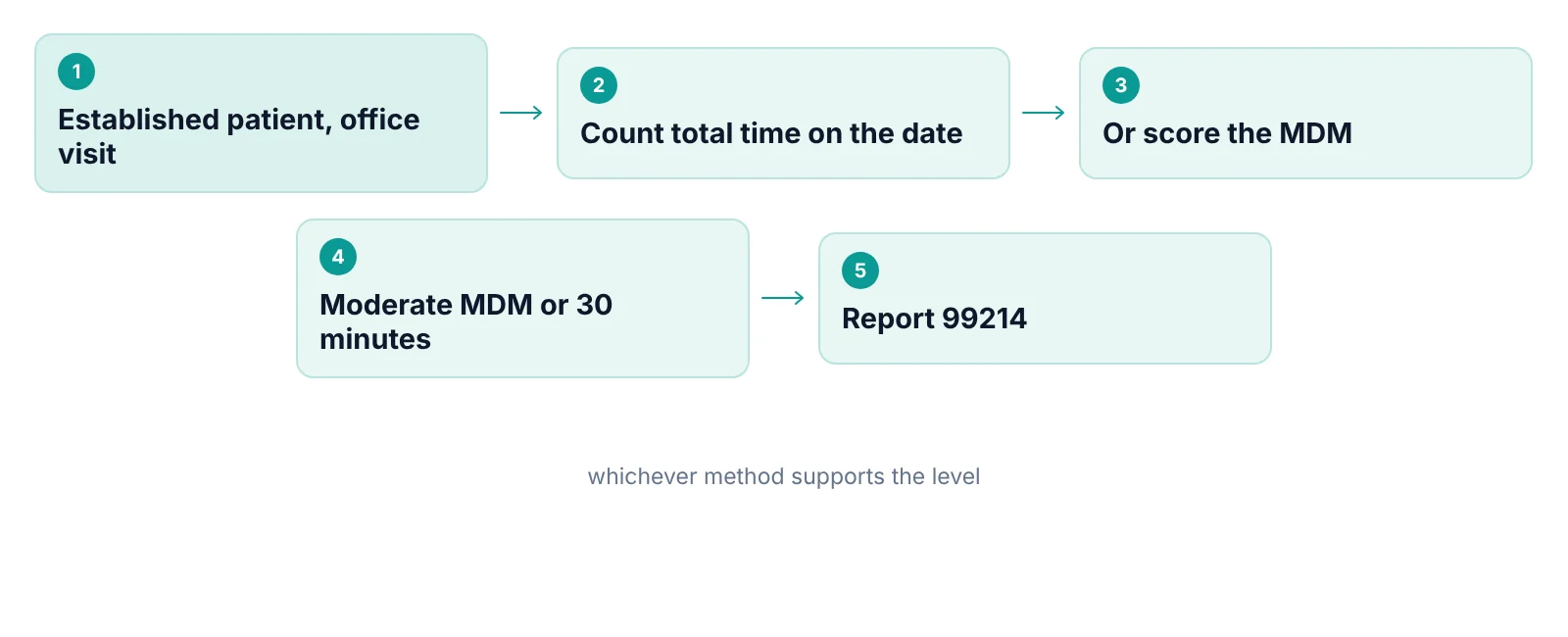
CPT 99214 is an office or other outpatient visit for an established patient that meets moderate medical decision making, or that takes at least 30 minutes of total practitioner time on the date of the encounter. You choose the level by MDM or by time, whichever the note supports.
99214 is one of the most billed E/M codes, which makes it one of the most reviewed. It sits between 99213 and 99215, and the line between them is where most disagreements start. A visit coded 99214 on a thin note, or coded 99213 on a strong one, costs the practice either way.
This guide explains the time rule, the three parts of medical decision making, and the documentation that holds the level up. The time and MDM thresholds follow the current CPT office visit guidelines as summarized by CMS and the AAFP, so check your payer if it publishes its own rules.
Key takeaways
- 99214 requires moderate MDM or 30 minutes of total time on the date of the encounter.
- MDM is scored on three elements: problems, data, and risk. Two of the three must meet the level.
- Time counts the practitioner’s own work on the date of the visit, not clinical staff time and not time spent on separately reported services.
- Do not pick the level from the diagnosis list alone. The note has to show the work.
What is CPT 99214?
99214 describes an office or other outpatient visit for an established patient that includes a medically appropriate history and exam and moderate medical decision making. When time is used instead, the threshold is 30 minutes or more of total time. A patient is established if they received professional services from the practitioner or another practitioner of the same specialty in the same group within the past three years.
| Code | MDM level | Total time on the date of the encounter |
|---|---|---|
| 99212 | Straightforward | 10 minutes must be met or exceeded |
| 99213 | Low | 20 minutes must be met or exceeded |
| 99214 | Moderate | 30 minutes must be met or exceeded |
| 99215 | High | 40 minutes must be met or exceeded |
Thresholds from the current CPT office visit guidelines, as summarized by the AAFP. See also our guides to 99213 and 99215.
What counts as moderate medical decision making?
MDM has three elements: the number and complexity of problems addressed, the amount and complexity of data reviewed or analyzed, and the risk of the patient’s management. The level is the one that two of the three elements meet or exceed.
| Element | What meets moderate | Example |
|---|---|---|
| Problems | One or more chronic illnesses with exacerbation or side effects, or two or more stable chronic illnesses, or an undiagnosed new problem with uncertain prognosis | Diabetes above goal plus hypertension managed in one visit |
| Data | Meets one of three categories, such as review of several tests, independent historian, or discussion with an external clinician | Reviewing labs and discussing with a specialist |
| Risk | Moderate risk of morbidity from treatment | Prescription drug management |
Summarized from the AMA CPT MDM table as reproduced in AAFP guidance.
Prescription drug management is the most common way a visit reaches moderate risk. If the practitioner adjusts a drug, that supports the risk element, and a second element such as two stable chronic conditions can complete the level.
How does the time rule work for 99214?
You may choose the level by total time on the date of the encounter instead of MDM. For 99214 the threshold is 30 minutes. Time includes things the billing practitioner does personally on that date, such as reviewing records, examining the patient, counseling, ordering, documenting and coordinating care.
- Counts: the practitioner’s own face-to-face and non-face-to-face work on the date of the visit.
- Does not count: clinical staff time, time spent on separately reported services, and travel.
- Document the total: a statement such as “total time on the date of the encounter: 32 minutes” with a short description of the activities.
For visits that run well beyond the top level, CMS uses G2212 and the AMA uses 99417 for prolonged services. The thresholds differ between the two, so check which code your payer accepts before you bill a prolonged visit.
How is 99214 different from 99213 and 99215?
The three codes differ by the complexity of the decision making or the time. A routine follow-up for one stable condition is typically 99213. A visit where the practitioner manages several conditions, adjusts a prescription or works up a new problem is typically 99214. A visit with severe exacerbation, a threat to life or bodily function, or intensive drug monitoring leans toward 99215.
| Level | Problems pattern | Risk pattern |
|---|---|---|
| 99213 (low) | One stable chronic illness, or an acute uncomplicated problem | Low risk, such as an over-the-counter drug |
| 99214 (moderate) | Multiple stable chronic illnesses, or one with exacerbation | Prescription drug management |
| 99215 (high) | Severe exacerbation, or a threat to life or bodily function | Drug therapy needing intensive monitoring, or a decision about hospitalization |
Examples are illustrative. The full AMA table has more detail.
What documentation supports 99214?
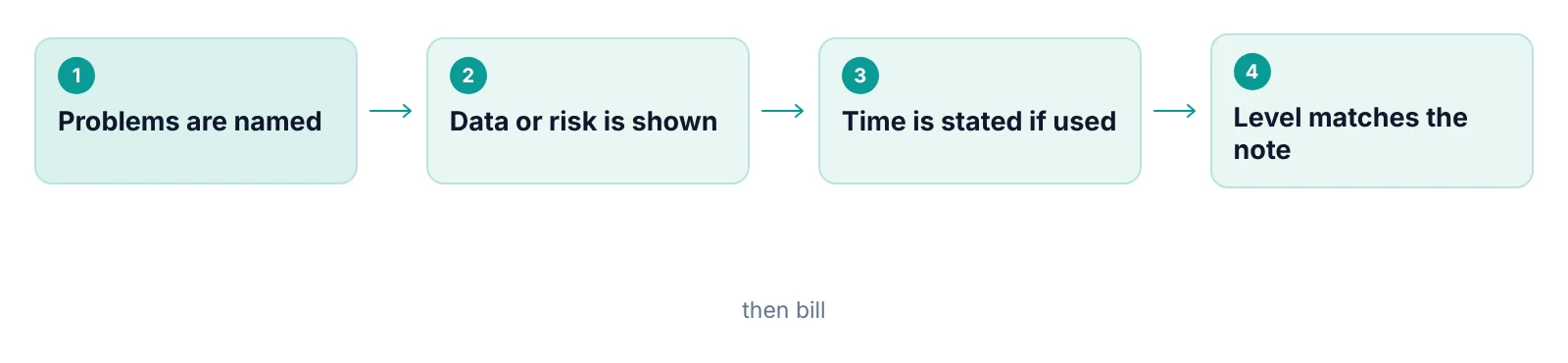
Name each problem addressed and what was done about it. State the data reviewed, including the source. Record the management decision and, where relevant, the reason it carried risk. If you are billing by time, state the total and the activities.
Want a second pair of eyes on your claims?
Send us your recent denials and we will show where the same issue repeats. The audit is free and the fix list is yours to keep.
- Problems: list each condition and its status (stable, worsening, new).
- Data: list tests reviewed, the independent historian or the outside discussion.
- Risk: record the prescription decision or other management step in words.
Habits that make this easier are covered in our guide to clear documentation.
What are the most common 99214 audit problems?
The usual problems are a level chosen from the problem list alone, a copied note that does not describe this visit, and time stated without detail.
| Problem | Why it fails | Fix |
|---|---|---|
| Level based on the problem list | Listing a condition is not the same as addressing it | Record what was done for each problem |
| Copied note text | The note does not describe this visit | Edit every note to this encounter |
| Time stated with no activities | Reviewers cannot test the total | Add a short list of what was done |
| Counting staff time | Only the practitioner’s time counts | Remove clinical staff minutes |
See our guides to upcoding and down-coding for the risks on both sides.
A regular coding audit of E/M levels will show whether your 99214 rate is supported.
Related E/M codes
99214 is one rung of the established patient ladder. See 99212 at the low end and 99215 at the top. For new patients, read 99204, and for the add-on that can ride with a visit, G2211.
Our recommendations
- Teach MDM and time side by side. Providers should know both methods and choose the one that fits the visit.
- Use a time statement template. A short template with total time and activities prompts the detail reviewers need.
- Audit by practitioner. Compare each practitioner’s 99214 share with peers and explain outliers.
- Check payer policies. Some payers publish their own E/M edits.
- Watch modifier 25 visits. A same-day procedure changes how the E/M is billed. See modifiers 25 and 59.
- Review denials by level. A pattern of 99214 downcodes tells you where notes fall short.
Bottom line
99214 is supported by moderate MDM or 30 minutes of total time, and the note has to show the work. Teach both methods, document specifically, and audit regularly. If E/M denials keep returning, our denial management services can help find the cause.
Frequently asked questions
How many minutes are required for 99214?
Thirty minutes of total practitioner time on the date of the encounter must be met or exceeded when you choose the level by time. Only the practitioner’s own time counts, and time spent on separately reported services does not. Document the total and a short description of what was done, so a reviewer can see how the figure was reached.
What is moderate medical decision making?
Moderate MDM means two of three elements meet the moderate level: problems addressed, data reviewed or analyzed, and risk of management. Examples include two or more stable chronic illnesses or one with exacerbation, review of several tests or an outside discussion, and prescription drug management. The note must show the work behind each element.
Can I bill 99214 for a routine refill visit?
Only if the documented work reaches moderate MDM or 30 minutes. A refill visit for one stable condition often supports 99213. If the practitioner reviews several conditions, adjusts prescriptions or manages a new problem, moderate MDM may be supported. The level must come from the note, not from the reason for the visit.
Does clinical staff time count toward 99214?
No. Total time counts only the billing practitioner’s own work on the date of the encounter. Staff time for rooming, vitals or education does not count. If staff did work that the practitioner would otherwise do, that may be part of other services, but it does not add minutes to the practitioner’s total.
Can G2211 be added to 99214?
Yes, G2211 can be added to an eligible office or outpatient E/M visit such as 99214 when the practitioner serves as the continuing focal point for care or provides ongoing care for a serious or complex condition. Medicare generally does not pay it when the E/M carries modifier 25. Check your payer for its own rules.
What happens if a payer downcodes 99214?
The payer pays at a lower level, usually 99213, and the remittance shows an adjustment. Review the note against the MDM and time rules before you appeal. If the note supports moderate MDM or 30 minutes, appeal with the specific elements. If it does not, correct the process so future notes reflect the work.
Get your free practice audit
Tell us about your practice. We will contact you using the details you give.
- A review of your recent claims, denials and A/R aging
- Where your front desk and prior authorizations slow payment
- A prioritized fix list you keep, whether or not you hire us
Pricing is quoted after the audit, based on your volume and the services you choose. Prefer to talk? Call +1 (302) 556-2288.
Sources
- Evaluation and Management Services Guide (MLN006764) — Centers for Medicare & Medicaid Services (2025)
- Time and medical decision making levels for evaluation and management — American Academy of Family Physicians (2025)
- Complexity Add-on Code G2211 — Noridian Healthcare Solutions, JF Part B (2026)
- Medicare Claims Processing Manual, Chapter 12 — Centers for Medicare & Medicaid Services (2026)
- Medicare Physician Fee Schedule — Centers for Medicare & Medicaid Services (2026)
- Evaluation and management services — American Medical Association (2025)
Disclaimer: This article is educational and is not legal, coding, billing, medical or compliance advice. CPT codes and modifier descriptions are owned by the AMA, and code meanings, Medicare contractor policies and payer rules change and vary by payer, contractor and state. Verify current requirements with the official CPT manual, your payers and your counsel before you act.
