
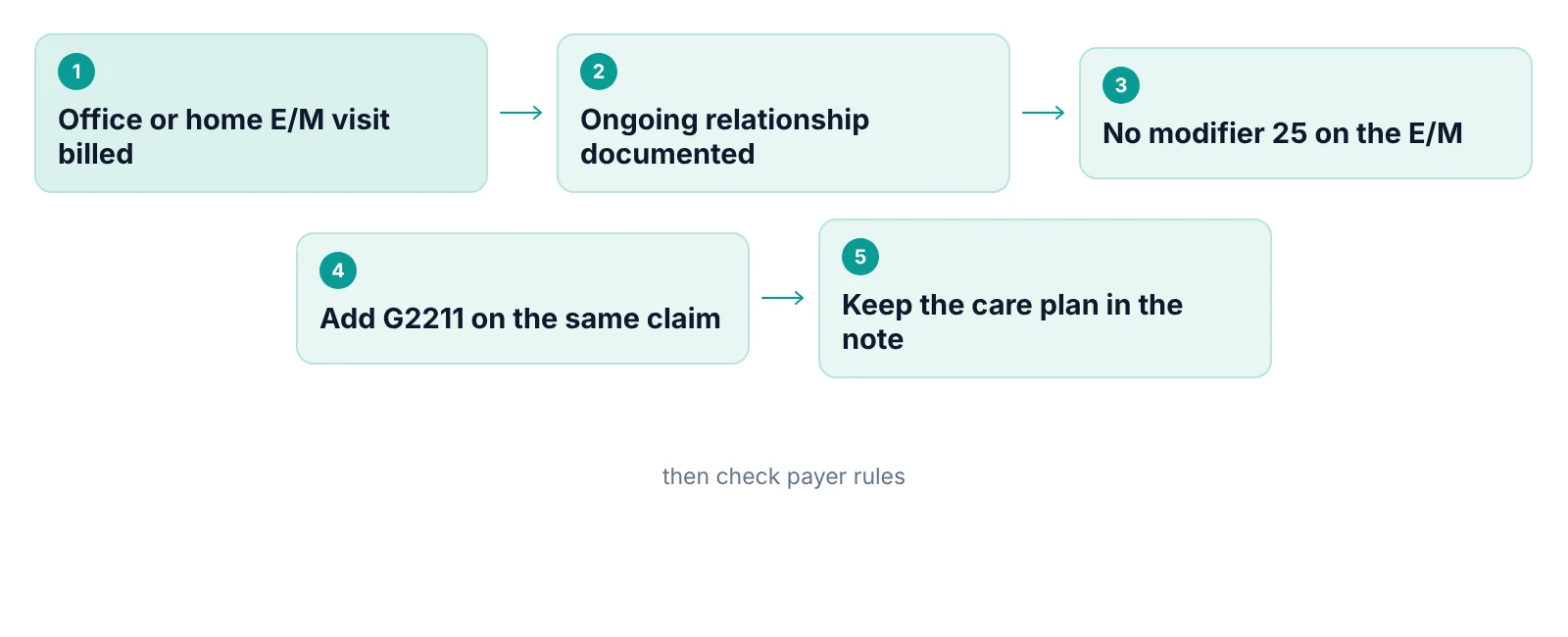
G2211 is a Medicare add-on code for the visit complexity that comes from being the continuing focal point for a patient’s care, or from ongoing care for a single serious or complex condition. It is billed with an office or outpatient E/M visit, and Medicare generally does not pay it when the E/M carries modifier 25.
G2211 is easy to add and easy to lose. The code is small, but the rules around it decide whether a claim line is paid, denied or later questioned in an audit. Most denials trace to one of three things: modifier 25 on the visit, a note that reads like a template, or a visit that was really a one-time encounter.
This guide covers what the code describes, which visits qualify, how modifier 25 interacts with it, and what the record needs to show. The rules below come from Medicare administrative contractor guidance and CMS material, so confirm details against your own contractor and payers before you bill.
Key takeaways
- G2211 is an add-on to an office or outpatient E/M visit, and from 2026 also to home or residence E/M visits. It is not billed alone.
- Medicare does not pay G2211 when the E/M is billed with modifier 25, with a narrow exception for certain same-day preventive services.
- No specific diagnosis is required. The relationship has to be real and visible in the record.
- Templated language is a weak defense. Notes should show the care plan and the practitioner’s continuing role.
What does G2211 describe?
G2211 describes visit complexity inherent to an E/M service when the practitioner is the continuing focal point for all of a patient’s health care needs, or provides ongoing care related to a patient’s single serious or complex condition. It adds payment for the longitudinal relationship, not for extra time in the room.
| Situation | What it looks like | Example setting |
|---|---|---|
| Focal point for all care | The practitioner is the patient’s main point of contact and coordinates their health needs over time | A primary care practice that manages the whole patient |
| Ongoing care for one serious or complex condition | The practitioner treats a single condition over time and is the continuing source of care for it | A specialist who manages a long-term serious condition |
| Not a fit | A one-time visit with no expected follow-up relationship | An urgent visit for a minor, self-limited problem |
Summarized from Medicare contractor guidance on the visit complexity add-on code. Always confirm with your own contractor.
CMS does not limit the code by specialty. What matters is the role the practitioner plays for the patient. Specialists who manage a serious condition over time can qualify, as can primary care practitioners.
Which E/M visits can carry G2211?
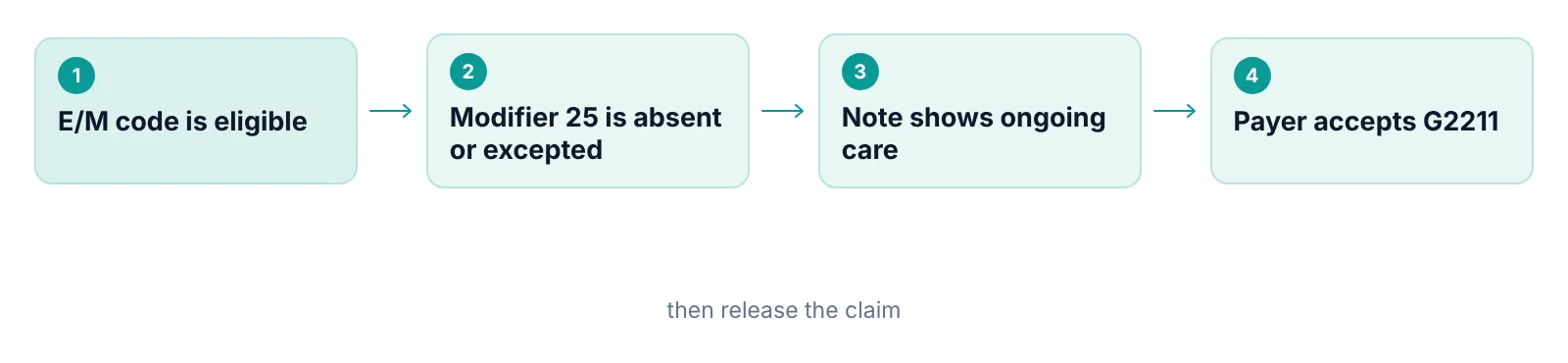
G2211 is added to office and outpatient E/M visits, new or established, which are 99202 through 99215. According to Noridian’s page, home or residence E/M visits 99341 through 99350 also qualify beginning in 2026. If your visit mix includes those, check your payer’s start date.
| Visit type | Code range | Notes |
|---|---|---|
| Office or outpatient, new patient | 99202-99205 | See our guide to CPT 99203 |
| Office or outpatient, established patient | 99212-99215 | Examples: 99213, 99214, 99215 |
| Home or residence visit | 99341-99350 | Beginning in 2026 per Noridian |
Code ranges as described in Noridian JF Part B guidance on G2211.
Consult the E/M level separately. G2211 does not change how the visit level is chosen, and the level must stand on its own medical decision making or time.
How does modifier 25 affect G2211?
Medicare will not pay G2211 when the E/M visit is billed with modifier 25. That is the rule behind many denials: a same-day minor procedure usually needs the E/M to carry modifier 25, and the add-on then fails.
There is a narrow exception. Since January 2025, Noridian says G2211 may be paid when a separately identifiable office or outpatient E/M visit with modifier 25 is billed on the same day as certain preventive services, such as an annual wellness visit, an initial preventive physical exam or a listed vaccine administration, if the record supports it.
- E/M plus a minor procedure, modifier 25: expect G2211 to be denied.
- E/M plus an annual wellness visit, modifier 25: the exception may apply if the note supports the add-on.
- E/M alone, no modifier: G2211 can be paid if the relationship is documented.
For a refresher on when modifier 25 belongs on the E/M at all, see our comparison of modifiers 25 and 59.
What documentation supports G2211?
The record needs to show a continuing relationship and a plan. Noridian says services should be furnished on an ongoing basis with a personalized, comprehensive, continuous care plan, and that templated language may not adequately support medical necessity. A once-a-year visit without a care plan for an ongoing condition is unlikely to qualify.
| Element | Supportive wording or content | Weak or risky wording |
|---|---|---|
| Relationship | Practitioner is the patient’s regular source of care, follow-up arranged | Generic statement copied into every note |
| Condition or scope | Names the serious or complex condition, or states the practitioner coordinates overall care | Condition not named, visit is isolated |
| Plan | Dated follow-up, goals and next steps in the note | No plan for return visits |
Based on Noridian guidance. Your payer may ask for more.
Want a second pair of eyes on your claims?
Send us your recent denials and we will show where the same issue repeats. The audit is free and the fix list is yours to keep.
A shared template can still be used, but the free text must be specific to the patient. See our guide to clear documentation for habits that hold up in review.
Why is G2211 denied and how do you fix it?
Most denials come from a short list of causes. Work through them in order before you appeal.
| Cause | What to check | Fix |
|---|---|---|
| Modifier 25 on the E/M | Was a procedure billed the same day? | Do not appeal unless the preventive exception clearly applies |
| Payer does not recognize the code | Commercial policy may exclude it | Read the payer policy, then adjust expectations or appeal if it is covered |
| Note does not show the relationship | Is the language generic? | Add patient-specific detail going forward, and do not alter past notes |
| Visit was not eligible | Was it a code outside the eligible ranges? | Remove the add-on |
Check each cause against the remittance codes on the denial. Our guide to CO-97 covers one denial that often appears when an add-on is bundled.
If the same cause repeats, build a prompt into the charge screen. The method in denial root cause analysis shows how to find the pattern.
What is the audit risk with G2211?
An add-on that appears on nearly every visit is the kind of pattern reviewers notice. Use the code where the relationship is real and documented, and track your usage rate by practitioner so that outliers are explained rather than discovered. See our guide to coding audits and the broader billing compliance guide for how to set up a routine check.
Related E/M and billing topics
G2211 sits on top of the visit level, so the level has to be right first. Read 99214 for established visits, and chronic care management billing for another way ongoing care is paid. When a visit includes work by someone other than the billing practitioner, incident-to billing rules matter.
Our recommendations
- Make the add-on a deliberate choice. Do not auto-populate G2211. Prompt the practitioner to confirm the ongoing relationship.
- Flag modifier 25 visits. A charge-entry rule that warns when G2211 and modifier 25 appear together saves denials.
- Write specific notes. A line naming the condition and the follow-up plan is stronger than a template phrase.
- Check each payer separately. Medicare policy does not automatically apply to commercial plans.
- Track usage by practitioner. Review outliers monthly and explain them.
- Review the CMS update each year. Rules shifted in 2025 and 2026. Re-read the contractor page every January.
Bottom line
G2211 pays for a real, continuing relationship, and the claim has to show it. Keep modifier 25 in mind, write notes that name the condition and plan, and check each payer. If add-on denials keep recurring, our denial management services can help find where the claim breaks.
Frequently asked questions
What does G2211 stand for?
G2211 is a HCPCS add-on code for visit complexity inherent to evaluation and management associated with medical care services that serve as the continuing focal point for all needed health care services, or that are part of ongoing care for a single serious or complex condition. It is reported with an eligible E/M visit and is not billed on its own.
Can G2211 be billed with modifier 25?
Generally no. Medicare does not pay G2211 when the E/M visit is billed with modifier 25. Noridian describes a narrow exception beginning January 2025 for a separately identifiable office or outpatient E/M visit on the same day as certain preventive services, if the record supports the add-on. Check your contractor before relying on it.
Does G2211 require a specific diagnosis?
No specific diagnosis is required according to Noridian. The practitioner must either be the continuing focal point for all of the patient’s health care needs or provide ongoing care for a single serious or complex condition. The note should show that relationship and a continuing care plan rather than rely on a diagnosis code alone.
Which visits can carry G2211?
Office and outpatient E/M visits for new and established patients, codes 99202 through 99215, can carry G2211. Noridian also states that home or residence E/M visits 99341 through 99350 qualify beginning in 2026. The code is not limited by specialty, but it is never billed without an eligible E/M visit.
Is a template enough to support G2211?
Usually not by itself. Noridian notes that templated language may not adequately support medical necessity. Notes should name the condition or scope of care and the follow-up plan in patient-specific terms. A shared template can organize the note, but the free text must reflect the actual relationship and plan.
Do commercial payers pay G2211?
It depends on the payer. Some commercial plans adopt Medicare add-on codes and others do not, and policies change. Read the payer’s published reimbursement policy before you bill, and track denials by payer so you can tell a coding problem from a coverage rule. Do not assume Medicare rules apply to commercial plans.
Get your free practice audit
Tell us about your practice. We will contact you using the details you give.
- A review of your recent claims, denials and A/R aging
- Where your front desk and prior authorizations slow payment
- A prioritized fix list you keep, whether or not you hire us
Pricing is quoted after the audit, based on your volume and the services you choose. Prefer to talk? Call +1 (302) 556-2288.
Sources
- Complexity Add-on Code G2211 — Noridian Healthcare Solutions, JF Part B (2026)
- How to use the office and outpatient E/M visit complexity add-on code G2211 (MM13473) — Centers for Medicare & Medicaid Services (2024)
- HCPCS code G2211 frequently asked questions — Centers for Medicare & Medicaid Services (2024)
- Evaluation and Management Services Guide (MLN006764) — Centers for Medicare & Medicaid Services (2025)
- Decoding G2211: when to use the add-on code — American Academy of Family Physicians (2025)
- Complexity Add-on Code G2211 — Noridian Healthcare Solutions, JE Part B (2025)
Disclaimer: This article is educational and is not legal, coding, billing, medical or compliance advice. CPT codes and modifier descriptions are owned by the AMA, and code meanings, Medicare contractor policies and payer rules change and vary by payer, contractor and state. Verify current requirements with the official CPT manual, your payers and your counsel before you act.
