
Dental billing services handle the claim side of a dental practice: eligibility checks, CDT claim submission, payment posting, denial appeals, A/R follow-up and patient statements. Outsource the repeatable, rule-driven work. Keep clinical documentation, treatment estimates and patient conversations in the office, and sign a business associate agreement before any vendor sees patient data.
Hiring a billing company does not hand off the whole revenue cycle. Some steps need a dentist’s notes, a treatment coordinator’s judgment or a front-desk conversation that only the office can have. This guide is for owners and office managers deciding where the line sits, and what to ask before signing.
It looks at the buying decision. For how the cycle runs stage by stage, read the dental revenue cycle management guide, and for code-level detail see the dental billing and coding guide. The dental marketing plan and dental digital marketing guide cover the patient-acquisition side.
Key takeaways
- Outsource repeatable, rule-driven work (claims, posting, secondary claims, follow-up); keep clinical evidence, estimates and patient conversations in the office.
- A billing company that handles patient information is a business associate, and HHS requires a written agreement before it does.
- Plans judge dental necessity from submitted documents, so the clinic must supply notes, radiographs and narratives.
- Credentialing is often separate from billing; CAQH re-attestation may be needed every 120 days (ADA News, June 2026).
- Require stage-level monthly reports: A/R by age and payer, claims by stage, denials by reason, payments against expected amounts.
What do dental billing services cover?
Dental billing services cover the claim side of the practice: benefit checks, claim creation and submission, payment posting, secondary claims, denial work, A/R follow-up and patient statements. Some also add reporting, credentialing support or remote front-desk staff.
What sets dental apart is that plan design drives payment. The ADA’s benefits primer lists annual maximums, deductibles, frequency limits, exclusions for conditions that predate coverage and alternate-benefit clauses as plan terms that shape what is paid (ADA, Introduction to Dental Benefits). A billing team needs to read those terms, not just enter codes. Federal rules also give dental its own code set: the ADA’s Code on Dental Procedures and Nomenclature, used on a dental claim form.
Whatever the model, the scope should be in writing. A useful agreement names the tasks included, the systems the vendor may access and at what role level, how quickly denials are worked, the reports delivered each month, and what happens to the data when the contract ends. HHS notes that a service agreement must not block the practice’s access to its own data and that the agreement should require return or destruction of patient information at termination (HHS cloud computing guidance).
RCM Finder pairs a billing team with remote front-desk staff and a claims portal for dental practices, working inside the practice’s existing software. The end-to-end revenue cycle management service page describes the model.
Which dental billing tasks suit outsourcing, and which should stay in the office?
Outsource work that is repeatable and rule-driven, and keep work that depends on clinical evidence or on a conversation with the patient. Most practices end up with a hybrid, because several tasks need both sides.
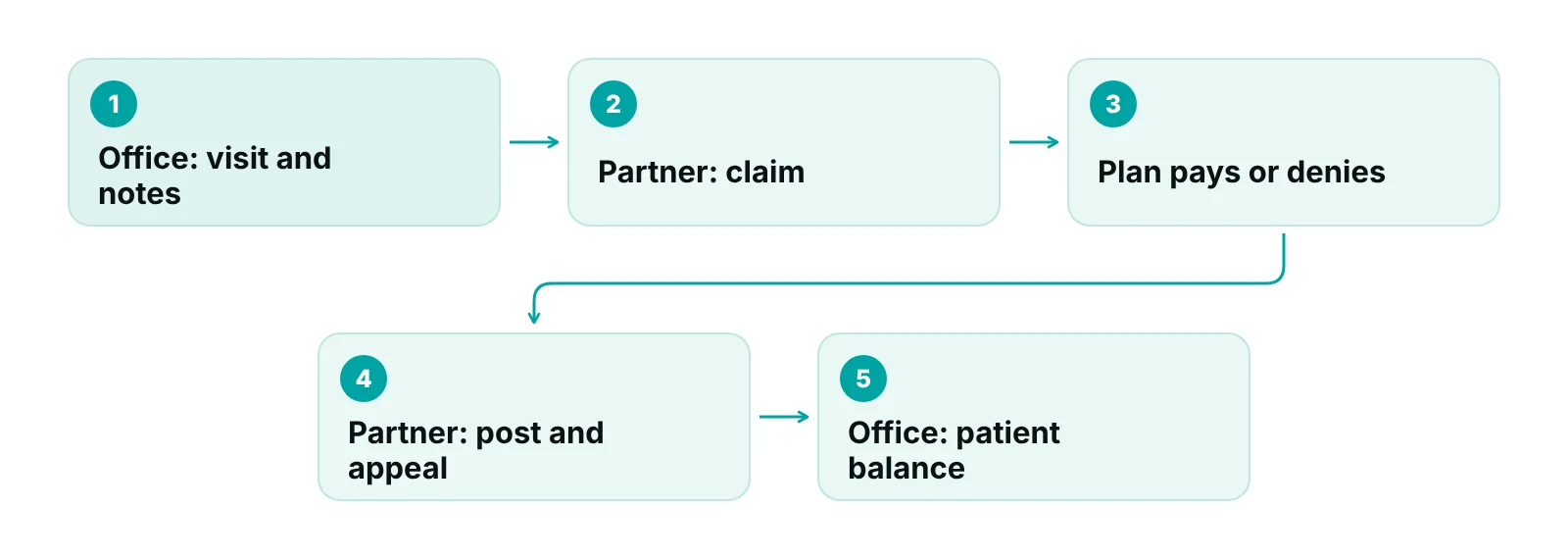
| Task | Usual owner | Why |
|---|---|---|
| Eligibility and benefit checks | Outsource, or a remote assistant | Repeatable; results feed the estimate and must be recorded |
| Treatment estimate and financial conversation | Keep in the office | Needs clinical context; an estimate is not a guarantee of payment |
| Clinical notes, radiographs, charting and narratives | Keep in the office | Plans decide necessity from the documents submitted; only the clinic can create them |
| Procedure code selection | Shared | The clinical team knows what was done; the billing team checks the code against the CDT edition in force on the service date |
| Claim creation and submission | Outsource | Rule-driven; depends on the claim form fields and plan requirements |
| Payment posting and secondary claims | Outsource | Coordination-of-benefits mechanics; no write-off until every plan has paid |
| Denials and appeals | Shared | The billing team drafts and tracks; the clinician supplies the narrative and peer-to-peer call |
| Patient statements and collection calls | Shared | Statements can move out; difficult conversations stay with the office |
Source: RCM Finder framework, based on guidance from the ADA, the claim form instructions and HHS; see the sources listed below.
Three rows deserve a closer look. First, clinical evidence. The ADA says plan consultants judge dental necessity from the claim form, radiographs and other submitted documents only, and lists the narrative, charting, photographs or models that support each type of appeal (ADA, Responding to Claim Rejections). A billing partner can request them but cannot create them.
Second, coding. A June 2026 ADA News article says dentists should not alter clinical reporting to match a payer’s payment preference and should report the accurate code (ADA News). That keeps final responsibility for what was done with the clinical team, whoever keys the claim. Third, the estimate. The ADA’s guidance says predeterminations and estimates are not guarantees and that a written office financial policy helps because patients often assume treatment is covered (ADA pre-authorization page; ADA, participating in a plan).
A fourth row deserves attention: what the patient owes. A March 2026 ADA News article advises recording “noncovered” (the patient owes the full fee) separately from “nonpayable” (the patient owes up to the allowed amount) and training front-desk staff with scripts for both (ADA News). A vendor can post the balance, but the explanation to the patient is better given by someone from the office who was in the room when treatment was discussed.
Check what your billing process could recover
Enter your claim volume in the revenue calculator to see what delays and denials may be costing the practice.
What does HIPAA require when a billing company handles dental claims?
A billing company that handles patient information for a dental practice is a business associate, and HIPAA requires a written business associate agreement before it does. The agreement and the vendor’s safeguards are the first things to check, ahead of price.
HHS lists billing, claims processing and practice management among business associate functions, along with clearinghouses that convert claims into standard transactions. A BAA must describe permitted uses of patient information, bar other uses, require Security Rule compliance by the vendor and its subcontractors, and require reporting of security incidents and breaches. A vendor must also have a BAA with any subcontractor before passing it patient data (HHS business associate guidance). A dental office submitting claims to a plan needs no BAA with the plan, because payment disclosures are exempt, but it does need one with a billing company working for it.
Business associates are directly liable under HIPAA for items that include Security Rule failures, impermissible uses or disclosures, missing breach notices to the covered entity and failing to limit information to the minimum necessary (HHS, direct liability of business associates). That does not remove the practice’s own duty to choose and oversee the vendor.
| Question | What a sound answer includes | Basis |
|---|---|---|
| Will you sign a BAA before accessing patient data? | A signed agreement covering permitted uses, safeguards and incident reporting | HHS business associate guidance |
| Which subcontractors touch patient data? | A named list, each bound by its own BAA | HHS business associate guidance |
| Who sees what? | Unique logins, role-based access, two-factor authentication for remote access, session time-outs | HHS Security Rule remote-use guidance |
| Where is data stored and accessed, and what happens at termination? | Location disclosed and covered in the risk analysis; return or destruction of data at the end | HHS cloud computing guidance |
| How are incidents reported, and how fast? | Timing and content set in the BAA | HHS business associate guidance |
| How is access removed when a staff member leaves? | Same-day removal and a logged record | RCM Finder framework |
Source: HHS Office for Civil Rights business associate and cloud computing guidance; HHS Security Rule remote-use guidance (2006).
HHS’s cloud guidance adds two useful points: storing electronic patient information outside the United States is permitted with a BAA, but the location’s risks must be part of the risk analysis, and a service agreement must not block the practice’s access to its own data (HHS). The guidance on remote access calls for unique user names, role-based authorization, encryption and training (HHS Security Rule remote-use guidance). The HIPAA compliance checklist for medical practices covers the wider safeguards.
RCM Finder puts a Business Associate Agreement in place before accessing patient data. Its portal uses role-based staff permissions, an audit log and encrypted HTTPS connections.
What dental-specific skills should a billing partner show?
A partner should be able to explain plan behavior, not just submit claims. Test with real scenarios from the practice’s own recent claims.
- Code edition: which CDT edition applies to a date of service, and what happens when software truncates a descriptor. The ADA says the edition in force on the service date applies (ADA).
- Coordination of benefits: who is primary for a child on two plans, what goes on the secondary claim and why no write-off is posted early (ADA).
- Noncovered versus nonpayable: how each is recorded and who explains it to the patient (ADA News).
- Plan reductions: how bundling, downcoding and alternate-benefit decisions are spotted and appealed.
- Out-of-network accounts: assignment of benefits, and how an EOB showing no patient responsibility is challenged (ADA News).
The guide to questions for choosing a medical billing company adds general questions, and the dental revenue cycle management guide shows where each issue arises in the cycle.
What about credentialing and payer enrollment?
Credentialing is usually a separate service from billing. Ask the vendor whether enrollment is included, sold separately or left to the practice, because claims cannot be paid in network until it is done.
ADA News reported in June 2026 that the ADA Credentialing Service, powered by CAQH, lets a dentist keep one profile shared with multiple payers, that CAQH had rebranded the service as DataSpring that month, and that information should be re-attested every 120 days when required. It also noted that Medicaid enrollment can take months, that missing or expired documents are a common cause of delay, and that in-network status is tied to the tax ID or business, not only the individual dentist (ADA News). Delays are the dentist’s problem as much as the vendor’s, because attestations need the dentist.
The insurance credentialing guide for group practices covers the process in more depth.
In-house, outsourced or hybrid: which fits which practice?
The right model depends on volume, turnover and how many plans the practice carries. No model removes the need for a person in the office who understands the numbers.
| Situation | Likely fit | Watch for |
|---|---|---|
| One trained biller and steady volume | In-house, with outside review of denials and A/R | Single point of failure when the biller is absent |
| No biller, or frequent turnover | Outsourced billing, with remote help at the front desk | Handoffs for notes, narratives and estimates |
| Several locations on different software | Hybrid with one reporting standard | Inconsistent plan rules and fee schedules between sites |
| Growing plan list or new locations | Hybrid, with enrollment planned early | Enrollment delays before claims can be paid |
| High denial volume | Outsourced denial and appeal work, with clinical narratives from the office | Denials caused upstream by benefit checks |
| Large out-of-network share | Hybrid; office owns estimates and financial policy | Patients surprised by balances |
Source: RCM Finder framework.
One decision never moves out: which networks to join or leave. The ADA advises reading each contract carefully before signing and notes that carriers may require a specific notice period to terminate (ADA, participating in a plan). It also recommends its contract analysis service before signing with a carrier (ADA). A billing partner can show what a plan actually pays, but the owner decides whether the fee schedule is acceptable.
Remote front-desk staff can take over verification and intake without changing who owns billing. The virtual medical assistant services page describes the model, and the dental virtual assistant guide covers insurance, phones and scheduling. CAQH data reported by ADA News shows why verification attracts attention: dental eligibility and benefit verification spending rose 15% to $2.1 billion in 2023 (ADA News).
How should a practice start with a billing partner and review it?
Start with a baseline, limit access by role, and review the same reports every month. The first 90 days show whether the partner understands dental plans.
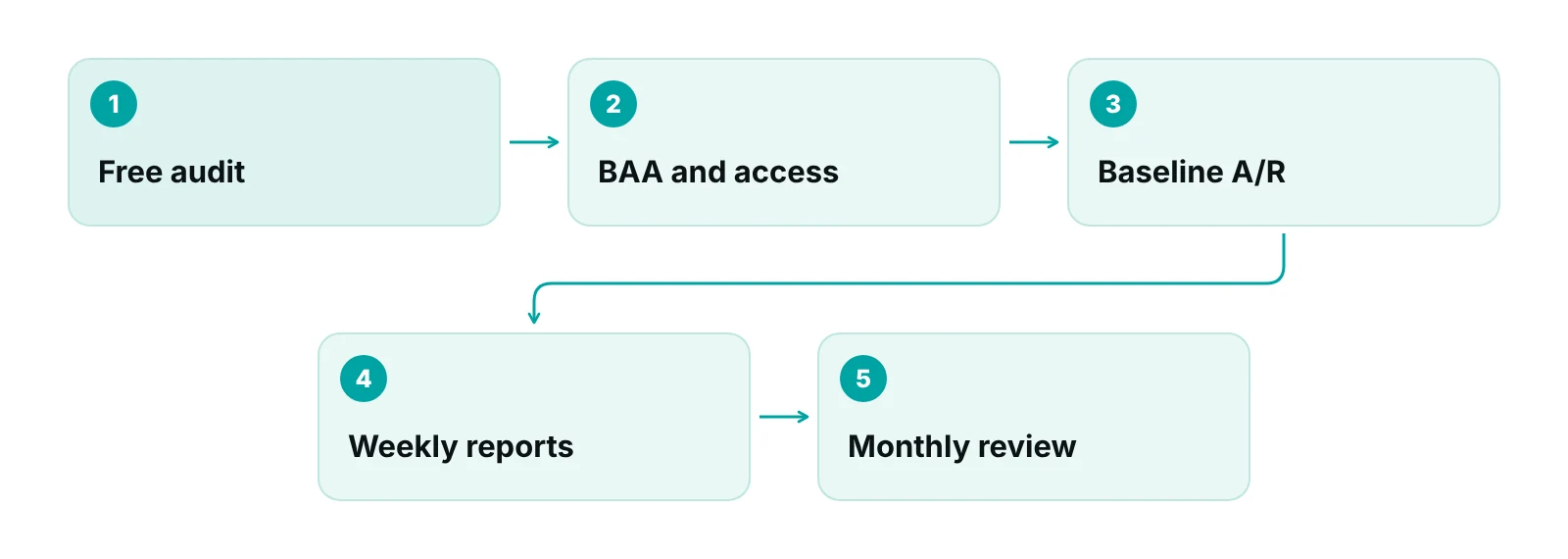
A monthly report should show, in plain language:
- A/R by age and payer, with items over 90 days listed.
- Claims by stage, so each unpaid claim has an owner.
- Denials by reason, with the cause upstream and the fix.
- Payments compared with expected amounts, so short payments are flagged.
- Patient balances and the number of unworked items.
The RCM Finder portal tracks claims by stage, checks claim data before submission, flags underpayments against expected amounts, and gives billing companies a client portal for each practice they serve; the dental practice management software guide explains how that fits alongside chairside software. Pricing is quoted after a free practice audit.
Get a second opinion on the billing process
A free practice audit reviews recent claims, EOBs and denials and shows what could stay in the office and what could move.
Our recommendations
- Map every billing task to an owner before talking to vendors. List tasks from benefit checks to statements, then mark each as office, partner or shared.
- Keep clinical evidence and patient conversations in the office. Notes, radiographs, narratives, estimates and the financial policy need the dentist or treatment coordinator.
- Sign the business associate agreement first, and limit access by role. Require the subcontractor list, incident reporting terms and a record of who can see what.
- Test dental skill with real scenarios. Use recent claims to check code edition, coordination of benefits, noncovered versus nonpayable handling and appeals.
- Ask about enrollment explicitly. Find out whether credentialing is included, and keep the practice’s own CAQH profile current.
- Require the same stage-level report every month. A/R by age and payer, claims by stage, denials by reason, payments against expected amounts and patient balances.
Bottom line
Dental billing services work as a split: the partner does the repeatable, rule-driven work, and the office keeps the clinical evidence, the estimate and the patient conversation. Put the BAA, access limits and reporting in place first, then test dental skill on real claims. The dental revenue cycle management guide shows the stages in order, and RCM Finder’s end-to-end revenue cycle management service is available to practices that want a free audit before deciding.
Frequently asked questions
What do dental billing services include?
They typically include benefit checks, claim submission, payment posting, secondary claims, denial appeals, A/R follow-up and patient statements. Some also offer reporting, credentialing support or remote front-desk staff. Confirm in writing which tasks are included, which stay with the practice, what the reports cover and what happens to the data if the contract ends.
Is it HIPAA-compliant to outsource dental billing?
Yes, if a business associate agreement is signed first. HHS treats billing and claims processing as business associate functions, and the agreement must cover permitted uses, safeguards, subcontractors and incident reporting. The practice should still choose and oversee the vendor carefully, asking about subcontractors, access controls and how incidents are reported.
What should a dental office keep in-house?
Clinical notes, radiographs, narratives, treatment estimates, the financial policy and difficult patient conversations. Plans judge necessity from submitted documents, and only the clinic creates them. The billing partner can request them and track appeals but cannot replace them.
Does a billing company need access to the practice's software?
Many work inside the practice’s existing software. Grant access by role and limit it to what the work needs. HHS guidance calls for unique user names, role-based authorization, encryption and training. Ask how access is removed when a staff member leaves.
How should a practice judge a dental billing partner's reports?
Look for A/R by age and payer, claims by stage, denials by reason with upstream causes, payments compared with expected amounts and patient balances. A report that shows only collections hides where money is stuck. Compare the same figures month to month so trends show up early.
Can a billing company handle dental credentialing?
Some do, but it is often a separate service. ADA News says Medicaid enrollment can take months, documents must be current and CAQH attestation is needed every 120 days when required. Ask whether enrollment is included and who does the follow-up.
Get your free practice audit
Tell us about your practice. We will contact you using the details you give.
- A review of your recent claims, denials and A/R aging
- Where your front desk and prior authorizations slow payment
- A prioritized fix list you keep, whether or not you hire us
Pricing is quoted after the audit, based on your volume and the services you choose. Prefer to talk? Call +1 (302) 556-2288.
Sources
- Business Associates — HHS Office for Civil Rights (2026)
- Direct Liability of Business Associates — HHS Office for Civil Rights (2026)
- Guidance on HIPAA & Cloud Computing — HHS Office for Civil Rights (2026)
- HIPAA Security Guidance: Remote Use of and Access to Electronic Protected Health Information — HHS (CMS), Security Rule guidance (2006)
- Responding to Claim Rejections — American Dental Association (undated, read 2026)
- Dear ADA: Downcoding — ADA News (2026)
- Pre-Authorizations — American Dental Association (undated, read 2026)
- Participating in a Plan — American Dental Association (undated, read 2026)
- ADA Guidance on Coordination of Benefits — American Dental Association (undated, read 2026)
- Dear ADA: Noncovered services — ADA News (2026)
- Dear ADA: Out-of-network billing — ADA News (2026)
- Credentialing 101: What new dentists need to know — ADA News (2026)
- Benefit verification drives increased administrative spending in dental offices — ADA News (2025)
- Introduction to Dental Benefits — American Dental Association (undated, read 2026)
- 2024 ADA Dental Claim Form Completion Instructions — American Dental Association (2024)
- Health Care Transactions Basics — Centers for Medicare & Medicaid Services (undated, read 2026)
Disclaimer: This article is educational and is not legal, coding, tax or compliance advice. Advertising, privacy and payer rules differ by state and by plan and change over time, so confirm current requirements with your state dental board, your attorney and each payer before acting. CDT is a registered trademark of the American Dental Association and CPT is a registered trademark of the American Medical Association; official code descriptors are not reproduced here.
