
Dental revenue cycle management is the chain of steps that turns a scheduled visit into collected payment: verifying benefits, estimating costs, filing CDT claims, posting insurance and patient payments, working denials and collecting balances. Dental plans pay by contract limits as much as by clinical need, so the front desk and the billing desk have to hand off cleanly.
A crown is seated, the claim goes out, and weeks later the plan pays a fraction because the annual maximum was used up in spring. Nothing was coded wrong. The leak happened at the front desk, before the visit. This guide walks the dental revenue cycle from first call to final balance and marks where money leaks at each handoff.
It is a process view. For code-level detail, such as CDT basics and what a claim must carry, see the dental billing and coding guide. For choosing a partner, see the dental billing services guide, and for how marketing feeds this cycle, see the dental marketing plan and the dental digital marketing guide.
Key takeaways
- Dental plans pay by contract limits (maximums, frequency limits, alternate benefits), so limits must be known before treatment.
- Only 3.4% of patients reach a typical annual maximum (ADA Health Policy Institute, 2024), but large treatment plans make remaining benefit the key field to check.
- Dental eligibility and benefit verification cost the industry $2.1 billion in 2023, up 15% (CAQH Index, reported by ADA News in 2025).
- A predetermination is not a guarantee; benefits follow the coverage in force on the date of service.
- Send secondary claims with the primary EOB, and post no write-off until every plan has paid.
What is dental revenue cycle management?
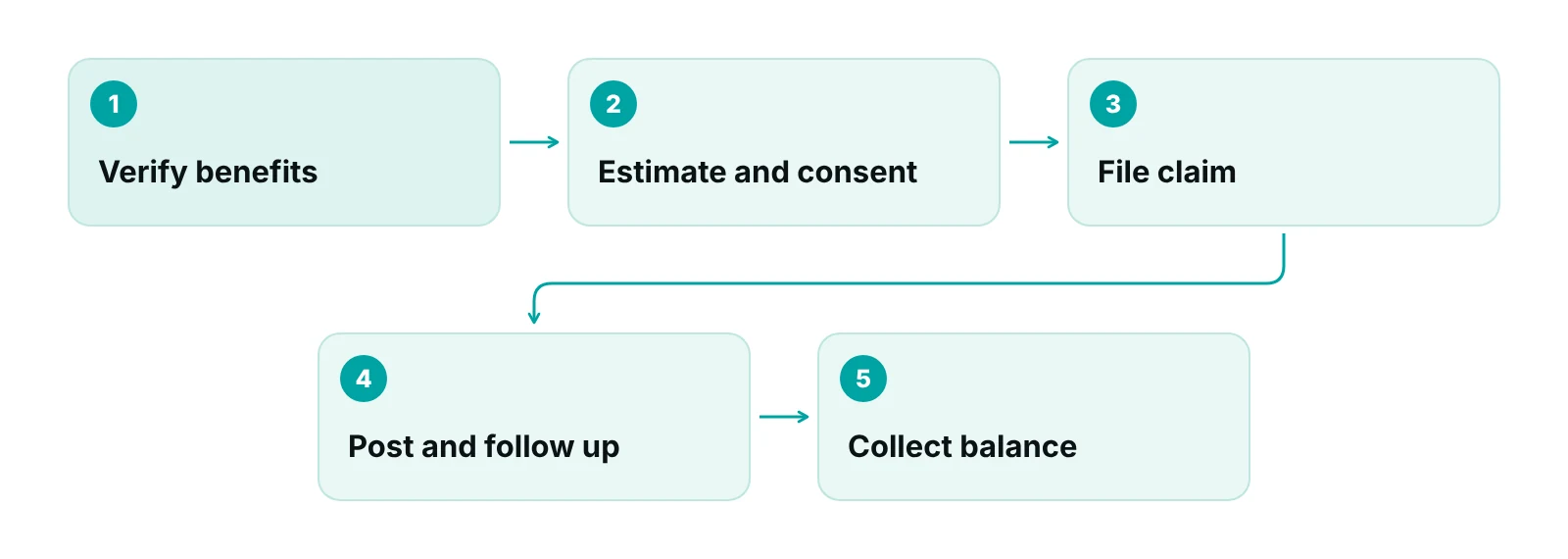
Dental revenue cycle management covers every step from the first call to the last payment, in five stages: verify benefits, estimate and consent, file the claim, post and follow up, and collect the balance. The payment rules are what set it apart.
The difference is plan design. The ADA’s benefits primer says PPOs held 86% of the dental benefit market in 2022 and describes plan terms that cap or shape payment regardless of need: annual maximums, deductibles, frequency limits, exclusions for conditions that predate coverage, and alternate-benefit clauses (ADA, Introduction to Dental Benefits). A procedure can be coded correctly and still pay little. The cycle works when plan limits are known before treatment, not discovered on the explanation of benefits.
Funding adds another split. Fully insured plans fall under state insurance law, while self-funded employer plans fall under ERISA and are generally exempt from many state laws. Offices often cannot tell which they face, which matters later for assignment of benefits and appeals.
Stage 1: How should benefits be verified before the visit?
Verify the plan’s limits and remaining benefits before treatment is scheduled, and write them down in one place. A bare “active coverage” answer does not tell the office what the plan will pay.
A standard electronic path exists. CMS lists the X12 270/271 transaction as the HIPAA standard for eligibility and benefit inquiries, with federally mandated operating rules effective January 1, 2013 (CMS). The cost of doing it by hand is visible in the CAQH Index: eligibility and benefit verification was the largest increase in dental administrative spending in 2023, up 15% to $2.1 billion, and switching to automated electronic checks could save the dental industry $580 million, up 7% (ADA News on the 2024 CAQH Index).
| Plan term | What it means | Question for the front desk |
|---|---|---|
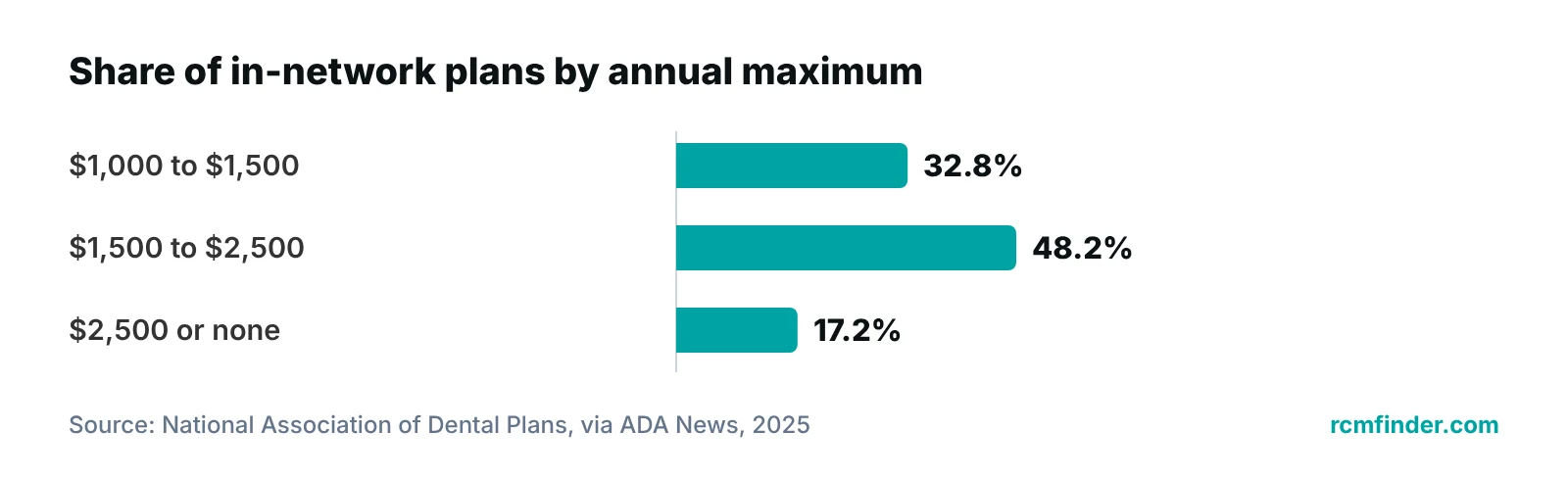
| Annual maximum | A yearly dollar cap on what the plan pays; commonly $1,000 or $1,500 in the ADA primer | How much is left this plan year? |
| Deductible | An amount the patient pays before benefits apply; often waived for preventive care | Has it been met, and which services does it apply to? |
| Frequency limit | Limits how often a service is covered, such as one full-mouth series in five years | When was this service last paid, by any dentist? |
| Pre-existing exclusion | Group plans may exclude conditions such as teeth missing before coverage; a break of 63 days or more may mean earlier coverage does not count | Is a missing-tooth rule in play for this treatment? |
| Alternate benefit (LEAT) | Benefits limited to the least costly option the plan recognizes | Will the plan pay for a cheaper alternative instead? |
| Coinsurance by category | Percent the plan pays for basic and major work; the primer’s examples are 80% and 50% | What is the percentage for this procedure? |
| Funding type | Fully insured or self-funded, which changes the legal rules that apply | Who administers the plan, and is it self-funded? |
Source: ADA, Introduction to Dental Benefits; ADA, Responding to Claim Rejections.
Maximums bind fewer patients than owners expect. An ADA Health Policy Institute analysis from 2024 found that 3.4% of patients reach a typical annual maximum and another 3.3% come within $100 of it (ADA News, December 2025). They matter most for patients with large treatment plans, so remaining benefit is the field to check before costly work.
Stage 2: What belongs in a treatment estimate and consent?
An estimate should state the plan’s expected share, the patient’s expected share, and the fact that neither is a guarantee. Many offices get into trouble by letting a verbal estimate sound like a promise.
The ADA separates two requests. Preauthorization is required by many DHMO plans before a specialist referral. Predetermination is a voluntary service offered by most DPPO and indemnity plans, and it shows what the plan expects to cover if the patient remains eligible and has not exhausted the maximum. The estimate is not a guarantee of payment, benefits follow the coverage in force on the date of service, and denials can still occur after a preauthorization. The ADA suggests submitting predeterminations for costly or complex work as close to the service date as possible (ADA).
The office also has to say what the patient owes when the plan does not pay. A March 2026 ADA News article draws a line many ledgers blur: a noncovered service is one the plan never recognizes, so the patient may owe the full fee, while a covered-but-nonpayable service is blocked by a maximum, frequency limit, deductible or waiting period, so the contracted fee generally applies. It reports that 44 states have noncovered-services laws, six states leave the question to the PPO contract, and self-funded plans may claim exemption (ADA News). Ledgers should record the two cases separately.
- Give a written estimate that shows the plan’s limits.
- Keep a signed financial policy on file; the ADA recommends one because patients often assume recommended treatment is covered (ADA).
- Record the patient’s acknowledgment when a cheaper alternative is accepted under an alternate-benefit clause.
Stage 3: What makes a dental claim go out clean?
A clean dental claim has the right code for the date of service, the full fee, the other-coverage fields filled in, and the support the plan will ask for. Errors here are the cheapest to prevent and the most expensive to fix later.
Federal rules fix the language. The HIPAA code-set rule names the ADA’s Code on Dental Procedures and Nomenclature for dental services (45 CFR 162.1002), and CMS lists the X12 837 version 5010 as the claim standard for institutional, professional and dental claims (CMS). The ADA says the code set in effect on the date of service applies no matter when the claim is filed, and that some software truncates the full nomenclature, so staff should read the descriptor (ADA).
On the 2024 ADA Dental Claim Form, the completion instructions call for the dentist’s full fee, other dental or medical coverage in items 4 to 11 and a flag for enclosed attachments. The remarks field suits items such as the primary carrier’s payment on a secondary claim, and should stay concise because remarks may trigger manual review (ADA claim form instructions).
Attachments are changing. A CMS final rule on health care claims attachments takes effect May 26, 2026 with a compliance date of May 26, 2028, and adopts X12 275 and 277 for attachment transactions; the fact sheet does not mention dental, so offices should ask their clearinghouse and plans how it applies (CMS).
Stage 4: How are payments posted, secondary claims sent and denials worked?
Post the payment line by line, bill the secondary plan with the primary explanation of benefits, and work every short payment before writing anything off.
On electronic payments, CMS says the EFT should carry the same trace number as its remittance advice so the money can be matched to the 835 remittance (CMS). For two plans, the ADA’s order of benefits puts the plan covering the patient as employee or main policyholder first; for a child on both parents’ plans, the parent whose birthday falls earlier in the calendar year is primary; and a medical plan is primary over a dental plan. The secondary claim goes in with the full fee and the primary EOB, and no write-off should be posted until all plans have paid (ADA). Some self-funded plans use nonduplication, under which the secondary pays nothing if the primary paid as much as the secondary would have. The coordination of benefits guide covers the wider concept.
For denials, the ADA’s guidance is to check the code first, identify the reason, gather support, submit a written appeal marked “appeal”, ask for a peer-to-peer call and use every level of appeal. For state-regulated plans an unresolved dispute can go to the state insurance commissioner (ADA, Responding to Claim Rejections).
| Denial reason | Support the ADA lists | Why it happens |
|---|---|---|
| Scaling and root planing (D4341, D4342) | Radiographs showing bone loss, periodontal charting, narrative | Plans may require set pocket depths and process the claim as a prophylaxis if not met |
| Periodontal maintenance (D4910) | Radiographs, charting, narrative | Some plans pay only within a window after scaling and root planing |
| Core buildup (D2950) | Radiographs, pre- and post-operative photos, narrative | Plans may not cover it or may bundle it with the crown |
| Bundling | Narrative | Separate procedures are combined, reducing the benefit |
| Downcoding | Radiographs, narrative | The plan pays a less complex or lower-cost code than the one reported |
| Alternate benefit (LEAT) | Radiographs, charting, study models, narrative | Benefits limited to the least costly acceptable option |
| Not dentally necessary | Radiographs, charting, study models, narrative | A plan consultant decides from the submitted documents only |
Source: ADA, Responding to Claim Rejections.
On downcoding, a June 2026 ADA News article advises reading the EOB first, appealing in writing if it is unclear, and reporting the accurate code rather than changing clinical reporting to match a payer’s payment preference (ADA News).
Stage 5: How should patient balances and out-of-network accounts be handled?
Collect what the plan did not pay as soon as the explanation of benefits arrives, and state the patient’s responsibility before treatment, not after.
The ADA’s May 2026 article on out-of-network billing says the patient remains responsible for the office’s full fee even if the office waits for the plan to process the claim, and that an EOB showing zero patient responsibility when the plan has not paid the full fee should be challenged. On the 2024 claim form, item 37 carries the subscriber’s signature or “signature on file” to direct payment to the dentist; as of July 2024 an estimated 23 states required plans to honor a patient’s direct-payment request (ADA News).
A written financial policy, a clear statement of network status at intake and consistent application make the conversation easier. The patient-friendly billing statement guide covers statements.
Which numbers show where the dental revenue cycle leaks?
Measure each stage on its own. A single A/R total hides where the problem began.
| Number | How to count it | What a poor reading points to |
|---|---|---|
| Verified before visit | Scheduled patients with benefits checked and recorded before the appointment | Front-desk process or missing plan information |
| First-pass claim acceptance | Claims accepted by the payer without a rejection or request | Coding, missing fields or attachments |
| Denials by reason | Denied claim lines grouped by the reasons in the table above | A repeat cause that a front-end fix could remove |
| A/R over 90 days, by payer | Share of outstanding insurance balances older than 90 days | Slow follow-up or a payer-specific problem |
| Secondary claims sent | Days from primary payment to the secondary claim | Missed second plans or weak posting |
| Patient balance collected | Share of patient responsibility collected within a set period | Unclear estimates or no financial policy |
Source: RCM Finder framework; definitions are operational, not published benchmarks.
The revenue cycle KPI guide explains how to set targets from the practice’s own history; no dental benchmarks appear here because the sources checked publish none.
Who should own each stage?
Give each stage one owner. Handoffs fail when two people each assume the other is checking.
- Verification and intake: front-desk staff or remote virtual medical assistants. See the virtual medical assistant services page and the dental virtual assistant guide.
- Estimates and consent: the treatment coordinator, since it needs clinical context.
- Claims, posting, denials and A/R: a billing team, in-house or outsourced, working inside the practice’s existing software. The end-to-end revenue cycle management service describes how RCM Finder covers these steps.
- Visibility: a claim tracker that shows each claim by stage. The RCM Finder practice management system tracks claims by stage, checks claim data before submission and flags underpayments against expected amounts, though it does not replace chairside charting.
Find where dental claims leak
A free practice audit reviews recent claims, EOBs and denials, then shows where benefits, attachments or secondary plans cost the practice revenue.
Our recommendations
- Verify before the visit and record the limits. Store remaining maximum, deductible status, frequency history, alternate-benefit clause and plan funding type in one place the whole team can see.
- Never let an estimate read as a promise. State that predeterminations and estimates are not guarantees and that benefits follow coverage on the date of service.
- Separate noncovered from nonpayable in the ledger. The patient’s liability differs, and state law and plan funding change the answer.
- Send secondary claims with the primary EOB, and hold write-offs. Post no write-off until every plan has paid.
- Work denials by reason, with the support the ADA lists. Appeal in writing, ask for a peer-to-peer call, and use every appeal level before escalating.
- Review stage-level numbers monthly. Look at verification, first-pass acceptance, denials by reason, secondary claim timing and patient balances separately.
Bottom line
Dental revenue cycle management is a handoff problem. Plan limits are known before treatment, estimates are honest, claims carry what the plan will ask for, secondary plans are billed in order, and balances are collected with a clear policy. Start by measuring each stage on its own, then read the dental billing and coding guide for code-level detail and the dental practice management software guide for the tools that hold the data. RCM Finder’s end-to-end revenue cycle management service is available to practices that want help running the back end.
Frequently asked questions
What is dental revenue cycle management?
It is the process that turns a dental visit into collected payment: verifying benefits, estimating costs, filing claims, posting insurance and patient payments, working denials and collecting balances. It differs from medical revenue cycle work mainly because dental plans cap and shape payment through maximums, frequency limits and alternate-benefit clauses.
Why do dental claims pay less than expected?
Common reasons are an exhausted annual maximum, a deductible, a frequency limit, bundling or downcoding of codes, an alternate-benefit clause, or a coverage exclusion. The ADA lists these as frequent denial or short-payment reasons. Checking limits before treatment prevents most surprises.
Is a dental predetermination a guarantee of payment?
No. The ADA says an estimate reflects eligibility and remaining benefits on the date it was issued, benefits follow the coverage in force on the date of service, and denials can occur after preauthorization if eligibility ends or a maximum is reached.
Who is primary when a patient has two dental plans?
Under the ADA’s guidance, the plan covering the patient as employee or main policyholder is primary. For a child on both parents’ plans, the parent whose birthday falls earlier in the calendar year is primary. State law and plan type can change the answer, so confirm with the plan.
What should an office do when a dental claim is denied?
Check the code against the descriptor and the date of service, identify the denial reason, gather the support the plan needs, and submit a written appeal labeled as an appeal. Ask for a peer-to-peer call and use every appeal level. Deadlines vary by carrier, so confirm them directly.
Can a dental office outsource revenue cycle work?
Yes, many offices outsource claims, posting, denials and follow-up while keeping estimates, consent and patient conversations in-house. A billing vendor that handles patient information is a HIPAA business associate and needs an agreement. The dental billing services guide explains what to outsource and what to keep.
Get your free practice audit
Tell us about your practice. We will contact you using the details you give.
- A review of your recent claims, denials and A/R aging
- Where your front desk and prior authorizations slow payment
- A prioritized fix list you keep, whether or not you hire us
Pricing is quoted after the audit, based on your volume and the services you choose. Prefer to talk? Call +1 (302) 556-2288.
Sources
- Introduction to Dental Benefits — American Dental Association (undated, read 2026)
- Pre-Authorizations — American Dental Association (undated, read 2026)
- ADA Guidance on Coordination of Benefits — American Dental Association (undated, read 2026)
- Responding to Claim Rejections — American Dental Association (undated, read 2026)
- 2024 ADA Dental Claim Form Completion Instructions — American Dental Association (2024)
- ADA Dental Claim Form — American Dental Association (2024)
- Dear ADA: Annual maximums — ADA News (2025)
- Benefit verification drives increased administrative spending in dental offices — ADA News (2025)
- 45 CFR 162.1002, Medical data code sets — eCFR (current)
- Adopted Standards and Operating Rules — Centers for Medicare & Medicaid Services (2026)
- Health Care Payment and Remittance Advice and Electronic Funds Transfer — Centers for Medicare & Medicaid Services (2026)
- Health Care Claims Attachments final rule fact sheet — Centers for Medicare & Medicaid Services (2026)
- Dear ADA: Noncovered services — ADA News (2026)
- Dear ADA: Out-of-network billing — ADA News (2026)
- Dear ADA: Downcoding — ADA News (2026)
- Participating in a Plan — American Dental Association (undated, read 2026)
- The Dental Care Market — ADA Health Policy Institute (2026)
Disclaimer: This article is educational and is not legal, coding, tax or compliance advice. Advertising, privacy and payer rules differ by state and by plan and change over time, so confirm current requirements with your state dental board, your attorney and each payer before acting. CDT is a registered trademark of the American Dental Association and CPT is a registered trademark of the American Medical Association; official code descriptors are not reproduced here.
