

Chiropractic website design converts local searchers when a phone-ready page shows the service, the location, a tap-to-call button and a short request form without scrolling. It must also load quickly, work with a keyboard and screen reader, avoid cure or guarantee claims, and keep third-party tags off pages that collect health details.
A patient with neck pain taps a clinic from a map and decides in a few seconds whether to call. If the number is hard to tap, the form wants a medical history or the page promises a cure, the visit is lost. This guide is for chiropractic owners and managers building or auditing a site.
It covers page structure, calling, forms, wording, accessibility, speed and tags. Profile and review rules are in the chiropractic SEO guide, and the whole operating picture is in the chiropractic practice management guide.
Key takeaways
- Design the first screen for a phone: clinic name, city, what you treat, a tap-to-call button and a request button.
- Ask for little on the first form; collect medical history only after booking, through a secure channel.
- The FTC judges claims by net impression, so headings, images and patient stories count as well as paragraphs.
- Build to WCAG 2.2 AA: DOJ names unlabeled forms, low contrast and mouse-only navigation as common barriers.
- Appointment and intake pages need a tag review, because HHS says tracking there can disclose protected health information.
What must a chiropractic website show a local searcher first?
Show who you are, where you are, what you treat and how to reach the clinic, all on the first phone screen. Pew Research Center’s 2026 survey found 91% of U.S. adults owned a smartphone, and 16% were smartphone-only internet users. Many visitors will never see the desktop layout.
Google also indexes the mobile version of a page. Its mobile-first indexing guidance (updated December 2025) recommends the same content on mobile and desktop and names responsive design as the easiest pattern to maintain.
| Element | Question it answers | Check before launch |
|---|---|---|
| Clinic name, city, one-line description | Am I in the right place? | Name matches signage and profile; no cure words |
| Tap-to-call button | Can I talk to someone now? | Working phone link; staffed during hours shown |
| Request-a-visit button | Can I ask without calling? | Short form; no marketing tags |
| Insurance and payment line | Will this cost too much? | Plans or cash options; no coverage promises |
| Address, hours and map link | Is it close and open? | Matches profile and location page |
| Doctor photo and licence title | Who will I see? | Title as your state board requires |
Sources: Pew Research Center, Mobile Fact Sheet (2026); Google Search Central, mobile-first indexing (2025).
How should service and location pages be built?
Use one repeatable template for each service and one page for each real office. The chiropractic SEO guide explains which pages deserve to exist and how they support the map listing. This section covers how the page reads and works. For general layouts, see this overview of medical website designs.
A service page template
- A headline in the patient’s words, such as the area of the body, not a promise of the result
- What a first visit involves, who performs it and roughly how long it takes
- The treating doctor, with licence title and a short, factual biography
- How the clinic bills, without guarantees of coverage
- Call and request buttons repeated after each major block
A location page template
- Name, address and phone for that office only, matching the business profile
- Hours, parking notes and a map link that opens in the phone’s map app
- Doctors who see patients there, each linked to a biography
- A call button that rings that office, not a central number
Keep one main action per page: call or request. Make everything else quiet.
How should click-to-call and the new-patient path work?
Make every phone number a tappable link and make sure a person is ready to answer it. Google’s web.dev guide on click-to-call says to wrap the number in a link that uses the tel scheme, include the country code with a plus sign, and tag numbers yourself instead of relying on browser auto-detection. Most devices ask the user to confirm before dialing.
The link is the easy part. The new-patient path is the whole chain from search to a kept visit.
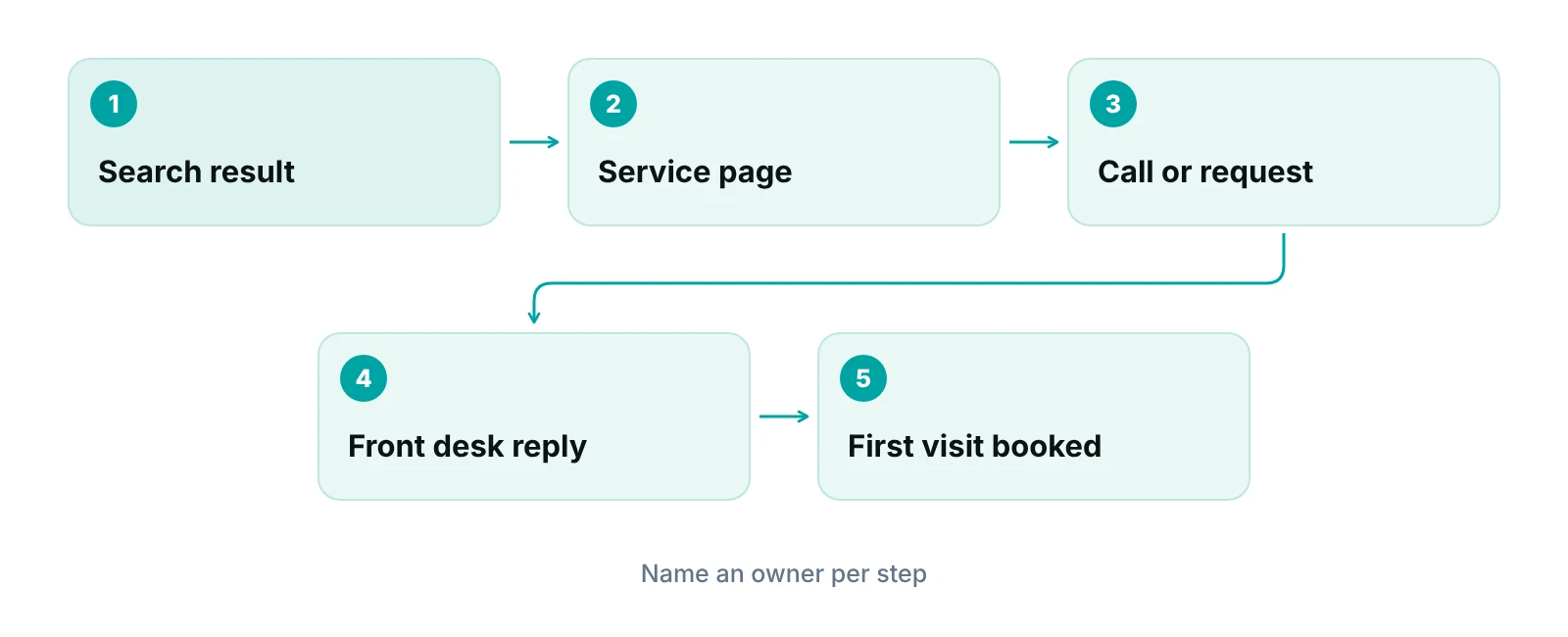
- Offer three ways in. Call, request a visit, or book online if your scheduling tool supports it.
- State the response time honestly. If forms are answered within one business day, say so, and staff to it.
- Route requests to a person. Name who reads the inbox, who calls back and by when.
- Cover closed hours. A caller who reaches voicemail at 7 pm may call the next clinic on the map.
- Hand off cleanly. Capture the insurance details the biller will need when the visit is booked.
Booking software choices are covered in the chiropractic practice management software guide, and how intake data should flow into the chart is in the chiropractic EHR evaluation checklist.
What belongs on a new-patient form?
Ask for only what you need to reply: name, phone, a preferred contact method and a good time to call. Collect history and insurance after the visit is booked. A free-text box that invites a description of the problem turns a contact form into a health-information form.
HHS treats this seriously. Its tracking technologies bulletin says tracking on an unauthenticated page that lets people schedule appointments may collect protected health information, such as an email address or the reason for care, and the HIPAA Rules then apply.
- Two stages. A short request form first. Full intake and history through a secure link or patient portal after booking.
- Secure delivery. Send submissions to a system the clinic controls, with a Business Associate Agreement in place where the form vendor handles patient information, not to a plain staff email address.
- Limit email content. HHS’s email FAQ says the Privacy Rule does not prohibit unencrypted email for treatment-related communication but expects safeguards, a limit on the information sent, and other options for a patient who finds unencrypted email unacceptable.
- Consent for follow-up. If the form lets the clinic text or email marketing, keep that choice separate and optional. Rules for campaigns are in the chiropractic email marketing guide.
- Plain labels and errors. A visible label on every field and a clear message when a field is wrong help every user, and DOJ lists inaccessible forms among common barriers.
What can the website say about care?
The site can describe what the clinic does and how a visit works. It should not promise cures or guaranteed results, and every health claim should have evidence behind it. The FTC’s Health Products Compliance Guidance says health claims need “competent and reliable scientific evidence” and that an ad is judged by its net impression. A heading, a photo and a patient quote can each carry a claim the paragraph never states. The guidance is written for health-related products, but the FTC applied the same evidence standard to chiropractic services in a February 5, 2021 warning letter about coronavirus claims on a clinic website and Facebook page.
| Common site wording | Why it is a risk | Safer pattern |
|---|---|---|
| “Chiropractic cures sciatica” or “guaranteed relief” | Texas rule 22 TAC 77.4 bars advertising that states or implies chiropractic can cure any condition or that results are guaranteed | Describe the evaluation and care offered; let the doctor explain expectations in the visit |
| “Boost your immune system” or “fight off viruses” | The FTC’s 2021 letter told a clinic to stop claims that lacked competent and reliable scientific evidence | Remove it unless evidence is on file for the exact claim |
| Patient story: “Pain-free after two visits” | The FTC says an honest testimonial is not enough and anecdotes never substantiate health effects | Keep stories to experience of the service, not results; follow your state’s testimonial rules |
| “Free exam” banner with no usual fee shown | Florida s. 460.413 lists advertising a free service without prominently stating the usual fee as a ground for discipline | State the usual fee next to the offer; check your own state’s text |
| A review widget that shows only five-star reviews | The FTC’s 2024 reviews rule bans misrepresenting that a curated set shows all or most reviews | Show reviews as they appear on the platform and link to the full set |
Sources: FTC Health Products Compliance Guidance; FTC warning letter (Feb. 5, 2021); 22 Tex. Admin. Code 77.4 (current through June 27, 2025 per the page fetched); Fla. Stat. 460.413; FTC press release on the consumer reviews rule (Aug. 14, 2024).
State boards differ, and the table shows examples from two of them, not a national rule. Florida also requires an advertisement to identify the licensee as a chiropractic physician. Ask your board whether it treats a website as advertising and keep a dated copy of every page as published. Offers, testimonials and claim evidence are covered in more depth in the chiropractic marketing guide.
How accessible does a chiropractic website need to be?
Build it to WCAG 2.2 Level AA and test it with a keyboard. Which law applies depends on the clinic, so ask counsel.
- Businesses open to the public. DOJ’s web guidance (March 18, 2022) says ADA requirements apply to goods and services offered online and lists barriers such as poor color contrast, missing text alternatives for images, no captions on video, inaccessible online forms and mouse-only navigation. That page does not set a technical standard for private-business sites.
- State and local government websites. DOJ’s Title II web rule requires WCAG 2.1 Level AA, with dates of April 26, 2027 for larger entities and April 26, 2028 for smaller ones, as the page lists them after an April 2026 interim final rule.
- Recipients of HHS funding. HHS extended the accessibility deadlines on May 7, 2026 to May 11, 2027 for recipients with 15 or more employees and May 10, 2028 for smaller ones, under WCAG 2.1 AA. Whether a given chiropractic office receives HHS financial assistance is a question for counsel; the page does not mention Medicare Part B.
WCAG 2.2 became a W3C Recommendation on October 5, 2023. W3C says the 2.0 and 2.1 criteria are essentially the same in 2.2, with one exception, so building to 2.2 also meets 2.1 AA. It adds criteria that matter on a clinic site, including a minimum target size of 24 by 24 CSS pixels for tap targets, a rule that information already entered should not have to be entered again, and a rule that focused controls not be hidden behind sticky headers or chat bubbles.
A sticky call bar can cover a form field, so test each page with the bar on.
How fast should the site load, and which tags are safe?
Aim for Google’s “good” Core Web Vitals on phones, and treat every tag as both a speed cost and a privacy question. Web.dev’s threshold definitions set good at 2.5 seconds for Largest Contentful Paint, 200 milliseconds for Interaction to Next Paint and 0.1 for Cumulative Layout Shift, measured at the 75th percentile of page views.
| Check | Target | Source or reason |
|---|---|---|
| Largest Contentful Paint | 2.5 seconds or less | web.dev Core Web Vitals thresholds |
| Interaction to Next Paint | 200 milliseconds or less | web.dev Core Web Vitals thresholds |
| Cumulative Layout Shift | 0.1 or less | web.dev Core Web Vitals thresholds |
| Mobile and desktop content | Same content on both | Google mobile-first indexing guidance |
| Phone link | Tapping the number opens the dialer | web.dev click-to-call guidance |
| Form without a mouse | Every field and button reachable and labelled | DOJ web guidance; WCAG 2.2 |
| Tap targets | At least 24 by 24 CSS pixels or spaced apart | WCAG 2.2, criterion 2.5.8 |
| Tags on booking and intake pages | None without a Business Associate Agreement or authorization | HHS OCR tracking bulletin |
Sources: web.dev (Core Web Vitals thresholds, click-to-call); Google Search Central (2025); DOJ (2022); W3C WCAG 2.2; HHS OCR (page last reviewed June 26, 2024).
On tags, the HHS bulletin says regulated entities must make sure tracking-technology vendors have signed a Business Associate Agreement and that a Privacy Rule permission applies before PHI is disclosed. Cookie banners and privacy-policy notices do not count as a valid authorization.
On June 20, 2024, a federal court in Texas vacated part of the bulletin, the part about tracking on unauthenticated public pages about health conditions or providers. HHS said it was evaluating next steps. The appointment-page and login-page language is still on the HHS page, so the safe design is to keep third-party tags off scheduling, intake and portal pages and measure those pages with a system the clinic controls. The chiropractic digital marketing guide covers ad tracking in more depth, and the HIPAA compliance checklist covers the wider program.
Who keeps the website working after launch?
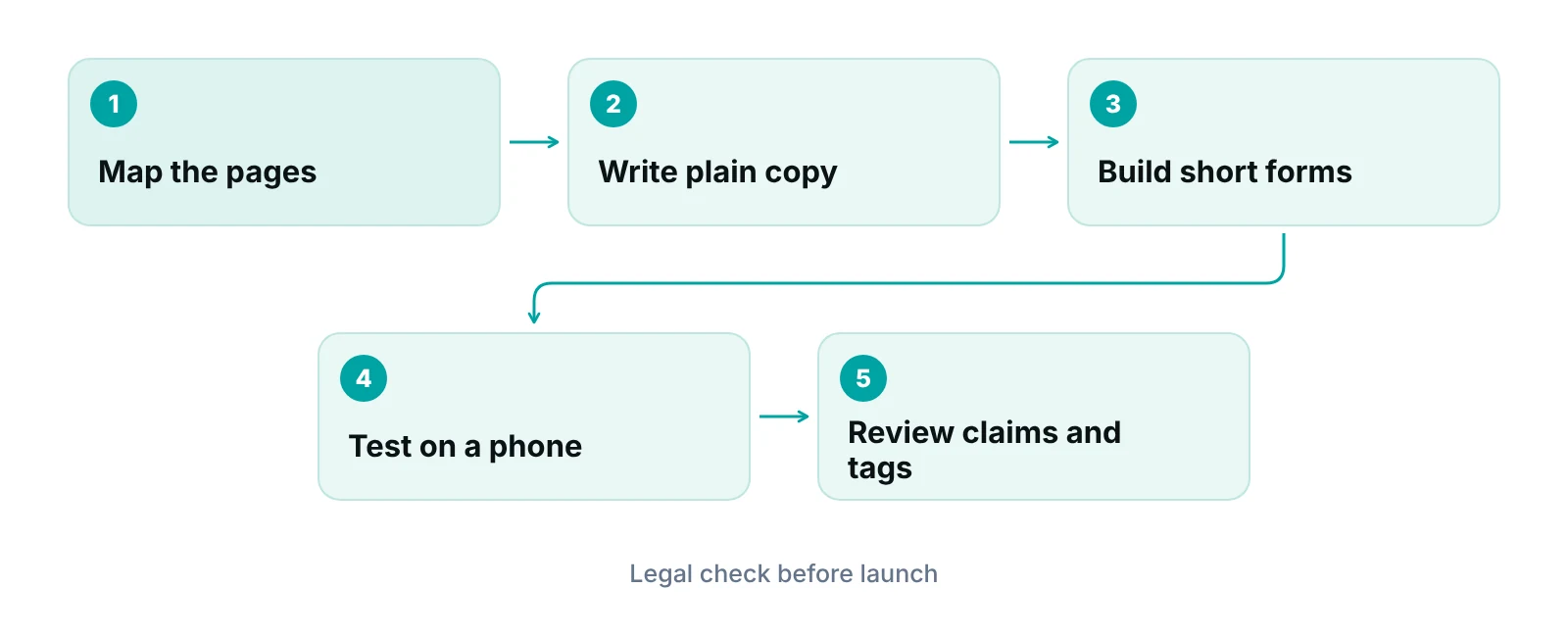
One named person should own the site after launch, with a short monthly list and a quarterly one.
- Monthly: test the call link and request form, confirm hours and doctor names, and review new pages for claims.
- Quarterly: book a test visit from a phone and time each step, re-check mobile speed, and re-scan booking and intake pages for third-party scripts.
“A website is a front desk that never closes, so it deserves the same training, scripts and supervision as the people at the counter.”
— Awais Afzal, Healthcare Operations & Data Analyst
Check the path from search to booked visit
A free practice audit looks at how a local search turns into a call or request, who answers it and what happens next. Pricing is quoted after the audit.
Our recommendations
- Design the phone view first. We check the first screen on a phone before any desktop layout.
- Make the first form short. We would ask for name, phone and a good time to call, then collect history securely after booking.
- Name an owner for every step. A form, a phone line and a reply are three jobs. Write down who does each and by when.
- Review every page for claims. We read headings, images and patient stories for cure, guarantee and unsupported claims.
- Build to WCAG 2.2 AA and tab through it. If we get stuck using only a keyboard, a patient will too.
- Keep third-party tags off booking and intake pages. List every script there and remove any without a Business Associate Agreement or authorization confirmed by counsel.
Bottom line
Chiropractic website design is mostly discipline: a phone-first first screen, a number that rings a person, forms that ask for little, wording that makes no promises, pages anyone can use and tags that stay off the booking path. Start with the chiropractic practice management guide for the wider operating picture. For help turning local searches into booked visits, see our healthcare digital marketing service or request a free practice audit.
Frequently asked questions
What pages does a chiropractic website need?
At minimum: a home page, one page for each service the clinic actually offers, one page for each real office, a biography for each doctor, a new-patient page that explains the first visit, and a contact or request page.
Should a chiropractic website have online booking?
It can, if the scheduling tool fits the clinic and a person monitors it. Offer calling and a short request form beside it, because some patients prefer to talk. Review what tags a booking widget adds first.
Do chiropractic websites have to be ADA accessible?
DOJ’s 2022 guidance says the ADA applies to goods and services offered online by businesses open to the public and lists common barriers. It does not set a technical standard for private sites. Government and HHS-funded entities have WCAG 2.1 AA deadlines. Build to WCAG 2.2 AA and ask counsel which rules apply.
Can I put patient testimonials on my chiropractic site?
State boards and the FTC both limit them. The FTC says an honest testimonial is not enough to substantiate a health claim, and it bans fake or incentivized reviews. Check your state board’s text, avoid stories that promise results, and have counsel review testimonials before they go live.
Is a contact form on my website covered by HIPAA?
It can be. HHS says information entered on an appointment page, such as an email address or reason for care, may be protected health information. Keep the form short, send it to a secure system under a Business Associate Agreement where required, and keep marketing tags off the page.
How fast should a chiropractic website load?
Google’s Core Web Vitals call 2.5 seconds or less for Largest Contentful Paint good, along with 200 milliseconds or less for Interaction to Next Paint and 0.1 or less for layout shift, assessed at the 75th percentile. Test on phones, using field data where your developer can get it.
Get your free practice audit
Tell us about your practice. We will contact you using the details you give.
- A review of your recent claims, denials and A/R aging
- Where your front desk and prior authorizations slow payment
- A prioritized fix list you keep, whether or not you hire us
Pricing is quoted after the audit, based on your volume and the services you choose. Prefer to talk? Call +1 (302) 556-2288.
Sources
- Mobile Fact Sheet — Pew Research Center (2026)
- Mobile sites and mobile-first indexing — Google Search Central (2025)
- Click-to-call — web.dev (Google) (n.d.)
- How the Core Web Vitals metrics thresholds were defined — web.dev (Google) (n.d.)
- Use of Online Tracking Technologies by HIPAA Covered Entities and Business Associates — HHS Office for Civil Rights (2024)
- Does the HIPAA Privacy Rule permit providers to use email to discuss health issues with patients? (FAQ 570) — HHS (2013)
- Health Products Compliance Guidance — Federal Trade Commission (n.d.)
- Warning letter to a chiropractic center on coronavirus claims — Federal Trade Commission (2021)
- FTC announces final rule banning fake reviews and testimonials — Federal Trade Commission (2024)
- 22 Tex. Admin. Code 77.4 Misleading Claims — Texas Board of Chiropractic Examiners (via Justia) (2025)
- Florida Statutes 460.413 Grounds for disciplinary action — Florida Legislature (n.d.)
- Guidance on Web Accessibility and the ADA — U.S. Department of Justice (2022)
- Fact Sheet: Final Rule on Accessibility of Web Content and Mobile Apps (first steps) — U.S. Department of Justice (2026)
- HHS extends mobile and web accessibility deadline — U.S. Department of Health and Human Services (2026)
- What's New in WCAG 2.2 — W3C Web Accessibility Initiative (2023)
Disclaimer: This article is educational and is not legal, coding, tax or compliance advice, and it does not tell any clinician how to treat a patient. State board rules, accessibility and privacy law, and payer policies differ and change, so confirm the current rule with your state board and qualified counsel before you act.