
Physical therapy billing services take over eligibility checks, claims, payment posting, denial appeals and A/R follow-up for a clinic. Before you outsource, ask for a signed business associate agreement, proof the partner tracks the Medicare KX threshold and plan of care dates, and monthly reports showing denials by reason and claims by stage.
Hiring a billing partner does not hand off the whole revenue cycle. The therapist still writes the note, attests to medical necessity and gets the plan of care signed. This guide is for owners and managers deciding where the line sits.
It is the buying guide. For code choice read the evaluation and treatment codes guide, and for units the 8-minute rule guide. Medicare rules below are as of October 22, 2026.
Key takeaways
- Move repeatable work (claims, posting, follow-up) to a partner; keep notes, KX attestation and patient conversations in the clinic.
- A billing company that handles patient information is a business associate; HHS requires a written agreement first.
- For CY 2026 the Medicare KX threshold is $2,480 for PT and speech-language pathology combined; claims above it without KX are denied.
- Plan of care recertification is due at least every 90 days; a signed order or referral exception has applied since January 1, 2025.
- Require a monthly report with A/R by age, claims by stage and denials by reason.
What do physical therapy billing services actually do?
Physical therapy billing services handle the claim side of a clinic: benefit checks, claim creation and submission, payment posting, denial appeals, A/R follow-up and patient statements. Some partners add reporting or remote front-desk help. The clinic still owns the treatment record that every claim depends on.
Physical therapy medical billing is built from the note: the evaluation level, the timed minutes behind each unit and the signed plan of care all come from the therapist’s documentation. Our guide to the evaluation and treatment codes covers how those codes are chosen, and the 8-minute rule guide covers how minutes become units. This post covers who should do which job and what to ask before you sign.
Put the scope in writing before price is discussed: tasks included, systems and role levels, denial turnaround, monthly reports, and what happens to claims in progress if the contract ends. HHS says a service agreement should not block the customer’s access to its own electronic patient information, and a business associate agreement must address return or destruction of it at termination where feasible (HHS cloud computing guidance).
RCM Finder offers billing, coding support, claim scrubbing, denial management and A/R follow-up for practices, with the team working inside the practice’s existing EHR. The end-to-end revenue cycle management page describes the service.
Which billing tasks should move to a partner, and which should stay in the clinic?
Move repeatable, rule-driven work to a partner. Keep anything that depends on the therapist’s judgment, signatures or a conversation with the patient. Most clinics end up with a hybrid.
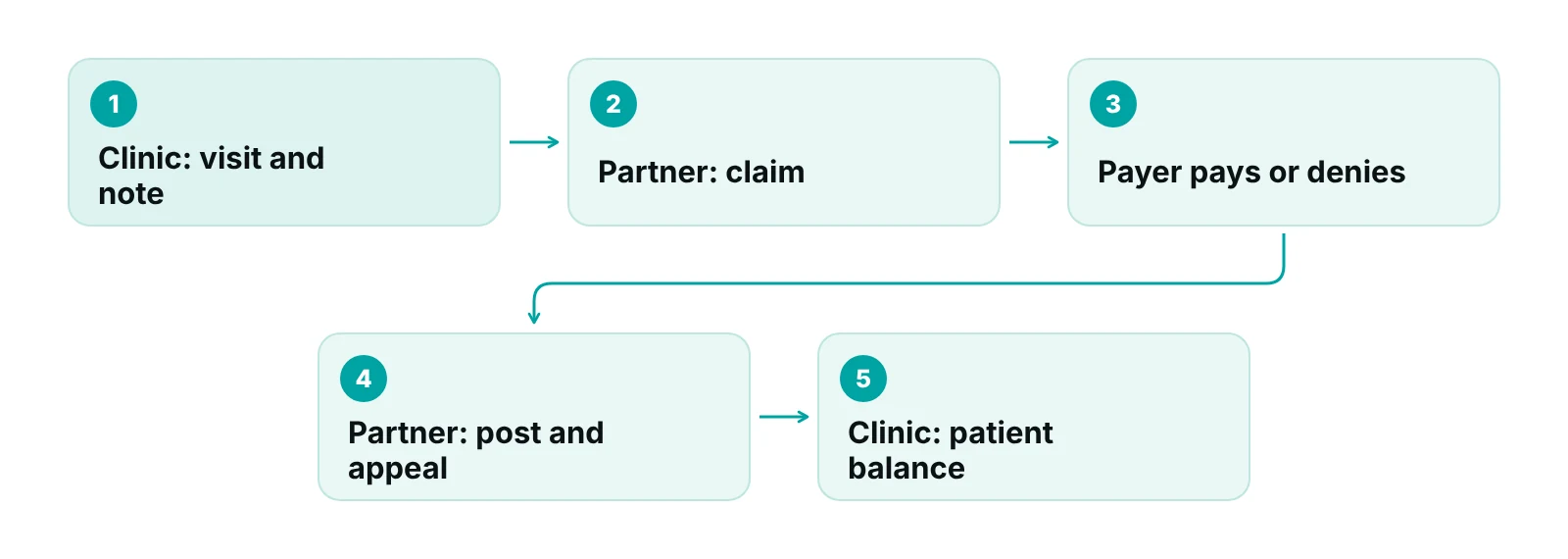
| Task | Usual owner | Why |
|---|---|---|
| Eligibility and benefit checks | Partner, or a remote assistant | Repeatable; results need to be recorded before the first visit |
| Evaluation level, treatment codes and minutes | Clinic documents; partner reviews | The code must match the note, and only the therapist can write it |
| Plan of care signature and recertification dates | Shared | The partner tracks due dates; the clinic gets the referring practitioner’s signature |
| Claim creation and submission | Partner | Rule-driven; depends on payer edits and data completeness |
| Payment posting and short-payment checks | Partner | Compares each payment with what the contract should pay |
| Denials and appeals | Shared | The partner drafts and tracks; the therapist supplies clinical detail |
| Copays, statements and balance conversations | Shared | Statements can move out; hard conversations stay with the front desk |
Source: RCM Finder framework, informed by the CMS and Noridian sources listed below.
Two rows need extra care. The first is the note. Auditors look at whether therapy meets coverage criteria and is medically necessary, so the record is the clinic’s evidence (CMS Recovery Audit Program topic 0228). A partner can flag a missing minute count but cannot write one afterward.
The second is the patient conversation, which lands better from the front desk. A remote assistant can take over verification and intake; the virtual medical assistant services page describes that model.
Check what your billing process could recover
Enter your claim volume in the revenue calculator to see what delays and denials may be costing the clinic.
What Medicare rules should a physical therapy billing partner know in 2026?
A partner should be able to explain, without notes, the CY 2026 KX threshold, the plan of care certification rule and the assistant supervision rule. The table shows what is in force as of October 2026.
| Item | Rule today | Ask the partner |
|---|---|---|
| KX modifier threshold | $2,480 per patient for CY 2026 for PT and speech-language pathology combined, and $2,480 for OT. Claims above it without KX are denied. | How do you spot patients nearing it, and who decides KX applies? |
| Targeted medical review | $3,000 for PT/SLP combined and for OT through CY 2028. Not every claim above it is reviewed. | What happens when a records request arrives? |
| Plan of care certification | Practitioner certifies need, care under a practitioner and a plan; due as soon as possible after the plan is set (42 CFR 424.24(c)). | How do you track unsigned plans? |
| Recertification | At least every 90 days; no patient encounter needed and not separately billable. A re-evaluation is a different service. | Do alerts fire before day 90? |
| Order or referral exception | Since January 1, 2025, a signed, dated order or referral plus proof the plan went to the referrer within 30 days can satisfy certification. | What proof of sending do you keep? |
| Assistant supervision and CQ | General supervision of PTAs in private practice since January 1, 2025. Services furnished in whole or part by a PTA carry CQ and pay 85%, with de minimis exceptions. | How are CQ cases flagged before billing? |
Source: CMS Therapy Services (2026); Noridian JF Part B (2026); eCFR 42 CFR 424.24; CMS CY 2025 PFS summary.
CMS and Noridian both state the amounts and the denial for a missing KX (CMS Therapy Services; Noridian). APTA adds that the amount is indexed annually by the Medicare Economic Index (APTA). The 2027 amount was not available when this post was written, so ask your partner how they will load it in January.
KX is a clinical attestation
The RAC topic page says KX indicates the clinician attests that services are necessary. A partner can flag the threshold and request the justification, but the therapist decides (CMS).
Under the order-or-referral exception, Noridian says silence from the referring provider counts as consent to the therapist’s plan (Noridian). Noridian also notes that recertification is a time-based requirement while a re-evaluation is indicated by a significant change in condition (Noridian). The evaluation codes guide explains the re-evaluation side.
The supervision change comes from the CY 2025 fee schedule final rule (CMS summary), and APTA notes that state practice acts may be stricter (APTA). Noridian is one Medicare Administrative Contractor; others publish their own articles and run their own reviews, so check your MAC and each commercial payer’s policy separately.
How does a good partner prevent denials in a physical therapy clinic?
A good partner prevents denials before submission by checking benefits, certification dates and claim data, then fixes the cause of the denials that still arrive.
Noridian’s review results show where outpatient therapy claims fail. For January through March 2024, its JF Part A review of therapy claims billed with KX listed two top reasons: documentation that did not meet therapy requirements, and documentation that did not support medical necessity (Noridian JF Part A). Its JE Part A review for October through December 2025 covered 343 claims with an 11.96% error rate and the same two themes (Noridian JE Part A). Both are Part A facility reviews, so treat them as a pattern, not a forecast for a Part B private practice.
The JE page also lists what a plan of care must hold: diagnosis, long-term goals, and the type, amount, frequency and duration of therapy. A partner can check that on every new patient.
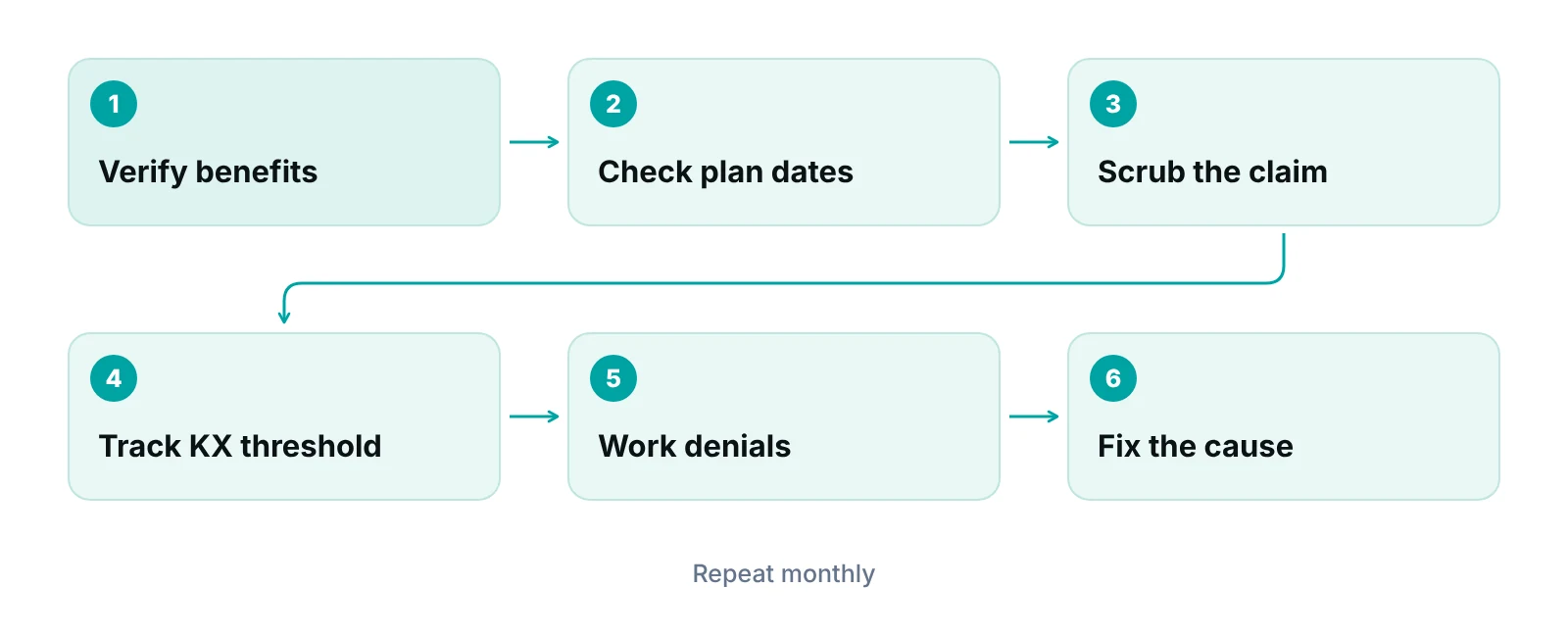
Ask the partner to show this loop on real claims:
- Front end: benefits and visit limits recorded before the first visit.
- Plan dates: an alert before each 90-day recertification and a list of plans still unsigned.
- Claim scrub: missing minutes, mismatched diagnosis and assistant-modifier gaps caught before submission. See our denial management guide for the wider method.
- Threshold watch: a list of patients near the KX amount so the therapist can review the justification in time.
- Denial reasons: a monthly count by reason, each traced to the clinic, the payer or the partner.
What should the business associate agreement and security answers include?
A billing company that handles patient information is a business associate, and HIPAA requires a written agreement before it does.
The agreement must describe permitted uses, bar other uses, require Security Rule compliance and incident reporting, and extend to subcontractors, which need their own agreements before receiving data. No agreement is needed to send a claim to the payer, because payment disclosures between a provider and a plan are exempt (HHS business associates guidance).
| Question | What a sound answer includes | Basis |
|---|---|---|
| Will you sign a BAA before touching patient data? | A signed agreement covering permitted uses, safeguards and incident reporting | HHS business associate guidance |
| Which subcontractors see patient data? | A named list, each bound by its own BAA | HHS business associate guidance |
| Where is data stored and accessed? | Locations disclosed and included in the risk analysis | HHS cloud computing guidance |
| What happens to our data when we leave? | Return or destruction at termination, and no block on our access meanwhile | HHS cloud computing guidance |
| Who can see which records? | Unique logins, role-based access, and a log of who did what | RCM Finder framework |
Source: HHS Office for Civil Rights business associate and cloud computing guidance.
Business associates are directly liable for Security Rule failures, impermissible disclosures, missed breach notices and exceeding the minimum necessary (HHS fact sheet). The clinic must still choose and oversee the vendor. HHS also says there is no HIPAA rule specific to storing electronic information outside the United States, but a BAA is still required and the location’s risks belong in the risk analysis (HHS).
RCM Finder puts a Business Associate Agreement in place before accessing patient data. Its portal uses role-based staff permissions, an audit log and encrypted HTTPS connections. The HIPAA compliance checklist for medical practices covers the wider safeguards.
What should the monthly report and the contract say?
The report should show where money is stuck, not only what was collected. Ask for the same figures every month so trends show early.
- A/R by age and payer, with items over 90 days listed by name.
- Claims by stage, so each unpaid claim has an owner.
- Denials by reason, with the upstream cause and the fix.
- Payments compared with expected amounts, so short payments are flagged.
- Plans awaiting signature and patients nearing the KX threshold.
- Patient balances and the count of unworked items.
The RCM Finder portal tracks claims by stage, checks claim data before submission and flags underpayments against expected amounts. The physical therapy practice management software guide explains how clinic software and a claims portal divide the data, and our practice management system page describes the portal.
In the contract, look for the term and notice period, who owns unfinished claims after cancellation, data export, and response times. Our guide to choosing a medical billing company lists general questions that apply to every specialty.
Two edge cases belong in the scope. Telehealth visits follow separate billing rules, so read the physical therapy telehealth guide before assuming the partner covers them. And if referral growth from your physical therapy marketing plan will raise visit volume, agree in advance how the partner handles extra claims.
How should a clinic start with a partner and review it?
Start with a baseline, limit access by role, and review the same report each month.
- Audit recent claims, EOBs and denials to set a baseline.
- Sign the BAA and set role-based access before data moves.
- Agree on an owner for each task in the table above.
- Test the partner on three real claims: a threshold case, an unsigned plan and an assistant-modifier case.
- Review the monthly report together and assign each denial cause to an owner.
Pricing is quoted after a free practice audit.
Get a second opinion on the billing process
A free practice audit reviews recent claims, EOBs and denials and shows which tasks could stay in the clinic and which could move.
Our recommendations
- Map every billing task to an owner first. Mark each task as clinic, partner or shared before you talk to vendors.
- Sign the BAA and set role-based access before data moves. Ask for the subcontractor list and incident reporting terms.
- Make the partner explain the KX and certification rules. They should state the 2026 threshold and the 90-day recertification and say how they track both.
- Keep clinical judgment in the clinic. The therapist attests to KX and writes the note. The partner chases and reminds.
- Test on your own recent claims. Use a threshold case, an unsigned plan and an assistant-modifier case from last quarter.
- Require the same stage-level report every month. A/R by age and payer, claims by stage, denials by reason, payments against expected amounts.
Bottom line
Physical therapy billing services work best as a split: the partner does the repeatable, rule-driven work, and the clinic keeps the note, the KX attestation and the patient conversation. Put the BAA, access limits and reporting in place first, then test the partner on your own claims. RCM Finder’s end-to-end revenue cycle management service is available to clinics that want a free audit before deciding.
Frequently asked questions
What do physical therapy billing services include?
They typically cover benefit checks, claim submission, payment posting, denial appeals, A/R follow-up and patient statements. Some add reporting or remote front-desk help. Confirm in writing which tasks are included, what stays with the clinic, which reports arrive monthly and what happens to claims and data if the contract ends.
Is it HIPAA-safe to outsource physical therapy billing?
Yes, if a business associate agreement is signed before the vendor sees patient data. HHS treats billing and claims processing as business associate functions. The agreement should cover permitted uses, safeguards, subcontractors and incident reporting, and the clinic should still oversee the vendor.
Who decides when to add the KX modifier?
The treating clinician. CMS describes KX as the clinician’s attestation that services above the threshold are necessary and supported by the record. A billing partner can flag patients nearing the 2026 amount of $2,480 and request the justification, but should not add KX on its own.
How often does a Medicare plan of care need recertification?
At least every 90 days under 42 CFR 424.24(c). Noridian says recertification needs no patient encounter and is not separately billable, unlike a re-evaluation. Ask the partner how they track due dates, and check your own MAC’s articles because other contractors may word things differently.
What should a physical therapy clinic keep in-house?
Clinical notes, minute counts, the choice to attest KX, plan of care signatures and difficult patient conversations. The partner can chase, remind and flag gaps, but cannot create the evidence a payer reviews. Many clinics use a hybrid, with the partner handling claims, posting and follow-up.
What reports should a physical therapy billing partner send?
Monthly: A/R by age and payer, claims by stage, denials by reason with the cause, payments against expected amounts, plans awaiting signature, patients near the KX threshold and unworked patient balances. A report showing only collections hides where claims are stuck.
Get your free practice audit
Tell us about your practice. We will contact you using the details you give.
- A review of your recent claims, denials and A/R aging
- Where your front desk and prior authorizations slow payment
- A prioritized fix list you keep, whether or not you hire us
Pricing is quoted after the audit, based on your volume and the services you choose. Prefer to talk? Call +1 (302) 556-2288.
Sources
- CY 2026 Therapy Services Updates — Centers for Medicare & Medicaid Services (2026 (page modified March 2026))
- Transmittal R13437CP (CY 2026 therapy thresholds) — Centers for Medicare & Medicaid Services (2025)
- Per-Beneficiary KX Modifier Thresholds — Noridian Healthcare Solutions (JF Part B) (2026 (updated March 16, 2026))
- 42 CFR 424.24 Requirements for medical and other health services — eCFR (current)
- The Difference Between Outpatient Therapy Recertifications and Re-evaluations — Noridian Healthcare Solutions (JF Part B) (2026 (updated April 21, 2026))
- Initial Certification and Recertification Outpatient Therapy – New Exception — Noridian Healthcare Solutions (JF Part B) (2025)
- CY 2025 Physician Fee Schedule final rule summary (MM13887) — Centers for Medicare & Medicaid Services (2024)
- Therapy Cap / KX Modifier — American Physical Therapy Association (2026)
- PTA Supervision — American Physical Therapy Association (undated, read 2026)
- 0228 Therapy Claims Billed with KX Modifier, Medical Necessity and Documentation Requirements — CMS Recovery Audit Program (2026 (issue date April 15, 2026))
- Outpatient Therapy Services Billed with KX Modifier TPE Review Results — Noridian Healthcare Solutions (JF Part A) (2024)
- Outpatient Therapy Services TPE Review Results — Noridian Healthcare Solutions (JE Part A) (2026)
- Business Associates — HHS Office for Civil Rights (2026)
- Direct Liability of Business Associates — HHS Office for Civil Rights (2026)
- Guidance on HIPAA & Cloud Computing — HHS Office for Civil Rights (2026)
- Physical Therapy Billing Services for Small Practices: In-House vs. Outsourced — Physitrack (2026)
- Physical Therapy Billing: To Outsource Or Not To Outsource — PT Practice Pro (undated)
Disclaimer: This article is educational and is not legal, coding, tax or compliance advice. Medicare rules are described as of October 22, 2026 using CMS and Noridian sources; other Medicare Administrative Contractors and commercial payers differ and rules change, so confirm current requirements with your MAC, each payer and your attorney before acting. CPT is a registered trademark of the American Medical Association; official code descriptors are not reproduced here.
