
Physical therapy telehealth means live video visits for evaluations, exercise coaching and follow-up, with hands-on care kept in the clinic. CMS says Medicare lets therapists bill telehealth, including to patients at home, through December 31, 2027, and not after. A practice also needs state licensure, documented consent and a video vendor that signs a business associate agreement.
Pages that rank for this topic mostly speak to patients or sell a platform. This guide is for the owner or manager deciding whether to run telerehabilitation and how. It is a narrow companion to our guide to physical therapy practice management software.
Claims, units and denials are covered in physical therapy billing services. Dates below were checked on October 22, 2026, and Medicare has a hard stop for therapists, so read that section before you commit money.
Key takeaways
- Medicare’s current telehealth flexibilities for therapists run through December 31, 2027; CMS says physical therapists can no longer furnish Medicare telehealth from January 1, 2028.
- Route visits by a written, therapist-approved policy: hands-on-dependent plans of care stay in the clinic.
- Licensure follows the patient’s location; the PT Compact can add privileges but not in every state.
- Record consent, platform, patient location and that audio and video both worked on every visit.
- Sign a business associate agreement with any vendor that handles video, messages or exercise data before the first visit.
Which physical therapy visits suit telehealth, and which belong in the clinic?
Your therapists decide this, in writing, before the schedule opens. HHS’s telehealth guide says physical therapy has traditionally been considered a discipline needing in-person care, with direct physical exam and hands-on treatment (Telehealth.HHS.gov). A university billing article adds that if a plan of care depends heavily on hands-on techniques, telerehabilitation may not be clinically appropriate (Arizona Telemedicine Program, July 2026).
A routing table lets the front desk book the right visit type. The example below is for your therapists to adapt and sign off, not a clinical standard.
| Visit type | Example routing | Decide in advance |
|---|---|---|
| Home exercise review and progression, established patient | Telehealth candidate | Home equipment; who checks form |
| Education: ergonomics, return-to-activity planning | Telehealth candidate | Handout and message channel |
| Follow-up on a stable plan of care | Telehealth candidate | Red-flag questions; when to bring the patient in |
| Initial evaluation | Therapist decides case by case | Who approves; how it is recorded |
| Plan built on manual therapy or hands-on testing | In-person | Whether a remote check-in fits between visits |
| No private space, stable connection or safe setting at home | In-person | Script for redirecting the booking |
Source: RCM Finder example policy, informed by Telehealth.HHS.gov and the Arizona Telemedicine Program (2026); not a clinical standard. Each clinic’s therapists set routing.
One therapist-education article says telehealth cannot fully replicate hands-on work, so remote time goes to exercise prescription and education (Elite Learning, 2025). Give the front desk scripts for offering telehealth and sending a caller to the clinic. Our team can run that scheduling and intake step as virtual medical assistants working inside your existing EHR (for example PrognoCIS, eClinicalWorks or athenahealth), which the virtual medical assistant service page describes.
Which state licensure rules apply, and does the PT Compact help?
The therapist generally needs authority to practice in the state where the patient is during the visit. Telehealth.HHS.gov says a telehealth appointment occurs in the state where the patient is located at the time, and that providers should verify patient location and obtain consent before the appointment (Telehealth.HHS.gov, updated April 30, 2025). APTA guidance from 2020 also told therapists to keep complying with their state practice act (Elite Learning, 2020).
| Route | What it means | Check before using |
|---|---|---|
| Full license in the patient’s state | Therapist is licensed where the patient sits | Board time and fees |
| PT Compact privilege | A PT in a member home state buys a privilege in another member state | Home-state membership; the other state issues privileges |
| Temporary practice law | Some states allow limited care of an existing patient who is visiting | Time limit; whether PT is covered |
| Border-state reciprocity | Some states let border-state providers offer telehealth | Whether your state pair has it |
| Telehealth registration | Some states let out-of-state providers register; conditions can include no office there and an annual fee | Whether PTs qualify |
Source: Telehealth.HHS.gov, Licensing across state lines (updated Apr. 30, 2025) and Licensure compacts; PT Compact Informational Flyer (Aug. 2025). Availability for physical therapists varies by state.
The PT Compact flyer says a licensed therapist can practice in another member state by buying a privilege. It requires an unencumbered home-state license, no disciplinary action in two years, and a home state that is an active member. The cost is a $45 Commission fee plus a state fee, and not all member states are ready to issue and accept privileges (PT Compact).
A staffing-industry page updated in October 2026 reports 38 jurisdictions issuing and accepting privileges, three states not yet issuing (Maine, Michigan, Rhode Island), and eight non-members, including California, Florida and New York (Advantis Medical). That is a secondary source, so check ptcompact.org before relying on it. Nevada says a privilege is not a license (Nevada PT Board). Washington reports that the Commission has proposed rule amendments, with comments due November 27, 2026 (Washington DOH).
Build the rule into scheduling: ask where the patient will be, record it, and block the booking if no therapist on your team holds authority there. Confirm with your state board or counsel before offering cross-state visits, and ask separately how your state treats physical therapist assistants in telehealth.
Where does Medicare telehealth stand for therapists as of October 22, 2026?
Medicare telehealth for therapists is available now but has an end date. The CMS telehealth FAQ (updated October 9, 2026) says that through December 31, 2027, an extended range of practitioners may bill Medicare telehealth, and that starting January 1, 2028, physical therapists, occupational therapists, speech-language pathologists and audiologists can no longer furnish Medicare telehealth services. A trade-press report ties the extension to H.R. 7148, signed February 3, 2026 (Mobility Management).
| Item | Status | What to do |
|---|---|---|
| Therapists as telehealth practitioners | Allowed through Dec. 31, 2027; not from Jan. 1, 2028 | Treat the revenue as time-limited |
| Patient location | Anywhere in the U.S., including home, through Dec. 31, 2027; from Jan. 1, 2028 generally a rural medical facility (behavioral health excepted) | Record location every visit |
| Place of service | POS 02 away from home; POS 10 at the patient’s home | Build both into charge screens |
| Payment for home visits | Paid at the non-facility rate for home-based telehealth claims since Jan. 1, 2024 | Check your fee schedule |
| Hospital outpatient therapy at home | Hospitals may bill remote outpatient therapy to patients at home through Dec. 31, 2027, not after | Hospital-owned clinics: ask compliance |
| Modifiers BB and BC | Required from Jan. 1, 2027: BB for a contracted virtual platform, BC for incident-to; no payment implications | Ask your MAC if either applies |
| CY 2027 fee schedule | Proposed July 14, 2026 (CMS-1848-P), effective on or after Jan. 1, 2027; no final rule listed | Re-check when the final rule posts |
Source: CMS Medicare Telehealth FAQ (updated Oct. 9, 2026); CMS Physician Fee Schedule Federal Regulation Notices; CMS CY 2027 PFS proposed rule fact sheet (July 14, 2026).
Two gaps matter for billing. The CMS FAQ does not address modifiers 95, 93, GQ, GT or CQ, so ask your Medicare Administrative Contractor (MAC) and each payer; MACs may differ. And services must be on CMS’s list payable when furnished by telehealth, with changes effective each January 1 (CMS). The posted list is for calendar year 2026, so confirm your codes on the 2027 list.
Plan for the 2028 cliff now
APTA backed H.R. 1614 in 2025, which would make PTs and PTAs permanent Medicare telehealth providers (APTA, Sept. 9, 2025). I found no source showing it has passed, so model Medicare telehealth volume as ending after December 31, 2027.
For remote therapeutic monitoring, the CY 2027 proposed rule would limit it to established patients, require a separately reportable initiating visit, and pay only when clinical staff employed by the practice perform it (CMS fact sheet). Treat monitoring as unsettled until the final rule.
What changes on the claim when the visit is remote?
A telehealth claim rests on the same plan of care and timed notes as a clinic visit, plus the facts that make it remote. Units and denials are in our physical therapy billing services guide, and code basics are in the evaluation and treatment code guide.
The University of Arizona article lists evaluation and re-evaluation codes (97161-97164), therapeutic exercise (97110), therapeutic activities (97530) and self-care training (97535) as telehealth-eligible, and lists manual therapy (97140) and physical agent modalities (97012, 97014) as not eligible (Arizona Telemedicine Program, July 30, 2026). That is a secondary source, so check each code against CMS’s list and payer policy.
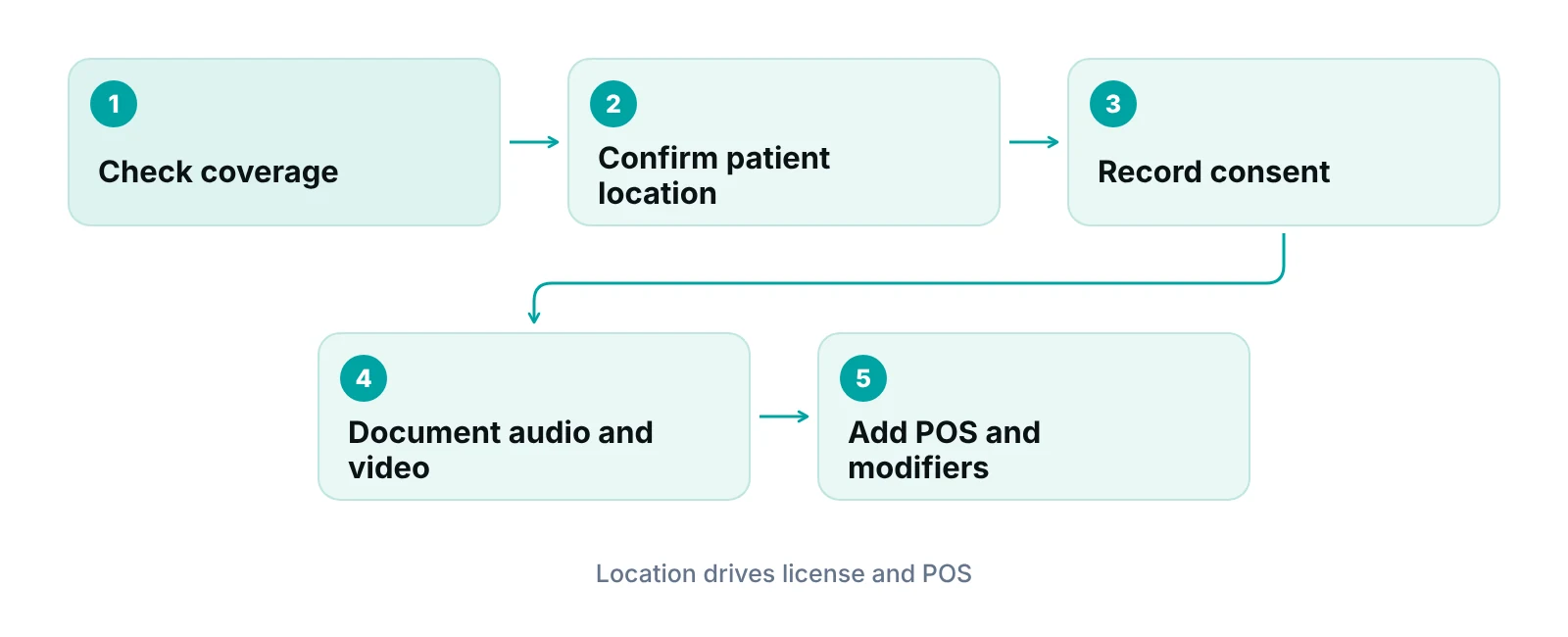
- Confirm the payer covers physical therapy by telehealth, then check eligibility.
- Document the platform, that audio and video were both active, and where the patient and therapist were.
- Choose the place of service from the patient’s location (POS 02 or 10 for Medicare). The POS 10 telehealth guide and the telehealth modifiers guide give background.
- Add the modifier the payer requires. The Arizona article calls modifier 95 standard for Medicare and most commercial payers, with GT still used by some Medicaid programs and older contracts, and a 2020 article paired 95 with the therapy-discipline modifier. Ask your MAC and each payer which they expect now.
- Bill under the rendering therapist, who must be authorized where the patient was.
- Check prior authorization and visit limits for telehealth.
The same article lists common denial causes: missing modifiers, wrong place of service, codes off the telehealth list, missing consent and audio-only billing. Medicare’s audio-only allowance in the CMS FAQ does not mean every therapy code allows it, so confirm code by code. The telehealth billing guide covers general coding background.
What consent and documentation should a PT telehealth visit carry?
Consent is recorded at intake and confirmed in each note. Telehealth.HHS.gov says most states require informed consent for telehealth, which can be written, electronic or verbal at the start of each session, and others joining must consent too (Telehealth.HHS.gov, updated Sept. 18, 2024). That page is written for behavioral health, so treat it as a model, not the PT rule. The Arizona article advises putting consent in intake and documenting it in every visit note.
- Consent form: the video format, what the clinic cannot do remotely, the in-person option, who may join, and recording only with agreement.
- Patient setup: a private space, stable connection, device and room to move, checked at booking.
- Safety plan: the patient’s address at the start of every visit and a named step if a symptom needs urgent care.
- Note elements: modality, platform, both locations, others present, time and what was done.
- Exercise material: file the home program and messages in the chart, not a personal phone.
Have your attorney review the form. The practice management system page explains our workflow tools, including early-access scheduling.
What privacy and platform checks must a clinic make?
Any vendor that creates, stores or transmits patient video, messages or exercise data for you is a business associate, so a signed agreement comes before the first visit. HHS says a cloud service provider that handles electronic protected health information for a covered entity is a business associate, must sign a business associate agreement, and stays one even if it holds only encrypted data (HHS cloud computing guidance). Ask for the agreement in writing.
Do not rely on pandemic-era leniency. HHS OCR reports that its telehealth notifications of enforcement discretion expired at 11:59 p.m. on May 11, 2023, with a transition period through August 9, 2023 (HHS OCR). HHS says an agreement must cover permitted uses, safeguards, reporting, subcontractors, return or destruction of data and termination for a material breach (HHS sample provisions).
Ask every video or messaging vendor these questions and keep the written answers:
- Will you sign a business associate agreement before we load any patient data, and does it cover your subcontractors?
- Where are recordings and messages stored, for how long, and can we export or delete them?
- Who at your company can see our sessions, and is access logged?
- Do notes reach our EHR chart, or do staff copy them over?
- Is recording off by default?
- What happens to our data if we end the contract?
For wider security work, use the HIPAA compliance checklist for medical practices. To see how a virtual option fits referrals, read our physical therapy practice growth strategies and physical therapy marketing plan posts.
How should a clinic roll out physical therapy telehealth?
Start with one therapist, a few visit types and one payer mix, then widen. A pilot shows where connections fail and which claims come back while mistakes are cheap.
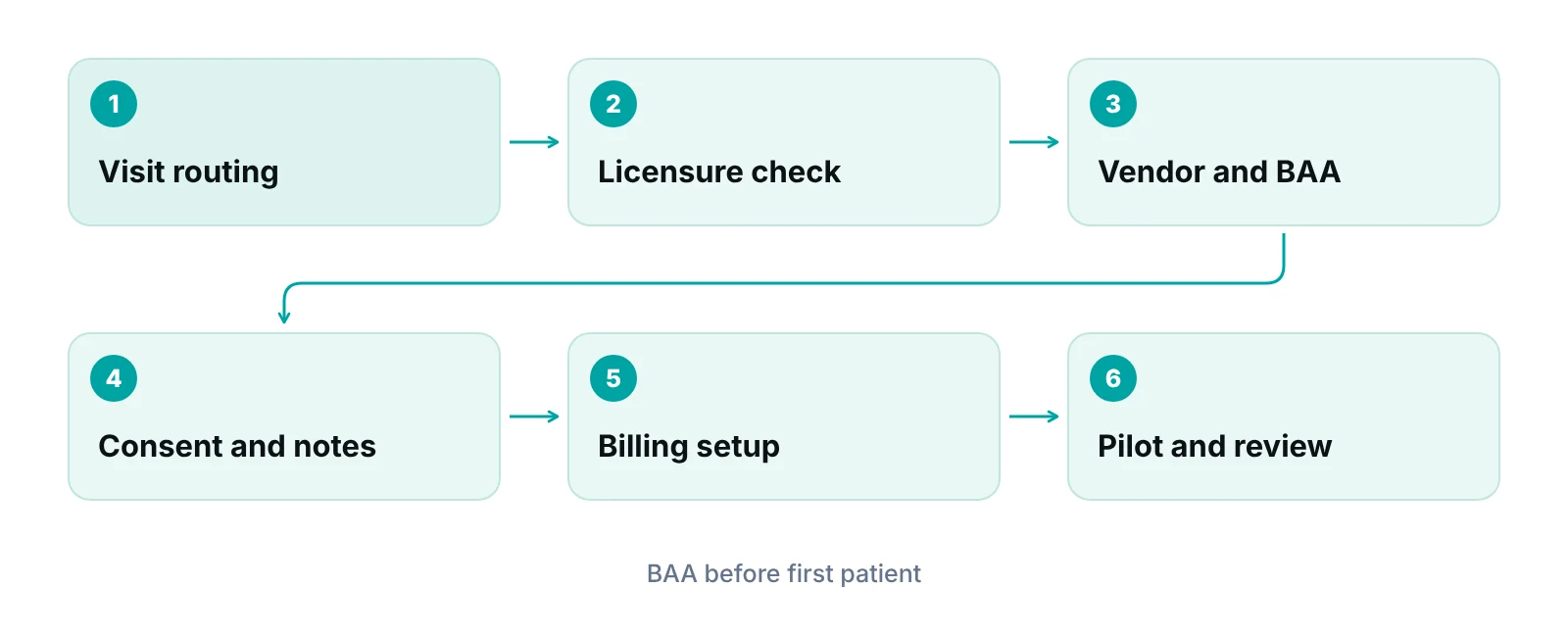
- Name a policy, privacy and billing owner.
- Adopt the visit routing table, the licensure check and the consent form.
- Sign the BAA, set up the platform, and test with staff as patients.
- Train the front desk on scripts and the therapists on the note template.
- Run a short pilot; review no-shows, dropped connections and denials.
- Set recheck dates for Medicare in early and late 2027.
“A telehealth program is a set of small rules people can follow on a busy Tuesday. Write the rules first, then buy the tool.”
— Awais Afzal, Healthcare Operations & Data Analyst
Want a second pair of eyes on your telehealth workflow?
A free practice audit looks at how visits, eligibility checks and claims flow today, so a telehealth pilot starts on a clean base.
Our recommendations
- Write the routing policy first. Have therapists sign a visit table so booking does not depend on who answers the phone.
- Treat Medicare telehealth as ending in 2027. We would plan revenue and contracts around December 31, 2027 until Congress or CMS says otherwise.
- Ask where the patient will be, every time. Licensure, compact privileges and place of service all follow location.
- Get the BAA signed before any patient data moves. No patient data go to a vendor until the agreement is in place.
- Confirm modifiers with your MAC and each payer. The CMS FAQ does not settle them, so get answers in writing.
- Calendar the review dates. Re-read the CMS FAQ when the CY 2027 final rule appears and again in 2027.
Bottom line
Physical therapy telehealth works when routing, licensure, consent, the platform contract and the claim line up before the first visit, and Medicare’s end date for therapists is on the calendar. If you want scheduling, claim tracking and reporting around the new visit type, see our practice management system page, and read how to choose physical therapy practice management software for the software questions.
Frequently asked questions
Does Medicare pay for physical therapy telehealth in 2026?
Yes. According to the CMS telehealth FAQ updated October 9, 2026, an extended range of practitioners, which includes therapists, may bill Medicare telehealth through December 31, 2027, with patients allowed to be at home. CMS says physical therapists can no longer furnish Medicare telehealth from January 1, 2028. Confirm your codes are on CMS’s telehealth list.
Can a physical therapist treat a patient in another state by video?
Generally the therapist needs authority to practice in the state where the patient is during the visit. Options include a full license, a PT Compact privilege, a temporary practice law, border reciprocity or telehealth registration, depending on the state. Rules vary, so check the state board and record the patient’s location each time.
What is the PT Compact, and does it cover telehealth?
The PT Compact lets a licensed therapist whose home state is an active member buy a privilege to practice in another member state. The patient’s location still decides where care happens, so a privilege is needed for patients in that state. Not every member state issues privileges yet; check ptcompact.org.
Which place of service code do we use for a home telehealth visit?
For Medicare, CMS says to use POS 10 for telehealth in the patient’s home and POS 02 for telehealth elsewhere. Home claims have been paid at the non-facility rate since January 1, 2024. Commercial payers and Medicaid may differ, so confirm each policy in writing.
Do we need a business associate agreement with our video platform?
Yes, if the vendor creates, receives, maintains or transmits protected health information for you. HHS says a cloud provider storing ePHI is a business associate even if the data are encrypted. Get the agreement signed before any patient data are loaded, and keep the vendor’s written security answers.
Which PT visits should stay in the clinic?
Your therapists decide. Plans of care that rely heavily on manual therapy or hands-on testing usually stay in the clinic, while exercise progression, education and some follow-up can go remote. Write the routing as a signed policy so staff apply it the same way each time.
Get your free practice audit
Tell us about your practice. We will contact you using the details you give.
- A review of your recent claims, denials and A/R aging
- Where your front desk and prior authorizations slow payment
- A prioritized fix list you keep, whether or not you hire us
Pricing is quoted after the audit, based on your volume and the services you choose. Prefer to talk? Call +1 (302) 556-2288.
Sources
- Medicare Telehealth FAQ (updated Oct. 9, 2026) — CMS (2026)
- Medicare Telehealth FAQ (updated Feb. 4, 2026) — CMS (2026)
- List of Telehealth Services — CMS (2026)
- Telehealth — CMS (2026)
- Physician Fee Schedule Federal Regulation Notices — CMS (2026)
- CY 2027 Medicare Physician Fee Schedule Proposed Rule fact sheet — CMS (2026)
- Telehealth flexibilities extended for OTs, PTs through December 2027 — Mobility Management (2026)
- Medicare Extends Telehealth Coverage Through 2027 — PYA (2026)
- The clock is ticking for Congress to extend Medicare telehealth waivers — APTA (2025)
- How Physical Therapists Can Bill for Telerehabilitation — Arizona Telemedicine Program (2026)
- Telehealth for physical therapy — Telehealth.HHS.gov (2026)
- Physical Therapists and Telehealth — Elite Learning (2020)
- Physical therapy telehealth guidance — Elite Learning (2025)
- Licensing across state lines — Telehealth.HHS.gov (2025)
- Licensure compacts — Telehealth.HHS.gov (2026)
- PT Compact Informational Flyer — PT Compact Commission (2025)
- PT Compact status page (reviewed Sept. 2026) — Advantis Medical (2026)
- Physical Therapist and PTA Licensure Compact — Washington State Department of Health (2026)
- Physical Therapy Compact — Nevada Physical Therapy Board (2026)
- Informed consent for telebehavioral health — Telehealth.HHS.gov (2024)
- Telehealth and HIPAA — HHS OCR (2026)
- Guidance on HIPAA and Cloud Computing — HHS (2026)
- Sample Business Associate Agreement Provisions — HHS (2026)
Disclaimer: This article is educational and is not legal, coding, clinical or compliance advice. CPT is a registered trademark of the American Medical Association, and its official descriptors are not reproduced here. Licensure, consent, privacy and payer rules differ by state and payer and change often, and Medicare telehealth policy for therapists is time-limited, so confirm current requirements with your attorney, privacy officer, payers and Medicare contractor before acting.
