

Physical therapy marketing works when a clinic runs two doors well: referral sources such as physicians, employers and schools, and direct access where state law allows. Close the loop with every referrer, state your state's limits plainly, follow FTC and HIPAA rules in ads and reviews, and track each referral to a completed visit.
A clinic can run a full set of ads and still lose the referral that sat unreturned until Thursday. Marketing for a PT practice is mostly about what happens to a referral, a phone call and a discharged patient. This guide is for owners and managers who want a plan built on that.
It sits alongside four companion guides: the physical therapy SEO guide, physical therapy billing services guide, physical therapy practice management software guide and physical therapy telehealth guide. Read them for search, billing, software and telehealth. This one covers who sends patients and how to keep them coming.
Key takeaways
- Run two doors: referral sources first, then direct access where your state allows it.
- Close the loop on every referral with an evaluation, progress and discharge note; HHS treats treatment communications as outside HIPAA marketing.
- All 50 states offer provisional or unrestricted direct access (APTA, July 2025), but many cap treatment by days or visits.
- Reviews and patient stories answer to the FTC rule and to HIPAA; OCR settled for $23,000 over review replies in 2022.
- Track every referral from receipt to completed plan of care, by source.
What should physical therapy marketing do for a clinic?
Physical therapy marketing has two jobs: keep referral sources sending patients, and make it easy for people to book without a referral where state law allows. Most clinics need both, and each has its own audience, its own rules and its own numbers.
The market is crowded. The Bureau of Labor Statistics reports that physical therapists held about 283,700 jobs in 2025, with 36% working in offices of physical, occupational and speech therapists and 26% in hospitals (BLS Occupational Outlook Handbook). A private clinic competes for the same referrals as other offices and hospital-based outpatient departments.
This post is the referral and direct-access plan. It does not repeat the local-search work in our physical therapy SEO guide, or the Google profile and offer advice in our broader guide to growing a physical therapy practice. It covers referral sources, direct access, lapsed patients, ad and review rules, and tracking a referral through to a visit.
Which referral sources should a PT clinic market to?
Start with the sources that already send patients, then add one at a time. Each group wants something different.
| Source | What they usually want | What to send back | Rule to check first |
|---|---|---|---|
| Physicians, nurse practitioners and physician assistants | A fast answer when a patient is referred and a clear note on progress | Evaluation summary, progress note, discharge summary | Anti-kickback and self-referral laws; HIPAA treatment communications |
| Surgeons and their care coordinators | A protocol they trust and visits that start on the surgeon’s timeline | Post-operative milestones and any concern, same day | Same federal laws; payer authorization rules |
| Employers and occupational health contacts | Fewer lost workdays and a simple way to send an injured employee | Work status and restrictions the employee has agreed to share | Patient authorization before sharing any health detail |
| Schools, coaches and athletic trainers | A quick path for an injured athlete and injury-prevention help | Return-to-play updates shared with parent or guardian consent | Minor consent and state rules; written authorization |
| Direct-access patients and former patients | A clear next step, what a first visit involves and what it costs | A visit plan; a message after discharge | State direct-access limits; payer rules; advertising claims |
Source: RCM Finder editorial summary; rules described in the sections below from HHS, OIG, CMS and APTA (2019-2025).
Employers and schools are slower to build than physician offices. Offer something specific, such as a short injury-prevention talk or a named contact for new injuries, and ask who decides where an injured worker or student goes. Decision-makers differ by employer, district and state.
Keep referral marketing inside the law
Two federal laws shape how a clinic may court referral sources. The HHS Office of Inspector General describes the Anti-Kickback Statute as a criminal law that bars knowingly and willfully paying remuneration to induce or reward patient referrals, and it says remuneration includes anything of value, with free rent and lavish meals and travel among its examples (OIG). Both the person who offers and the person who receives can be liable.
The physician self-referral (Stark) law is separate. CMS lists physical therapy services among the designated health services it covers, so a physician’s financial tie to a PT business can bring the law into play (CMS). Directorships, leases and physician ownership need legal review first.
Ask counsel before gifts, meals or payments
Routine lunches for a referring office, gift cards, free services for staff and any payment tied to a referral source can create risk. Have a healthcare attorney review each arrangement and write down the clinic’s policy.
How do you keep referring providers sending patients?
Close the loop on every patient. A referrer who hears back after the evaluation, at a progress point and at discharge learns that sending patients to your clinic is easy and safe. Silence sends the next patient somewhere else.
These updates are not marketing in the HIPAA sense. HHS guidance says a communication is not marketing if it is made for the treatment of the individual, or for care coordination, and a physician’s referral to a specialist is one of its examples (HHS Office for Civil Rights).
For Medicare patients, the same updates do double duty. Under 42 CFR 424.24(c), outpatient therapy needs a certification of the plan of care by a physician or a qualifying practitioner, it must be obtained as soon as possible after the plan is set, and recertification is required at least every 90 days (42 CFR 424.24). When a therapist sets the plan, a separate knowledgeable-clinician signature is not needed if the record holds a written order or referral and shows the plan was delivered to that clinician within 30 days of the initial evaluation. Other payers have their own rules, and Medicare contractors can publish their own documentation expectations, so check yours.
A clinic that returns clean, timely plans of care is easier to work with, so treat the return as part of referral marketing. Our guide to physical therapy evaluation and treatment coding explains how evaluation coding ties into that first visit.
“The best referral marketing I have seen is boring. The referrer gets a call back, then a note, then a discharge summary. Nobody has to remember the clinic's name because the clinic keeps showing up.”
— Awais Afzal, Healthcare Operations & Data Analyst
What does direct access change for marketing?
Direct access means a patient can see a physical therapist without a physician referral, and it lets a clinic market to the public. It does not remove every limit. The American Physical Therapy Association (APTA) says that as of July 1, 2025, all 50 states, the District of Columbia and the U.S. Virgin Islands have either provisional or unrestricted direct access, and that some provisions tied to treatment without a referral still persist in a number of states (APTA).
It took years to get there. APTA’s timeline marks 2015 as the year Oklahoma and Michigan became the 49th and 50th states on its direct-access list (APTA timeline). The state-by-state summaries of today’s limits sit behind an APTA account login (APTA direct access by state). The last public version we could read, dated June 2023, sorts states into three groups.
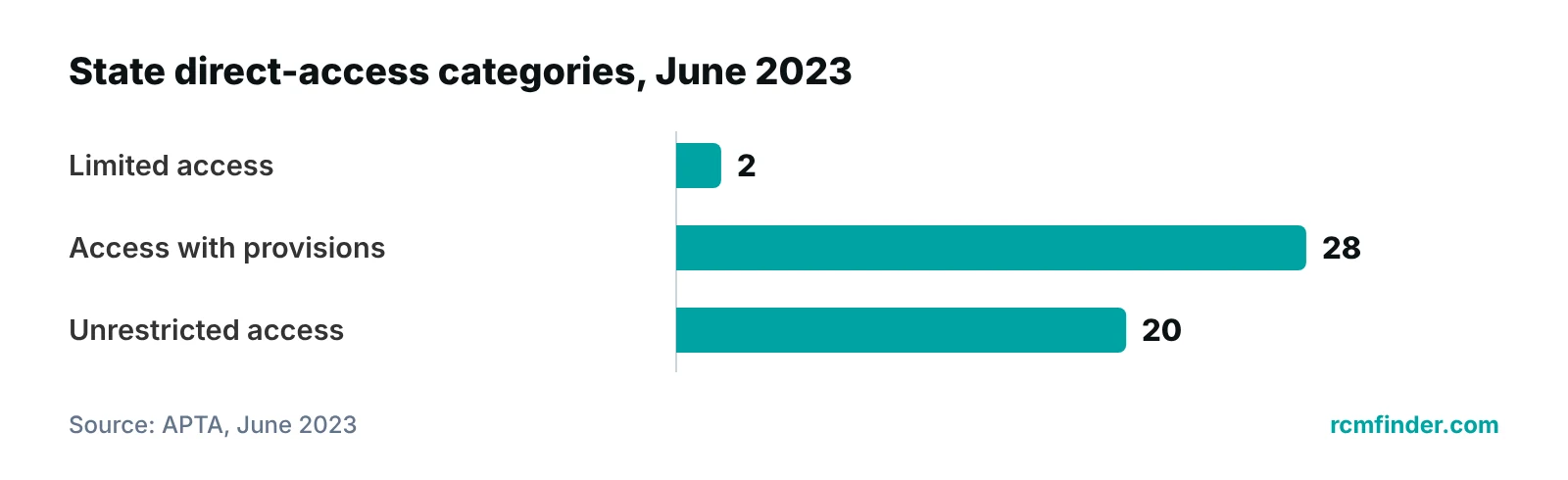
| State | Category | Limit on treatment without a referral |
|---|---|---|
| California | Provisions | Up to 45 calendar days or 12 visits, whichever comes first, unless a physician, surgeon or podiatrist signs the plan of care |
| Georgia | Provisions | Referral needed after 21 days or eight visits, with exemptions for wellness and some diagnosed conditions |
| Illinois | Provisions | Referral needed if no measurable or functional improvement after 10 visits or 15 business days; PT notifies the patient’s provider within 5 business days of the first visit |
| Texas | Provisions | 10 days for PTs licensed under one year; up to 15 days for doctoral-level PTs with a completed residency or fellowship |
| Alabama | Limited | Treatment without a referral only for specific groups or wellness settings; plan of care to the diagnosing provider within 15 days for a diagnosed condition |
Source: APTA, Direct Access by State (data current as of June 2023). Laws change; APTA reports data current as of July 2025 behind a login.
Three lessons follow. Say what is true in your state: a page that implies unlimited care without a referral misleads in a provisions state. Plan the handoff: if your state caps direct-access care by days or visits, the referral work above is how you keep the patient in care past that point. Check the payer: state law on who may treat does not decide who pays. Medicare still requires the certification described above, and commercial plans set their own rules.
Direct-access messaging should tell a patient what to bring and what the first visit covers. Our physical therapy billing services guide covers the authorization and billing steps that follow.
What can a physical therapy ad or website say?
An ad can make a health claim only if the clinic can support it. The FTC’s health-claims guidance says benefit claims need competent and reliable scientific evidence, and that testimonials are never sufficient to substantiate claims about the effects of a health product (FTC). The guidance covers health products, but the logic applies to a clinic advertising results.
- Avoid promises of cure or guaranteed relief. “Pain gone in three visits” is a result claim you would need to support for the typical patient.
- Do not rely on “results not typical.” The FTC says a disclaimer like that does not cure a deceptive testimonial; the ad should state what a typical patient can expect.
- Disclose material connections. A paid endorser, a staff member or a referral partner who promotes the clinic should say so clearly.
- Check your state. PT practice acts and licensing boards set their own advertising rules, including how credentials and specialty terms may be used.
Our medical marketing ROI guide shows how to connect each channel to revenue once the claims are settled.
How do you reactivate lapsed and former patients?
Reactivation is a follow-up program for patients who stopped early, finished a plan of care or have not been seen in a year. It needs a clear rule for who you may contact and how.
Under HHS guidance, a communication that describes a health-related service the clinic itself offers is not marketing, and neither is a communication made for the patient’s treatment; marketing that involves payment from a third party needs the patient’s written authorization (HHS). So a message to a patient about finishing their own plan of care is a treatment communication. A message promoting a service paid for by a third party is a different matter. Exceptions do not cancel other rules.
- Split the list. Separate patients who dropped before finishing a plan, patients who were discharged and patients who were last seen long ago. Each group gets a different message.
- Lead with the patient’s own situation. “Your plan of care was not finished. Call us if you still have symptoms” is a clinical follow-up, not a sale.
- Use a person for the first contact. A call from the front desk or a virtual medical assistant works better than a mass message. Record the answer and the reason the patient stopped.
- Follow email rules. Promotional email must be accurate in its headers, identify itself as an ad, carry a valid postal address and honor opt-outs within 10 business days, and the FTC lists penalties per email (FTC CAN-SPAM guide). Have counsel review text-message consent as well.
- Do not discount for government-plan patients without advice. Waived copays and free sessions can raise beneficiary-inducement issues. Our growth guide covers the reasoning in more depth.
- Measure it. Track contacts made, patients who rebooked and plans completed after the message.
A virtual assistant is one way to staff this without pulling the front desk off the phones. Our virtual medical assistant service describes how remote staff handle scheduling and intake in your clinic’s time zone.
What are the rules for reviews and patient stories?
Two sets of rules apply: the FTC rule on reviews and testimonials, and HIPAA. A review program that ignores either can create liability even when the reviews are real.
The FTC’s rule on consumer reviews and testimonials took effect on October 21, 2024. It bars fake or false reviews, paid reviews that require a particular sentiment, undisclosed insider reviews and review suppression through intimidation (FTC press release). The FTC’s questions-and-answers page says insiders such as staff must disclose their relationship to the business, and a generalized review request sent to all customers does not make the business liable for an undisclosed employee review (FTC Q&A).
HIPAA is the second layer. In December 2022, OCR announced a $23,000 settlement with a California dental practice over disclosures of patient information in replies to online reviews, and it said the use of social media to respond to patient reviews this way is illegal under HIPAA (HHS OCR). A PT clinic that replies “We are glad your shoulder is better” has confirmed the person is a patient and disclosed a condition.
- Ask every patient for a review in the same way, with no offer tied to a positive rating.
- Reply to reviews in general terms and do not confirm that the reviewer is a patient.
- Get a signed HIPAA authorization before publishing a patient’s name, photo, video or story, even if the patient wrote it.
- Keep staff reviews and family reviews disclosed, or leave them off.
Our guide to online reputation management for doctors goes further on review requests and replies, and the HIPAA compliance checklist for medical practices covers the wider privacy rules a clinic’s website and staff must follow.
How do you track a referral through to a visit?
Count each referral at every step from receipt to completed plan of care. Without that, a clinic cannot tell a referral source that sends many patients from one that sends many who never arrive.
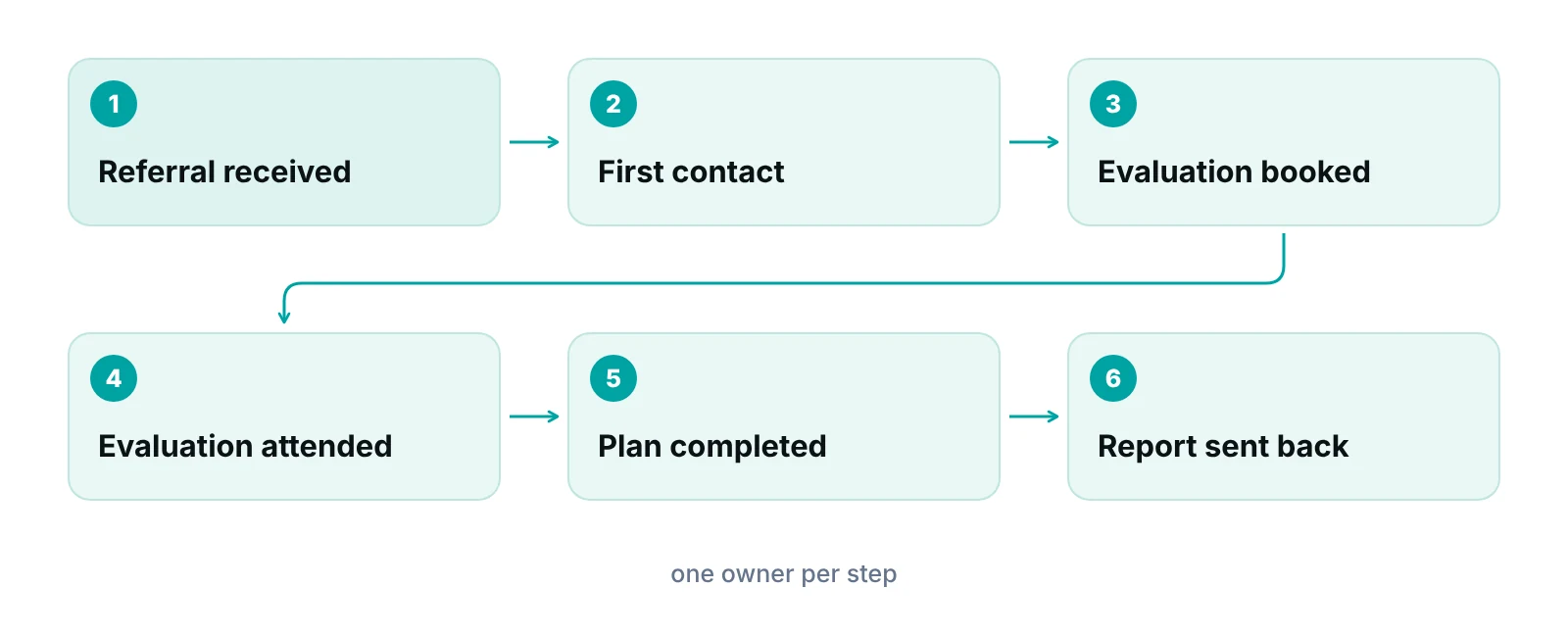
| Step | What to record | Measure to review monthly | Who owns it |
|---|---|---|---|
| Referral received | Date, source, referring clinician, channel (fax, portal, call, self-referral) | Referrals by source | Front desk |
| First contact | Date and time of first call, attempts, outcome | Share contacted within one business day | Front desk or virtual assistant |
| Evaluation booked | Date booked, insurance checked, authorization needed | Share of referrals that book | Front desk |
| Evaluation attended | Attended, cancelled or no-show | Share of booked evaluations that attend | Clinic manager |
| Plan completed | Visits attended against plan, discharge reason | Share completing the plan of care | Treating therapist |
| Report sent back | Dates of evaluation, progress and discharge updates; plan returned for signature | Days from visit to update | Treating therapist |
Record the source as a fixed list, not free text, so two spellings of one office do not become two sources. Review the table monthly and look for the step where each source loses patients. A source whose referrals never book usually points to a callback problem, not a source problem.
Be careful with web and call tracking. OCR’s tracking-technology bulletin says regulated entities cannot use tracking technologies in ways that cause impermissible disclosures of PHI, and that scheduling an appointment or a symptom checker can involve PHI, though a federal court vacated part of the guidance in June 2024 (HHS OCR). Keep tracking tags off booking forms and portals unless a vendor agreement and a permitted purpose are in place. A practice management system that records each referral and patient task by stage and owner keeps this data inside systems you control.
See where your referrals stop
Our free practice audit looks at how referrals, calls and billing move through your clinic, and where patients or revenue drop out. Pricing is quoted after the audit.
Our recommendations
- List your referral sources before you add new ones. Pull the last 90 days of new patients and name the referring office for each. Protect the biggest sources first.
- Return a note on every referred patient. Send an evaluation summary, a progress update and a discharge summary, and assign one person to own it.
- Put your state's direct-access limits on one page. Write down the day, visit or condition limits for your state and teach the front desk to explain them. Check it against your state PT practice act each year.
- Run every gift, meal and offer past a healthcare attorney. Anti-kickback, self-referral and beneficiary-inducement rules reach farther than most owners expect.
- Reply to reviews without confirming the reviewer is a patient. Use a general reply, and get written authorization before you publish any patient story, photo or video.
- Track each referral from receipt to completed plan. Use a fixed source list and the tracker above, and fix the step that loses the most patients before spending more on outreach.
Bottom line
Physical therapy marketing grows a clinic when referrers hear back, patients understand their state’s direct-access limits and every claim and review reply stays within the rules. Start with the tracker, then build outreach around the sources that convert. Our healthcare digital marketing team works with practices on local search, reputation and patient-growth programs, and the free practice audit looks at where referrals stall.
Frequently asked questions
What is the best way to market a physical therapy practice?
Start with referral sources and the callback that follows each referral. Add direct-access messaging where your state allows it, then reviews and reactivation. Track every referral from receipt to completed plan of care, and check the claims in each ad against FTC and state rules. Local search belongs in the plan too, and our PT SEO guide covers it.
How do I get more physician referrals for my PT clinic?
Make referring easy and report back. Give one fax or secure-message route and a named contact, return calls fast and send evaluation, progress and discharge notes. Avoid gifts or payments tied to referrals, because federal anti-kickback and self-referral laws apply.
Does direct access mean patients never need a referral?
No. APTA reports that all states have provisional or unrestricted direct access as of July 1, 2025, but some states limit treatment without a referral by days or visits. Payers may also require a referral or certification, as Medicare does for therapy plans of care. Check each state and each payer before you promise a patient anything on a web page.
Can a PT clinic post patient testimonials?
Only with care. A testimonial that identifies a patient discloses health information, so get written HIPAA authorization first. The FTC also bars fake reviews and undisclosed insider reviews, and a testimonial cannot support a claim about treatment results.
Can I reply to a negative Google review?
Yes, in general terms. Do not confirm that the person is a patient or mention a condition or treatment. OCR settled with a dental practice for $23,000 in 2022 over review replies that disclosed patient information.
How do I reactivate patients who stopped coming?
Split the list by reason, then call first with a clinical message about finishing their plan of care. Record why they stopped. Follow email and consent rules for any promotional message, and avoid discounts or waived copays for government-plan patients without legal advice. Measure how many patients rebook and finish their plan after the contact.
Get your free practice audit
Tell us about your practice. We will contact you using the details you give.
- A review of your recent claims, denials and A/R aging
- Where your front desk and prior authorizations slow payment
- A prioritized fix list you keep, whether or not you hire us
Pricing is quoted after the audit, based on your volume and the services you choose. Prefer to talk? Call +1 (302) 556-2288.
Sources
- Direct Access Advocacy — American Physical Therapy Association (2025)
- Direct Access by State (landing page) — American Physical Therapy Association (2025)
- Direct Access by State (June 2023 map and summaries) — American Physical Therapy Association (2023)
- All 50 States Achieve Some Form of Direct Access — American Physical Therapy Association (2015)
- Consumer Reviews and Testimonials Rule: Questions and Answers — Federal Trade Commission (2024)
- FTC Announces Final Rule Banning Fake Reviews and Testimonials — Federal Trade Commission (2024)
- Health Products Compliance Guidance — Federal Trade Commission (2022)
- CAN-SPAM Act: A Compliance Guide for Business — Federal Trade Commission (2024)
- Marketing (HIPAA Privacy Rule guidance) — HHS Office for Civil Rights (2024)
- HHS Office for Civil Rights settlement with New Vision Dental — HHS Office for Civil Rights (2022)
- Use of Online Tracking Technologies by HIPAA Covered Entities and Business Associates — HHS Office for Civil Rights (2024)
- 42 CFR 424.24: Requirements for medical and other health services (outpatient therapy certification) — Legal Information Institute (Cornell Law School), reproducing the eCFR (2026)
- Physician Self-Referral — Centers for Medicare & Medicaid Services (2026)
- Fraud and Abuse Laws — HHS Office of Inspector General (2026)
- Physical Therapists: Occupational Outlook Handbook — U.S. Bureau of Labor Statistics (2025)
Disclaimer: This article is educational and is not legal, coding, tax or compliance advice. Advertising, privacy, referral and payer rules differ by state and by plan and change over time, so confirm current requirements with your state physical therapy board, your healthcare attorney and each payer before acting. CPT is a registered trademark of the American Medical Association; official code descriptors are not reproduced here.
