
For hypertension icd 10 coding, use I10 for hypertension with no heart or kidney involvement. The classification presumes a link to heart disease and chronic kidney disease, so those cases use I11, I12 or I13 instead. Secondary hypertension is I15.-, and crisis (I16.-) and resistant hypertension (I1A.0) are added alongside the underlying type.
Hypertension is among the most coded diagnoses in an outpatient practice, and it is also one of the easiest to code too simply. A note that says “HTN” next to “CKD stage 4” is not an I10 claim under the classification’s rules. This guide covers the codes, the presumption that links hypertension to heart and kidney disease, the layering of crisis and resistant hypertension, and the documentation that keeps claims clean. Code statuses were checked against the FY 2027 code set (effective 1 October 2026).
Key takeaways
- I10 is for hypertension with no documented heart or kidney involvement; it is not the default for every note that says hypertension.
- The classification presumes a causal link between hypertension and heart disease or chronic kidney disease unless the provider documents otherwise.
- I11, I12, I13 and I15 need extra codes: heart failure type (I50.-), CKD stage (N18.-) or the underlying cause.
- Hypertensive crisis (I16.-) and resistant hypertension (I1A.0) are reported with the type of hypertension, not in place of it.
- Pregnancy, pulmonary hypertension and a lone elevated reading each have their own codes and Excludes1 notes.
Which ICD-10 code do you use for hypertension?
Use I10 when the provider documents hypertension with no heart disease and no chronic kidney disease. I10 is a billable code in FY 2027, and its inclusion terms cover high blood pressure and hypertension described as benign, essential, malignant, primary or systemic, according to the FY 2027 listing of I10. Everything else in the hypertensive disease block, I10 to I1A, is a refinement of that starting point.
The block is a short one. I11 to I13 are combination codes for heart disease, kidney disease or both. I15 is secondary hypertension, I16 is hypertensive crisis and I1A.0 is resistant hypertension. Per the FY 2027 block listing, I10 is the only category in the block that is billable as it stands, and the others need a more specific code. Table 1 sets out the codes in one place.
| Code(s) | What it covers (our wording) | Use it when | Also report |
|---|---|---|---|
| I10 | Essential (primary) hypertension | Hypertension with no documented heart or kidney involvement, no secondary cause | Tobacco status code if applicable |
| I11.0 / I11.9 | Hypertensive heart disease, with or without heart failure | Hypertension plus heart disease (the link is presumed) | I50.- for the type of heart failure with I11.0 |
| I12.9 / I12.0 | Hypertensive chronic kidney disease: stages 1-4 or unspecified / stage 5 or end-stage | Hypertension plus chronic kidney disease (the link is presumed) | N18 stage code (N18.1-N18.4, N18.9, or N18.5, N18.6) |
| I13.0 / I13.10 / I13.11 / I13.2 | Hypertensive heart and chronic kidney disease, split by heart failure and CKD stage | Hypertension with both heart disease and CKD | I50.- if heart failure, and the N18 stage code |
| I15.0 / I15.1 / I15.2 / I15.8 / I15.9 | Secondary hypertension: renovascular, other renal, endocrine, other, unspecified | The provider documents hypertension caused by another condition | The underlying condition |
| I16.0 / I16.1 / I16.9 | Hypertensive urgency, emergency, crisis unspecified | The provider documents a crisis | The hypertension type, I10-I15 |
| I1A.0 | Resistant hypertension | The provider documents resistant (treatment-resistant) hypertension | The type of existing hypertension, if known |
| R03.0 | Elevated blood-pressure reading without a hypertension diagnosis | A high reading, but no diagnosis of hypertension | None |
Source: NCHS/CDC FY 2027 Official Guidelines (Figure I.C.9.a, AAPC-hosted copy); code status from CMS MS-DRG v44 manual and icd-10codes.com, 2minutemedicine.com, veroscribe.com (FY 2027).
Status for the I11 to I13 sub-codes and the I15 codes was confirmed on lookup pages for the I11 category, I12.9, I13.0 and I15.9. The CMS MS-DRG v44 definitions manual for FY 2027 also lists I10, I11.9, I15.0 to I15.9, I16.0 to I16.9 and I1A.0 as valid principal diagnoses in its hypertension group, so those are confirmed by an official source.
When is I10 wrong because the note mentions the heart or kidney?
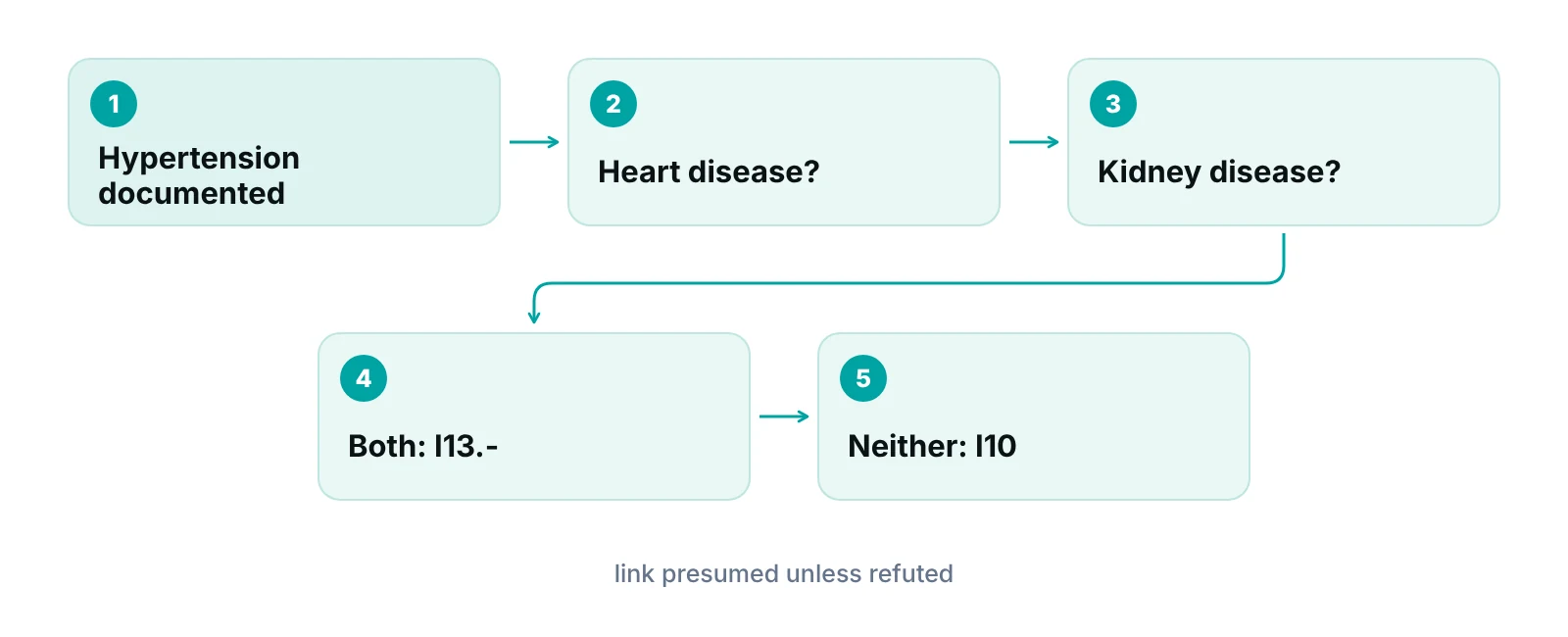
I10 is wrong when the record shows heart disease or chronic kidney disease alongside hypertension and the provider has not said they are unrelated. The classification presumes a causal relationship between hypertension and heart involvement, and links hypertension to kidney involvement through the index term “with,” as the figure in the FY 2027 Official Guidelines (AAPC-hosted copy) shows. You do not need the provider to write “hypertensive.”
Payer education pages describe the same rule. One state Blue plan hypertension coding page says the relationship is coded even without a linking statement unless the documentation clearly says the conditions are unrelated, and a 2019 Anthem provider news article adds that heart disease is presumed related unless the provider documents a different cause. Other conditions, such as cerebrovascular disease, are not covered by the presumption and need the provider to link them.
How the combination codes split
Each combination code splits further by heart failure and by CKD stage. Per Figure I.C.9.a in the AAPC-hosted FY 2027 guidelines, hypertension with heart failure uses I11.0 plus an I50.- code for the type of failure, and hypertension with heart disease but no failure uses I11.9. CKD stages 1 to 4 or unspecified use I12.9 with the stage code, and stage 5 or end-stage renal disease uses I12.0 with N18.5 or N18.6.
When heart and kidney disease are both present, the figure points to I13.0 for heart failure with CKD stages 1 to 4 and I13.2 for heart failure with stage 5 or end-stage disease. Without heart failure it points to I13.10 and I13.11 for the same two stage groups. In each case, add the heart failure type and the CKD stage, because the combination code does not carry them. The lookup page for I12.9 also says to report a code for the CKD stage, and the I13.0 page says to identify the heart failure type.
Sequence the combination code first
The notes at I12 and I13 tell you to add a stage or type code, which means the hypertension combination code leads and the N18 or I50 code follows. One secondary article we read says the N18 code is sequenced first. That conflicts with the use-additional-code notes, so follow the Tabular List and your encoder, not a summary.
How are secondary, crisis and resistant hypertension reported?
These three are layered. Secondary hypertension needs a code for the cause as well as the hypertension; a crisis code needs a hypertension type code; and resistant hypertension needs the existing type, if known. None of them replaces the hypertension type, and the notes in the Tabular List say so.
- Secondary hypertension (I15.-). Hypertension caused by another condition. The category’s code-also note tells you to report the underlying condition, and the order depends on the reason for the encounter. A coding spotlight gives hypertension due to lupus as an example: the lupus code plus I15.8.
- Hypertensive crisis (I16.-). I16.0 is urgency, I16.1 is emergency and I16.9 is crisis unspecified. The category has a code-also note for any identified hypertensive disease in I10 to I15 and I1A, per the FY 2027 listing of I16. A claim with I16.1 alone will often look incomplete.
- Resistant hypertension (I1A.0). The code carries a code-first note for the specific type of existing hypertension, if known, such as I10 or I15.-, according to the FY 2027 listing of I1A.0. Report the type, then I1A.0.
- Uncontrolled hypertension. None of the sources we read gives it a separate code. Code the documented type and have the provider state control status in the note for quality reporting.
Secondary hypertension has a few exceptions worth noting. Category I15 has an Excludes1 note for postprocedural hypertension (I97.3) and an Excludes2 note for secondary hypertension involving the vessels of the brain (I60-I69) or the eye (H35.0-), per the 2minutemedicine page for I15.9. Excludes1 means do not report together; Excludes2 means both can be reported, as the FY 2027 guidelines explain in Section I.A.12.
Which conditions look like hypertension but use other codes?
Several conditions use the word hypertension or a high reading but sit outside I10 to I1A. The block’s own notes name them. Excludes1 at the block level covers neonatal hypertension (P29.2) and primary pulmonary hypertension (I27.0), and Excludes2 covers hypertensive disease complicating pregnancy, childbirth and the puerperium (O10-O11, O13-O16). I10 itself has an Excludes1 note for the pregnancy codes.
- Pregnancy. Hypertension in a pregnant or postpartum patient is reported from the O10 to O16 range, not I10. See the pregnancy codes in your encoder.
- Pulmonary hypertension. This is reported in the I27 range. The BCBSNM page lists I27.0 and I27.20 to I27.29. Do not use I10 for it.
- A lone high reading. R03.0 is for an elevated blood-pressure reading without a hypertension diagnosis, and it is billable in FY 2027. Do not code hypertension from a single reading.
- Brain and eye involvement. I10 has Excludes2 notes for essential hypertension involving the vessels of the brain (I60-I69) and of the eye (H35.0-). Both can be reported when the provider documents both.
- Tobacco status. The block has a use-additional-code note for tobacco exposure or use, such as Z87.891, F17.- or Z72.0. Add it when the note supports it.
Cardiovascular findings often travel together in a note. Our guides on chest pain ICD-10 codes and hyperlipidemia ICD-10 codes show how nearby symptoms and diagnoses are coded, and the sibling hypotension ICD-10 guide covers the other direction of the blood pressure scale.
What must the provider document to support the code?
A hypertension code is only as strong as the assessment it comes from. Coders must code from the documentation, and the same payer pages stress that each diagnosis should show how it was monitored, evaluated, assessed or treated on the date of service. Ask providers to cover the points below.
- The type. Essential, secondary (with the cause), resistant, or a crisis (urgency or emergency).
- Heart involvement. Heart disease, and whether there is heart failure and which type (for example acute, chronic, systolic or diastolic), so the I50.- code can be completed.
- Kidney involvement. The CKD stage. “CKD” with no stage forces an unspecified stage code.
- Any statement that conditions are unrelated. If the provider believes CKD is from another cause, say so, because the presumption otherwise applies.
- Status and plan. Current readings, medication review and what changed, so the diagnosis is supported at that visit.
“The most common hypertension mistake I see is not a wrong code. It is a note that lists hypertension and CKD on the same page and never says whether the provider thinks they are related.”
— Awais Afzal, Healthcare Operations & Data Analyst
Control status deserves a mention. Providers often write controlled, uncontrolled or well controlled. The sources we read give those words no separate code, so they do not change the code choice, but they matter for quality measures and for showing the diagnosis was assessed at the visit. Ask for the word and the supporting reading in the note, and keep the code tied to the documented type.
Hypertension is a chronic condition, so the same code often repeats visit after visit. That is fine when the condition is addressed each time, but a problem list that auto-fills I10 beside a new CKD diagnosis will produce the wrong code. Ask coders to re-read the assessment, not the problem list, at every visit.
What denial and edit reasons come up with hypertension codes?
The usual edit problems are I10 used where a combination code applies, a missing second code, and an Excludes1 pair. Most of these are visible before the claim is sent. The table lists the patterns we would add to a pre-bill check, in payer-neutral terms.
| Provider documents | Report | Notes to check |
|---|---|---|
| Hypertension only | I10 | Add tobacco status code if applicable |
| Hypertension and heart failure | I11.0 plus I50.- | Heart failure type must be documented |
| Hypertension and heart disease, no heart failure | I11.9 plus the heart disease code if applicable | The flowchart lists I51.4, I51.89 and I51.9 for some cases |
| Hypertension and CKD stage 1-4 | I12.9 plus N18.1-N18.4 or N18.9 | CKD stage needed |
| Hypertension and CKD stage 5 or ESRD | I12.0 plus N18.5 or N18.6 | The stage code (N18.5 or N18.6) is needed |
| Hypertension, heart failure and CKD stage 1-4 | I13.0 plus I50.- and the N18 stage code | Heart failure type and CKD stage needed |
| Hypertension caused by renal artery disease | I15.0 plus the underlying condition | Underlying condition must be documented |
| Hypertensive emergency | I16.1 plus the hypertension type | Do not report I16.1 alone |
Source: NCHS/CDC FY 2027 Official Guidelines (Figure I.C.9.a, AAPC-hosted copy); notes at I11-I16 read on icd-10codes.com, veroscribe.com and 2minutemedicine.com (FY 2027).
| What the claim shows | Why it can stop or deny | What to do |
|---|---|---|
| I10 with an N18 stage code | Combination code expected for hypertension with CKD | Check for I12 or I13 unless the note says unrelated |
| I10 with heart failure (I50.-) | Combination code expected for hypertension with heart failure | Check for I11.0 or I13.- unless the note says unrelated |
| I12.9 with N18.5 or N18.6 | Stage 5 and ESRD use I12.0 | Recheck the stage in the note |
| I16.- with no I10-I15 code | The crisis code has a code-also note | Add the hypertension type |
| I1A.0 with no type of hypertension | I1A.0 has a code-first note | Add the existing type if known |
| I10 with an O10-O16 pregnancy code | I10 carries an Excludes1 note for pregnancy codes | Use the pregnancy code only |
Source: Tabular List notes at I10, I12, I13, I16 and I1A.0 read on icd-10codes.com, veroscribe.com and 2minutemedicine.com (FY 2027). Payer edits vary.
A pre-bill review step is the cheapest place to catch these. A claim scrubber or a manual spot check can hold a claim that pairs I10 with an N18 stage code until someone confirms the provider’s view. Our guide to claim scrubbing explains how those rules are built, and our medical billing services page shows where coding review sits in an outsourced workflow.
Hospital claims face a separate check. The CMS MS-DRG v44 manual shows I10, I11.9, I15.-, I16.- and I1A.0 mapping to the hypertension DRG pair, 304 and 305, with the split depending on whether a major complication or comorbidity is present. That is an inpatient grouping rule and does not change the outpatient code choice, but it shows why the secondary diagnoses matter on a facility claim.
Are hypertension claims coming back for combination-code edits?
Send a sample of returned claims where hypertension appears with CKD or heart failure. A free practice audit shows whether the issue is the note, the code choice or the payer edit.
What does a worked example look like?
Example (made-up, de-identified; not a real patient or claim). An established adult is seen for a chronic care visit. The assessment reads: “Hypertension, controlled on current medication. CKD stage 4. No heart failure.” The provider did not say the CKD is unrelated, so the presumed link applies. Report I12.9 and N18.4 in that order, not I10.
Change the note to: “Hypertension, well controlled. CKD stage 4 due to long-standing diabetes, not hypertensive.” The provider has refuted the link, so I10 stands alone for the hypertension, and the CKD is coded separately from its documented cause. Our diabetes ICD-10 codes guide explains the diabetic kidney codes.
Last, an urgent care visit: “Hypertensive emergency, known essential hypertension.” Report I16.1 together with I10. If the claim carries I16.1 alone, the code-also note means it is incomplete. The same logic applies to resistant hypertension: the type of hypertension goes first, and I1A.0 follows.
Our recommendations
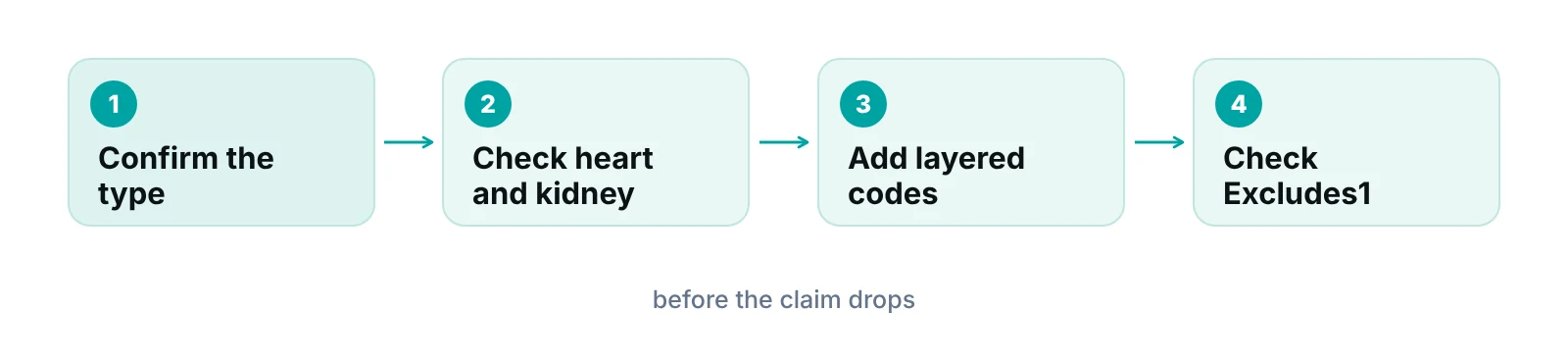
- Make the combination-code rule visible. Put Table 2 on the coder’s desk or in the encoder help text, with the sentence ‘hypertension plus CKD or heart disease is not I10 unless the note says unrelated.’
- Ask for CKD stage and heart failure type. Request both in every assessment where hypertension appears. A missing stage or type is the most common reason a combination code stays incomplete.
- Ask providers to state unrelated conditions. If a provider believes CKD or heart disease has another cause, a single sentence in the note prevents a wrong combination code.
- Add pair rules to the pre-bill check. Use Table 3 to flag I16.- without a type code, I1A.0 without a type code, and I10 beside an N18 or I50 code.
- Stop auto-filling I10 from the problem list. Code from the current assessment. The RCM Finder portal includes claim data-completeness checks before submission, but the diagnosis choice starts with the note.
- Re-verify every 1 October. The ICD-10-CM code set changes every fiscal year. Re-check your templates and encoder against the new files each fall.
Bottom line
Hypertension coding turns on one question: does the record show heart or kidney involvement? If yes, a combination code applies unless the provider says the conditions are unrelated. Layer crisis and resistant hypertension on top of the type, and keep pregnancy and pulmonary hypertension out of I10. If hypertension claims keep stalling, a review of your revenue cycle management process or our denial management services can show where, and you can ask for a free practice audit. Cardiology teams can also see our cardiology page.
Frequently asked questions
What is the ICD-10 code for hypertension?
I10, essential (primary) hypertension, is the code for hypertension with no documented heart or kidney involvement. If the record shows heart disease, chronic kidney disease or both, the classification presumes a link and a code from I11, I12 or I13 applies unless the provider documents they are unrelated.
Can I report I10 and N18.4 together?
Only if the provider states the CKD is not due to hypertension. Otherwise hypertension with stage 4 CKD is reported as I12.9 with N18.4. This is a presumed relationship, so no linking word is needed in the note.
Do I report I16.1 by itself for a hypertensive emergency?
No. The hypertensive crisis category has a code-also note for the hypertensive disease already identified, so report the type (such as I10) along with I16.1. The sequence depends on the reason for the encounter.
Is there a code for uncontrolled hypertension?
None of the sources we read lists a separate code. Report the documented type and ask the provider to state control status and the supporting reading in the note, because quality measures and audits look for it. Check the Alphabetic Index entry in your encoder before you set a rule.
What is I1A.0?
Resistant hypertension, added in the I10 to I1A block. It carries a code-first note for the type of existing hypertension, such as I10 or I15.-, so it is reported after the type, not in place of it. Ask the provider to name the type whenever resistant hypertension is documented.
When is R03.0 used instead of I10?
When the record shows an elevated blood-pressure reading but no diagnosis of hypertension. R03.0 is billable in FY 2027. Once the provider diagnoses hypertension, code the diagnosis, not the reading. A single high reading in a note with no assessment of hypertension should not be coded as the disease, and a query is better than assuming.
Get your free practice audit
Tell us about your practice. We will contact you using the details you give.
- A review of your recent claims, denials and A/R aging
- Where your front desk and prior authorizations slow payment
- A prioritized fix list you keep, whether or not you hire us
Pricing is quoted after the audit, based on your volume and the services you choose. Prefer to talk? Call +1 (302) 556-2288.
Sources
- ICD-10-CM FY 2027 file directory — NCHS/CDC (2026)
- Comprehensive listing of ICD-10-CM files — NCHS/CDC (2026)
- ICD-10-CM Official Guidelines for Coding and Reporting, FY 2027 — NCHS/CDC (2026)
- ICD-10-CM Official Guidelines, FY 2027 (AAPC-hosted copy) — AAPC (2026)
- ICD-10-CM/PCS MS-DRG v44.0 Definitions Manual, hypertension group (FY 2027) — CMS (2026)
- I10 Essential (primary) hypertension — 2minutemedicine.com (2026)
- I10-I1A hypertensive diseases block — icd-10codes.com (2026)
- I16 Hypertensive crisis — icd-10codes.com (2026)
- I1A.0 Resistant hypertension — icd-10codes.com (2026)
- I15.9 Secondary hypertension, unspecified — 2minutemedicine.com (2026)
- I11 Hypertensive heart disease — veroscribe.com (2026)
- I12.9 and I12.0 Hypertensive chronic kidney disease — veroscribe.com (2026)
- I13.0 Hypertensive heart and chronic kidney disease — veroscribe.com (2026)
- R03.0 Elevated blood-pressure reading, without diagnosis of hypertension — icd-10codes.com (2026)
- Hypertension coding tips — Blue Cross and Blue Shield of New Mexico (undated)
- Hypertension ICD-10-CM coding table, guidelines and tips — Find-A-Code (undated)
- Coding spotlight: Hypertension — Anthem Blue Cross (provider news) (2019)
Disclaimer: This article is educational and is not legal, coding, billing, medical or compliance advice. ICD-10-CM and CPT code meanings, guidelines, Medicare contractor policies and payer rules change (the ICD-10-CM code set updates every 1 October) and vary by payer, contractor and state. Verify current requirements with the official ICD-10-CM Tabular List and Official Guidelines, your payers and your counsel before you act.
