
The CPT code for shingles vaccine is 90750, the recombinant adjuvanted vaccine (Shingrix), reported once for each of the two doses. Add an administration code such as 90471 and Z23 as the diagnosis. The old live vaccine code, 90736 (Zostavax), is obsolete. For Medicare patients, shingles vaccine is a Part D benefit, not Part B.
Shingles vaccine claims look easy because there is one product code. They still fail, usually for the same reasons: a missing administration code, the wrong payer for a Medicare patient, or a second dose that does not match the first. This guide is for practice owners and billing managers who give the vaccine or are deciding whether to. It replaces an earlier version of this article that was built around Zostavax, which has not been sold in the US since 2020. Everything below was checked in October 2026 against the CDC Shingrix recommendations (October 2024), the CDC vaccine code set (reviewed September 18, 2026), the CMS Medicare Part D vaccines fact sheet (July 2026) and a national immunization coalition’s vaccine billing Q&A (revised February 2026). Codes and payer rules change, so treat this as a map to check against your own coding resources.
Key takeaways
- Report 90750 (Shingrix) for each dose, with an administration code and Z23 on the same claim.
- 90736 (Zostavax, live) is obsolete. CDC says Zostavax has not been available in the US since November 18, 2020.
- Medicare lists shingles vaccine under Part D, not Part B, so a Part B claim is aimed at the wrong payer.
- The series is two doses, 2 to 6 months apart for most adults. A late second dose is not a reason to restart.
- Add modifier 25 to a separately identifiable E/M visit billed the same day as the vaccine.
Which CPT code is used for the shingles vaccine?
Use 90750 for Shingrix, the only shingles vaccine in current US use. Payer policy pages such as Aetna’s clinical policy on varicella and zoster vaccines (reviewed March 2026) describe 90750 as the zoster vaccine, recombinant, sub-unit, adjuvanted, for intramuscular injection. CDC’s code set lists the matching vaccine, “zoster recombinant”, as CVX 187 and active.
The second code in the old version of this article, 90736, was the live vaccine given under the skin (Zostavax). CDC’s clinical page says Zostavax is no longer available in the US as of November 18, 2020, and CDC’s code set marks the live zoster product (CVX 121) as inactive. Aetna’s policy lists 90736 among the codes it does not cover. Keep 90736 in your system only so old records can still be read, and do not offer it on a new charge sheet.
| Code | What it is | Status and notes |
|---|---|---|
| 90750 | Shingrix: zoster vaccine, recombinant, adjuvanted, intramuscular | Current product code. CDC CVX 187 is active. |
| 90736 | Zostavax: zoster vaccine, live, subcutaneous | Obsolete. Not available in the US since November 18, 2020. CDC CVX 121 is inactive. |
| 90471 | Administration of one vaccine (non-oral, non-nasal) | Reported once per day for the first vaccine given. |
| 90472 | Add-on administration for each additional vaccine, same day | Only with 90471 on the same day. |
| Z23 | ICD-10-CM: encounter for immunization | Diagnosis linked to both the vaccine and the administration code. |
Source: CDC IIS vaccine code set (reviewed 2026); Aetna Clinical Policy Bulletin 0115 (2026); CDC Shingrix recommendations (2024); National Adult and Influenza Immunization Summit billing Q&A (2026).
What else belongs on a shingles vaccine claim?
A clean claim carries three things that agree with each other: the product code (90750), an administration code and a diagnosis. The National Adult and Influenza Immunization Summit explains that 90471 is the initial administration code for a non-oral, non-nasal vaccine and is billed once per day, while 90472 is the add-on for each additional vaccine given that day. It also says to link both the vaccine code and the administration code to Z23, one Z23 per vaccination.
Administration codes cover the injection itself. They do not include counseling time. The same source says that for patients 18 and younger with qualified counseling, the 90460 and 90461 pair applies instead. Shingles vaccine is an adult product, so 90471 and 90472 are the pair most practices will use.
Units are simple. North Carolina Medicaid’s Shingrix billing guidance (2018) treats one unit as one 0.5 mL dose, and the NAIIS guidance says to enter one unit each for the vaccine and the administration. Two doses on two dates of service means one unit of 90750 on each. State Medicaid programs publish their own rules and rates, so check yours before copying a pattern.
A visit often has more going on than a vaccine. The table shows how the claim changes with the visit type.
| Visit | Codes to report | Watch for |
|---|---|---|
| Vaccine-only visit (nurse or medical assistant) | 90750, 90471, Z23 | No E/M code. Modifier 25 is not needed. |
| Vaccine given during a problem visit with a separately identifiable E/M | E/M with modifier 25, plus 90750, 90471, Z23 | The note must support the E/M on its own. |
| Vaccine given at a preventive medicine visit | Preventive code (99381 to 99395 range) with modifier 25, plus 90750, 90471, Z23 | Modifier 25 goes on the preventive code. |
| Shingrix and another vaccine on the same day | 90750 and the other product code, 90471 for the first, 90472 for the second, Z23 for each | Different products can belong to different Medicare benefits (see below). |
Source: National Adult and Influenza Immunization Summit, Top Questions for Medical Benefit Coding and Billing for Vaccines (revised February 2, 2026).
Our guide to modifier 25 and when it applies covers the documentation side. If your claims go through a scrubber, an edit that checks for the administration code and Z23 whenever 90750 appears is a cheap safeguard. See claim scrubbing in medical billing for how those edits work.
Two doses, two claims: keep the series straight
Shingrix is a two-dose series. CDC recommends 2 doses separated by 2 to 6 months for immunocompetent adults aged 50 and older. CDC also recommends 2 doses for adults aged 19 and older who are or will be immunodeficient or immunosuppressed. For people who would benefit from finishing sooner, the second dose can be given 1 to 2 months after the first.
That matters for billing because each dose is its own date of service, its own claim line and often its own authorization check. The old version of this article said both doses use 90750 and stopped there. That is true, but it left out the work between the doses.
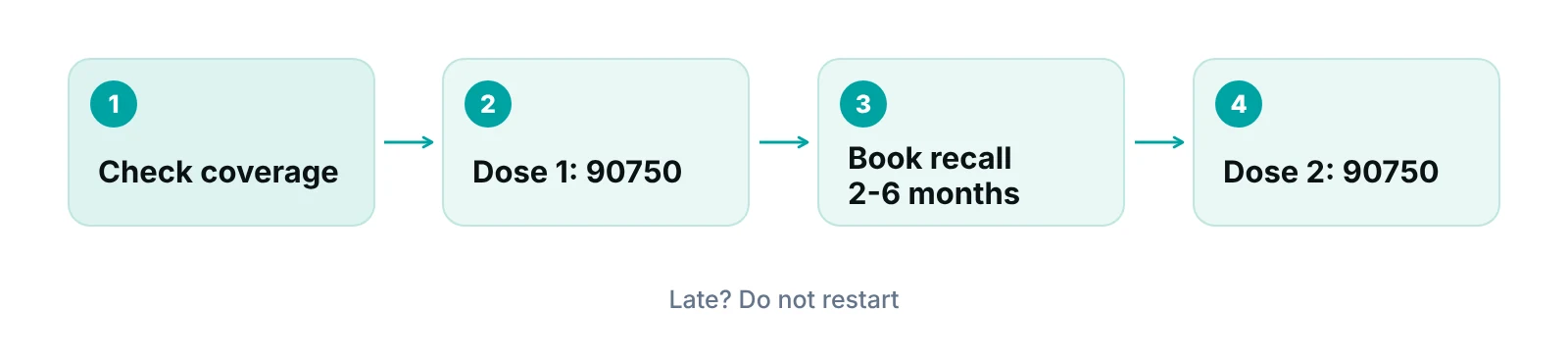
Three series rules are worth putting in your front-desk script:
- If the second dose is delayed past 6 months, CDC says to give it as soon as possible and not to restart the series.
- If a patient had Zostavax in the past, CDC says to wait at least 8 weeks before giving Shingrix.
- Shingrix can be given at a different anatomic site on the same day as other adult vaccines, including COVID-19 vaccines. CDC says co-administration with the adjuvanted flu vaccine is still being studied.
Recall is the weak point. A patient who gets dose one and never returns leaves you with a claim for an incomplete series and a patient with partial protection. A recall list tied to the first dose date, with a call at the 2-month mark, is simple to run and does not need new software.
Medicare: shingles vaccine is a Part D benefit
CMS names shingles as a Part D vaccine, alongside RSV and Tdap, in its Medicare Part D vaccines fact sheet (July 2026). Part B covers a short list instead: flu, pneumococcal, hepatitis B for people at intermediate or high risk, COVID-19, and some vaccines given to treat an injury or exposure, such as tetanus, rabies and hepatitis A. Shingles is not on it. Billing the Part B Medicare contractor for 90750 is billing the wrong payer, whatever the CPT code says.
| Vaccine | Medicare benefit | What it means at the front desk |
|---|---|---|
| Shingles (zoster) | Part D | Check the patient’s Part D plan, not the Part B card. |
| RSV (adult) | Part D | Same routing as shingles. |
| Tdap | Part D | Same routing. Tetanus alone for an injury is Part B. |
| Influenza | Part B | Different benefit from shingles, so a same-day flu and shingles visit can mean two payers. |
| Pneumococcal, COVID-19 | Part B | Medical benefit claim. |
| Hepatitis B | Part B | For people at intermediate or high risk. |
Source: CMS, Medicare Part D Vaccines, MLN908764 (July 2026).
CMS also describes the mechanics for a prescriber’s office. When the same provider dispenses and administers a Part D vaccine, the vaccine and its administration go on one claim. CMS says administration in a prescriber’s office is considered out-of-network because Part D networks are defined as pharmacy networks only, and out-of-network prescribers can submit claims through a plan’s web portal or on a standard physician claim form or electronic format. They should agree to accept the plan’s payment as payment in full.
The patient side is good news: CMS says people with Part D pay nothing out of pocket for ACIP-recommended adult vaccines, even from out-of-network providers. For a practice, though, the question is whether you can be paid for stocking the vaccine at all. Confirm the process with the Part D plans your patients carry before you buy stock. Pharmacies are often the easier route for Medicare patients, and sending a patient there is a legitimate choice.
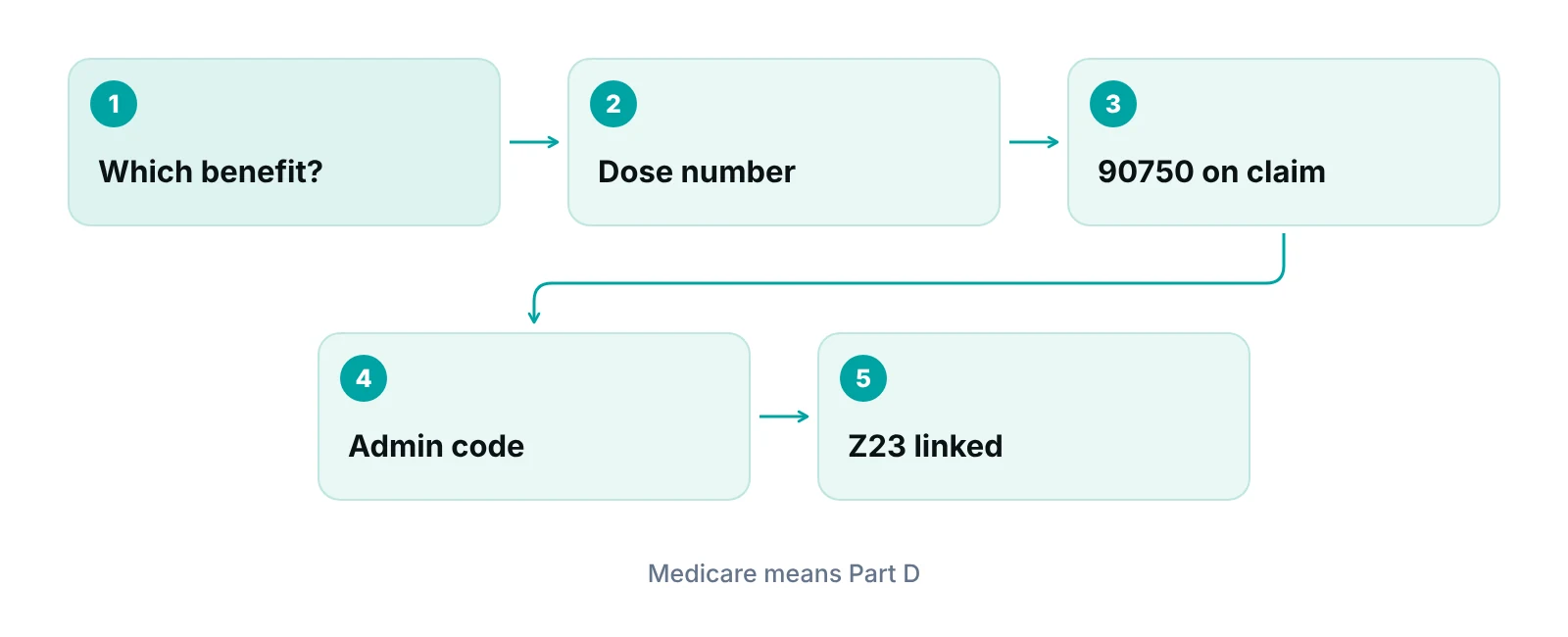
This is why an eligibility check belongs before the vaccine is drawn up, not after the remittance. Our guides on how to verify Medicare coverage and on the RSV vaccine CPT code, which has the same Part D issue, walk through the front-end check.
Who is eligible, and why it matters for the claim
A practice does not decide who should be vaccinated, but payers apply age and risk edits, so the front desk should know the basics. CDC’s current page recommends Shingrix for immunocompetent adults aged 50 and older and for adults aged 19 and older who are or will be immunodeficient or immunosuppressed.
The old version of this article gave only the 50-and-older rule and described Zostavax as an alternative. Neither is right today. An adult aged 19 to 49 with a documented immune condition can be a covered patient, and the chart should say why. A missing reason is a common cause of an eligibility question on a younger patient. That is an intake and documentation task for the front desk.
Where shingles vaccine claims break
Five points cause most avoidable rework. Each can be checked before the claim leaves the building.
- Wrong benefit. A Medicare patient’s shingles claim is sent to Part B. Route it to the Part D plan.
- Obsolete code. 90736 stays in the charge master and gets picked. Retire it from new-charge lists.
- Missing administration code. 90750 goes out alone. Add 90471 or 90472 and link Z23.
- Modifier 25 missing or misused. An E/M the same day without it is likely to be bundled. Add it only when the E/M is separately identifiable.
- Series gaps. A second dose is billed with no record of the first. Match dose dates before billing.
“The costly vaccine claim is rarely the complicated one. It is the routine claim where the product, the administration code and the benefit were never checked against each other.”
When a vaccine claim is denied, the first step is the remittance reason code, not a resubmission. Our denial management services and medical billing services pages explain how outside help fits if rework is piling up.
Have your vaccine claims checked
Send us a sample of recent immunization claims. We will check the product, administration and diagnosis codes and the benefit routing, and show you where the gaps are. The audit is free, and pricing is quoted afterward.
Handle it in-house or bring in help
If you give a few shingles doses a month, a one-page rule sheet and a scrubber edit may be all you need. A larger Medicare panel, a mix of vaccines on the same day, or a vaccine program across several clinics raises the cost of each rule someone forgets. Offices in primary care feel this first, and our family practice billing support page covers how that work is set up.
- Keep in-house if volume is low, one person owns vaccine billing, and you can name your Part D process.
- Get help if vaccine claims are denied or aging, you stock several vaccines, or nobody owns the dose-two recall.
- Either way, ask any outside billing partner to sign a Business Associate Agreement before it sees patient data, and to work inside the EHR you already use.
If you want to size the stakes first, run your own numbers through the revenue calculator.
Estimate what denied and under-billed claims could cost
Use the free revenue calculator, or talk to our team about a practice audit.
Our recommendations
- Retire 90736 from new charge lists. Keep it in the system only so old records read correctly. Zostavax has not been available in the US since November 18, 2020.
- Build the claim as a set. Make 90750, an administration code and Z23 one charge template, so a staff member cannot post one without the others.
- Check the benefit before the dose. For Medicare patients, confirm the Part D plan and your process for being paid before the vaccine is drawn up.
- Run a dose-two recall. Set a recall at the date of dose one, and call at the 2-month mark. If the patient is late, give the dose and do not restart.
- Document the reason for patients 19 to 49. Record the immune condition or planned immunosuppression in the chart so the claim can be defended.
- Re-check codes each year. Review your vaccine codes against the CDC code set and the current CPT book each January and each fall season.
Bottom line
For the shingles vaccine, 90750 is the product code, 90471 or 90472 is the administration code, and Z23 is the diagnosis. The sharper risks are the payer for Medicare patients (Part D), the obsolete 90736 and a lost second dose. If vaccine claims are being denied or sitting unpaid, our denial management services can help find the pattern, and the team is here to talk it through.
Frequently asked questions
What is the CPT code for the shingles vaccine?
The CPT code for the shingles vaccine is 90750, which describes the recombinant adjuvanted zoster vaccine (Shingrix) given by intramuscular injection. Report it with an administration code such as 90471 and Z23 as the diagnosis. The older live vaccine code, 90736, applied to Zostavax, which is no longer sold in the US.
Do I bill 90750 for both Shingrix doses?
Yes. Each dose is a separate date of service, so each gets its own claim line with 90750, an administration code and Z23. The CDC schedule is two doses 2 to 6 months apart for most adults, or 1 to 2 months apart for people who need to finish sooner because of immune status.
Does Medicare Part B cover the shingles vaccine?
No. CMS lists shingles among the Part D vaccines, with RSV and Tdap. Part B covers flu, pneumococcal, hepatitis B for people at intermediate or high risk, COVID-19, and certain vaccines for an injury or exposure. A shingles claim should go to the patient’s Part D plan.
Is Zostavax 90736 still billable?
Not for new vaccinations. CDC says Zostavax has not been available in the US since November 18, 2020, and its code set marks the live zoster vaccine as inactive. Payers may still process old dates of service, but 90736 should not be offered on a current charge sheet.
What diagnosis code goes with the shingles vaccine?
Z23, encounter for immunization, is the diagnosis code used for a vaccination visit. National immunization coalition guidance says to report one Z23 per vaccination and link it to both the vaccine product code and the administration code. If the vaccine relates to an exposure, a different primary diagnosis may apply.
Can I bill an office visit on the same day as the vaccine?
Only if the visit is a separately identifiable E/M service or a preventive visit. Then modifier 25 goes on that visit code. If the patient came only for the injection, bill the vaccine and administration codes and no E/M. Documentation has to support the visit on its own.
Get your free practice audit
Tell us about your practice. We will contact you using the details you give.
- A review of your recent claims, denials and A/R aging
- Where your front desk and prior authorizations slow payment
- A prioritized fix list you keep, whether or not you hire us
Pricing is quoted after the audit, based on your volume and the services you choose. Prefer to talk? Call +1 (302) 556-2288.
Sources
- Shingrix Recommendations — CDC (2024)
- IIS: HL7 Standard Code Set (CVX) — CDC (2026)
- Medicare Part D Vaccines (MLN908764) — CMS (2026)
- Top Questions for Medical Benefit Coding and Billing for Vaccines — National Adult and Influenza Immunization Summit (2026)
- Clinical Policy Bulletin 0115: Varicella and Herpes Zoster Vaccines — Aetna (2026)
- Billing Guidelines: Zoster Vaccine Recombinant, Adjuvanted (Shingrix) CPT 90750 — North Carolina Medicaid (NCDHHS) (2018)
Disclaimer: This article is general educational information for practice owners and managers. It is not legal, coding, compliance or medical advice. Code sets, CDC recommendations and payer policies change; verify codes against the current CPT code set, CDC and your payers’ policies before billing.
