HIPAA-compliant voicemail means leaving only what the patient needs to call you back: your practice name, a callback number and, at most, an appointment time. HHS allows messages on answering machines but tells providers to limit the information. Leave out diagnoses, test results, treatments and balances.
Most front desks learn voicemail rules by word of mouth, and the rules drift. One person says the patient’s name is fine. Another reads out the appointment type. This guide gives your team one clear standard, based on what the HHS Office for Civil Rights (OCR) voicemail FAQ and the Privacy Rule text actually say. For the wider front-desk picture, see our HIPAA compliance guidelines for the front desk.
Key takeaways
- HHS allows answering machine messages but tells providers to limit the information.
- Name, callback number and a request to call back is the safest message.
- Written consent is not a condition for a limited message, but reasonable confidential-communication requests must be honored.
- Safeguards limit risk; HIPAA does not require you to eliminate it.
- Write one voicemail standard and store contact preferences where every role sees them.
What does HIPAA say about leaving voicemail for patients?
HIPAA allows you to call patients and leave messages. It does not ban voicemail. HHS says the Privacy Rule lets providers contact patients about their care at home, by mail, by phone or by other means, and that providers may leave messages on answering machines. The condition is that you “limit the amount of information disclosed” on the machine (HHS OCR).
HHS gives a practical picture of a limited message: your name, a callback number and the details needed to confirm an appointment, or a request that the patient call back (HHS OCR). That is guidance, not a script. It leaves room for judgment, which is why your practice needs a written standard.
No written consent is needed for a limited message
The old version of this post said to get written consent before leaving detailed messages. That overstated the rule. The HHS voicemail FAQ does not make written consent a condition for a limited message. What the rule does require is that you honor a reasonable request for confidential communications (see below). If you want to leave more detail than a basic callback message, set that up with the patient and record the preference, and ask your privacy officer or counsel how to word it.
Three Privacy Rule ideas sit behind every voicemail decision: reasonable safeguards, minimum necessary and incidental disclosures. The next section explains them in plain terms.
How do reasonable safeguards and minimum necessary apply to voicemail?
They mean you do not have to guarantee that nobody ever overhears a message, but you must take sensible steps to reduce the chance. HHS states that the Rule “does not require that all risk of incidental use or disclosure be eliminated” (HHS OCR, incidental uses and disclosures).
Incidental disclosures
HHS describes an incidental disclosure as a secondary one that happens alongside a permitted disclosure and cannot reasonably be prevented. It is allowed only if the practice has reasonable safeguards and applies minimum necessary where that standard applies. If the incidental disclosure comes from skipping those steps, it is not permitted (HHS OCR; 45 CFR 164.502(a)(1)(iii)). A plain callback request overheard at home is low-risk. A diagnosis overheard is not.
Reasonable safeguards
Safeguards are administrative, technical and physical, and HHS says they can be scaled to the size and type of the practice, weighing patient-care effects and cost. Its examples include speaking quietly in a waiting room, locking file cabinets and using computer passwords (HHS OCR). For voicemail, that translates into a written message standard, staff who listen to patient voicemail where others cannot hear, and password-protected phone systems.
Minimum necessary
Minimum necessary means making reasonable efforts to use and disclose only the information needed for the purpose (HHS OCR). The standard has exceptions, including disclosures to the individual (45 CFR 164.502(b)(2)). A call to a patient is aimed at the patient, but a recorded message can be heard by someone else. So the working rule for your team is simple: treat the HHS “limit the information” guidance as the standard for every message.
| Concept | What it means | What it looks like at the front desk |
|---|---|---|
| Reasonable safeguards | Administrative, technical and physical steps that fit the practice. They limit risk but do not have to remove it. | A written message standard, passwords on phone systems, staff listening to messages where others cannot hear. |
| Incidental disclosure | A secondary disclosure that cannot reasonably be prevented. Allowed only when safeguards and minimum necessary were applied. | A family member overhears a plain callback request. |
| Minimum necessary | Reasonable efforts to limit information to what is needed. Disclosures to the individual are an exception, but a voicemail can reach others. | Name, callback number and, at most, a time. No clinical detail. |
| Confidential communications | A provider must accommodate reasonable requests to be contacted by alternative means or at alternative locations. | A patient asks you to call a work number only, or not to leave voicemail at all. |
Source: HHS OCR, incidental uses and disclosures and minimum necessary guidance; 45 CFR 164.502 and 164.522. Front-desk examples are our illustration, not HHS text.
What can staff say in a patient voicemail?
Stick to the practice name, a callback number and a request to call back. Some practices add the appointment date and time, which fits the HHS example of details needed to confirm an appointment (HHS OCR). Everything beyond that is a judgment call, so write down where your line is and train to it.
One point teams often miss: the practice name itself can reveal health information. A message from a clinic whose name includes a specialty tells a listener something about the patient. HHS does not give a rule on this, so decide as a practice whether callers identify themselves by the full name or by a neutral form, and apply it everywhere.
| Message element | Safer choice | Avoid |
|---|---|---|
| Who is calling | First name and practice name, in the form your policy sets | Provider specialty or department that points to a condition |
| Why you are calling | “This is a message about your upcoming appointment.” | Visit type, diagnosis, procedure, test or medication |
| Appointment details | Date and time, if your policy allows it | Reason for visit, referral source, lab or imaging name |
| Billing | “Please call us about your account.” | Balance amounts, collections language, insurance denials |
| Next step | Callback number and office hours | Detailed instructions that need a verified conversation |
| Results | “Please call us when you get this message.” | Any result or its meaning, normal or abnormal |
Source: Practice guidance based on the HHS OCR answering-machine FAQ. HHS does not publish a content list; confirm your policy with your privacy officer.
Example scripts
These are illustrations for your own policy. Neither is an HHS-approved wording.
- Appointment reminder: “Hello, this is Maria from [practice name] with a message about an appointment. Please call us at [number], Monday to Friday, 8 to 5. Thank you.”
- Balance follow-up: “Hello, this is Sam from [practice name]. Please call us back at [number] when you can. Thank you.”
- Test or visit follow-up: “Hello, this is Priya from [practice name]. We would like to speak with you. Please call [number]. Thank you.”
If a message names a condition, a drug, a procedure or a dollar figure tied to care, it has gone past a limited message.

What if the patient asks you not to leave voicemail?
You must accommodate reasonable requests. A covered provider has to let patients ask to be contacted by alternative means or at alternative locations, and must accommodate reasonable requests (45 CFR 164.522(b)(1)). HHS gives examples such as calling the office instead of the home, or using a closed envelope or P.O. box for mail (HHS OCR).
The rule also sets limits on what you can ask. You may not require the patient to explain why they want confidential communication. You may require the request in writing, and you may ask for an alternative address or contact method and for information on how payment will be handled (45 CFR 164.522(b)(2); HHS OCR Privacy Rule summary).
A preference only works if every caller can see it
The most common failure is not the voicemail script. It is the scheduler, the biller and the reminder system all calling the same old number because the patient’s preference lives in one person’s notes. Put the contact preference in a field that every role sees before dialing.
Messages left with another person
If someone other than the patient answers, HHS says a provider may leave limited information with a family member or other person, using professional judgment that the disclosure is in the patient’s best interest and keeping it limited (HHS OCR). If the patient has asked for confidential contact, honor that first. When in doubt, ask for a callback and say nothing about the reason for the call.
| Situation | What HHS says | Practice approach |
|---|---|---|
| Patient’s own answering machine or voicemail | Permitted. Limit the information left. | Use the standard message: practice, number, request to call. |
| A family member or other person answers | Limited information may be left, using professional judgment about the patient’s best interest. | Give name and number only. Do not state the reason for the call. |
| Patient asked for confidential contact | Reasonable requests must be accommodated. | Use only the stated number or method. Record it for all roles. |
| Shared or workplace phone | HHS does not address it directly. | Ask the patient at registration whether messages are safe there. |
Source: HHS OCR, may health care providers leave messages (FAQ 198); 45 CFR 164.522(b). Practice approach column is our illustration.
How should staff listen to and store patient voicemails?
Treat an incoming patient voicemail as protected health information in your own system, because it often contains it. The same reasonable-safeguards standard applies to how you listen, store and share those messages (HHS OCR).
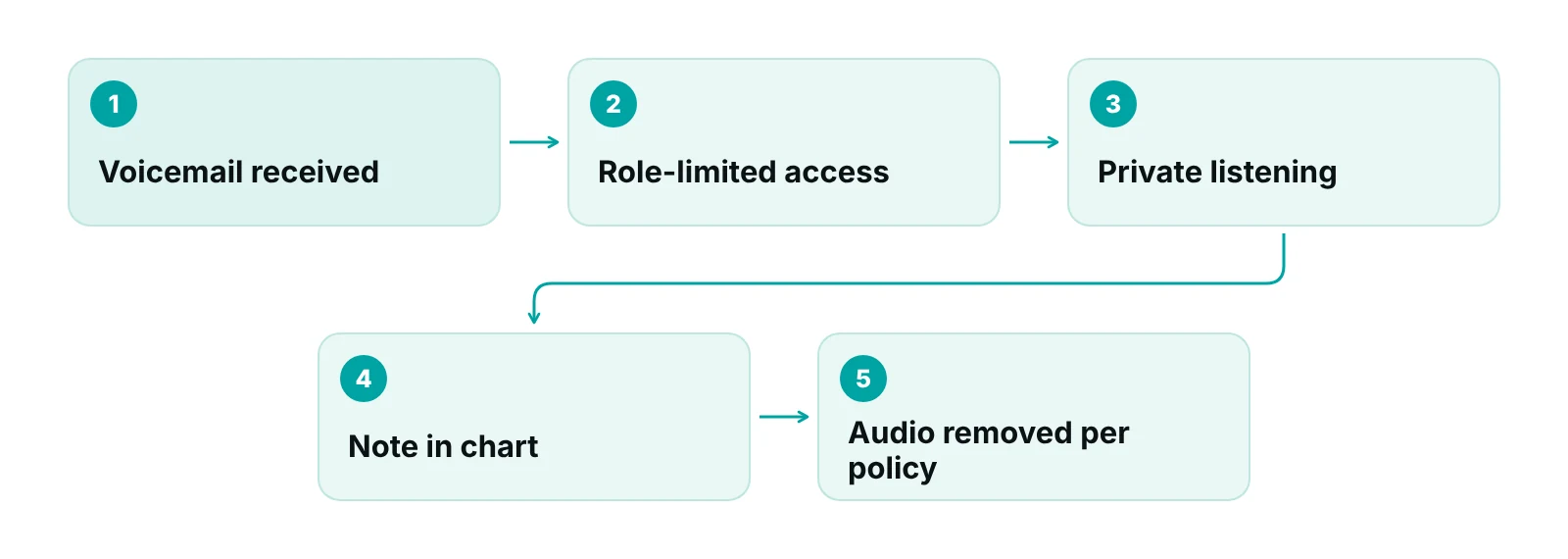
- Listen privately. Do not play patient messages on speaker at an open desk. HHS names speaking quietly in shared spaces as an example of a reasonable safeguard.
- Limit who can access the mailbox. Role-based access and passwords match the HHS examples of technical safeguards and the minimum-necessary idea of limiting access by job duty (HHS OCR).
- Move the content into the chart. Record what you need in the patient record and remove the audio when your retention policy says so. Do not forward audio files by personal email or messaging apps.
- Ask your phone vendor about its terms. If a vendor stores or transcribes voicemail for you, it may be handling PHI for you. Ask whether it will sign a Business Associate Agreement. Our HIPAA compliance checklist for medical practices covers the vendor questions.
- Document the policy. Keep the message standard and training sign-in sheets on file.
Patient voicemails about billing or results should reach the right person, not sit in a general mailbox. Our guide to how front desk staff affect the revenue cycle explains why call handling at the front end shapes what happens later in billing.
Want a second set of eyes on your front-desk call process?
Our checklist walks through the controls that sit around phone calls, vendors and staff training.
Do some specialties need stricter voicemail rules?
Some practices should set a tighter standard than the minimum. A neutral message is easy to defend; a revealing one is not. This applies most to services where the fact of being a patient is itself sensitive, such as therapy or addiction treatment.
If you run a behavioral health or mental health practice, consider leaving no voicemail unless the patient has said it is safe, and keep any message fully neutral. This guide covers the HIPAA Privacy Rule only. Other federal or state laws can add requirements for some services, so check with your compliance advisor.
What happens if a voicemail goes wrong?
A single overheard message is unlikely to be the story. Repeated problems, no written standard and no training are what turn small mistakes into findings. OCR sets civil money penalties in four tiers that depend on the level of culpability, from not knowing about the violation to willful neglect that was not corrected, and HHS adjusts the dollar amounts for inflation every year (Federal Register, annual civil monetary penalties inflation adjustment, January 2026). Check the current table rather than relying on an old figure, because older articles still quote outdated amounts.
Practical steps if you think a message reached the wrong person: record what was said and who may have heard it, tell your privacy officer the same day, and follow your breach assessment process. Our guide to maintaining patient privacy in the revenue cycle and confidentiality best practices post cover the next steps in more depth.
How do you train a front desk on voicemail rules?
Use one page and a short role-play. A written standard only helps if each person can say it from memory.
- Write the standard: what you may say, what you may never say, and who decides edge cases.
- Give every caller the same three templates: reminder, callback and follow-up.
- Practice with real situations: a shared phone, a spouse who answers, a patient who said no voicemail.
- Put contact preferences in one field every role sees.
- Review once a quarter and after any incident, and update the sheet.
If your front desk is stretched thin, the standard is the first thing to slip. A virtual medical assistant service that works inside your EHR to your written scripts can take over reminders and callbacks, but it does not replace your privacy officer or your policy. Related guidance is in our post on the HIPAA Security Rule and the revenue cycle.
Not sure where your front desk is exposed?
A free practice audit looks at calls, reminders and follow-up as part of your wider operations. No obligation.
Our recommendations
- Write a one-page voicemail standard. We start every front-desk review with this page. Name what staff may say, what they may not, and who decides edge cases. Without it, each person invents a rule.
- Use a neutral identification. Decide how callers name the practice on a message, especially if the practice name points to a specialty. Apply the same form on every call and in every reminder tool.
- Ask about contact preferences at registration. Ask which number is safe, whether voicemail is allowed and who may take a message. Record it where scheduling, billing and reminder staff all see it.
- Make the callback easy. A minimal message works only if the callback goes to someone who can help. Give a direct number and hours, and make sure the line is answered.
- Control the inbound mailbox. Limit who can open patient voicemail, listen privately, and move the content to the chart. Ask any phone vendor about a Business Associate Agreement.
- Review the policy after any near miss. Treat a wrong-number message or a shared-phone issue as training material. Update the script and brief the team that week.
Bottom line
A HIPAA-compliant voicemail is a short one: practice name, callback number, a request to call back, and nothing clinical. Pair it with a written standard, a shared contact-preference field and staff training. If missed calls and reminder follow-ups are stretching your team, look at our medical appointment scheduling services or talk to us about a free practice audit.
Frequently asked questions
Is it a HIPAA violation to leave a voicemail for a patient?
No. HHS says providers may leave messages on answering machines, as long as they limit the information. A message with your practice name, a callback number and a request to call back is the safest form. A violation is more likely when a message includes a diagnosis, test result, treatment or amount owed.
Can I mention the appointment date and time in a voicemail?
HHS gives details needed to confirm an appointment as an example of limited information. Many practices include date and time and leave out the reason for the visit. Decide in writing whether your practice does so, and skip it for patients who asked for confidential communication.
Do I need written consent before leaving a detailed voicemail?
HHS does not make written consent a condition for a limited message. If you want to leave more than a callback request, set that up with the patient first and record their preference. Ask your privacy officer or counsel how your practice should word and document it.
What if a patient asks me not to call or leave messages?
A provider must accommodate reasonable requests for confidential communications. You may not require the patient to explain the request. You may ask for it in writing, for an alternative contact method, and for information on how payment will be handled. Record the preference so every staff member sees it.
Can I leave a message with a family member who answers the phone?
HHS says a provider may leave limited information with a family member or another person, using professional judgment about the patient’s best interest. Give your name and number and ask for a callback. Do not state the reason for the call, and follow any confidential-communication request first.
Does a voicemail system need a Business Associate Agreement?
It depends on what the vendor does. If a vendor stores, transcribes or otherwise handles patient voicemail for you, ask whether it will sign a Business Associate Agreement. Our HIPAA checklist lists the vendor questions. Confirm your specific setup with your privacy officer or counsel.
Get your free practice audit
Tell us about your practice. We will contact you using the details you give.
- A review of your recent claims, denials and A/R aging
- Where your front desk and prior authorizations slow payment
- A prioritized fix list you keep, whether or not you hire us
Pricing is quoted after the audit, based on your volume and the services you choose. Prefer to talk? Call +1 (302) 556-2288.
Sources
- May health care providers leave messages for patients at home or on an answering machine? — HHS Office for Civil Rights (n.d.)
- Incidental Uses and Disclosures — HHS Office for Civil Rights (n.d.)
- Minimum Necessary Requirement — HHS Office for Civil Rights (n.d.)
- Summary of the HIPAA Privacy Rule — HHS Office for Civil Rights (n.d.)
- 45 CFR 164.522 Rights to request privacy protection — eCFR (current)
- 45 CFR Part 164 Subpart E — eCFR (current)
- Annual Civil Monetary Penalties Inflation Adjustment — Federal Register (HHS) (2026)
Disclaimer: This post is general educational information about HIPAA Privacy Rule operations. It is not legal, compliance or coding advice. Rules can change and state or other federal laws may apply. Confirm your policies with your privacy officer or qualified counsel before acting.