
A non-participating provider letter tells patients, in plain words, that your practice no longer has a contract with their plan or has chosen non-participating status with Medicare, what that changes in what they pay, and what happens next. Medicare treats non-par and opt-out very differently, so pick the right letter first.
Most sample letters online blur three different situations: leaving a commercial network, becoming a Medicare non-participating (non-par) provider, and opting out of Medicare entirely. Each has different rules and needs different words. This guide separates them, uses primary sources from CMS, the federal regulations and a Medicare Administrative Contractor (MAC), and gives you two templates you can adapt. It is general information, not legal or compliance advice. Have counsel check the final wording for your state.
Key takeaways
- Pick the letter by situation: leaving a commercial plan, Medicare non-par, or Medicare opt-out. They are not interchangeable.
- Medicare non-par is not opt-out: you still file Medicare claims, and you cannot charge patients for filing them.
- The limiting charge is 115% of the non-par fee schedule amount, which works out to about 109.25% of the full fee schedule amount.
- Medicare participation decisions are made once a year, from mid-November through December 31, and take effect January 1.
- Never put a number in a letter that your contract, state rules or MAC have not confirmed for your situation.
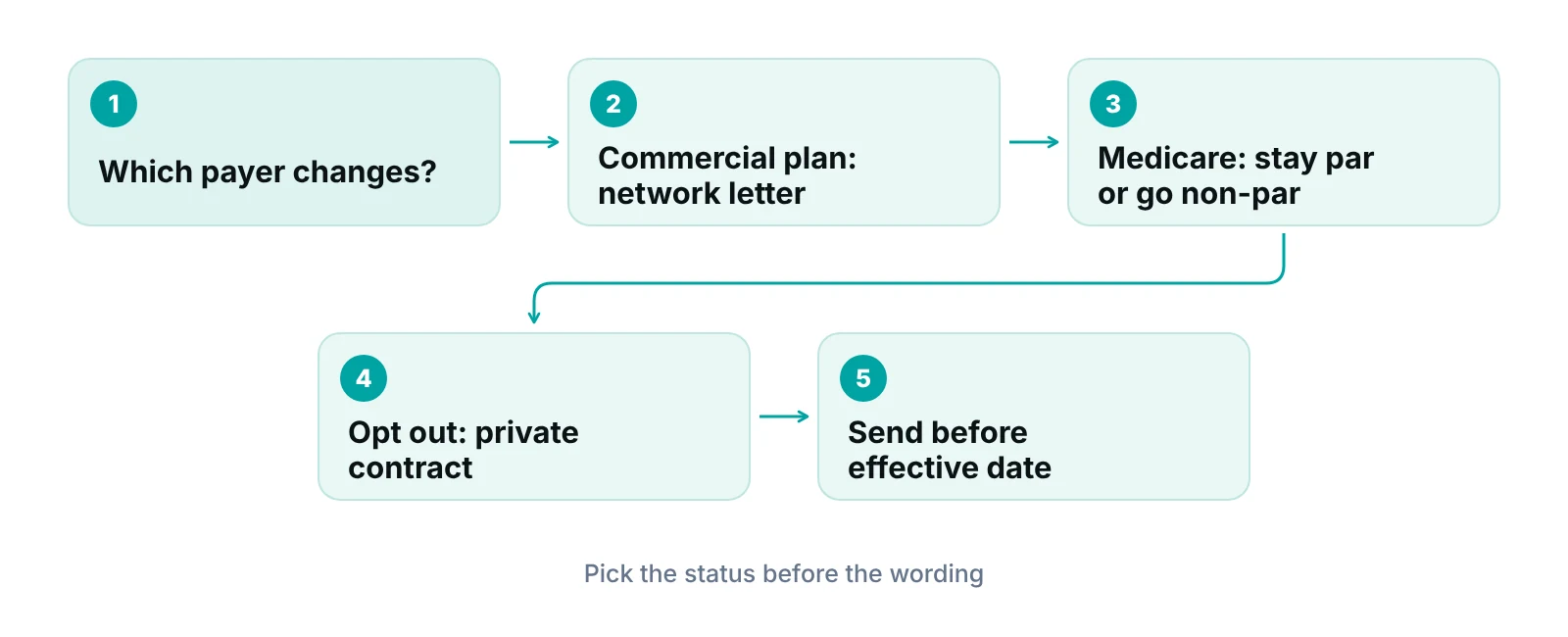
Which letter do you actually need?
Start with the decision, not the wording. The right letter depends on which relationship is changing, because the patient impact, the legal rules and the timing differ.
| Situation | What changes for the patient | Who sets the rules | What the letter is |
|---|---|---|---|
| Leaving a commercial plan’s network | Claims are processed out of network. Cost sharing and balance billing exposure depend on the plan and state law. | Your contract with the plan, the plan’s documents, state law | Network change notice with the effective date and options |
| Medicare non-participating (non-par) | You still file the Medicare claim. You may or may not accept assignment claim by claim. Charges are capped at the limiting charge. | Federal Medicare rules, your MAC | Status notice before the new calendar year |
| Medicare opt-out | Medicare pays nothing for covered services you give. The patient signs a private contract first. | 42 CFR Part 405, Subpart D | Private contract, plus your affidavit to the MAC. It is not a courtesy letter. |
Sources: CMS, Annual Medicare Participation Announcement (page last modified March 10, 2026); 42 CFR Part 405, Subpart D (eCFR)
If you are leaving a commercial plan, your payer contract usually sets how much notice you must give the plan and the patients. Read the termination clause first. For the wider picture of network status see our guide to in-network vs out-of-network billing.
Do not use a non-par letter for an opt-out
If you plan to opt out of Medicare, each patient must sign a written private contract before you provide services under it, and you file an affidavit with each MAC. A friendly notice does not do that. See the opt-out section below.
Medicare participating, non-participating and opt-out: the rules in one place
A participating provider signs an agreement to accept assignment on all covered services. A non-participating provider has not signed, and may accept assignment case by case. An opted-out provider has a private-contract relationship with Medicare patients and bills Medicare for nothing. This is how the CMS MLN booklet on Medicare enrollment (October 2024) and the CMS participation page describe the first two.
| Participating | Non-participating | Opted out | |
|---|---|---|---|
| Assignment | Required for all covered services | Optional, claim by claim | Not applicable: no Medicare claims for these services |
| Payment on the fee schedule | Full Medicare Physician Fee Schedule amount | 5% less than the participating amount | Set privately by contract with the patient |
| What you may collect from the patient | Deductible and coinsurance or copayment only | On assigned claims, the same. On unassigned claims, up to the limiting charge | Whatever the private contract says |
| Appeal rights | Not limited | Limited | Not applicable |
| How you join or leave | Sign CMS-460; change status in the annual window | Default if you do not sign CMS-460 | Affidavit to each MAC; 2-year period |
Sources: CMS MLN9658742 (October 2024); CMS Annual Medicare Participation Announcement; 42 CFR 414.48; 42 CFR Part 405, Subpart D (eCFR)
Two points that old articles often get wrong. First, non-par is not opt-out: a non-par provider still has to submit Medicare claims for patients. Second, “non-participating” in a commercial plan context is a contract status, while in Medicare it is a federal payment category.
What a non-par provider can charge: the limiting charge, done correctly
The limiting charge is 115% of the non-participating fee schedule amount. Noridian, a MAC, states this directly, and 42 CFR 414.48 sets the limiting charge for fee schedule services at 115 percent of the fee schedule amount for nonparticipating suppliers. Because the non-par amount is 5% below the participating amount, the cap equals 1.15 x 0.95, or about 109.25% of the full fee schedule amount. Many guides, including the earlier version of this one, wrongly say 115% of the Medicare-approved amount.
| Participating fee schedule amount | Non-par amount (95%) | Limiting charge (115% of non-par) | Limiting charge as % of full amount |
|---|---|---|---|
| $100.00 | $95.00 | $109.25 | 109.25% |
| $200.00 | $190.00 | $218.50 | 109.25% |
| $500.00 | $475.00 | $546.25 | 109.25% |
| $1,000.00 | $950.00 | $1,092.50 | 109.25% |
Illustrative arithmetic based on the Noridian and 42 CFR 414.48 rules above. Dollar amounts are examples, not actual fee schedule rates. The limiting charge does not apply to assigned claims (Noridian).
In a letter, do not quote percentages at patients. Say that Medicare limits what you can bill for unassigned claims and that you will tell them the expected charge before each visit. If you give estimates, use the practice’s real fee schedule and say they are estimates.
Three rules the old post missed. Providers must submit claims for their Medicare patients, and may not charge patients for preparing or filing a Medicare claim; the requirement to file does not mean you must accept assignment (Noridian, citing Social Security Act 1848(g)(4)). Violations can bring a civil monetary penalty of up to $2,000 per violation or exclusion from Medicare. And a non-par surgeon who will not accept assignment on nonemergency elective surgery expected to cost $500 or more must give the patient a signed written notice before surgery with the charge, the expected Medicare allowance and payment, and the patient’s out-of-pocket cost (Noridian).
The yearly Medicare participation window
You can change Medicare participation once a year. CMS says that each year from mid-November through December 31, physicians and suppliers can decide whether to participate for the upcoming year, and changes take effect January 1. New providers have a separate decision point: the MLN booklet says you have 90 days after your initial enrollment approval letter to decide, and otherwise the next chance is the annual window.
- Participating and staying: nothing to file.
- Non-participating and want to participate: file the CMS-460 agreement with your Medicare contractor during the window (effective January 1).
- New provider: submit the CMS-460 electronically with your enrollment application, within 90 days of the initial approval letter.
- Participating and leaving: send written notice to each MAC you bill, postmarked before December 31, per CMS.
- Non-participating and staying: nothing to file.
CMS gives only “mid-November” as the start. Confirm the exact 2026 dates with your MAC or the CMS announcement before you tell patients a deadline. The CMS page links the 2026 letter to Medicare providers, dated December 2, 2025; check whether a letter for the 2027 year has been posted.
Work backward. If you decide in November to leave the participating group for next year, your patient letters should land in December, before the January 1 effective date, not after.
If you are considering Medicare opt-out instead
Opting out is a bigger step than going non-par. 42 CFR Part 405, Subpart D sets the rules. The opt-out period is two years starting on the date the affidavit is signed, and it renews automatically for successive two-year periods unless you cancel in writing to each MAC no later than 30 days before the period ends.
- Before services: a private contract in print large enough for the patient to read, signed by both sides, stating the effective and expiration dates of the two-year period.
- The affidavit: signed by you and filed with each MAC you would otherwise bill. The initial affidavit must be filed within 10 days after you sign your first private contract.
- Participating physicians: file the affidavit at least 30 days before the start of the calendar quarter you choose.
- No emergency or urgent-care signing: the private contract cannot be signed while the patient has an emergency or urgent care need.
- Mistakes are costly: knowingly billing Medicare for covered services during the period can bar you from opting back out until the period ends.
This is legal territory. Talk to counsel before you opt out. The patient-facing piece is the private contract, not the templates below.
Template 1: Medicare non-participating status notice
Use this when your practice moves from participating to non-participating for the new calendar year, or when you want new Medicare patients to understand your current status. Replace the brackets, keep the sentences short, and send it before the effective date.
Before you send
Check that every sentence is true for your practice. For example, delete the assignment sentence if you will not accept assignment, or if you accept it for all patients. Do not copy the limiting-charge figure into the letter.
Sample wording
Subject: Our Medicare status for [year]
Dear [Patient name],
Starting [effective date], [Practice name] will be a Medicare non-participating provider. You can keep seeing us, and Medicare still covers eligible services. We will continue to send your claims to Medicare for you, and we do not charge for this.
What changes: for services where we do not accept assignment, Medicare limits what we can charge. For [some or all] services we may still accept assignment. We will tell you which applies, and the amount we expect to charge, before your appointment. You remain responsible for your Medicare deductible and coinsurance.
You have choices. You may keep your appointment with us, or ask us to help you move your records to a participating provider. Call [phone] or write to [email] with questions. We value your trust and want you to know your costs in advance.
Sincerely, [Provider name], [Practice name]
Template 2: Leaving a commercial plan's network
Use this when your contract with a commercial or Medicare Advantage plan ends. Pull the termination clause from the contract first: it decides how much notice the plan and your patients are owed, and whether patients in active treatment have transition rights. We do not give a general number of days, because it differs by contract and state. Our group practice credentialing guide and payer enrollment strategy guide cover how contracts and enrollment fit together.
Sample wording
Subject: A change to your insurance coverage with [Practice name]
Dear [Patient name],
Our contract with [Plan name] ends on [date]. After that date we will be out of network with your plan. This was a business decision and does not change the care you receive from us.
What this may mean for you: your plan may pay less for visits with us, or nothing, and you may owe more. Please check your plan’s out-of-network benefits or call the number on your card. Our team will give you an estimate before your visit if you ask.
If you are in the middle of treatment, tell us now. We will talk with you about timing and options, including how to request a transfer of your records. Reach us at [phone] or [email].
Sincerely, [Provider name], [Practice name]
State and plan rules vary
We did not verify state notice laws or federal continuity-of-care rules for this guide. Have counsel review your final letter against your contract and your state’s requirements. Our post on surprise medical bills explains what patients may ask you next.
Roll it out so patients hear it from you first
A letter alone does not protect you. The front desk is where patients will ask what it means, so train them with the same plain-language answers the letter uses.
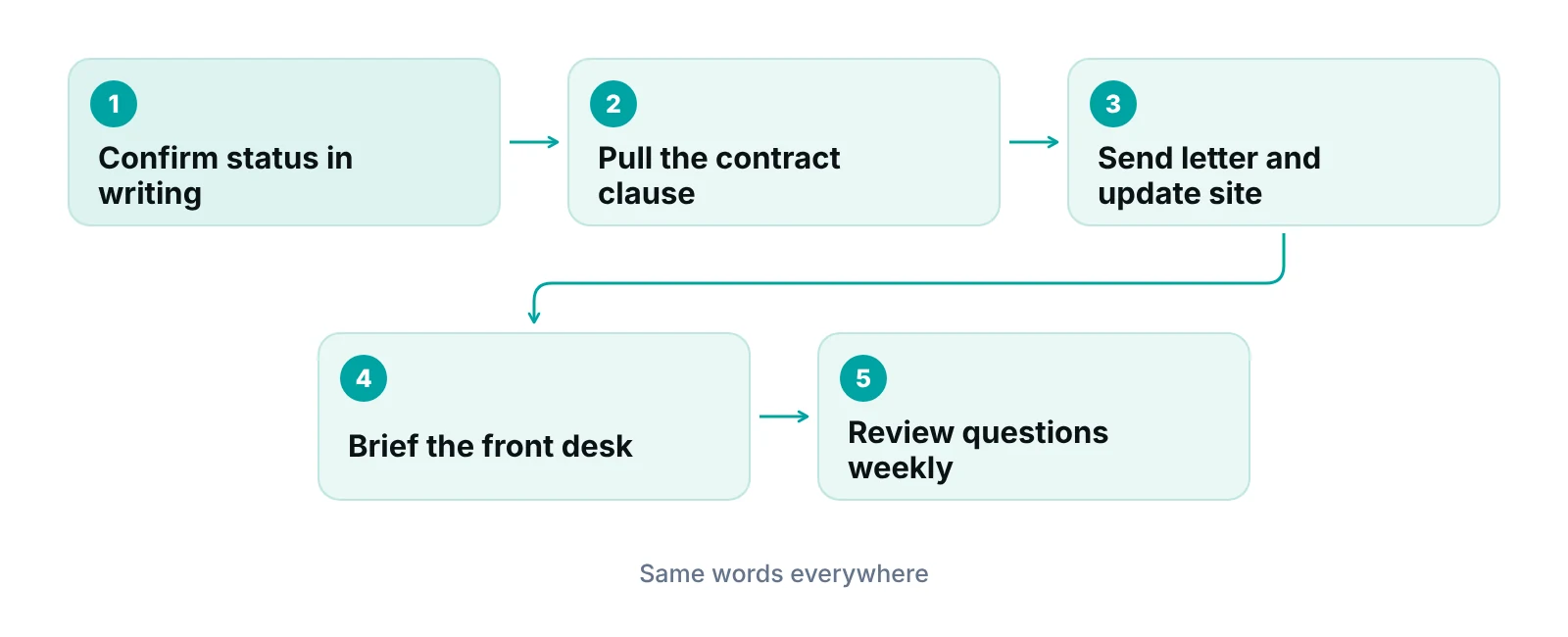
- Confirm status in writing. Get the MAC or plan confirmation of your effective date before you tell anyone.
- Segment your list. Send the right letter to the right patients: Medicare patients get Template 1; patients on the leaving plan get Template 2.
- Update everything patients see: your website, voicemail, intake forms and appointment reminders.
- Give the front desk a script and an escalation path. Our post on the front desk and the revenue cycle shows why this role matters.
- Track questions and complaints for 60 days and update the letter if the same question keeps coming up.
Not sure which status fits your practice?
Our team can look at your payer mix and enrollment status in a free practice audit and tell you what we would check before you send a letter.
What the decision costs you, and what to check first
Going non-par or leaving a plan trades payment rate for flexibility, and it also adds work: estimates, collecting at the visit, patient questions and more self-pay follow-up. Count that before you decide.
- Patient volume. How many patients on this payer or on Medicare did you see last year, and how many will stay?
- Cash flow. Unassigned claims and out-of-network patients change when and from whom you collect.
- Staff time. Estimates and calls are real hours. Our revenue calculator can help you test the effect of lost volume.
- Compliance. Claim filing, charge limits and notices are federal rules for Medicare. Treat them as non-negotiable.
- Contract and credentialing timing. If you may rejoin later, ask what re-enrollment takes. See our credentialing and payer enrollment services.
Requirements and the share of Medicare patients differ by specialty; our specialty RCM pages show how billing patterns vary. For the self-pay side, read our self-pay patient billing guidelines. For how out-of-network claims are handled, see our out-of-network billing guide.
Our recommendations
- Decide the status before the wording. We start by writing down the exact change: which payer, which effective date, which services. Only then do we pick a template.
- Read the contract before you write. For commercial plans, the termination clause sets who must be told and when. We would not send a letter until someone has read it.
- Keep numbers out of the letter. Percentages and limiting charges confuse patients and age badly. Promise a written estimate instead, and make sure your team can produce one.
- Mark the calendar for mid-November. The Medicare participation window opens once a year. Put the date in your compliance calendar and confirm it with your MAC each autumn.
- Have counsel review the final version. State notice rules and patient-protection laws vary. A short legal review is cheap compared with a patient complaint.
Bottom line
A non-participating provider letter works when it is accurate, short and sent before the change takes effect. Choose the status first, then the template, then train your front desk. If payer enrollment and participation decisions are a bottleneck, our credentialing and payer enrollment team can help, and our medical billing services cover the claims side once the decision is made.
Frequently asked questions
What is a non-participating provider letter?
It is a written notice to patients that your practice does not participate with a payer, or is a Medicare non-participating provider, and what that means for their costs. It states the effective date, how billing changes, and how patients can reach you or move care. It is not the same as a Medicare opt-out private contract, which has its own legal requirements.
Is a non-participating provider the same as opting out of Medicare?
No. A non-par provider is still in Medicare, must submit claims for patients, and cannot charge for filing them. An opted-out provider files an affidavit with each MAC, signs private contracts with patients, and cannot bill Medicare for those services during the two-year period. Check 42 CFR Part 405, Subpart D before opting out.
How much can a non-participating provider charge a Medicare patient?
On an unassigned claim, up to the limiting charge: 115% of the non-participating fee schedule amount, per Noridian and 42 CFR 414.48. Since the non-par amount is 95% of the participating amount, that is about 109.25% of the full fee schedule amount. On assigned claims you accept the Medicare-allowed amount.
When can a practice change its Medicare participation status?
Generally once a year. CMS says each year from mid-November through December 31 you can decide whether to participate for the upcoming year, effective January 1. New providers have 90 days after the initial enrollment approval letter. Confirm exact dates with your MAC before telling patients.
Do I have to give patients notice before leaving a commercial plan?
Your contract and state law decide the notice period, and we have not verified a general rule here. Read the termination clause, tell the plan as it requires, and send patients a clear letter before the effective date. Ask counsel about continuity-of-care rights for patients in active treatment.
Should the letter mention the limiting charge?
Usually not. Patients rarely know the term, and it only applies to Medicare unassigned claims. Say that Medicare limits what you can charge, that you will file the claim for free, and that you will give an estimate before the visit. Keep the exact percentages in your internal billing policy.
Get your free practice audit
Tell us about your practice. We will contact you using the details you give.
- A review of your recent claims, denials and A/R aging
- Where your front desk and prior authorizations slow payment
- A prioritized fix list you keep, whether or not you hire us
Pricing is quoted after the audit, based on your volume and the services you choose. Prefer to talk? Call +1 (302) 556-2288.
Sources
- Annual Medicare Participation Announcement — CMS (2026)
- Medicare Enrollment for Providers and Suppliers (MLN9658742) — CMS / HHS (2024)
- 42 CFR Part 405, Subpart D (Private Contracts) — eCFR (current)
- 42 CFR 414.48 Limiting charge — Cornell LII (eCFR text) (current)
- Non-Participation — Noridian Healthcare Solutions (MAC) (2026)
- Mandatory Claim Submission — Noridian Healthcare Solutions (MAC) (2026)
- 2026 Letter to Medicare Providers — CMS (2025)
Disclaimer: This article is general educational information for practice owners and managers. It is not legal, coding or compliance advice, and Medicare and payer rules change. Confirm current requirements with your Medicare Administrative Contractor, your payer contracts and qualified counsel before you act.