

Accounts receivable recovery in a small practice works best as a weekly routine: split open balances into payer and patient lists, work the oldest and largest first, check claim status before calling, and appeal inside the payer's deadline. Patient balances need clear statements and easy ways to pay.
Most overdue A/R in a small practice is not a patient problem. It is claims that were denied, underpaid or never acknowledged, sitting on a list nobody owns. Patient balances are the smaller list, and they need a different approach.
This post replaces an earlier version that treated every balance as an invoice and relied on unsourced percentages. It covers payer and patient balances separately, the deadlines that decide whether a payer claim is still recoverable, and when it makes sense to hand follow-up to a specialist. For the basics of the A/R process, start with our guide to accounts receivable in medical billing.
Key takeaways
- Keep two worklists: payer balances (claims) and patient balances (statements). They run on different clocks.
- Work by age from the date of service and by dollars, and give every balance an owner and a next-action date.
- Original Medicare claims must be filed within one calendar year of the date of service; appeals have their own windows. Commercial limits sit in your contracts.
- Check claim status before calling, then fix data errors fast and appeal payer errors in writing.
- Check payer contracts and program rules before offering any prompt-pay discount, and know the debt collection rules before using an agency.
Why do small practices have two different A/R problems?
Open A/R is two lists with different rules. A payer balance is a claim waiting on an insurer, so the clocks that matter are filing limits, appeal windows and the payment terms in your contract. A patient balance is an amount owed after insurance, so the clocks are your statement cycle and your written financial policy. Mixing the two on one list is the most common reason follow-up stalls.
The table below shows how the five most common overdue situations differ. The Medicare time limits are from federal rules; commercial limits vary by contract, so read yours before you rely on any number.
| Situation | Who owes it | Clock that applies | First action | If that fails |
|---|---|---|---|---|
| Claim sent, no payment or acknowledgment | Payer | Filing limit and payment terms in the payer contract. Original Medicare: claim filed within 1 calendar year after the date of service | Check claim status online or by 276/277 request | Call the provider representative; resubmit if the payer has no record |
| Claim denied | Payer | Appeal window. Original Medicare redetermination: 120 days from receipt of the initial determination | Read the denial reason; correct and resubmit if it is a data error | Written appeal with supporting records |
| Claim paid below the contract rate | Payer | Same appeal window as a denial; contract dispute terms | Compare the payment with the expected amount | Dispute in writing and cite the fee schedule |
| Patient balance after insurance | Patient | Your statement cycle and written financial policy | Send a clear statement once the payer has adjudicated | Phone call, then a payment plan offer |
| Patient balance unpaid after reminders | Patient | Your written policy; state and federal collection rules | Offer a payment plan | Review collection options with counsel |
Source: 42 CFR 424.44 (eCFR); CMS, First Level of Appeal: Redetermination by a Medicare Contractor. Commercial payer limits vary by contract.
A practice that bills mostly Original Medicare, a few commercial plans and self-pay patients may need three different playbooks. That is normal. What matters is that each balance has a named owner and a date for the next action.
How do you decide which A/R to work first?
Work the oldest and largest balances first, aged from the date of service, and stop working balances in the order they happen to appear. A short weekly worklist beats a long monthly clean-up because deadlines are measured in days, not months.
A usable worklist has these columns, sorted by payer, then age, then balance:
- Patient or claim identifier, payer and date of service
- Billed amount and expected amount under the contract
- Date and result of the last contact
- Next action, the date it is due and the person who owns it
- Appeal or filing deadline, where one applies
Then measure the whole book so you know whether follow-up is working. The American Academy of Family Physicians publishes formulas and reference points for three numbers. These are reference points, not targets for every specialty or payer mix. Our post on the A/R report metrics to track explains how formulas differ between HFMA, MGMA and AAFP and how to keep your own definitions stable.
| Measure | AAFP reference point | How AAFP calculates it |
|---|---|---|
| Days in A/R | Below 50 days at minimum; 30 to 40 days preferable | Total receivables divided by average daily charges (charges minus credits, divided by days in the period) |
| Adjusted collection rate | 95% at minimum; average 95% to 99%; top performers 99% or more | Payments net of credits divided by charges net of approved contractual adjustments, times 100 |
| Denial rate | 5% to 10% is the industry average; below 5% is more desirable | Dollar amount of claims denied divided by dollar amount of claims submitted in the same period |
Source: American Academy of Family Physicians, Managing practice finances.
Totals hide the problem
A practice can show a healthy average days in A/R while one payer holds most of the balances older than 90 days. Split every number by payer and by age bucket before deciding where to spend staff time.
What should weekly payer follow-up look like?
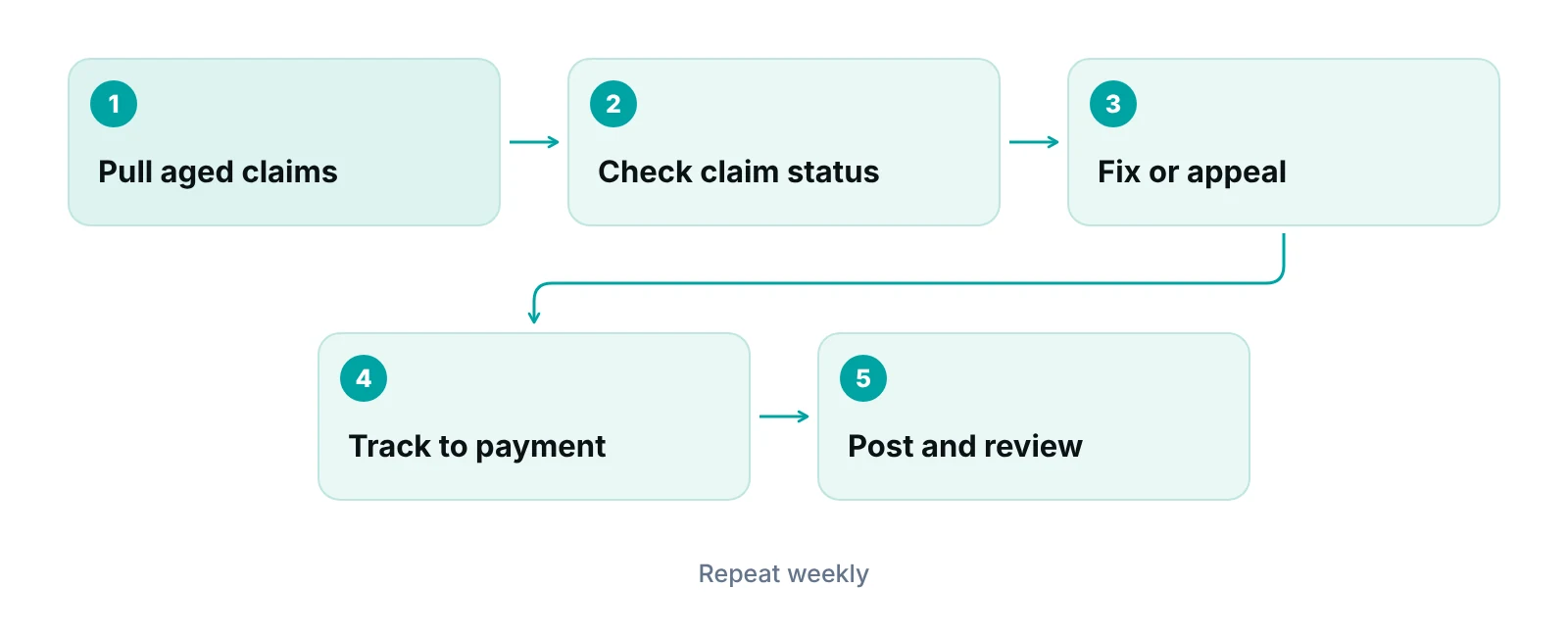
Weekly payer follow-up is a short loop: check status, decide whether the claim needs a fix or an appeal, and record what happened. Calling a payer without checking status first wastes the call.
Check claim status before you call
HIPAA transaction standards include a claim status inquiry and response. CMS describes the 276 as an inquiry from a provider to a health plan and the 277 as the plan’s response. In practice, many payers also offer a portal. Use whichever is faster for each payer, and call only when the status is missing, unclear or past the payer’s stated processing time.
Fix data errors, appeal payer errors
A denial caused by a missing modifier, wrong subscriber ID or other data problem is usually fastest to correct and resubmit. A denial the payer got wrong, such as a covered service denied as non-covered, needs a written appeal with records attached. The denial management process and the denial management guide go deeper on reading denial codes; this post stays on the follow-up routine.
Know the deadlines before they pass
For Original Medicare, 42 CFR 424.44 says a claim must be filed no later than the close of the period ending one calendar year after the date of service, with limited exceptions such as contractor error or retroactive entitlement. If a deadline falls on a federal nonworkday it moves to the next workday.
If a Medicare claim is denied, CMS says a redetermination request is due within 120 days of receiving the initial determination. Receipt is presumed five calendar days after the date of the notice unless there is evidence otherwise, and the contractor generally decides within 60 days of receiving the request. Commercial plans and Medicare Advantage plans set their own limits in contracts and plan documents. Put each payer’s limits in a one-page reference and check it when a balance crosses a bucket.
“An appeal filed with the records attached on the first try is worth more than three phone calls.”
Write down every touch
Record the date, the person you spoke with, a call reference number and what the payer promised. Good notes let a second staff member pick up the account, and they become the evidence in an appeal or a contract dispute.
Check underpayments, not only denials
A paid claim is not always a correct payment. Compare each remittance with the contracted rate for the code billed, and put short payments on the same worklist as denials. Underpayments often sit unnoticed because the claim looks closed.
How do you collect patient balances without losing trust?
Collect patient balances with a clear statement sent soon after the payer finishes processing, a few reminders and more than one easy way to pay. Most unpaid patient balances come from confusion, not refusal, so clarity does more than pressure.
- Send the statement promptly. Wait until the payer has adjudicated, then show what was billed, what insurance paid, any adjustments, what the patient owes, the due date and how to pay. Our guide to patient-friendly billing statements covers the layout.
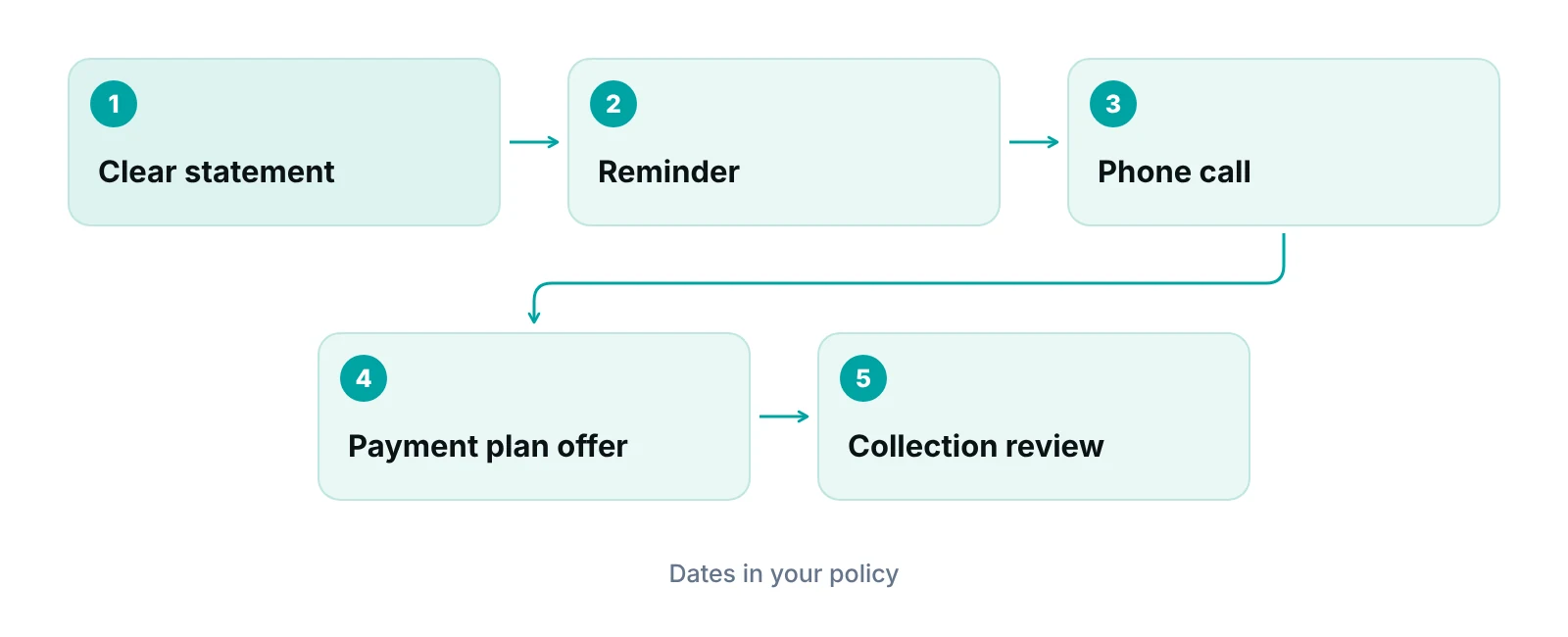
- Set a reminder cadence and keep to it. A statement, a reminder, a phone call and a payment plan offer, each on a set date, is easier to run than ad hoc calls.
- Name one owner. Training one or two staff members to handle patient balances politely and consistently works better than sharing the task across the front desk.
- Offer several ways to pay. Card, bank payment, online portal and a mobile-friendly payment page cover most preferences, and checks or cash at the desk cover the rest.
- Offer payment plans early. A plan with a fixed monthly amount keeps a balance moving. See our payment plan best practices for how to set terms.
- Protect payment data. Ask your payment processor and practice software vendor how card data is protected, and ask any vendor that handles patient information to sign a Business Associate Agreement.
Be careful with prompt-pay discounts and waivers
Early-payment discounts and loyalty rewards are common in other businesses, but healthcare adds rules. In a 1999 statement, the HHS Office of Inspector General said it has a long-standing concern with providers routinely waiving coinsurance or copayments, because the practice can implicate the anti-kickback statute and the False Claims Act. Payer contracts may also require you to collect patient cost-sharing. Before you offer any discount, read your contracts and ask a healthcare compliance adviser. A written, consistently applied hardship policy is a safer tool than a blanket discount.
Using a collection agency
An agency is a last step, not a first one, and it is not a guaranteed recovery. The FTC explains that the Fair Debt Collection Practices Act covers third-party debt collectors. A creditor collecting its own debts is generally outside the basic definition, unless it uses a name other than its own while collecting. Even then, the FTC Act’s ban on unfair or deceptive practices still applies. State laws may add requirements. Choose an agency that follows these rules, keep your patient communications consistent with your policy and review the plan with counsel. For older balances, see our post on legacy accounts receivable.
When should a small practice hand A/R follow-up to a specialist?
Hand it off when follow-up keeps slipping behind other front-office work, when aged payer balances are growing, or when no one on staff can spend regular time on appeals. The right model depends on volume, payer mix and how much visibility you want.
| Model | Fits when | Watch for | What you keep |
|---|---|---|---|
| In-house with a named owner | Low claim volume and a staff member with protected time each week | Absences, turnover and deadlines missed during busy periods | Everything: worklist, payer contact, appeals |
| In-house with tracking software | Staff can do the work but need a view of every claim by stage | Software shows problems but does not fix them | Payer contact and appeals, with better visibility |
| Outsourced payer A/R follow-up | Aged payer balances are growing or appeals are not getting done | Unclear reporting; confirm who contacts payers and how work is logged | Patient communication and policy decisions |
| Hybrid | You want help on aged payer claims but prefer to handle patients in-house | Hand-off gaps between the two teams | Patient balances, clinical documentation, final approval of write-offs |
Payer rules and common denials differ by specialty, so ask any vendor how they handle yours. Our specialty billing pages list the specialties RCM Finder supports. If you decide to outsource, A/R management services cover payer follow-up on unpaid and underpaid claims, and the practice management system that tracks claims by stage gives your team an owner and a status for every claim, flags payments below the expected amount and reports on aging.
Questions to ask any A/R vendor
Ask who contacts payers and how often, how work is logged, what reports you will see weekly, how appeals are handled, how they treat patient communication, and whether they will sign a Business Associate Agreement before accessing patient data.
See where your A/R is stuck
Request a free practice audit and we will look at your aging by payer and where follow-up is slipping. You can also estimate what unpaid claims cost with the revenue calculator.
Our recommendations
- Split payer and patient A/R today. We recommend two separate worklists with different owners. Payer follow-up needs claim and denial skills; patient follow-up needs clear communication.
- Write each payer's limits on one page. List the filing limit, appeal window and contact path for every payer you bill. Check it whenever a balance moves into an older bucket.
- Review aged claims weekly. A 30-minute weekly review of the oldest and largest payer balances catches deadlines that a monthly review misses.
- Track underpayments as closely as denials. Compare remittances with contracted rates and treat short payments as open work.
- Put your financial policy in writing. Statement dates, reminder steps, payment plan terms and hardship rules should be documented and applied the same way for every patient.
- Review discounts and agency use with counsel. Before offering prompt-pay discounts or sending balances to an agency, have a healthcare compliance adviser review the plan against your payer contracts and state law.
Track every claim by stage with an owner.
RCM Finder's practice management system tracks claims by stage with an owner, flags payments below the expected amount and shows aging in reporting dashboards.
See how the RCM Finder portal works · Create a portal account
Disclosure: RCM Finder builds and sells this portal. It is a practice management system, not an EHR.
Bottom line
Accounts receivable recovery is mostly routine: two lists, clear owners, weekly review and deadlines written down. Small practices that keep payer follow-up and patient statements on separate tracks recover more of what they have already earned. If appeals and aged claims are the part that keeps slipping, our denial management services and A/R follow-up team can take that work on, and the revenue calculator shows what stalled claims may be costing.
Frequently asked questions
How long should it take to collect accounts receivable?
AAFP describes 30 to 40 days in A/R as preferable and says days in A/R should stay below 50 at minimum. Those are reference points. Your own figure depends on payer mix and specialty, so track your trend by payer and age bucket.
What is the first thing to do with overdue insurance claims?
Check the claim status. Use the payer portal or a claim status request to see whether the claim was received, denied or is still pending. Then correct data errors and resubmit, or file an appeal if the payer decided incorrectly. Call only when the status is unclear.
What is the Medicare timely filing limit?
For Original Medicare, 42 CFR 424.44 requires a claim to be filed no later than the close of the period ending one calendar year after the date of service, with limited exceptions. Commercial and Medicare Advantage plans set their own limits in contracts, so check each one.
How long do I have to appeal a Medicare denial?
For a first-level Medicare appeal, CMS says to request a redetermination within 120 days of receiving the initial determination. Receipt is presumed five days after the notice date. The contractor generally decides within 60 days. Other payers set their own windows.
Can a practice offer discounts for early payment?
Be careful. OIG has long raised concerns about routinely waiving copayments or coinsurance, and payer contracts may require you to collect cost-sharing. Get advice from a healthcare compliance adviser and check your contracts before offering any discount.
Do debt collection laws apply to a medical practice?
The FTC explains that the FDCPA covers third-party collectors, and generally not creditors collecting their own debts unless they use another name. The FTC Act and state laws can still apply. Review any collection plan with counsel.
Get your free practice audit
Tell us about your practice. We will contact you using the details you give.
- A review of your recent claims, denials and A/R aging
- Where your front desk and prior authorizations slow payment
- A prioritized fix list you keep, whether or not you hire us
Pricing is quoted after the audit, based on your volume and the services you choose. Prefer to talk? Call +1 (302) 556-2288.
Sources
- 42 CFR 424.44 Time limits for filing claims — eCFR (National Archives) (2026)
- First Level of Appeal: Redetermination by a Medicare Contractor — CMS (2026)
- Managing practice finances — American Academy of Family Physicians (2026)
- Statement of Kevin G. McAnaney to the Practicing Physicians Advisory Council — HHS Office of Inspector General (1999)
- Think your company's not covered by the FDCPA? You may want to think again — FTC Business Blog (2015)
- Claim Status Basics (About Administrative Simplification) — CMS (2026)
Disclaimer: This article is educational and is not legal, coding, compliance or financial advice. Payer rules, contract terms and state laws vary and change; confirm details with the payer, your contracts and a qualified adviser before acting.
