
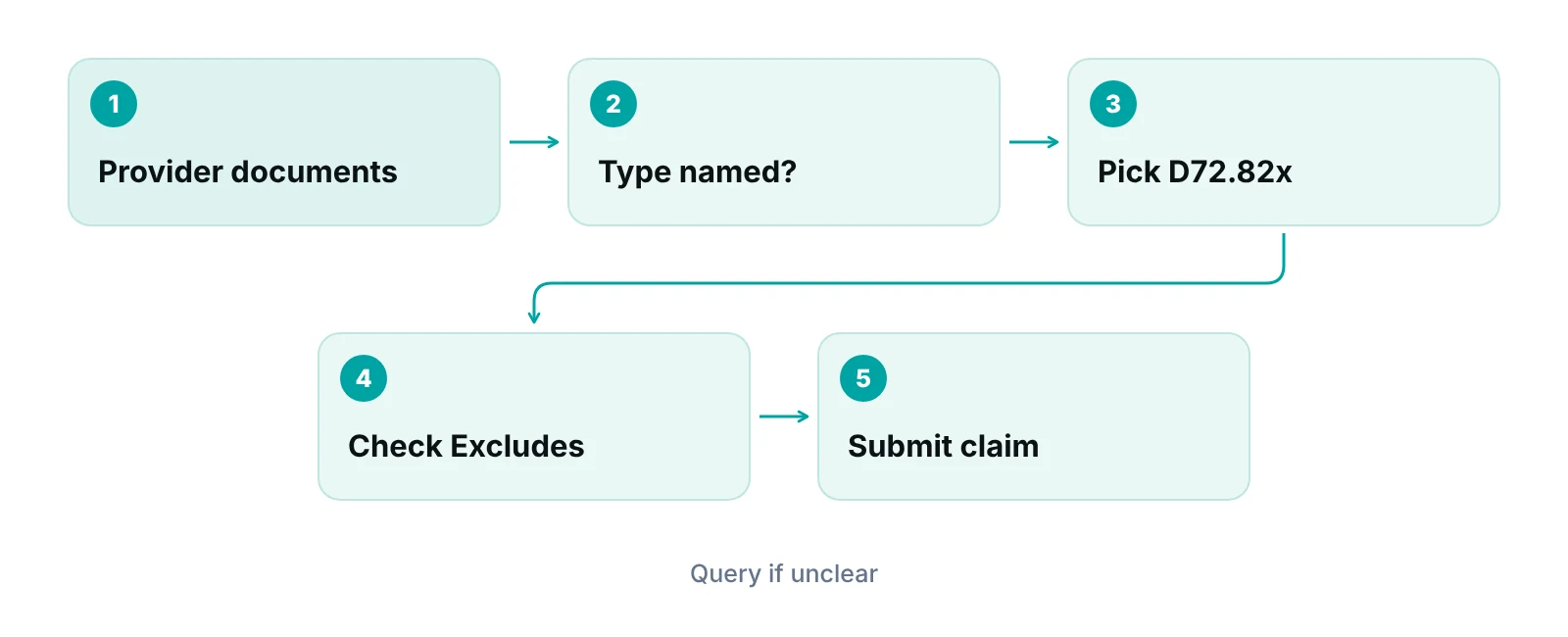
The ICD-10 code for leukocytosis is D72.829, "Elevated white blood cell count, unspecified," a billable code in the FY2027 set (October 1, 2026 to September 30, 2027). Report it when the provider documents leukocytosis without a named type or cause. If the provider names a type, such as bandemia, a more specific D72.82x code may fit.
This guide is for coders, billers and practice managers. It covers the code itself, the other codes in the D72.82 group, the Excludes notes that stop two codes from sharing a claim, and the chart documentation that has to exist first. It does not cover causes or treatment of a high white blood cell count, which belong to the clinician.
Key takeaways
- D72.829 is “Elevated white blood cell count, unspecified” and is billable in the FY2027 code set.
- The D72.82 group has eight codes, D72.820 to D72.829 (there is no D72.826 or D72.827), so check for a specific type before defaulting to unspecified.
- Two Excludes1 notes matter most: eosinophilia goes to D72.1, and leukemia goes to C91 to C95.
- A lab value alone is not a diagnosis: code assignment follows the patient’s provider documentation.
- Build a query step into your workflow for results the provider has not addressed.
What D72.829 means and when it fits
D72.829 is the diagnosis code for an elevated white blood cell count with no further detail. Its official descriptor is “Elevated white blood cell count, unspecified.” The code sits under D72 (other disorders of white blood cells), D72.8 (other specified disorders of white blood cells) and D72.82 (elevated white blood cell count), per icd-10codes.com. The same page lists “leukocytosis, unspecified” and “elevated leukocytes, unspecified” as index terms that lead to it, and shows it as billable in the FY2027 code set.
The FY2027 code set applies to services from October 1, 2026 through September 30, 2027, according to the CDC’s ICD-10-CM files page. The old version of this post carried a 2025 label. If your claim has a 2026 date of service before October 1, you are working from the FY2026 release, so check the tabular for that year.
“Unspecified” is not a mistake. The official guidelines say unspecified codes should be reported when they best reflect what is known (Section I.B.18, in the FY2027 guidelines). If the provider writes “leukocytosis” and goes no further, D72.829 is the honest code. The coding question is not whether to use an unspecified code. It is whether the chart supports a more specific one.
Plain version
A coder cannot pick a more specific code than the provider documented. If the note says “leukocytosis,” that points to D72.829. If it says “bandemia” or “leukemoid reaction,” a different code in the same group fits better.
The D72.82x family: all eight codes
The D72.82 group has eight codes, and the sequence skips two numbers: there is no D72.826 or D72.827. Before you settle on D72.829, read the whole group. Table 1 lists each code with its descriptor, as shown on the AAPC code page for D72.82.
| Code | Descriptor | Coder's note |
|---|---|---|
| D72.820 | Lymphocytosis (symptomatic) | The descriptor says symptomatic. Check the provider’s note. |
| D72.821 | Monocytosis (symptomatic) | The descriptor says symptomatic. Check the provider’s note. |
| D72.822 | Plasmacytosis | Specific type, so do not fall back to unspecified. |
| D72.823 | Leukemoid reaction | Specific condition named by the provider. |
| D72.824 | Basophilia | Also named in an Excludes1 note at D72; see Table 2. |
| D72.825 | Bandemia | Specific type, so do not fall back to unspecified. |
| D72.828 | Other elevated white blood cell count | For a specified type that has no code of its own. |
| D72.829 | Elevated white blood cell count, unspecified | Leukocytosis with no type or cause documented. |
Source: AAPC code page for D72.82 (2026). Descriptors as shown there; confirm against the CDC tabular for your date of service.
The old post listed only three codes, and it gave D72.828 the label “Unspecified Conditions.” That was wrong. D72.828 is “other” and D72.829 is “unspecified.” Those two words mean different things to a coder. “Other” means the provider named a specific type that the classification has no code for. “Unspecified” means the type was not stated.
Blood disorders are where these codes come up most often in specialty billing. If your practice is a hematology practice, our hematology billing and RCM page describes how we support that specialty.
The Excludes notes that change your code choice
Excludes notes tell you when two codes should not appear together. The guidelines define two kinds (Section I.A.12 of the FY2027 guidelines). Excludes1 means “not coded here”: the excluded code should not be used with the code above the note unless the two conditions are unrelated. Excludes2 means “not included here”: the condition is not part of the code, but both may be reported together when both are present.
| Where the note sits | Type | Condition named | What it means for you |
|---|---|---|---|
| D72.82 | Excludes1 | Eosinophilia (D72.1) | Eosinophilia goes to D72.1, not to D72.82x. |
| D72.8 | Excludes1 | Leukemia (C91 to C95) | A leukemia diagnosis is coded in C91 to C95, not here. |
| D72 | Excludes1 | Basophilia (D72.824), immunity disorders (D80 to D89), preleukemia (D46.9) | Check the target code before sending both on one claim. |
| D72 | Excludes2 | Neutropenia (D70) | Both may be reported when both are documented. |
| Chapter 3 | Excludes2 | Symptoms and abnormal findings (R00 to R94), neoplasms, and others | Codes in those ranges may be reported separately when they apply. |
Source: AAPC (2026) and icd-10codes.com (2026), as shown on their code pages; definitions of Excludes1 and Excludes2 from CDC FY2027 guidelines, Section I.A.12.
Two points save the most rework. First, if the provider documents eosinophilia, D72.829 is the wrong place to look. The chart points to D72.1. Second, if a leukemia diagnosis exists, the white cell count is a feature of that diagnosis, and the Excludes1 note at D72.8 keeps the two apart.
The Excludes1 note at D72 that names D72.824 can look odd, because D72.824 also sits inside D72.82. We report it as the code sites show it. Before building a claim edit around it, read the entry in the CDC tabular for your date of service.
An Excludes1 exception
The guidelines let you report two Excludes1 codes together when the conditions are unrelated. Do that only when the provider’s note clearly shows two separate conditions, not to get a claim through an edit.
What the chart must show before you code it
A lab result is not a diagnosis. The guidelines say code assignment is generally based on the patient’s provider’s documentation (Section I.B.14). Some data, such as BMI, can come from other clinicians, but the related diagnosis must be documented by the provider. The same logic applies to a flagged white blood cell count: if the provider has not addressed it, you have a result on a lab report, not a coded condition.
The guidelines also have sections that speak directly to abnormal findings and to patients who receive diagnostic services only (Section III.B and Section IV.K in the FY2027 guidelines). Read both before you write a rule for your team, because they decide when a lab abnormality can be reported by itself. The same guidelines state that signs and symptoms routinely associated with a disease process should not be coded in addition (Section I.B.5).
In practice, a clean entry has four parts:
- The provider’s note names the condition in words (for example, leukocytosis, bandemia or leukemoid reaction).
- The note ties that diagnosis to the date of service you are billing.
- The note shows the provider evaluated or addressed it at that visit, in whatever way fits the care delivered.
- The code on the claim matches the most specific wording in the note.
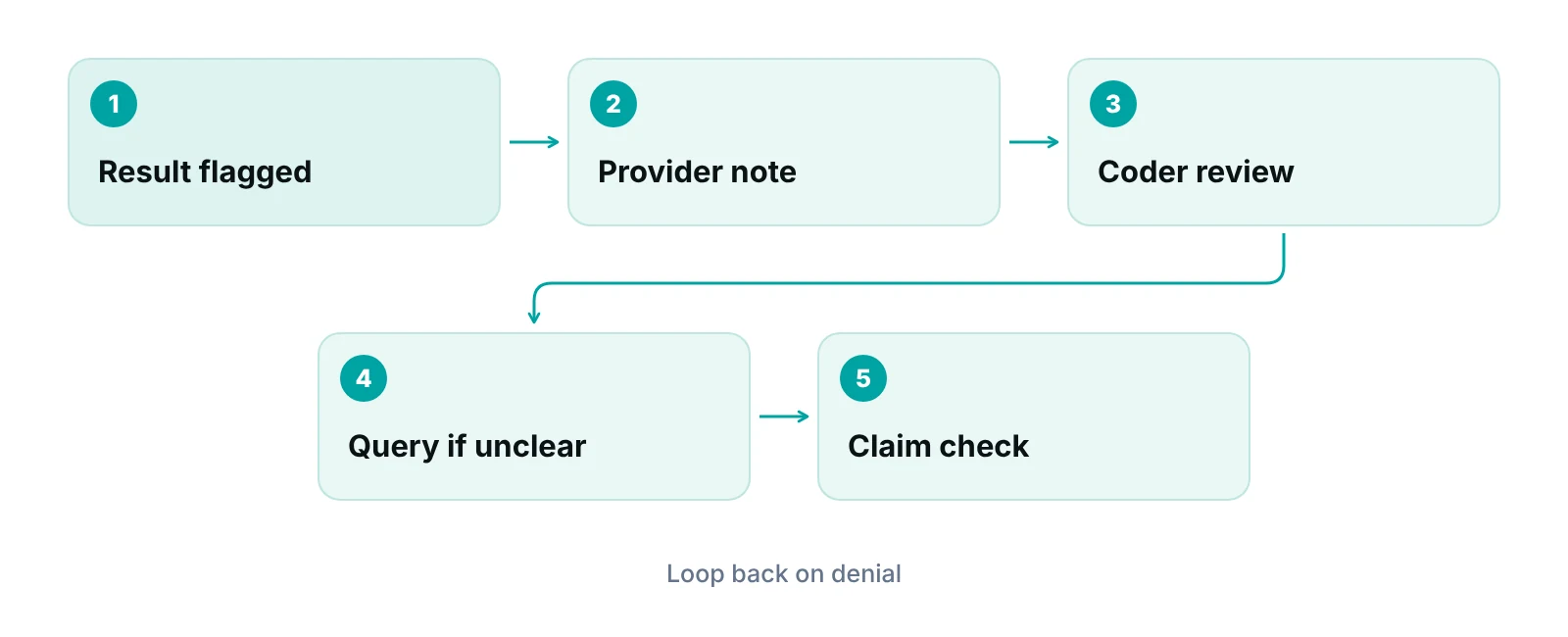
When the note and the result do not line up, send a query to the provider. A good query asks an open question and offers no leading answer. For example: “The CBC result from this visit is flagged high. Please document any associated diagnosis you evaluated, or state that none applies.” Our guide on why clear documentation matters in medical billing covers how to set up that loop with providers.
If your team also codes the lab order, the test itself is a separate question from the finding. The diagnosis that supports a blood count order is covered in our guide to the CBC ICD-10 code, and the wider set of lab diagnosis codes is in ICD-10 codes for lab review.
A decision table: which code fits which note
Use Table 3 as a screening tool. It does not replace the tabular list or a coder’s review, but it shows the order of questions that keeps unspecified codes from becoming a habit.
| What the provider documented | Code to review | Why |
|---|---|---|
| “Leukocytosis” or elevated WBC, no type or cause | D72.829 | Matches the unspecified descriptor and index terms. |
| A specific type with its own code (plasmacytosis, leukemoid reaction, bandemia) | D72.822, D72.823 or D72.825 | Specific codes exist, so the unspecified code is not the best fit. |
| A named type with no code of its own | D72.828 | “Other” is for a specified type without a dedicated code. |
| Lymphocytosis or monocytosis | D72.820 or D72.821 | Descriptors say symptomatic; check the note. |
| Eosinophilia | D72.1 | Excludes1 note at D72.82 sends it elsewhere. |
| Leukemia diagnosed | C91 to C95 | Excludes1 note at D72.8 sends it elsewhere. |
| No provider statement, only a flagged lab value | Query the provider | A result alone does not support a diagnosis code. |
Source: Built from the AAPC and icd-10codes.com code pages (2026) and CDC FY2027 guidelines Sections I.A.12 and I.B.14.
Notice the last row. It is the one most often skipped. A flagged value in the lab interface is easy to code from by reflex. A short query to the provider is cheaper than correcting the claim later.
Where leukocytosis coding touches the revenue cycle
Diagnosis coding sits between the clinical note and the claim, so errors there show up later as rework. A code that does not match the note is a risk in any audit, and an unspecified code used out of habit hides detail the note may contain. We have no figure to give you on how often that happens, so the point here is process, not statistics.
Our team builds these checks into the claim workflow rather than relying on memory. When we review a practice’s billing, we look at three places. First, where the diagnosis is chosen: who picks it, and from what. Second, where the code is checked against the note before the claim is scrubbed. Third, where a rejected or denied claim sends the finding back to the person who coded it. That third step is the one that fixes habits. If you want to size what rework costs your practice, our revenue calculator is a place to start.
If your own staff handle coding, our medical billing services page describes how we support charge entry and coding review inside your existing EHR (for example PrognoCIS, eClinicalWorks or athenahealth). For background, see how clean claims in medical billing are defined and checked, and how the CPT, ICD-10 and HCPCS code sets fit together on one claim.
Want a second pair of eyes on your diagnosis coding?
Our free practice audit looks at how diagnoses move from the note to the claim and where unspecified codes pile up. Pricing is quoted after the audit.
Our recommendations
- Read the whole D72.82 group before defaulting. Print or bookmark Table 1. A coder who knows all eight codes is less likely to choose D72.829 when the note names a type.
- Treat a flagged lab value as a prompt, not a diagnosis. Make it a written rule: a result without provider documentation goes to a query, not to the claim. Use open questions only.
- Add a pre-bill check for Excludes1 pairs. If your system supports claim edits, add one for D72.82x with D72.1 and with C91 to C95. Let the coder override it only with a note explaining why the conditions are unrelated.
- Audit your unspecified codes quarterly. Pull every D72.829 you billed and read the notes. If many name a type, the fix is provider education or a template change. Have a coder or a second reviewer sample them each quarter.
- Update each October. Set a calendar reminder for the new code set. Re-check descriptors and Excludes notes before the new fiscal year starts.
- Talk to us before you change a workflow. If you want help designing the query step, contact our team and we will walk through your current process.
Bottom line
The ICD-10 code for leukocytosis is D72.829 when the provider documents it without a type or cause, and one of the other D72.82x codes when the note is more specific. The code is only as good as the note behind it. If you want help connecting diagnosis coding to claim edits, denial follow-up and A/R, see our end-to-end revenue cycle management service, or start with the free audit.
Frequently asked questions
What is the ICD-10 code for leukocytosis?
The code is D72.829, “Elevated white blood cell count, unspecified.” It is billable in the FY2027 code set, which applies to services from October 1, 2026 through September 30, 2027. Use it when the provider documents leukocytosis without a named type. If a type is named, review the other D72.82x codes first.
What is the difference between D72.828 and D72.829?
D72.828 is “Other elevated white blood cell count” and D72.829 is “Elevated white blood cell count, unspecified.” Use D72.828 when the provider names a type that has no code of its own. Use D72.829 when the provider states only that the count is elevated. The old version of this post mislabeled D72.828 as unspecified.
Can I code leukocytosis from a lab result alone?
Not safely. The guidelines base code assignment generally on the provider’s documentation. A flagged value on a lab report is a result, not a diagnosis. If the provider has not addressed it, send a non-leading query. Also read Sections III.B and IV.K of the FY2027 guidelines, which address abnormal findings and diagnostic-only services.
Can D72.829 be reported with eosinophilia or leukemia?
Not as a rule. The tabular shows an Excludes1 note at D72.82 for eosinophilia (D72.1) and one at D72.8 for leukemia (C91 to C95). An Excludes1 note means the two codes should not be reported together unless the conditions are unrelated. Check the provider’s note and the tabular before you override an edit.
Are all the D72.82x codes valid for FY2027?
We confirmed D72.829 as billable in FY2027 on the icd-10codes.com page. The AAPC page for the D72.82 group lists eight codes but shows no fiscal year. Check each code against the CDC tabular list and the FY2027 addenda for your date of service before you load them into your system.
Does RCM Finder code leukocytosis claims?
Our team supports coding review and claim checks inside your EHR as part of our billing and revenue cycle work, and the diagnosis still has to come from your provider’s documentation. We do not assign a diagnosis a provider did not document. Pricing is quoted after a free practice audit.
Get your free practice audit
Tell us about your practice. We will contact you using the details you give.
- A review of your recent claims, denials and A/R aging
- Where your front desk and prior authorizations slow payment
- A prioritized fix list you keep, whether or not you hire us
Pricing is quoted after the audit, based on your volume and the services you choose. Prefer to talk? Call +1 (302) 556-2288.
Sources
- D72.82 Elevated white blood cell count (code page) — AAPC (2026)
- D72.829 Elevated white blood cell count, unspecified — icd-10codes.com (2026)
- ICD-10-CM files (FY2027 release) — CDC, National Center for Health Statistics (2026)
- ICD-10-CM Official Guidelines for Coding and Reporting, FY2027 — CDC, National Center for Health Statistics (2026)
Disclaimer: This article is educational and is not coding, legal, compliance or clinical advice. Code sets update each year on October 1, and payer policies vary. Confirm every code against the current ICD-10-CM tabular list, the official guidelines and your payer's policy, and ask a clinician about any clinical question.
