
The CO-16 denial code means the payer could not process the claim because information was missing or wrong. CO shows the provider owes the amount. A remark code sent with it names the problem. Correct the source data, then send a corrected or new claim before the filing limit.
Many billers log CO-16 and move on, and the claim comes back again. The fix is in the remark code. This guide explains what CO-16 means, which remark codes travel with it, and when to resubmit instead of appeal. For other codes in this series, see our CO-22 guide.
Key takeaways
- CO-16 is generic: always read the remark code (RARC) paired with it.
- CARC 16 is not meant for missing attachments or records.
- Fix the source record, not only the claim.
- Medicare contractors say unprocessable claims cannot be appealed: send a corrected or new claim.
- Track the filing limit on every open CO-16.
What does the CO-16 denial code mean?
CO-16 means the payer could not process the claim because information was missing or wrong. The standard wording for claim adjustment reason code (CARC) 16 is that the claim or service lacks information or has a submission or billing error. The CO in front is the group code. It tells you the provider, not the patient, is responsible for the amount (CMS).
CO-16 is a generic code. By itself it does not say what is missing. That is why the payer must send a second code with it. The standard asks for at least one remittance advice remark code (RARC) or, for pharmacy-type claims, an NCPDP reject reason code. CMS made this a rule for CARC 16 in 2007 because the code was so generic and so common (MassHealth CARC memo, CMS MLN Matters MM5634).
Read the pair, not the code
On the remittance advice (ERA or paper), CO-16 is the question. The remark code beside it is the answer. If you only log “CO-16” in your denial tracker, you lose the one detail that tells your staff what to fix.
CO-16 is not a request for records
The code definition says not to use CARC 16 for claim attachments or other documentation (Noridian, MassHealth). If a payer wants medical records, that should come back as a different reason. If your CO-16 remark points to a missing form, call the payer to confirm what they actually need before you send anything.
What causes CO-16 denials?
Most CO-16 denials trace back to a field that was blank, mistyped or did not match the payer’s records. The claim passed through your system, but the payer’s edit rejected it. The remark code names the field. Here are common causes, grouped by where the error starts.
Patient and coverage data
- Name or ID that does not match the card: Medicare, for example, lists remark MA36 (missing, incomplete or invalid patient name) and an invalid Medicare Beneficiary Identifier among the remarks it pairs with CARC 16 (Noridian).
- Missing other-payer information: remark MA04 says a secondary payment cannot be considered without the primary payer’s identity or payment information (X12). This hits secondary claims.
- Old insurance on file: a front-desk check before the visit prevents this. See our insurance verification guide.
Service and provider data
- Procedure code problems: remark M51 means a procedure code is missing, incomplete or invalid, and N56 means the code billed is not correct or valid for the service or date of service (X12).
- Ordering or referring provider issues: remarks N264 and N575 point to a missing, incomplete or invalid ordering provider name, or a name that does not match the payer’s records (Noridian). Medicare asks for an ordering physician NPI that is registered in PECOS.
- Keying errors: a transposed digit in a date of birth, a wrong place-of-service value or a diagnosis pointer left blank. These are small, and they are the easiest to prevent.
Pharmacy-type claims
The CARC 16 definition allows an NCPDP reject reason code in place of a RARC (MassHealth). NCPDP is a pharmacy transaction standard. If you bill professional claims only, you will rarely see this. If you bill supplies or drugs through a pharmacy-style flow, check for it.
Which remark codes come with CO-16?
Payers send many remark codes with CO-16. Noridian’s Medicare denial resolution page lists these with CARC 16: M51, M81, MA04, MA120, MA121, MA122, N56, N257, N264, N265, N290, N382 and N704 (Noridian). The table below covers the ones we can tie to a published definition. Use your payer’s own list for the rest.
| Remark code | What it says | First place to check |
|---|---|---|
| M51 | Procedure code missing, incomplete or invalid | Charge entry and the code set for that date of service |
| N56 | Procedure code billed is not correct or valid for the service or date of service | Code validity on the date of service; coder review |
| MA36 | Patient name missing, incomplete or invalid | Registration versus the insurance card |
| MA04 | Secondary payment cannot be considered without primary payer identity or payment information | Primary payer EOB or ERA attached to the secondary claim |
| N264 / N575 | Ordering provider name missing, incomplete or invalid, or does not match the payer’s records | Ordering NPI and name against PECOS; person NPI, not group NPI |
| N382 | Listed with an invalid Medicare Beneficiary Identifier on Noridian’s page | MBI on the card versus the claim |
Source: X12 Remittance Advice Remark Codes (2025 code list) for M51, N56, MA36, MA04; Noridian Medicare (2025) for N264/N575, N382 and the pairing with CARC 16.
Do not trust a code list from an old blog post
Remark codes are added, changed and retired. X12 publishes the standard once a year and approves changes through ballots (X12). Several remark codes shown in older guides on this topic, including some about equipment ownership and certificates of medical necessity, are documentation issues. Because CARC 16 is not meant for attachments, we left them out. Always check the code on your payer’s current list.
How do you fix and resubmit a CO-16 claim?
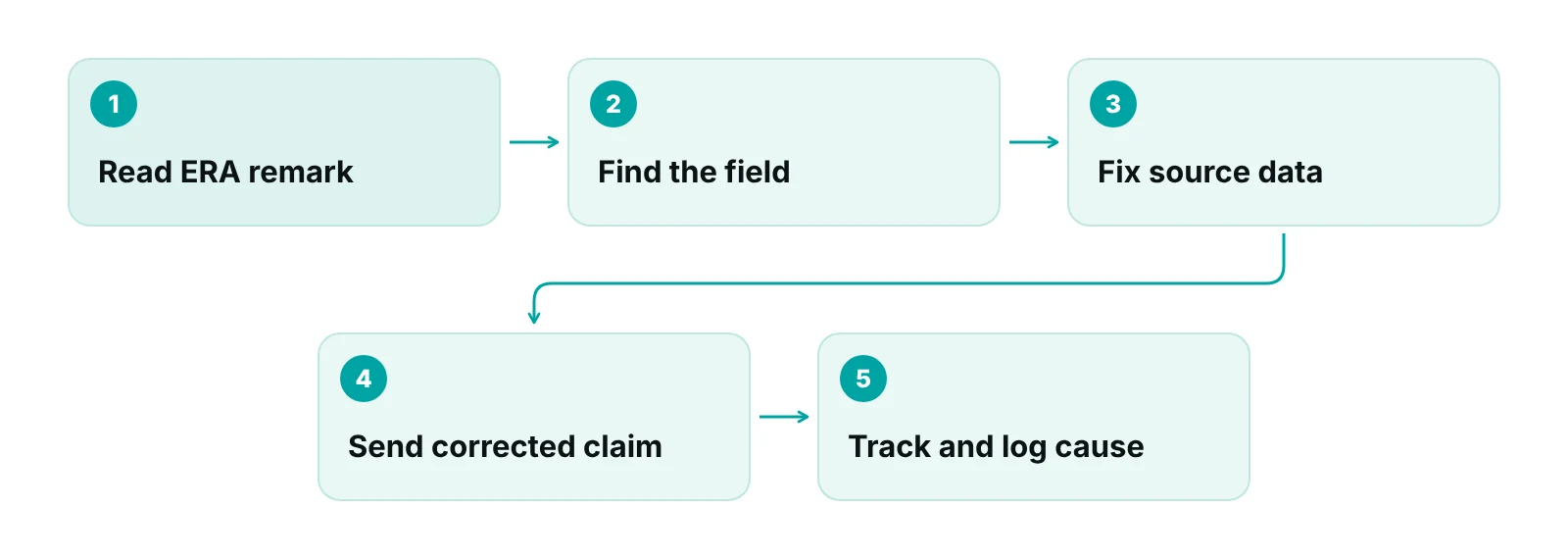
Fix the data at its source, then send a corrected claim. Do not just retype the claim and resubmit it, or the same error returns next month. Use these steps in order.
- Pull the remittance advice. Note the group code, CARC 16 and every remark code on that line. If the 835 carries a policy identification segment, read it too. The code definition points to it (MassHealth)
- Find the field. Match the remark to the claim field in the table above. If the remark is vague, call the payer or check its portal.
- Correct the source record. Fix registration, charge entry or the provider file first, not only the claim.
- Check the claim type before you resubmit. Some payers treat CO-16 claims as unprocessable and need a new claim. Others accept a corrected claim or a reopening. The next section explains the difference.
- Send before the filing limit runs out. Medicare requires claims to reach the contractor within 12 months of the date of service (Noridian). Commercial limits are set by your contract and are often shorter.
- Log the cause. Record the remark code and the root cause so you can see patterns.
Should you resubmit or appeal a CO-16 denial?
For most CO-16 denials, resubmit with corrected information. Do not appeal first. Medicare contractors say that claims returned as unprocessable cannot be appealed. First Coast says an appeal in that case only delays payment and can lead to a timely-filing denial (First Coast).
| Situation | What the contractor says | What to do |
|---|---|---|
| Claim returned as unprocessable (remark MA130) | The claim has incomplete or invalid information and has no appeal rights | Send a new claim with complete, correct information |
| CARC 16 with invalid patient name (MA36) or invalid MBI | Noridian: you may not appeal, but you can resubmit with corrected information if warranted | Correct the name or MBI and resubmit |
| Ordering provider remark (N264 / N575) | Noridian directs you to resubmit with a valid, PECOS-registered ordering NPI | Fix the ordering NPI and resubmit |
| Corrected claim sent after the filing limit | A claim denied for timely filing has no appeal rights | Prevent this: track every CO-16 against the filing deadline |
Source: First Coast Service Options (2025); Noridian Medicare denial resolution pages (2025); Noridian timely filing page (2025). Commercial payers and Medicaid plans set their own rules.
These are Medicare rules. Commercial payers and Medicaid plans differ on corrected-claim forms, frequency codes and appeal rights. Read the payer’s provider manual or call before you choose a route.
Why do CO-16 denials cost more than the claim itself?
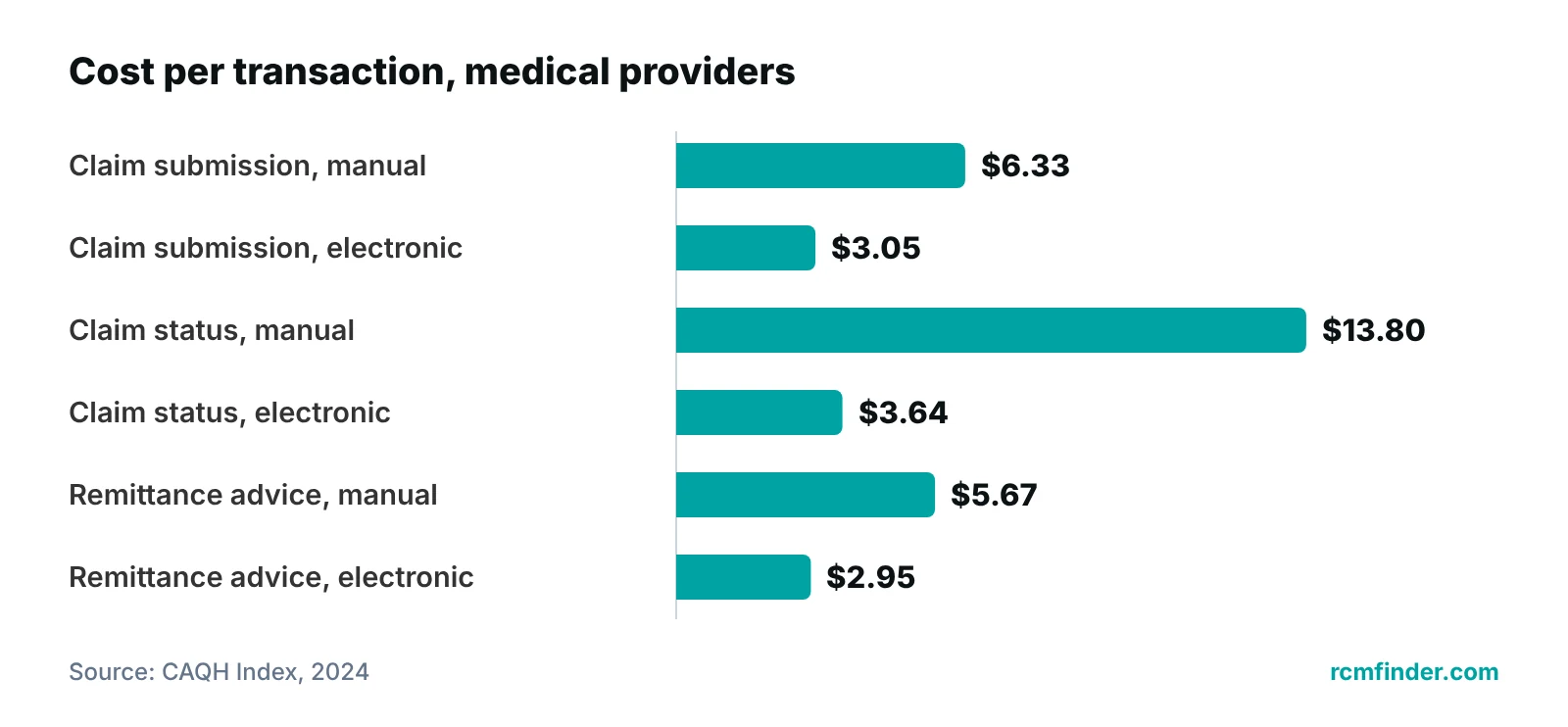
Each CO-16 puts a claim back in a work queue, and manual work costs more than electronic work. CAQH’s 2024 Index (2023 data) found medical providers spend about $6.33 on a manual claim submission versus $3.05 electronically, and $13.80 on a manual claim status inquiry versus $3.64 electronically (CAQH). Those figures are provider labor cost per transaction, and they exclude system costs.
The real cost of a CO-16 is staff time on the same claim twice, plus the delay in payment. Most CO-16 claims can still be paid once corrected. The loss comes when the correction is late or never happens. We do not put a dollar figure on your practice here, because it depends on your volume and payer mix. You can find your own number with the revenue calculator or by pulling your own CO-16 count from the last 90 days.
A two-minute self-check
Export last quarter’s denials. Filter for CARC 16. Group by remark code. If three or four remarks make up most of the list, you have a front-end or charge-entry problem you can fix, not a payer problem.
How do you prevent CO-16 denials?
Catch missing and mismatched data before the claim leaves your system. Prevention comes from three checkpoints: registration, charge entry and a pre-submission scrub. Our guides on claim scrubbing and denial management cover the mechanics.
- At registration: compare the name and ID to the card and run eligibility before the visit.
- At charge entry: require ordering and referring provider fields where the payer expects them. Validate procedure codes against the date of service.
- Before submission: run edits for required fields, and send secondary claims only with primary payer data attached.
- After posting: read remark codes, not just CARCs, and fix the upstream cause.
| Checkpoint | What to verify | Who owns it |
|---|---|---|
| Registration | Name, date of birth and ID match the card; eligibility run before the visit | Front desk |
| Charge entry | Procedure codes valid for the date of service; ordering or referring provider present; diagnosis pointers set | Biller or coder |
| Pre-submission scrub | Required fields complete; secondary claims carry primary payer data | Billing lead |
| ERA posting | Remark code logged with every CARC 16 and a resubmission deadline set | Payment poster |
Specialty matters here. A DME supplier sees ordering-provider and equipment remarks; a behavioral health practice sees ID and authorization issues. If you want to see how billing rules differ by specialty, browse our specialty billing pages.
If CO-16 is one of several denial types you see, read how it compares with our guides on CO-22 and CO-24. Each denial code has a different owner and a different fix.
When should you bring in outside help?
Bring in help when the same remark codes keep coming back or when corrected claims sit unworked. Typical signals are a growing pile of unworked CO-16 lines, a billing person who is also answering phones, or a filing deadline you cannot see. Our denial management services work these queues inside your existing EHR (for example PrognoCIS, eClinicalWorks or athenahealth) and report root causes back to you. For the full claim lifecycle, see our medical billing services.
Want to know what your CO-16 denials say about your front end?
Our free practice audit looks at your denial reasons by remark code and shows where the errors start. Pricing is quoted after the audit.
Our recommendations
- Log the remark code with every CO-16. We recommend a denial tracker with separate columns for CARC and RARC. Without the RARC you cannot see patterns.
- Fix the source record, then the claim. If registration or the provider file is wrong, the next claim will fail too. Correct the root first.
- Check Medicare versus commercial rules. Keep a one-page cheat sheet per major payer: corrected claim method, appeal rights and filing limit.
- Put a deadline on every denial. Every CO-16 should carry a date by which a corrected claim must reach the payer. Do not leave it to memory.
- Review the top three remarks monthly. Pick the three most common remark codes and assign one person to remove their cause.
- Scrub secondary claims separately. Secondary claims fail on missing primary payer data. Give them their own edit check.
CO-16 usually means information is missing or invalid.
The portal's data-completeness checks run before submission, and every claim has an owner if one does come back.
See how the RCM Finder portal works · Create a portal account
Disclosure: RCM Finder builds and sells this portal. It is a practice management system, not an EHR.
Bottom line
A CO-16 denial is a data problem you can trace and fix, as long as you read the remark code and correct the source record. If your team is stuck in rework, our medical billing services and denial management team can take that queue off your desk. Start with a free practice audit, or talk to us.
Frequently asked questions
What does CO-16 mean on an EOB or ERA?
CO-16 means the claim or service lacks information or has a submission or billing error. CO is the group code: the provider is responsible for the amount. A remark code must appear with it to say what is missing. Read the remark code first, because CO-16 alone does not tell you what to fix.
Can you appeal a CO-16 denial?
Often not. Medicare contractors say claims returned as unprocessable cannot be appealed, and appealing can delay payment and cost you the timely filing window. In most cases you correct the information and send a new or corrected claim. Commercial payers differ, so check the payer’s manual or call before choosing a route.
Is CO-16 the same as a rejection?
Not always. Some payers reject a claim before adjudication, with no remittance advice. Others process it and return CO-16 on the ERA. In both cases the fix is similar: find the missing or wrong data and send a correct claim. Check where in the process your payer stops the claim, because the resubmission method may differ.
How long do I have to resubmit a CO-16 claim?
For Medicare, claims must reach the contractor within 12 months of the date of service, and a claim denied for timely filing has no appeal rights. Commercial payers set their own limits by contract, often shorter. Look up each payer’s limit and track it against every open denial.
What is the difference between CO-16 and CO-22?
They have different reasons and different fixes. CO-16 is about missing or wrong claim information. For CO-22, read our CO-22 guide. Always check the exact wording of each code on your payer’s current list before assigning staff to work it.
Can software prevent CO-16 denials?
It can catch many of them. A claim scrubber checks required fields and code validity before submission, which targets the same issues CO-16 reports. It cannot fix wrong data at registration, so staff checks still matter. See our guide to claim scrubbing, linked above, for the basics.
Get your free practice audit
Tell us about your practice. We will contact you using the details you give.
- A review of your recent claims, denials and A/R aging
- Where your front desk and prior authorizations slow payment
- A prioritized fix list you keep, whether or not you hire us
Pricing is quoted after the audit, based on your volume and the services you choose. Prefer to talk? Call +1 (302) 556-2288.
Sources
- Companion guide: CARC memo — MassHealth (Mass.gov) (2025)
- MLN Matters MM5634 — CMS (2007)
- Denial Code Resolution — Noridian Medicare JF Part B (2025)
- Reason Code 16 | Remark Codes MA13 N264 N575 — Noridian Medicare JD DME (2025)
- Remittance Advice Remark Codes — X12 (2025)
- What you should do with claims returned as unprocessable — First Coast Service Options (2025)
- Claim Submission Timeliness — Noridian Medicare JF (2025)
- CAQH Index Report 2024 — CAQH (2024)
Disclaimer: This post is general educational information about revenue cycle operations. It is not legal, coding, billing-compliance or financial advice. Code definitions, payer rules, filing limits and appeal rights vary by payer and plan and change over time. Confirm requirements with the payer and qualified advisors before acting.
