
Skin substitute CPT codes 15271 to 15278 report the application of a skin substitute, not the product itself. Choose the family by body site (15271-15274 for trunk, arms and legs; 15275-15278 for face, scalp, hands, feet and similar sites), then count the total wound area. Medicare changed how it pays for the products on January 1, 2026.
This guide is for practice managers, billers and coders who handle wound care claims. It explains how the eight application codes fit together, how to turn a wound measurement into units, and what changed in 2026. It replaces an earlier version of this post that mixed up the area thresholds. For the wider picture, see our wound care CPT coding guide.
Key takeaways
- Codes 15271-15278 report applying a skin substitute. The product is reported separately with its own HCPCS code.
- Two things pick the code: the anatomic site group and the total wound surface area.
- Each primary code covers a first block of area. Add-on codes cover each further block or part of one.
- From January 1, 2026, CMS pays for skin substitutes under the physician fee schedule as incident-to supplies, and the JW and JZ modifiers do not apply to non-BLA products.
- Documentation of wound size, product and medical necessity decides whether the claim is paid. Check your Medicare contractor’s article before billing.
What do skin substitute CPT codes 15271-15278 actually cover?
They cover the work of putting a skin substitute graft on a wound. They do not cover the product. The graft material is reported separately with a HCPCS product code, and the two lines sit on the same claim. Our HCPCS versus CPT explainer covers why two code sets appear on one claim.
The old title of this post said skin graft, but these eight codes are about skin substitutes. A skin substitute is a product applied to a wound to support healing. Grafts that move the patient’s own skin from a donor site are coded elsewhere and are outside this guide.
According to a Dermatology World coding column (2025), these codes are not reported for plain dressings such as gels, foams or ointments, or for injected substitutes. The same column says removal of an existing graft and simple wound cleansing are included in the application and product codes. Debridement of the wound bed has its own rules, covered in our debridement CPT codes guide.
In the wound care setting these claims usually come from podiatry, dermatology, surgery and dedicated wound clinics. Teams that handle wound care billing see the same two questions again and again: which site group, and how many units.
How are the eight codes organized?
The eight codes form two families of four. Each family has a primary code and an add-on code for small wounds, then a primary code and an add-on code for larger wounds. The families differ only by body site.
| Code | Site group | Role | Wound area it reports |
|---|---|---|---|
| 15271 | Trunk, arms, legs | Primary | First 25 sq cm or less, when the total wound is under 100 sq cm |
| 15272 | Trunk, arms, legs | Add-on | Each additional 25 sq cm or part of it |
| 15273 | Trunk, arms, legs | Primary | First 100 sq cm, when the total wound is 100 sq cm or more |
| 15274 | Trunk, arms, legs | Add-on | Each additional 100 sq cm or part of it |
| 15275 | Face, scalp, hands, feet and similar sites | Primary | First 25 sq cm or less, when the total wound is under 100 sq cm |
| 15276 | Face, scalp, hands, feet and similar sites | Add-on | Each additional 25 sq cm or part of it |
| 15277 | Face, scalp, hands, feet and similar sites | Primary | First 100 sq cm, when the total wound is 100 sq cm or more |
| 15278 | Face, scalp, hands, feet and similar sites | Add-on | Each additional 100 sq cm or part of it |
Source: APMA coding slides citing the 2022 CPT Professional edition (2023); Dermatology World (2025). Descriptions are paraphrased; CPT descriptors are owned by the AMA.
The second site group is broader than the table shows. The APMA slides list face, scalp, eyelids, mouth, neck, ears, orbits, genitalia, hands, feet and multiple digits. For infants and children, the 100 sq cm threshold on the larger codes is expressed as a percentage of body area instead. Check the current CPT manual for the exact wording.
How do you count wound area and add-on units?
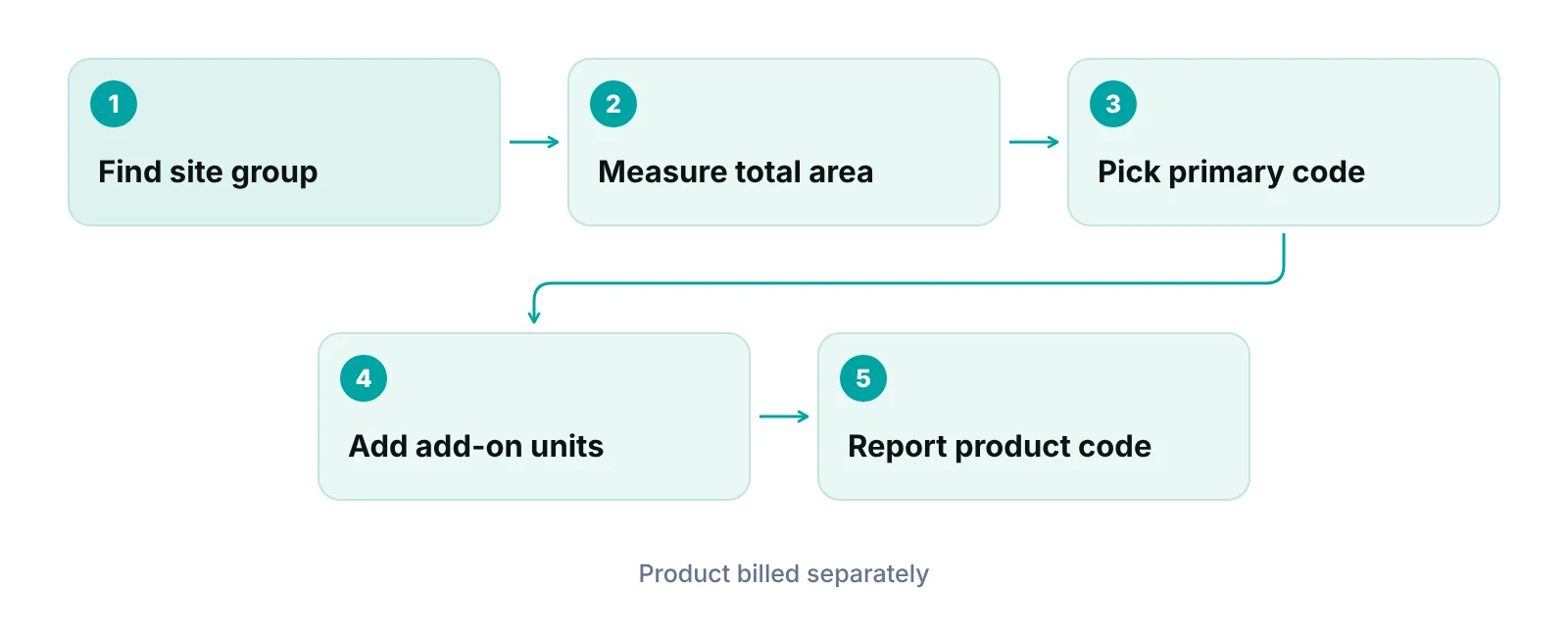
Measure the total wound surface area for the site group, then work down the code ladder. The first block of area goes on the primary code. Every further block, or part of a block, is one unit of the add-on code.
When a patient has more than one wound, add the areas together inside the same site group. The Dermatology World column gives the pattern: trunk and arm wounds are combined, but a face wound and an arm wound are not. Each site group is coded on its own.
| Wound | Codes to report | How the units add up |
|---|---|---|
| 20 sq cm on the leg | 15271 x 1 | Under the first 25 sq cm, so no add-on. |
| 78 sq cm on the leg | 15271 + 15272 x 3 | First 25 sq cm, then 53 sq cm left: two full blocks of 25 and a part block. |
| 45 sq cm total from a trunk wound (15) and an arm wound (30) | 15271 + 15272 x 1 | Same site group, so areas combine: 25 first, 20 left is one part block. |
| 120 sq cm on the back | 15273 + 15274 x 1 | First 100 sq cm, then 20 sq cm is one part block. |
| 250 sq cm on the trunk | 15273 + 15274 x 2 | First 100 sq cm, then 150 left: one full block of 100 and a part block. |
| 40 sq cm on the scalp | 15275 + 15276 x 1 | First 25 sq cm, then 15 left is one part block. |
| 130 sq cm across both hands | 15277 + 15278 x 1 | First 100 sq cm, then 30 left is one part block. |
Source: worked from the code structure in the APMA slides (2023) and Dermatology World (2025). The 78 sq cm example matches the APMA slides. Confirm unit counts with a certified coder.
Wound area is not product size
A Medicare contractor’s article says payment is based on the documented wound area in square centimeters, and that this is a pricing basis. It does not mean the product is packaged or sold by the square centimeter. Record the wound measurement, not the size of the sheet that was cut or opened. First Coast Service Options is the source.
What changed in Medicare payment for skin substitutes in 2026?
For 2026, CMS finalized paying for skin substitutes under the physician fee schedule as incident-to supplies, instead of treating them as biologicals. The CPT application codes did not change. The payment and billing rules around the product did.
CMS’s October 2025 announcement said spending on skin substitutes rose from $256 million in 2019 to over $10 billion in 2024, which the agency attributes largely to abusive pricing. According to CGS Medicare, CMS estimates Medicare spending on these products will fall by nearly 90 percent in 2026.
The CMS fact sheet on the CY 2026 physician fee schedule final rule says the products are paid as incident-to supplies when used with a covered application procedure, in the non-facility setting under the fee schedule or in the hospital outpatient setting. It states a single payment rate for 2026 and says CMS intends to propose separate rates for three FDA categories in future years: 361 HCT/P products, premarket approvals and 510(k)s. The fee schedule rule is summarized here; it is not the final word on your payer mix.
| Topic | Before 2026 | From January 1, 2026 |
|---|---|---|
| Payment category | Treated as biologicals | Paid as incident-to supplies under the fee schedule (non-BLA products) |
| Products approved under a BLA | Biologicals | Still paid separately as biologicals |
| Discarded product | JW or JZ modifiers used | JW and JZ do not apply to non-BLA products; only the administered portion is payable |
| Claims carrying JW or JZ | Accepted | Rejected for dates of service on or after January 1, 2026 (First Coast, non-sheet products) |
| Application and product codes | Billed on the claim | Application codes must be billed with the product code on the same claim (First Coast, non-sheet products) |
| Future rates | Not applicable | CMS intends to propose separate rates by FDA category in later years |
Source: CMS (2025); CMS CY 2026 PFS fact sheet (2025); First Coast Service Options (2026). Contractor rules are shown for First Coast; other contractors may differ.
One detail matters for non-sheet products. The First Coast article lists HCPCS application codes G0681 through G0684 for those products. G0681 and G0682 are for wounds up to 100 sq cm and G0683 and G0684 for wounds of 100 sq cm or more. Whether a claim uses these or the CPT codes above depends on the product type and the contractor, so check before the first claim goes out. Our Medicare incident-to billing guide explains the incident-to concept in general terms.
What documentation does a skin substitute claim need?
At a minimum, name the product, record the total wound size in square centimeters and show why the treatment was medically necessary. First Coast says claims must carry that documentation and are denied without it.
Beyond that minimum, the right list comes from your Medicare contractor’s coverage article and any payer policy. The APMA coding slides suggest several elements worth capturing, and they line up with what most coverage policies ask for:
- Length, width and depth of the wound, and its stage.
- Evidence that standard care was tried and the wound did not improve. The Dermatology World column says Medicare generally expects about four weeks of standard care without improvement.
- How the wound bed was prepared, including any debridement.
- Management of related conditions such as diabetes, edema and pressure offloading.
- The name of the product and the reason it was chosen.
“A wound measurement that is rounded the same way every visit is easier to defend than one that changes with each clinician.”
Good habits here are the same as in any specialty, and our guide to clear documentation covers them. For skin substitutes the single most useful habit is recording the measurement in the note on the day of the procedure.
Where do skin substitute claims usually go wrong?
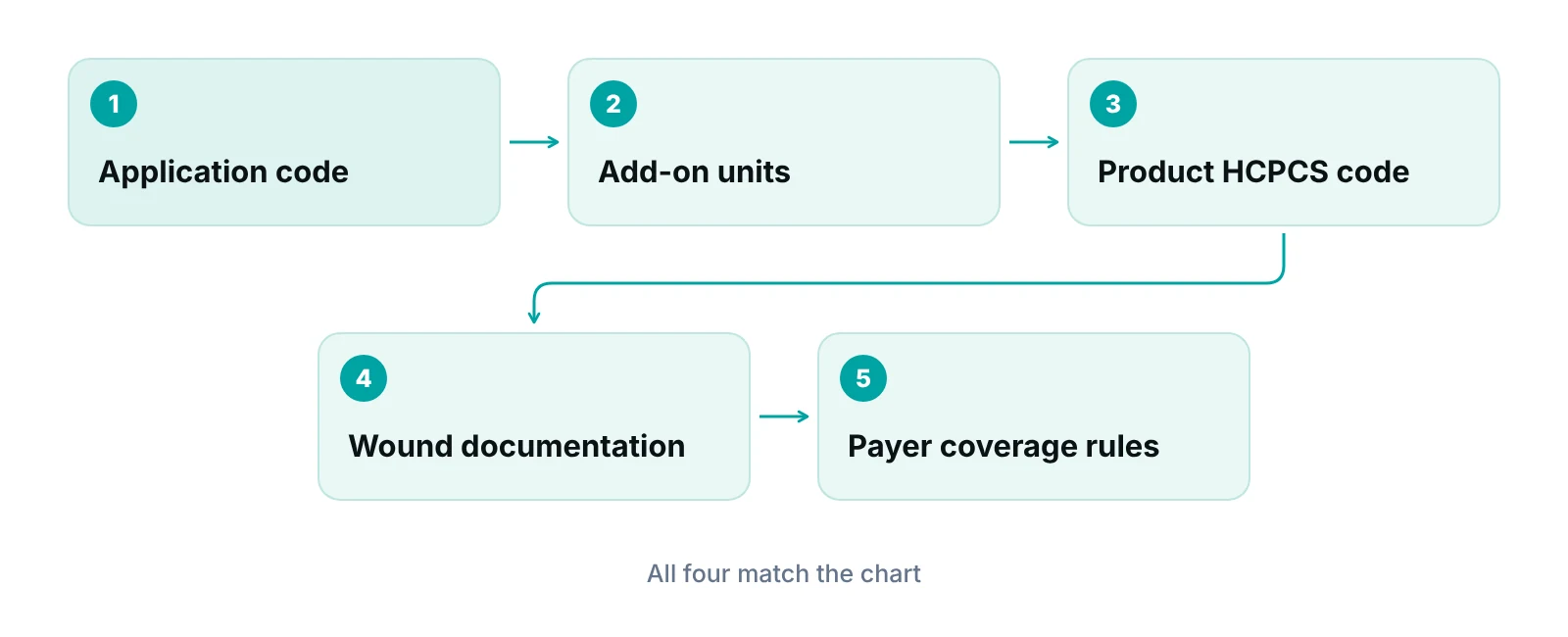
Most problems come from the wound measurement and the site group, not from the code list itself. These are the errors to look for before a claim is released.
- Mixing site groups. Trunk and arm wounds combine, but a face wound goes with the 15275-15278 family.
- Counting the product instead of the wound. Units follow wound area, not the size of the sheet.
- Rounding part blocks down. Each add-on code covers each additional block or part of one.
- Using 15271-15278 for dressings or injected products. The Dermatology World column says these codes are for skin replacement surgery only.
- Leaving off the product code. The application and the product are reported together.
- Sending JW or JZ in 2026. First Coast rejects them on non-BLA product claims with dates of service on or after January 1, 2026.
- Billing a separate visit without a separate reason. The Dermatology World column says an E/M service is reported only when the patient needed a distinct service.
When a claim is denied for one of these reasons, the fix is almost always in the documentation or the units. A denial management support workflow tracks which reason codes repeat so the cause is fixed once.
Check a few of your wound care claims
Send a sample of recent skin substitute claims and we will show where units, site groups or documentation could cause a denial. This is part of the free practice audit.
Our recommendations
- Build a one-page code ladder. Put the eight codes, the two site groups and the 25 and 100 sq cm thresholds on one reference sheet at the coding desk. Most unit errors come from not having the structure in front of the person entering charges.
- Require the wound measurement in the note. Do not release a claim until the total wound area for each site group is in the procedure note. If the number is missing, send the note back before billing.
- Read your Medicare contractor's article. Rules for sheet and non-sheet products, coverage conditions and application codes can differ between contractors. Read the current article and local coverage policy for your region and save the date you checked.
- Stop sending JW and JZ on non-BLA skin substitute claims. Update charge-entry templates for 2026 dates of service and confirm the rule for each contractor and payer.
- Track denials by reason. Tag skin substitute denials as units, site group, documentation or product code. Patterns show which step to fix, and the medical billing services team can review a sample with you.
Bottom line
Skin substitute CPT codes are simple once the structure is clear: pick the site group, add up the wound area, report one primary code and the right number of add-on units, then pair it with the product code. What needs care in 2026 is the Medicare payment rule, which differs from earlier years. If these claims are getting denied, denial management support or the revenue calculator is a sensible next step, and you can always contact the RCM Finder team.
Frequently asked questions
Which CPT codes are used for skin substitute grafts?
The application codes are 15271 to 15278. Codes 15271-15274 are for the trunk, arms and legs. Codes 15275-15278 are for the face, scalp, hands, feet and similar sites. The product itself is reported separately with a HCPCS code.
How do you count wound area for 15271 and 15272?
Use 15271 for the first 25 sq cm or less when the total wound is under 100 sq cm. Add one unit of 15272 for each further 25 sq cm or part of it. A 78 sq cm leg wound is 15271 plus 15272 times three.
When do you use 15273 and 15274 instead?
Use 15273 when the total wound area is 100 sq cm or more. It covers the first 100 sq cm. Add one unit of 15274 for each further 100 sq cm or part of it. A 120 sq cm wound on the back is 15273 plus 15274 times one.
Can you add wounds from different body areas together?
Only within the same site group. Trunk and arm wounds combine because they sit in the same code family. A face wound and an arm wound do not combine. Each site group gets its own primary code and add-on units.
What changed for skin substitutes in Medicare in 2026?
CMS finalized paying for skin substitutes under the physician fee schedule as incident-to supplies. A Medicare contractor says JW and JZ do not apply to non-BLA products, and claims carrying them are rejected for 2026 dates of service. Confirm the details with your contractor.
Is a skin substitute application the same as a skin graft code?
No. Skin substitute application codes report a product placed on a wound. Surgical skin grafts that use the patient’s own skin are coded differently. Use the procedure note to decide which applies, and ask a certified coder when it is unclear.
Get your free practice audit
Tell us about your practice. We will contact you using the details you give.
- A review of your recent claims, denials and A/R aging
- Where your front desk and prior authorizations slow payment
- A prioritized fix list you keep, whether or not you hire us
Pricing is quoted after the audit, based on your volume and the services you choose. Prefer to talk? Call +1 (302) 556-2288.
Sources
- CMS Modernizes Payment for Accuracy, Significantly Cuts Spending on Waste — CMS (2025)
- Calendar Year 2026 Medicare Physician Fee Schedule Final Rule (CMS-1832-F) fact sheet — CMS (2025)
- CY 2026 PFS final rule skin substitute summary — CGS Medicare (2025)
- Part B billing, payment methodology and documentation requirements for non-sheet skin substitute products — First Coast Service Options (Medicare contractor) (2026)
- Use of JW and JZ modifiers when billing separately payable incident-to supplies — First Coast Service Options (Medicare contractor) (2026)
- Skin substitutes coding slides (citing CPT 2022 Professional edition) — American Podiatric Medical Association (2023)
- Coding consult: skin substitutes — Dermatology World (AAD) (2025)
Disclaimer: This post is general educational information for practice owners, managers and billers. It is not legal, coding, billing-compliance or medical advice. CPT is a registered trademark of the American Medical Association. Payer rules and Medicare contractor policies vary and change; confirm current requirements with your Medicare Administrative Contractor and each payer, and use a certified coder for specific claims.
