
Accounts receivable in medical billing is the money payers and patients still owe your practice for care already delivered. Calculate it as charges minus contractual adjustments, payments and other adjustments. Then age it from the date of service, track days in A/R, and work the oldest and largest balances first with a written follow-up routine.
Every practice has A/R, even a well-run one. The question is whether you can see it, age it and put a name and a date against each balance. This guide covers the basics, the formulas and the follow-up routine for payer and patient balances.
The earlier version had a wrong formula and unsourced benchmarks. We rebuilt it from AAFP, HFMA, MGMA, eCFR and CMS material.
Key takeaways
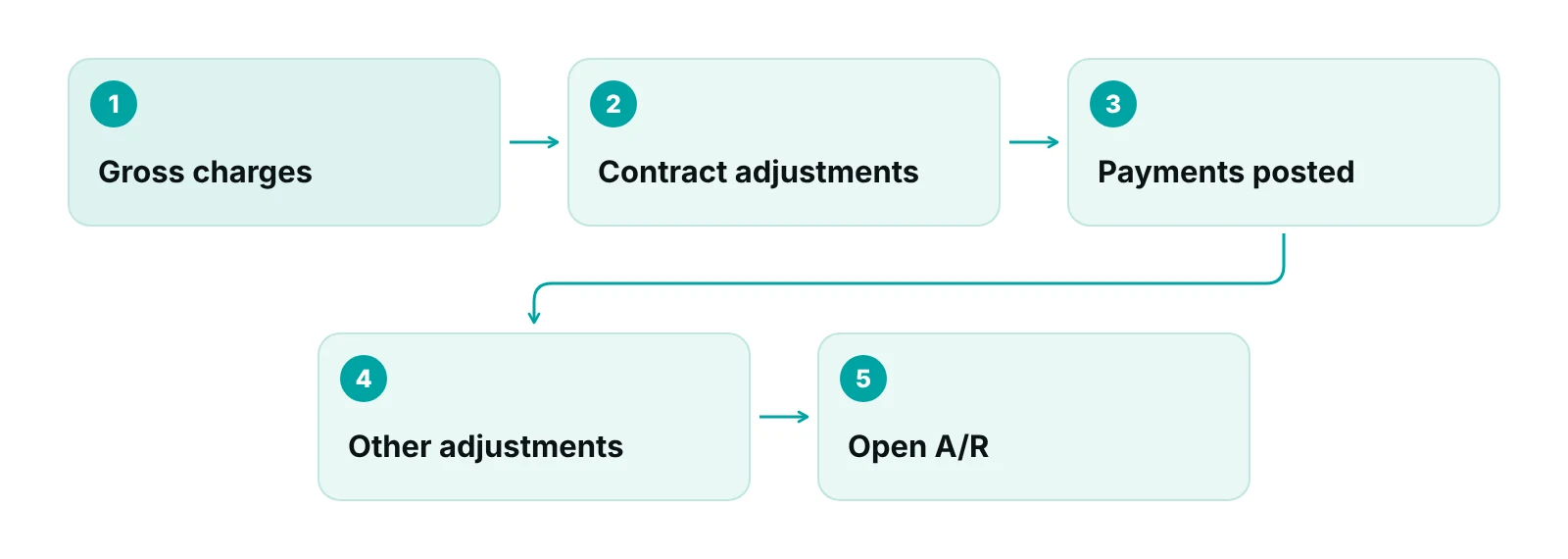
- Open A/R = gross charges – contractual adjustments – payments – other adjustments.
- Days in A/R is total A/R divided by average daily charges; AAFP’s reference range is 30 to 40 days, under 50 at a minimum.
- Age A/R from the date of service and watch balances over 120 days as their own number.
- Work each balance by its blocker: rejected, no response, short paid, denied or patient-owed.
- Load each payer’s filing and appeal deadlines so the worklist is sorted by deadline as well as age.
What is accounts receivable in medical billing?
Accounts receivable (A/R) in medical billing is every dollar your practice has earned but not yet collected. It covers balances waiting on insurers and balances waiting on patients. A charge becomes A/R when you bill it. It stops being A/R when it is paid or adjusted off the ledger.
Two things take a balance off the ledger without cash arriving. A contractual adjustment is the gap between your fee and the amount a payer contract allows, and it is posted when the claim is paid. A write-off is a balance your practice decides to stop pursuing. Keep the two apart in your reports. A large pile of write-offs can make A/R look healthy while the practice earned less than it should have.
Payer A/R and patient A/R
- Payer A/R: claims that were sent and are waiting for a decision, sitting in denial, or going through appeal.
- Patient A/R: copays, deductibles, coinsurance and self-pay balances that are left after the payer has processed the claim.
The two need different work. Payer balances are fixed with claim data, codes and documentation. Patient balances are fixed with clear statements, estimates and payment options. We report them on separate lines so one does not hide the other.
How do you calculate accounts receivable?
Open A/R equals gross charges, minus contractual adjustments, minus payments, minus other adjustments such as write-offs. The earlier version of this guide added adjustments instead of subtracting them. That is wrong, because adjustments reduce what is owed. A write-off should shrink A/R, not grow it.
| Ledger line | Amount | What it is |
|---|---|---|
| Gross charges billed | $100,000 | Your full fee for the services in the batch |
| Less contractual adjustments | – $35,000 | Difference between your fee and what the payer contracts allow |
| Less payments received | – $48,000 | Insurance and patient payments posted to these claims |
| Less other adjustments | – $2,000 | Write-offs and small-balance adjustments approved by policy |
| Open A/R | $15,000 | Still owed by payers and patients |
Illustrative numbers to show the arithmetic. They are not benchmarks.
This is a ledger identity, not a performance score. It tells you how much is open, not how well you are collecting. Check also whether your system reports gross A/R or net A/R. HFMA defines net A/R as the net patient receivable on the balance sheet (HFMA MAP Keys, 2023 edition), so the two totals will not match.
Reconcile before you analyze
Your A/R report total should equal the ledger. When it does not, look for unposted payments, unapplied credits and claims that were never entered. Fix those first, because every ratio built on a wrong total is wrong too.
How do you measure days in A/R?
Days in A/R is total receivables divided by average daily charges. AAFP describes average daily charges as total charges posted in a period, minus credits, divided by the number of days in that period. The result is the average number of days a practice takes to collect what it is owed.
Example with round numbers: a practice posts $540,000 in charges, net of credits, over 90 days. That is $6,000 a day. With $240,000 in open A/R, days in A/R is $240,000 ÷ $6,000 = 40 days.
AAFP says days in A/R should stay below 50 days at a minimum, with 30 to 40 days preferable. The earlier version of this guide said “below 30 days” with no source. Use AAFP’s range as a reference point only. Payer mix and specialty change what is reachable, and the trend over several months matters more than one reading.
Other bodies calculate it differently. MGMA’s data definitions divide total A/R by adjusted fee-for-service charges × 1/365 (MGMA, 2025). HFMA’s net days in A/R divides net A/R by the average daily net patient service revenue of the most recent three months (HFMA). Pick one method and keep it. Our guide to essential accounts receivable metrics compares the formulas side by side and covers net collection rate, denial rate and clean claim rate, so we do not repeat all five here.
How do you read an A/R aging report?
An aging report groups open balances by how long they have been unpaid. HFMA’s buckets are 0-30, 31-60, 61-90, 91-120 and over 120 days, and they must add up to 100% of billed A/R. For physician and outpatient accounts, HFMA ages from the date of service (HFMA). MGMA uses the same bucket labels (MGMA).
| Bucket (days from date of service) | Example balance | Share of A/R | Usual next step |
|---|---|---|---|
| 0-30 | $120,000 | 50% | Confirm acceptance; most are simply waiting on the payer |
| 31-60 | $60,000 | 25% | Check status on claims with no response |
| 61-90 | $36,000 | 15% | Call the payer; work denials and short payments |
| 91-120 | $12,000 | 5% | Escalate; confirm filing and appeal deadlines |
| Over 120 | $12,000 | 5% | Decide: appeal, bill the patient, or write off by policy |
| Total | $240,000 | 100% |
Source: bucket definitions from HFMA MAP Keys (2023) and MGMA DataDive glossary (2025). The dollar amounts, shares and next steps are our illustration, not a target.
The split above is an example, not a goal. None of the sources we reviewed sets a target split, and the earlier version of this guide printed one (60% current, 5% over 120) without a source. We removed it.
A good average can hide old balances. AAFP warns that claims aged past 90 or 120 days can sit behind a fine days-in-A/R figure, so it recommends tracking A/R over 120 days as its own number. MGMA’s aging measure leaves out accounts assigned to collection agencies, so decide how you treat those and write it down. If your report ages from the last billed date instead of the date of service, a resubmitted claim looks new and the old buckets look better than they are.
When balances are already deep in the oldest bucket and routine calls stopped working, use our guide to legacy accounts receivable for recovery and write-off decisions.
Why does accounts receivable get stuck?
A/R grows when claims leave the practice with problems, when nobody works them after they leave, or when payments are posted wrongly. The causes we look for first sit in four places inside the practice.
- Front end: wrong demographics or coverage data. A claim built on the wrong policy cannot be paid. See our patient insurance verification guide.
- Claim quality: missing or inconsistent data that fails edits before or after it reaches the payer. Our clean claims guide lists the common edits.
- Follow-up gaps: unpaid claims that no one has an owner or a next-touch date for.
- Posting errors: payments or adjustments posted to the wrong claim, which creates balances that do not exist and hides ones that do.
Denials add a fifth path. Work them by reason code rather than by claim, as described in our denial management guide, instead of repeating that process here.
“A/R is a list of unfinished jobs, not a number. The report only helps when every line has an owner and a next date.”
— Awais Afzal, Healthcare Operations & Data Analyst
What is the A/R follow-up workflow?
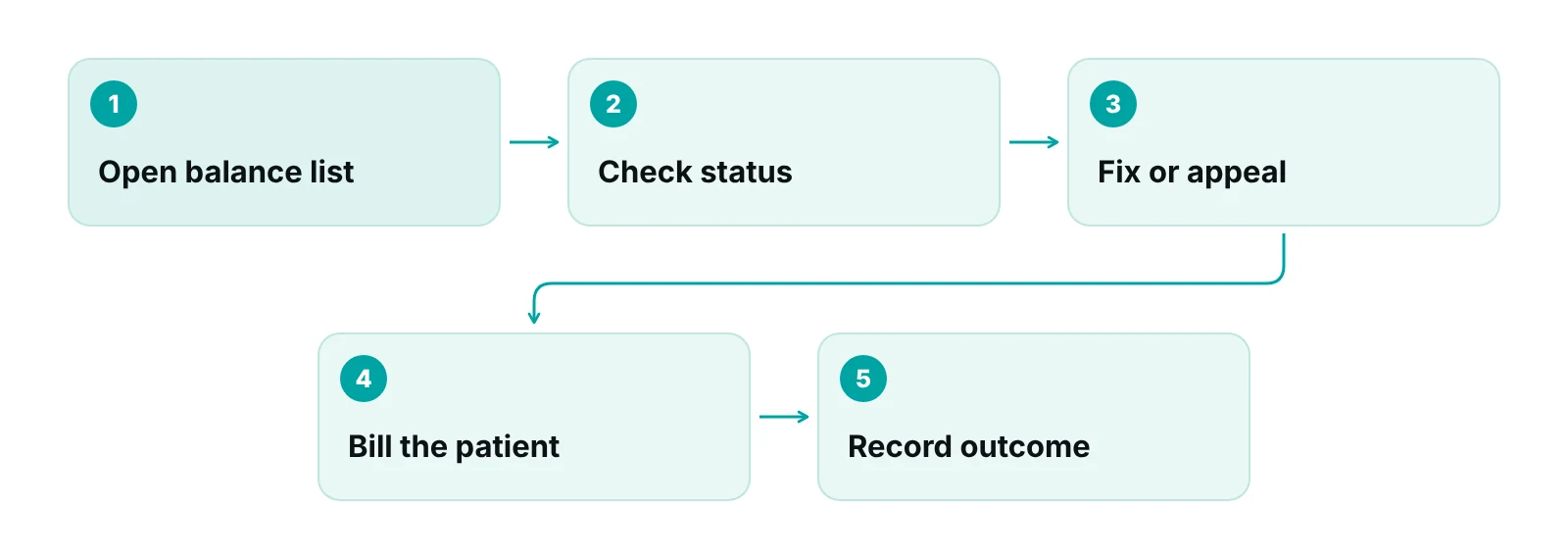
Work each open balance by what is blocking it: not accepted, no response, paid wrong, denied, or owed by the patient. Each blocker has its own fix, an owner and a next-touch date. The steps below are our recommended order. They are a working routine, not a regulation.
- Confirm the claim was accepted. Check the clearinghouse and payer acceptance reports before you call a claim unpaid. A rejected claim never reached adjudication, and it is one of the easier A/R problems to fix.
- Post the remittance accurately. Match each electronic remittance (835) or paper EOB to its claim. Post the payment, the contractual adjustment, the patient responsibility and any denial codes as separate items, and compare the payment with what the contract should allow.
- Check status on claims with no response. Use the payer portal or a claim status request through your clearinghouse or system. Set a first-touch rule for each payer, based on its contract and its usual processing time. We do not give one day count for every payer because they differ.
- Work denials by reason. Read the CARC and RARC codes, correct and resubmit, or appeal with the right documentation, and put the appeal deadline on the account.
- Bill the patient once the payer has finalized. Send a statement that shows what the insurer paid and what is owed, and offer a payment plan when it fits.
- Record every touch and escalate by rule. Log the date, the person, what the payer said and the next action date. Write-offs need a written approval rule and a reason code.
On status checks: CMS describes the 276 as the provider’s claim status inquiry and the 277 as the health plan’s response (CMS). The federal standard for the transaction is ASC X12N 005010X212 (45 CFR 162.1402). Your clearinghouse or practice system usually sends these for you.
| Open balance | First check | Usual owner | Where to read more |
|---|---|---|---|
| Claim rejected before the payer | Rejection reason on the clearinghouse report | Billing specialist | Clean claims guide |
| Accepted, no payer response | Claim status by portal or 276/277 | A/R specialist | This guide |
| Paid less than expected | Contract allowed amount against the remittance | A/R specialist | Payment posting and contract review |
| Denied | CARC/RARC codes and appeal deadline | Denial or A/R specialist | Denial management guide |
| Patient balance | Insurer’s final processing and the statement sent | Front desk or patient billing | Patient collections work |
| Over 120 days | Filing deadline, documents and write-off policy | Manager | Legacy A/R guide |
Which deadlines limit A/R follow-up?
Medicare generally requires a claim to be filed no later than one calendar year after the date of service (42 CFR 424.44). Medicare also limits how long you have to ask for a first-level appeal. Commercial and Medicaid limits sit in each payer’s contract or manual and can be much shorter.
- Medicare filing: within one calendar year after the date of service. The rule lists limited exceptions, such as an error by a government contractor, and moves a deadline that falls on a federal nonworkday to the next workday.
- Medicare redetermination: 120 days from receipt of the initial claim determination. CMS presumes the notice was received 5 calendar days after the date on it, and the contractor generally decides within 60 days of receiving the request (CMS).
- Commercial payers and Medicaid: read the contract or provider manual for each payer. Do not assume another practice’s number applies to you.
Sort the worklist by deadline as well as age
A 70-day-old claim with a 90-day appeal window is more urgent than a 130-day-old claim that has no deadline left. Put each payer’s filing and appeal limits in your system and show them on the worklist.
Who should work your A/R: staff, software or an outside team?
The right choice depends on who has time to work the list every week. A written routine and a named owner matter more than the model. Practices commonly use one of three: in-house staff, software that tracks claims, or an outside A/R team, and many combine them.
- In-house staff know your providers and patients. The risk is that A/R follow-up gets pushed aside by front-desk and posting work.
- Software keeps the list visible. Our own portal is a practice management system that tracks claims by stage, with an owner on each claim, underpayment flags against expected amounts and workflow rules. It is a claims system, not an EHR.
- An outside team takes over follow-up when staff time is the limit. Our A/R follow-up and management service works inside your existing EHR (for example PrognoCIS, eClinicalWorks or athenahealth) and reports against the definitions you agree.
If you hand work to any outside team, ask for the formulas in writing, claim-level drill-down on every report, a named contact, and a signed business associate agreement before patient data is shared. Our team can also build Power BI reporting so your aging report is trended by payer.
Payer mix and denial patterns differ across specialties, so the routine above needs tuning. Our specialty billing pages show how billing patterns differ.
Want a second look at your A/R?
Our free practice audit reviews your aging report, open balances by payer and follow-up routine, using the definitions in this guide. Pricing is quoted after the audit.
Our recommendations
- Write one definition sheet. Record how you calculate A/R, days in A/R and each aging bucket, and which accounts (for example collection placements) are included. Share it with staff and any vendor.
- Age from the date of service. We set reports to age from the date of service so a resubmitted claim does not look new. Show the 91-120 and over-120 buckets as separate lines.
- Give every balance an owner and a next date. A balance with no owner is the one that ages. Make the worklist show who touches it next and when.
- Load each payer's deadlines. Enter filing and appeal limits from contracts and provider manuals, and sort the worklist by the deadline as well as the age.
- Review the oldest and largest balances weekly. Take the oldest bucket and the five biggest payer balances first. Record what blocks each one, then fix the cause at the front end.
A practice management system built around claims, not charts.
RCM Finder's portal tracks every claim by stage with an owner, flags underpayments against expected amounts and applies workflow rules to hold or advance claims. It is a claims system, not an EHR.
See how the RCM Finder portal works · Create a portal account
Disclosure: RCM Finder builds and sells this portal. It is a practice management system, not an EHR.
Bottom line
Accounts receivable is a ledger balance with a clock on it. Get the formula right, age it from the date of service, and give every open balance an owner, a blocker and a next date. If you want help running that routine, see our end-to-end revenue cycle management service or talk to us, or start with a free practice audit.
Frequently asked questions
What is accounts receivable in medical billing?
It is the money owed to a practice for services already provided, split into payer balances and patient balances. A charge enters A/R when billed and leaves when paid or adjusted. It is a ledger balance, so it needs reconciling against payments and adjustments before any ratio built on it can be trusted.
What is the formula for accounts receivable?
Open A/R equals gross charges minus contractual adjustments, minus payments, minus other adjustments such as write-offs. Adjustments are subtracted, not added. Systems may report gross or net A/R, and HFMA defines net A/R as the net patient receivable on the balance sheet, so confirm which one your report shows.
What is a good days in A/R?
AAFP says days in A/R should stay below 50 days at a minimum, with 30 to 40 days preferable. Methods differ: MGMA uses annual adjusted charges and HFMA uses three months of net revenue. Compare your own trend using one method, and look at balances over 120 days as a separate number.
How long do I have to file or appeal a Medicare claim?
Medicare generally requires filing within one calendar year after the date of service (42 CFR 424.44). A first-level appeal, called a redetermination, must be requested within 120 days of receiving the initial claim determination. Commercial and Medicaid limits are set by each payer, so check the contract.
When should we start following up on an unpaid claim?
There is no single rule that fits every payer. Set a first-touch rule for each payer from its contract and its usual processing time, after you confirm the claim was accepted. Then check status, record the answer, and put the next action date on the account.
Should a small practice outsource A/R follow-up?
Consider it when staff cannot work the list every week. Outsourcing does not remove the need for definitions, deadlines and oversight. Ask for the formulas in writing, claim-level reports and a signed business associate agreement. Many practices keep patient statements in-house and hand payer follow-up to a team.
Get your free practice audit
Tell us about your practice. We will contact you using the details you give.
- A review of your recent claims, denials and A/R aging
- Where your front desk and prior authorizations slow payment
- A prioritized fix list you keep, whether or not you hire us
Pricing is quoted after the audit, based on your volume and the services you choose. Prefer to talk? Call +1 (302) 556-2288.
Sources
- Managing practice finances (days in A/R, adjusted collection rate, denial rate) — AAFP (n/d)
- Indicators of Revenue Cycle Excellence: MAP Keys, 2023 Edition — HFMA (2023)
- 2025 MGMA DataDive Definitions Glossary — MGMA (2025)
- 42 CFR 424.44 Time limits for filing claims — eCFR (Electronic Code of Federal Regulations) (current)
- First Level of Appeal: Redetermination by a Medicare Contractor — CMS (n/d)
- 45 CFR 162.1402 Standards for health care claim status — eCFR (Electronic Code of Federal Regulations) (current)
- Claim status transactions — CMS (n/d)
Disclaimer: This post is general educational information about revenue cycle operations. It is not legal, accounting, coding or compliance advice. Formulas, benchmarks and deadlines vary by payer, contract, state and system, and the examples use illustrative numbers. Confirm requirements with each payer and qualified advisors before acting.
