
HME vs DME billing is mostly a vocabulary question, not two separate billing systems. Medicare's rules turn on whether an item meets the regulatory definition of durable medical equipment, not on the label a company uses. Your claims change with the item, the payer's policy, the order on file and whether the item is rented or sold.
Many suppliers call themselves home medical equipment (HME) companies and bill durable medical equipment (DME) every day. The terms overlap, which is why a search for the difference returns vague answers. This guide separates the words from the billing rules that actually change how you get paid.
It is written for practice owners, billing managers and new suppliers who want to know what to set up before the first claim goes out. For code-level detail, see our guides to DME coding, HCPCS and ICD-10 and DME billing modifiers.
Key takeaways
- HME is a trade label; Medicare’s rules are written around durable medical equipment and DMEPOS supplier standards.
- An item must meet all five conditions in 42 CFR 414.202 to be DME.
- Accreditation, a surety bond and an order before delivery for listed items come before any claim.
- Capped rentals use KH, KI and KJ modifiers month by month, with ownership after 13 paid months.
- Medicaid and commercial plans publish their own rules; check each payer.
What HME and DME mean, and why the labels blur
DME is the term that appears in Medicare’s rules. HME is a trade term that suppliers and associations use for companies that deliver equipment and related services to patients at home. A single company can be both: it is an HME business in the way it describes itself and a DME supplier in the way it enrolls and bills.
That is the first thing to understand about HME vs DME billing. A payer does not ask whether you are an HME or a DME company. It asks what you delivered, who ordered it, what the item is coded as, and whether you are an enrolled supplier for that product category. The answer to those four questions drives the claim.
The federal sources reviewed for this guide define DME and set DMEPOS supplier duties. None of them sets out a separate Medicare billing rulebook for HME. If a source says HME billing “differs significantly” from DME billing, ask which rule it relies on. Usually the rules differ by item and payer, not by label.
The test that matters: Medicare's definition of DME
An item is DME for Medicare purposes only if it meets every condition in the federal definition at 42 CFR 414.202. Equipment that fails one condition is not billed under the DME benefit, even if the supplier calls it home medical equipment.
| Condition in the rule | What it means in practice | Billing question to ask |
|---|---|---|
| Can withstand repeated use | Built to be used again and again, not thrown away after one patient | Is this a reusable item or a disposable supply? |
| Expected life of at least 3 years (items classified as DME after January 1, 2012) | Newer products must meet a minimum lifetime to be classified as DME | Has the manufacturer or coding authority classified it as DME? |
| Primarily and customarily used to serve a medical purpose | The main use is medical, not comfort or convenience | Does the order and chart show a medical purpose? |
| Generally not useful without an illness or injury | A healthy person would not normally use it | Does the diagnosis on file explain the need? |
| Appropriate for use in the home | Suited to home use, though it may also be used elsewhere | Is the patient’s home use supported in the record? |
Source: 42 CFR 414.202, as published in the Code of Federal Regulations; CMS DME Center (2026 access).
The CMS DME Center repeats the three-year requirement and notes that items classified as DME on or before January 1, 2012 are exempt from it. The three-year condition and the illness-or-injury condition are easy to overlook, and both matter when a payer reviews medical necessity.
Where billing actually differs
The real differences come from the item, the payer and the rental status. The table below lists the checkpoints that change a claim, with the rule behind each one.
| Checkpoint | What decides it | What to confirm before billing |
|---|---|---|
| Supplier enrollment and accreditation | Whether you are enrolled and accredited for the product category | Accreditation lists the products you can bill; each location needs its own |
| Order before delivery | Whether the item is on CMS’s face-to-face and written order prior to delivery list | A written order is communicated to you before the item is delivered |
| Face-to-face encounter | Whether the item is on that same list | An encounter with the treating practitioner within 6 months before the order, documented in the record |
| Rental or purchase | The Medicare payment category of the item | The correct rental modifier for each month, or a purchase claim |
| Payer policy | Medicare, Medicaid or a commercial plan, each with its own policy | The payer’s own coverage rules and prior authorization needs, checked item by item |
Sources: 42 CFR 424.57 (eCFR); CMS notice, Federal Register, January 17, 2023; Noridian DME MAC capped rental page (2026 access). Payer policy row is general guidance; rules vary by payer.
Supplier enrollment and accreditation come first
Under the Medicare supplier standards in 42 CFR 424.57, each supplier location must be accredited by a CMS-approved accreditation organization before it enrolls or bills Medicare. The accreditation lists the specific products and services you can bill. If you add a product line, tell your accreditor so you can be surveyed for it.
The same standards require a continuous surety bond with a $50,000 base amount, comprehensive liability insurance of at least $300,000, and revalidation every three years. Changes to your enrollment information must be reported within 30 days. A claim can be perfect and still be denied if the supplier file is out of date.
Order timing is a billing issue
For items on CMS’s list, the written order must reach the supplier before delivery. The Federal Register notice of January 17, 2023 says the practitioner must have had a face-to-face encounter with the patient within the 6 months before the order, and that the encounter must be documented in the medical record. The first list took effect April 13, 2022, and ten more codes were added effective April 17, 2023. Power mobility devices are on the list by statute.
Not every item needs this. Check the current list before you assume an order can be completed after delivery. Our DME billing compliance guide covers how to keep order, delivery and claim records together.
Rental versus purchase changes the claim every month
Capped rental items are billed month by month with a modifier that tells the payer which rental month it is. Getting this wrong is a quiet source of denials, because each monthly claim looks fine on its own.
| Rental months | Modifier | Monthly cap (share of average purchase price) |
|---|---|---|
| Month 1 | KH | 10% |
| Months 2 and 3 | KI | 10% |
| Months 4 to 13 | KJ | 7.5% |
| Power wheelchairs, months 1 to 3 | KH, KI | 15% |
| Power wheelchairs, months 4 to 13 | KJ | 6% |
Source: Noridian Healthcare Solutions, DME MAC Jurisdiction D, Capped Rental page (2026 access).
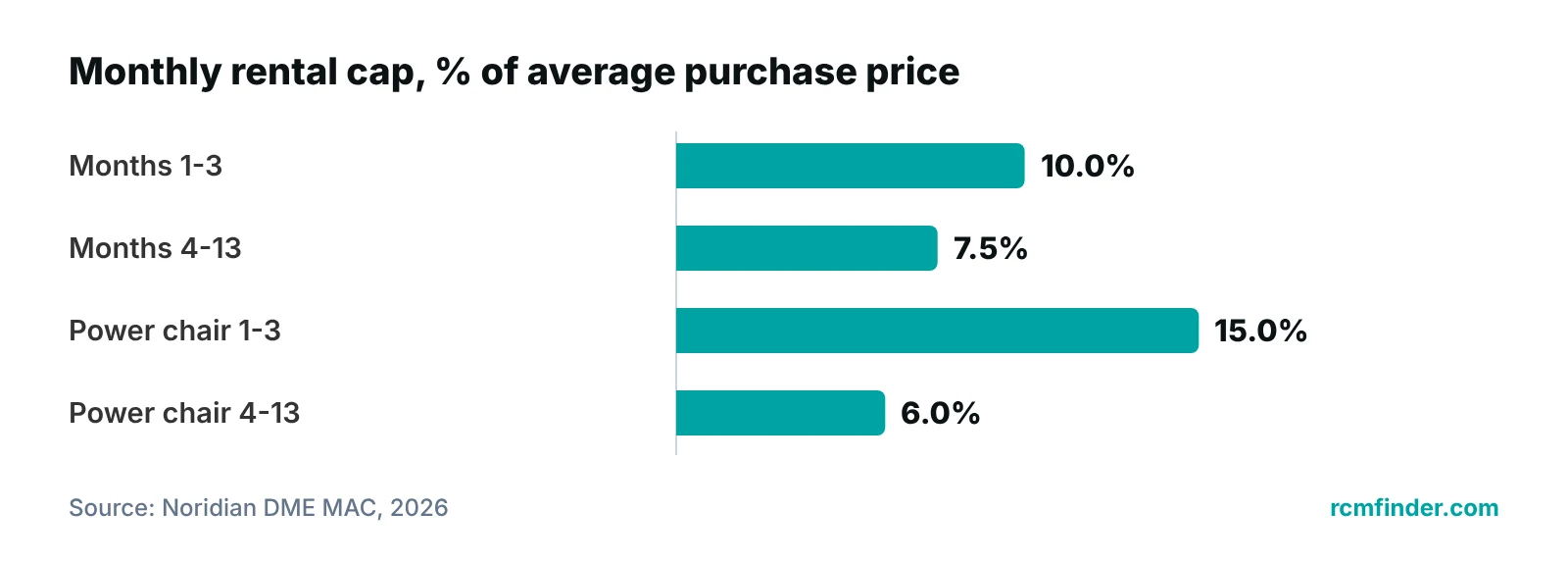
The same Noridian page says the beneficiary owns the item once 13 months of rental have been paid, and that Medicare then pays for reasonable and necessary maintenance and servicing not covered by a warranty. A new 13-month period starts only after an interruption of more than 60 consecutive days, plus the remaining days in the rental month when use stopped. If the break is due to medical need, you need a new order, a new face-to-face exam and a statement explaining the interruption.
This is why rental tracking is a process, not a setting. Someone has to know which month each patient is in, when use stopped, and which documents are needed to restart the count. A practice management system that tracks claims by stage can show an owner and a status for each monthly claim, which makes missed months visible.
Build one documentation file per patient
A clean DME claim rests on a file that tells one story: order, delivery, coding and billing all agree. The flow below is the order of operations most suppliers follow.
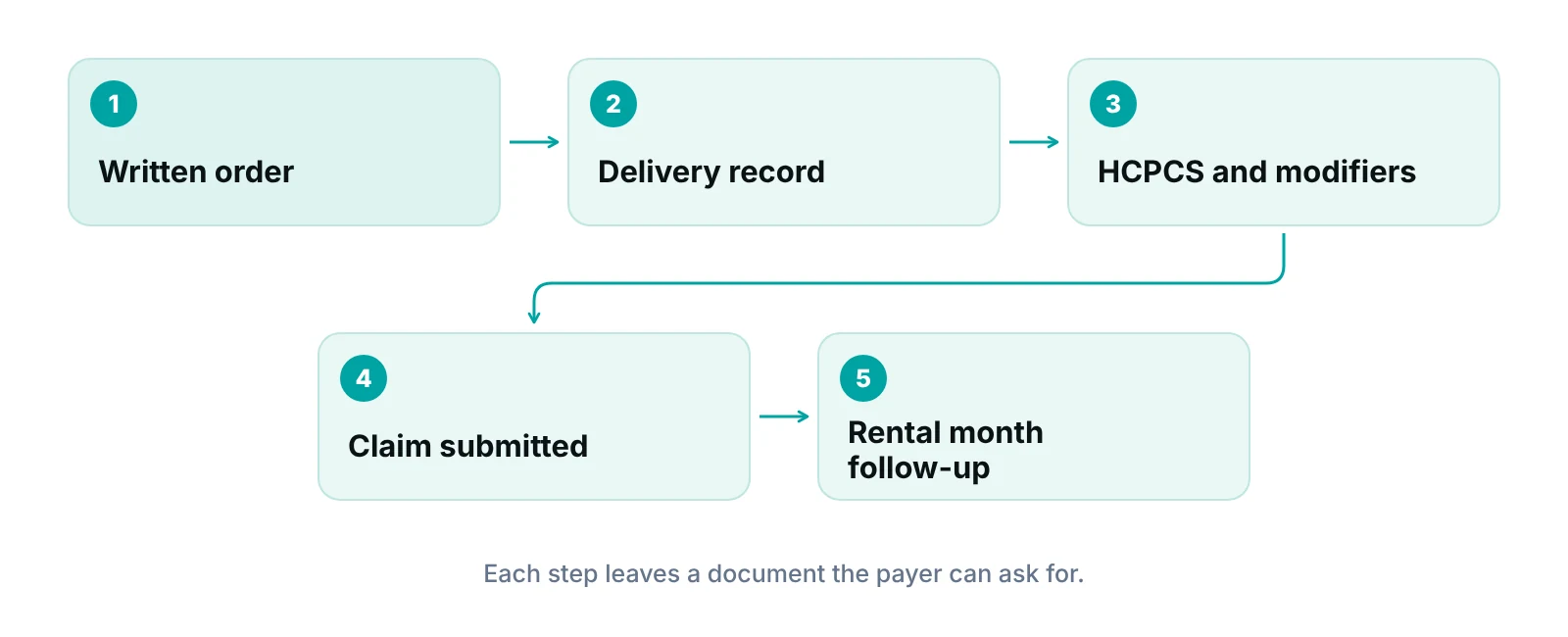
- Confirm the item meets the definition and that your accreditation covers the product category.
- Obtain the written order and, where the item is on CMS’s list, make sure it arrives before delivery along with the face-to-face encounter note.
- Record the delivery: date, item, serial or identifier where applicable, and who received it.
- Assign the HCPCS code and modifiers that match the order and the payer’s policy.
- Check the claim for missing fields before it leaves your system. Our clean claims guide explains what to check.
- For rentals, record the month and modifier on each monthly claim, and keep the interruption record if use stops.
“A DME claim is only as strong as the oldest document in the file. Fix the order before delivery, not after the denial.”
Mistakes that cost mixed HME and DME suppliers money
Suppliers that sell both DME and non-DME products often run one process for everything. That is the usual root of avoidable denials. These are the patterns to look for in your own data.
- Treating every product as DME because it is sold from the same store. Only items that meet the definition and a payer coverage policy belong on a DME claim.
- Letting the order arrive after delivery for items where it must come first.
- Billing rentals without a month-by-month schedule, so modifiers drift out of sequence.
- Adding a new product line without telling the accreditor, then billing for it.
- Skipping 30-day updates to enrollment details such as address or ownership changes.
- Using one payer’s rules for every payer. Medicaid and commercial plans publish their own policies.
Competitive bidding can change who may supply an item
Where a Medicare competitive bidding program applies, only contract suppliers may furnish certain items to beneficiaries. The program has had gaps between rounds, including one that began January 1, 2024 according to the CMS DME Center, so check the current status before you plan inventory. Our competitive bidding guide tracks the details so this post does not need to.
Denials from these patterns are also more costly than they look, because DME claims often involve high-value items and long rental histories. Reviewing denial reasons by item category quickly shows where the process breaks. If you want help with that, our denial management services work from the denial reason code, not from the patient’s name.
Medicare, Medicaid and commercial plans do not agree
The rules above come from Medicare. Medicaid programs and commercial plans may apply different codes, order forms, prior authorization requirements and rental terms. Before you add a payer, read its supplier manual and write down where it differs from Medicare.
If DME is only one part of what your organization does, our specialty billing pages show how billing logic varies across practice types, and our DME billing outsourcing guide weighs when handing off billing makes sense. If you are building a supplier business from scratch, the DME store setup checklist covers the non-billing steps.
For broader context on how claims move from order to payment, see our overview of medical billing services. If you want to estimate what denials and slow payment cost you, the revenue calculator gives a quick starting point.
What to do next
Start by writing down which of your products meet the Medicare DME definition, which sit on CMS’s order list, and which you rent. That one page tells you where your billing process needs the most care.
Not sure where your DME claims are leaking?
Our free practice audit reviews your order, delivery and claim workflow and shows you where claims stall.
Our recommendations
- Classify every product before you bill it. List each item you supply, test it against the Medicare DME definition, and record which payer policy applies. We recommend keeping this list where billing staff can see it.
- Confirm accreditation covers the product. Match your accreditation scope to your product lines. When you add a line, notify your accreditor before billing it.
- Check CMS's order list every quarter. Compare your catalog with the current face-to-face and written order prior to delivery list so no listed item ships without its order.
- Track every rental by month. Record the start date, current rental month, modifier and any interruption for each patient. A single owner for this task avoids gaps.
- Review denials by item category. Group denial reasons by product and payer. Patterns show whether the fix is in intake, documentation or coding.
- Ask any billing vendor for a Business Associate Agreement. Billing involves protected health information, so ask any vendor to sign a BAA and to explain who can access your data and how access is logged.
Track each rental month and claim stage in one place.
RCM Finder's portal tracks claims by stage with an owner, runs data-completeness checks before submission and flags underpayments against expected amounts.
See how the RCM Finder portal works · Create a portal account
Disclosure: RCM Finder builds and sells this portal. It is a practice management system, not an EHR.
Bottom line
HME vs DME billing is not a choice between two systems. The terms overlap, and what changes your payment is the item’s definition, the order, your supplier standing and the rental schedule. Set those up correctly and the label matters little. If you want a second pair of eyes on your DME workflow, our medical billing services and denial management services are built for exactly this kind of claim review.
Frequently asked questions
Is there a billing difference between HME and DME?
Not in the sense of two separate rulebooks. Medicare’s rules are written around durable medical equipment and its supplier standards. HME is a trade label. What changes billing is the item, the payer’s policy, the order timing and whether the item is rented.
What makes an item DME under Medicare?
Under 42 CFR 414.202 it must withstand repeated use, have an expected life of at least 3 years (for items classified as DME after January 1, 2012), serve a primarily medical purpose, generally not be useful without illness or injury, and be appropriate for home use.
Do all DME items need a written order before delivery?
No. CMS keeps a list of items that require a face-to-face encounter and a written order prior to delivery, including power mobility devices. Check the current list for each item you supply and do not assume an order can be completed after delivery. Payers other than Medicare may have their own order rules too.
What do the KH, KI and KJ modifiers mean?
They mark capped rental months for Medicare: KH for the first month, KI for the second and third, and KJ for the fourth through thirteenth. The beneficiary owns the item after 13 months of rental have been paid.
Do I need accreditation to bill Medicare for DME?
Yes. Under 42 CFR 424.57, each supplier location must be accredited by a CMS-approved organization before it enrolls or bills Medicare, and the accreditation lists the products you can bill. A $50,000 surety bond is also required.
Should we outsource DME billing?
It depends on volume, in-house skill and how well you can track rentals and orders. Outsourcing helps when billing knowledge is thin, but you still own the order and delivery documents, so the supplier must keep them complete and available. Our outsourcing guide weighs the trade-offs, including cost, control and how quickly problems are reported back to you.
Get your free practice audit
Tell us about your practice. We will contact you using the details you give.
- A review of your recent claims, denials and A/R aging
- Where your front desk and prior authorizations slow payment
- A prioritized fix list you keep, whether or not you hire us
Pricing is quoted after the audit, based on your volume and the services you choose. Prefer to talk? Call +1 (302) 556-2288.
Sources
- 42 CFR 414.202 Definitions (durable medical equipment) — Cornell LII / Code of Federal Regulations (2026 (accessed 2026-10-17))
- Durable Medical Equipment (DME) Center — CMS (2026 (accessed 2026-10-17))
- 42 CFR 424.57 Special payment rules for items furnished by DMEPOS suppliers — eCFR (2026 (accessed 2026-10-17))
- Federal Register notice, January 17, 2023 (face-to-face encounter and written order prior to delivery list) — GovInfo / Federal Register (2023)
- Capped Rental Items — Noridian Healthcare Solutions (DME MAC Jurisdiction D) (2026 (accessed 2026-10-17))
Disclaimer: This article is educational and is not legal, coding or compliance advice. Payer rules and CMS lists change; confirm requirements with the payer or your DME MAC before billing.
