
DMEPOS competitive bidding is the Medicare program in which suppliers bid to furnish selected equipment and supplies at set payment amounts. As of October 2026 no round is running. CMS lists Round 2028 next, with bidder registration opening December 1, 2026 and contracts targeted to start January 1, 2028.
Older articles on this program still repeat the 2021 brace round as if it were current. This update separates what CMS has confirmed from what is still a target, and shows each source so you can check it yourself. Dates marked as targets can move, so treat them as planning dates.
Key takeaways
- No round is running; a DME MAC page describes a gap period for all competitive bidding programs as of June 30, 2026.
- Round 2028 registration opens December 1, 2026 and the bid window runs January 5 to March 10, 2027.
- CMS lists seven categories, including CGMs, insulin pumps, urological and ostomy supplies and OTS braces.
- Awards (late summer or early fall 2027) and the January 1, 2028 start are CMS target dates.
- Suppliers need CMS-approved accreditation and state licensure before a contract can be awarded.
What DMEPOS competitive bidding is
It is a Medicare payment program for durable medical equipment, prosthetics, orthotics and supplies (DMEPOS). Instead of paying every supplier the same fee schedule amount, Medicare invites suppliers to bid in set geographic areas. Winning suppliers receive contracts and are paid a single payment amount for each item. Congress required the program in the Medicare Prescription Drug, Improvement, and Modernization Act of 2003, as described in a CMS fact sheet from January 2008. The rules sit in 42 CFR Part 414, Subpart F.
This guide is written for two readers: DME suppliers deciding whether to bid, and referring practices that need to know what the program means for orders and patient questions. It does not replace the CMS bidder instructions, and it covers status, not strategy for any one supplier.
Where the program stands in October 2026
There is no active round right now. The Medicare Administrative Contractor (MAC) page for DME says there is currently a gap period for all competitive bidding programs, and it was last updated June 30, 2026 (see Noridian Medicare, DME competitive bidding). CMS and its bid contractor list the next round as Round 2028.
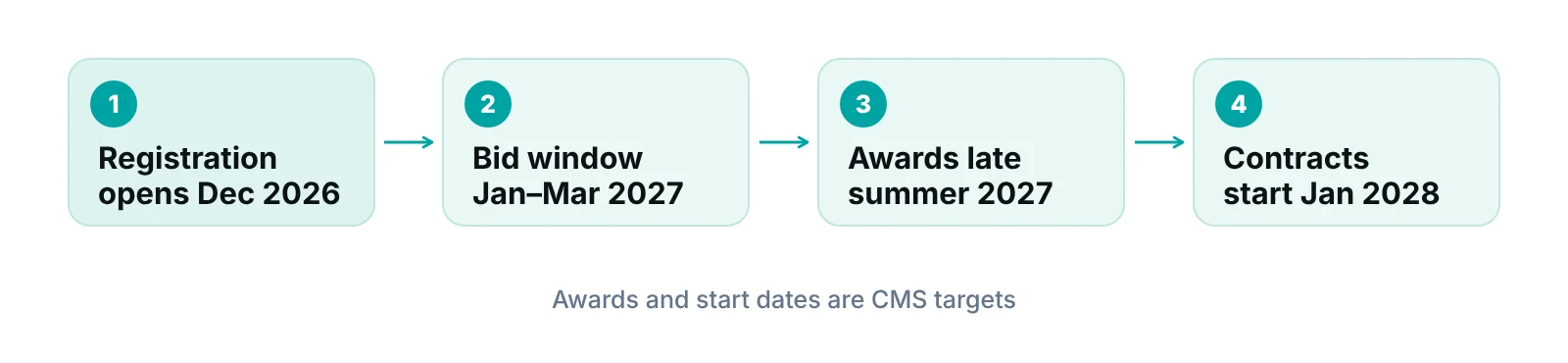
On October 7, 2026 CMS announced the registration and bid dates, according to its Round 2028 timeline and trade coverage in HME News. Bidding registration opens December 1, 2026, and the bid window runs from January 5 to March 10, 2027. Earlier CMS wording had pointed to a bid window in late summer or early fall 2026, so treat any older summary as out of date.
| Milestone | Date | Status |
|---|---|---|
| Bidding registration opens | December 1, 2026 | Set date |
| Bid window opens | January 5, 2027 | Set date |
| Bidding registration closes | February 1, 2027 | Set date |
| Covered document review date | February 8, 2027 | Set date |
| Bid window closes | March 10, 2027 | Set date |
| Contract awards and single payment amounts announced | Late summer or early fall 2027 | Target |
| Round 2028 starts; six-month transition for beneficiaries who used non-contract suppliers | January 1, 2028 | Target |
Source: CMS, DMEPOS Competitive Bidding Program, Round 2028 Timeline (page lists the notification and award periods as target dates).
Round 2028 product categories
CMS lists seven product categories for Round 2028 on its program page:
- Class II continuous glucose monitors (CGMs) and insulin pumps
- Urological supplies, excluding hydrophilic catheters
- Ostomy supplies
- Hydrophilic urinary catheters
- Off-the-shelf (OTS) back braces
- OTS knee braces
- OTS upper extremity braces
The same page says all Round 2028 product categories will be part of a nationwide remote item delivery program. Check the live CMS page before relying on this list, because lead items and contract counts per category were being announced in stages during 2026.
What the CY 2026 final rule changed
The CY 2026 home health final rule (CMS-1828-F) reworked how the next round is run. It was published in the Federal Register on December 2, 2025 and its regulations took effect January 1, 2026. The DMEPOS parts that matter most to suppliers are below.
| Topic | What the rule says | Why suppliers care |
|---|---|---|
| Lead item payment | The single payment amount uses the 75th percentile of winning bids instead of the maximum winning bid | Changes how bid prices translate into payment |
| Remote item delivery | Allows nationwide or regional programs where contract suppliers furnish items mainly by mail order to beneficiaries wherever they live in the area | Shifts competition toward national mail-order models |
| CGMs and insulin pumps | Certain CGMs and insulin pumps, with supplies and accessories, move to a bundled monthly rental payment | Affects how these items are billed and paid |
| Financial documents | Bidders no longer send tax return extracts or financial statements; a credit report with a five-tier score is still required | Lowers the paperwork needed to bid |
| Medical supplies | Ostomy, tracheostomy and urological supplies are included as items | Opens supply categories to bidding |
Source: Federal Register, Medicare and Medicaid Programs: CY 2026 Home Health PPS Rate Update (90 FR 55342), December 2, 2025.
A bid is not the same as a contract. CMS has said it will notify bidders about missing covered documents within 90 days after the covered document review date, and bidders then have 10 days to respond.
What a supplier needs before it can bid
A supplier must be accredited and licensed before CMS can award it a contract. Under 42 CFR 414.414, contract suppliers must meet CMS quality standards and be accredited by a CMS-approved organization, unless CMS specifies a grace period. A supplier must also hold the state and local licenses required for the items in the bid request, and CMS cannot award a contract in an area to an entity that fails state licensure rules.
The rule also requires a business credit report with a numerical score by the close of the bid window, generated within 90 days before the window opens. A new business that cannot yet generate one has a separate path using a business report and a personal credit report. Plan these documents early, because they are date-driven.
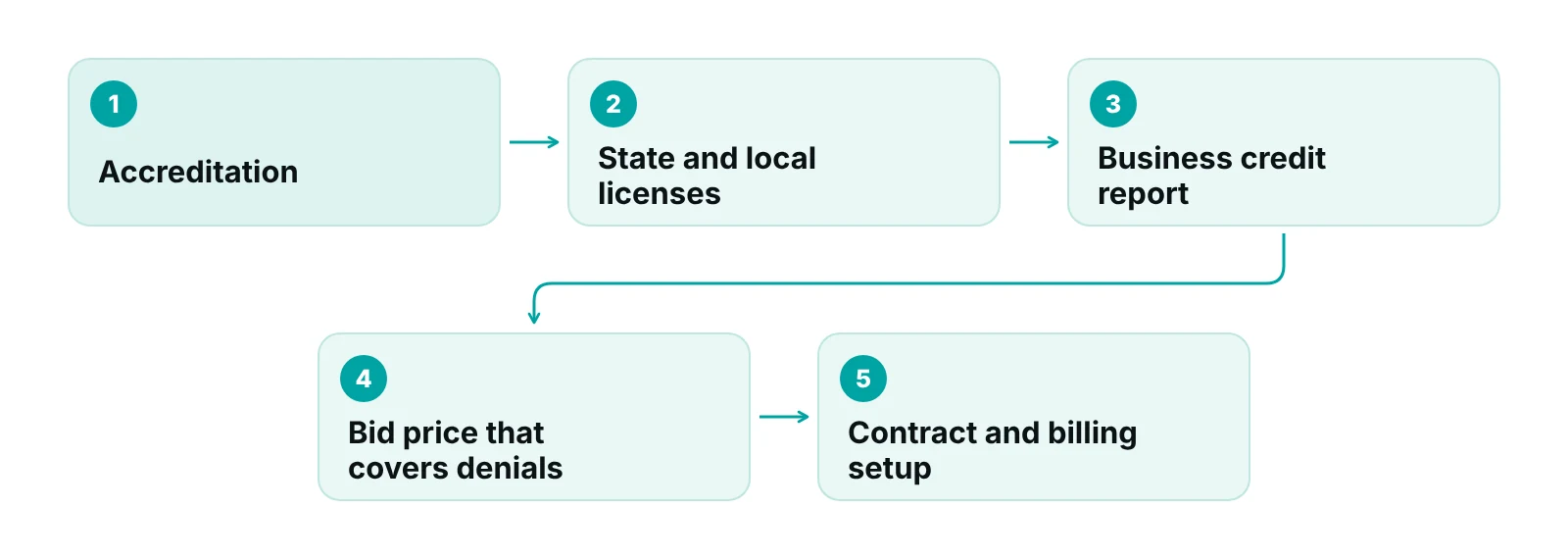
“Bid only on prices that still work after claim denials, delivery costs and documentation time are counted.”
Winning a contract changes the billing work, not just the price. Claims need correct HCPCS codes and modifiers, which our guides on DME coding and DME billing modifiers explain. Medical necessity paperwork is covered in the DME billing compliance checklist.
What it means for referring practices
When a round is in effect, patients with Original Medicare in a bidding area generally need a contract supplier for the included items. Medicare Advantage plans are not covered by the program and notify members if their supplier changes. These details come from the Medicare.gov guide for the 2021 round, so confirm that the same exceptions apply to Round 2028 when CMS publishes its beneficiary materials.
The Medicare.gov competitive bidding guide (revised February 2022) described these exceptions for off-the-shelf braces:
- A treating practitioner, including physical and occupational therapists, may provide a brace during the appointment as part of the clinical service without being a contract supplier.
- A hospital may supply a brace during admission or on the day of discharge.
- Repairs and replacement parts can come from any Medicare-enrolled supplier, but replacing the brace itself generally needs a contract supplier in the bidding area.
- If a specific brand is needed to avoid an unfavorable medical outcome, the doctor must prescribe it in writing and document the reason in the medical record. The contract supplier must then furnish the brand, help find another contract supplier that carries it, or work with the doctor on an alternative.
For a practice, the practical work is documentation and workflow: record the medical reason for any brand-specific order, know which local suppliers hold contracts once awards are announced, and tell staff who answer patient calls what to say. A practice management system that tracks claims by stage helps when orders, supplier handoffs and claim status all need an owner.
A short history, and what is no longer current
The program is older than most current rules. The table keeps to dates found in CMS documents.
| Year | Milestone | Source |
|---|---|---|
| 2003 | Congress mandates the program in the Medicare Modernization Act | CMS fact sheet, January 2008 |
| 2007 | Final competitive bidding rule published in April; CMS announces the first 10 areas | CMS fact sheet, January 2008 |
| 2008 | CMS materials describe a launch in 10 areas on July 1, 2008 | CMS backgrounder, May 2008 |
| 2021 to 2023 | A round covering off-the-shelf back and knee braces, January 1, 2021 through December 31, 2023 | Medicare.gov guide, revised February 2022 |
| 2026 | Gap period; CY 2026 final rule effective January 1; Round 2028 dates announced October 7 | CMS and Federal Register |
Sources: CMS (2008), Medicare.gov (2022), Federal Register (2025), CMS Round 2028 timeline (2026). Later rebids and rounds are not traced here.
Older web summaries often quote supplier counts, savings figures or the number of bidders in past rounds. Those numbers were not confirmed against a CMS source for this update, so they are left out.
How to prepare in the next few months
Preparation is a calendar exercise. Registration opens December 1, 2026, so the first task is confirming accreditation, licenses and credit documents. For billing, a supplier should know its denial patterns today, because bid prices are only as good as the cash actually collected. Our guides to in-house, outsourced and hybrid DME billing and setting up a DME store cover the operating side.
If your category is CGMs, insulin pumps or urological supplies, also read our Medicare diabetic supplies coverage guide and the HME versus DME billing guide so your coding and payer rules line up with how the category will be paid. Suppliers that want an outside review of billing workflows can ask for medical billing services support, and DME companies are listed with other equipment and clinical categories on our specialties page.
Want a second look at your DME billing workflow?
Request a free practice audit to find where claims stall before a bid or a new contract changes your volume.
Our recommendations
- Put the dates on a calendar. Registration opens December 1, 2026 and the bid window closes March 10, 2027. Work backward from those dates for accreditation, licenses and credit reports.
- Read the CMS page, not old summaries. Product categories, lead items and contract counts were still being announced in 2026. Check the CMS bidder page before each decision.
- Confirm accreditation and licensure first. Without a CMS-approved accreditation and required state licenses, a supplier cannot be awarded a contract.
- Price from real collections. Review current denial reasons and days to payment for your categories before choosing a bid.
- Document brand-specific orders. Referring practices should record the medical reason in the chart when a specific brand is needed.
- Check with your MAC for gap-period rules. Ask the DME MAC what applies to your items while no contracts are in effect.
Give every DME claim a stage and an owner.
The RCM Finder portal tracks claims by stage with an assigned owner, checks data completeness before submission, and flags underpayments against expected amounts. These features help a supplier see where claims stall as volume changes.
See how the RCM Finder portal works · Create a portal account
Disclosure: RCM Finder builds and sells this portal. It is a practice management system, not an EHR.
Bottom line
Round 2028 is the date to plan around: registration opens December 1, 2026 and the bid window closes March 10, 2027. Until contracts start, rely on the CMS bidder pages and your DME MAC for status. When denials or claim follow-up are the bottleneck behind a bid price, denial management and medical billing services are where to look first.
Frequently asked questions
Is the DMEPOS competitive bidding program active right now?
No round is running as of October 2026. The DME MAC page, last updated June 30, 2026, describes a gap period for all competitive bidding programs. CMS lists Round 2028 as the next round, with contracts targeted to start no later than January 1, 2028. Check the CMS page for any change.
What products are in Round 2028?
CMS lists seven categories: Class II CGMs and insulin pumps, urological supplies (excluding hydrophilic catheters), ostomy supplies, hydrophilic urinary catheters, and off-the-shelf back, knee and upper extremity braces. Lead items and contract counts per category were being announced during 2026, so confirm the final list on the CMS site before you plan.
When is the Round 2028 bid window?
CMS published the dates on October 7, 2026. Registration opens December 1, 2026 and closes February 1, 2027. The bid window opens January 5, 2027 and closes March 10, 2027. Contract awards are a target of late summer or early fall 2027, with the round starting January 1, 2028.
Does a supplier have to be accredited to bid?
Yes. Under 42 CFR 414.414, contract suppliers must meet CMS quality standards and be accredited by a CMS-approved organization, unless CMS specifies a grace period. Suppliers must also hold the state and local licenses required for the items in the bid. Confirm your accreditation status well before registration opens.
Does the program apply to Medicare Advantage patients?
The Medicare.gov guide for the 2021 braces round says the program does not apply to Medicare Advantage plans, and that those plans notify members if their supplier changes. Confirm this with CMS materials for Round 2028 when they are released.
What did the CY 2026 final rule change?
It uses the 75th percentile of winning bids for the lead item, allows nationwide or regional remote item delivery programs, moves certain CGMs and insulin pumps to a bundled monthly rental payment, and simplifies financial documents to a credit report. Its regulations took effect January 1, 2026.
Get your free practice audit
Tell us about your practice. We will contact you using the details you give.
- A review of your recent claims, denials and A/R aging
- Where your front desk and prior authorizations slow payment
- A prioritized fix list you keep, whether or not you hire us
Pricing is quoted after the audit, based on your volume and the services you choose. Prefer to talk? Call +1 (302) 556-2288.
Sources
- Round 2028 Timeline — CMS (DMEPOS Competitive Bidding Program) (2026)
- DMEPOS Competitive Bidding Program, Round 2028 — CMS (DMEPOS Competitive Bidding Program) (2026)
- CMS Adjusts Start of Registration, Bidding for Round 2028 — HME News (2026)
- Medicare and Medicaid Programs: CY 2026 Home Health PPS Rate Update (CMS-1828-F) — Federal Register (2025)
- DME Competitive Bidding — Noridian Medicare (DME MAC) (2026)
- 42 CFR 414.414 Conditions for awarding contracts — eCFR (via Cornell LII) (current)
- 42 CFR 414.400 Basis and scope — eCFR (via Cornell LII) (current)
- Medicare's DMEPOS Competitive Bidding Program Guide (11461) — Medicare.gov (2022)
- Expansion of Competitive Bidding Program for DMEPOS (fact sheet) — CMS (2008)
- DMEPOS Competitive Bidding Program backgrounder — CMS (2008)
Disclaimer: This article is educational and is not legal, coding or compliance advice. Program rules, dates and product categories are set by CMS and can change; confirm them on the CMS bidder pages and with your DME MAC before making decisions.