
Medical nutrition therapy billing under Medicare means billing 97802, 97803 and 97804 for dietitian visits, plus G0270 or G0271 when a second referral adds hours. Coverage is limited to patients with diabetes or non-dialysis kidney disease, needs a physician referral, and allows three hours in the first year and two hours each year after.
If you run a dietitian or nutrition practice, MNT is one of the few services where Medicare sets the rules in unusual detail: the diagnosis, the referral, the hours and who may bill. A missed rule rarely shows up until the claim comes back. This guide walks through the Medicare Part B rules from primary sources, then covers how to decide between billing in-house and getting help. This is general information, not coding or compliance advice, and it covers Medicare only. Commercial plans and Medicaid publish their own policies, so check each before you bill them.
Key takeaways
- Medicare covers MNT for diabetes, chronic kidney disease (not on maintenance dialysis) and the 36 months after a kidney transplant.
- Use 97802 once for the first individual visit, 97803 for later individual visits and 97804 for group sessions; G0270 and G0271 apply to extra hours after a second referral.
- The benefit is 3 hours in the first calendar year and 2 hours in later years, and a physician must refer.
- Dietitian MNT cannot be billed incident to a physician, and the referring physician’s NPI must be on the claim.
- Most MNT denials trace back to the diagnosis, the referral or the hour count, so check all three before the visit.
What does Medicare cover for medical nutrition therapy?
Medicare Part B covers MNT only for beneficiaries with diabetes or renal disease, and only when a physician refers them. The statutory basis is section 1861(s)(2)(V) of the Social Security Act, as summarized in National Coverage Determination 180.1, which took effect in its current version on January 1, 2022.
Renal disease has a specific meaning. Under 42 CFR 410.130, it includes chronic renal insufficiency, end-stage renal disease when the patient is not on dialysis, and the 36 months after a kidney transplant. The CMS claims manual puts chronic renal insufficiency at a GFR of 15 to 59 mL/min/1.73m². The same manual text says MNT is not covered for a beneficiary on maintenance dialysis paid under section 1881 of the Act.
The patient-facing description on Medicare.gov matches: an initial nutrition and lifestyle assessment, individual or group nutrition therapy and follow-up visits, delivered by a registered dietitian or other qualified nutrition professional. It also says the doctor’s referral is required.
Note the scope. This is a diagnosis-limited benefit. Weight management, prediabetes counseling and general wellness visits do not qualify under this NCD, so a patient without a qualifying diagnosis on the claim will be denied. Tell patients that at scheduling, not after the visit.
Medicare only, in this post
Everything below describes Original Medicare Part B. Medicare Advantage plans, Medicaid and commercial insurers set their own MNT policies, codes and visit limits. Verify each plan’s policy before you assume it follows Medicare. Our guide to verifying Medicare coverage shows how to check eligibility first.
Which codes do you use: 97802, 97803, 97804, G0270 or G0271?
Five codes cover almost every Medicare MNT visit. Pick the code by visit type (individual or group) and by where the patient is in the benefit, not by how long the conversation felt. Here is how the CMS claims manual describes them, in plain words.
| Code | Visit type | Unit | When to use it |
|---|---|---|---|
| 97802 | Individual, first visit | 15 minutes | Once, for a new patient’s initial assessment and intervention |
| 97803 | Individual, follow-up | 15 minutes | Every later individual visit, and when a change in condition affects nutritional status |
| 97804 | Group (2 or more people) | 30 minutes | Initial and later group visits |
| G0270 | Individual, extra hours | 15 minutes | Reassessment after a second referral in the same year for a change in diagnosis, condition or treatment |
| G0271 | Group, extra hours | 30 minutes | Same as G0270, for a group session |
Source: CMS Medicare Claims Processing Manual, Chapter 4, Section 300, via Transmittal 11426 (effective January 1, 2022). CPT is a trademark of the AMA; descriptions here are paraphrased.
G0270 and G0271 are the codes the old version of this post left out. They are how Medicare handles hours beyond the normal limit: the physician documents a change in condition, diagnosis or treatment, orders more MNT, and the dietitian bills the G code for those additional units. The CMS transmittal says medical review of these additional hours is post-payment, so your documentation has to hold up after the money is paid.
The dietitian chooses how many units to bill per visit, as long as the benefit hours and the other rules are met. One practical point: the manual does not list an MNT-specific modifier, so do not add one on habit. If a payer asks for a modifier, get that instruction from the payer in writing.
“Most MNT problems we see on paper are not coding mistakes. They are a missing referral or an hour count nobody tracked.”
— Awais Afzal, Healthcare Operations & Data Analyst
How many hours does Medicare allow, and what happens at the limit?
Medicare allows 3 hours of MNT in the first calendar year and 2 hours in each later year. Per the NCD 180.1 and Medicare.gov, unused hours do not carry over to the next year, and later years need a new referral.
| Situation | What Medicare allows | What to do |
|---|---|---|
| First calendar year of MNT | 3 hours of basic coverage | Track units by visit; unused hours do not carry over |
| Each later calendar year | 2 hours of follow-up coverage | Get a new physician referral each year |
| Change in diagnosis, condition or treatment | More hours if the physician documents the change and orders them | Bill G0270 or G0271 and keep the order and note on file |
| MNT and diabetes self-management training (DSMT) | Both covered if medically necessary, without reducing either benefit | Never schedule or bill both on the same date of service |
| Patient on maintenance dialysis | MNT not covered under this benefit | Confirm dialysis status at eligibility check |
Source: CMS NCD 180.1 (version effective January 1, 2022); 42 CFR 410.132; CMS Claims Processing Manual Ch. 4 §300 (Transmittal 11426).
The DSMT rule catches practices that offer both services. The CMS manual states that MNT and DSMT cannot be furnished or billed on the same date of service for the same beneficiary, and a Common Working File edit blocks those claims. Anything beyond the hour limits is denied, and the manual says the patient can be billed only when a valid ABN was in place. Otherwise the provider is liable. Our guide to the Advance Beneficiary Notice explains when and how to use one.
The regulation also covers the overlap case. Under 42 CFR 410.132, a beneficiary with both diabetes and renal disease gets the renal MNT hours in one episode of care, unless initial DSMT applies, in which case the greater amount applies. If your patient has both conditions, ask the MAC how it counts hours before you build the visit schedule.
Who can bill Medicare for MNT?
Only a registered dietitian or nutrition professional who meets 42 CFR 410.134 can furnish Medicare MNT. That section requires a bachelor’s or higher degree including an accredited nutrition or dietetics program, at least 900 hours of supervised practice, and a state license or certification where the services are performed. A registered dietitian in good standing with the Commission on Dietetic Registration is deemed to meet the education and practice requirements.
Per the CMS claims manual text, the billing side has its own rules:
- The dietitian must be enrolled in Medicare. A hospital can bill when it holds reassigned benefits from the dietitian.
- The provider must accept assignment, so the limiting charge does not apply.
- The Medicare specialty code for dietitians and nutritionists is 71.
- In a group practice, enter the provider ID of the dietitian who performed the service.
- MNT cannot be paid as an incident-to service of a physician.
That last rule matters for dietitians inside physician-owned practices. A physician cannot bill a dietitian’s MNT visit under their own NPI as incident to. Read our Medicare incident-to billing guide for how incident-to works for services where it is allowed. Enrollment is its own project: our guide to credentialing for group practices covers Medicare reassignment and effective dates, and a Medicare effective date decides which visits you can bill.
Medicare’s payment is the lesser of the actual charge or 85 percent of the physician fee schedule amount, according to the same manual text. Check your own fee schedule on your MAC’s website for the current dollar amounts rather than relying on a number in an article.
What does a clean MNT claim need?
A clean MNT claim has four things in place before the visit: a qualifying diagnosis, a documented physician referral, hours remaining in the benefit and a billing provider who is enrolled. Missing any one is the usual reason for a denial. This sequence works for most practices.
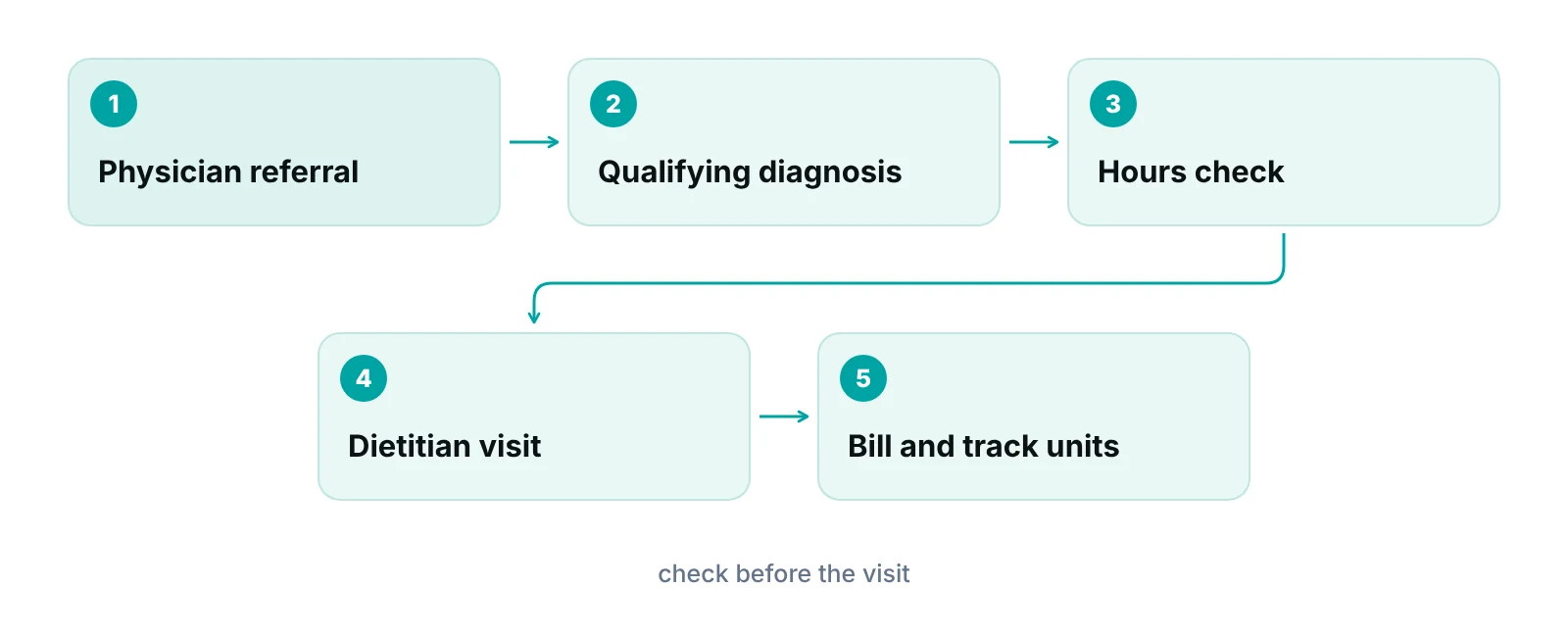
- Get the referral. Per the CMS manual, a physician must refer, and the referral is documented in the patient’s record for each episode of care and again for a reassessment prompted by a change in condition.
- Confirm the diagnosis. The claim must carry a diabetes or renal diagnosis. The manual says a claim with no diagnosis is returned as unprocessable and one without a diabetes or renal diagnosis is denied. Our post on diabetes ICD-10 codes helps with the diabetes side.
- Put the referring physician’s NPI on the CMS-1500. The manual says the MAC returns claims without it.
- Check hours used. Count units against the 3-hour or 2-hour limit for the calendar year before you book a follow-up.
- Bill the right code and unit count. 97802 once, 97803 or 97804 after that, G0270 or G0271 for extra hours with a new referral.
Since January 1, 2022, the referring physician no longer has to be the patient’s treating physician. The CMS manual notes this change to the earlier policy, so a referral from a physician who is not the patient’s primary care physician can still count. The old advice that a primary care physician must refer is out of date.
Why do MNT claims deny, and how do you fix them?
MNT denials come from a short list of causes, and most are preventable at scheduling. Here are the triggers named in the CMS manual and what to do about each.
| What goes wrong | What Medicare does | Fix |
|---|---|---|
| No diagnosis on the claim | Returns it as unprocessable | Add the qualifying diagnosis and resubmit |
| No diabetes or renal diagnosis | Denies it as not reasonable and necessary | Verify the diagnosis in the referral before the visit |
| Referring physician NPI missing | Returns the claim | Collect the NPI at intake and store it in the chart |
| Hours over the annual limit | Denies; patient liable only with a valid ABN | Track hours; use G0270/G0271 only with a documented change and new order |
| DSMT and MNT on the same date | Duplicate edit blocks the claim | Schedule the two services on different days |
| Provider does not meet MNT criteria | Denies with MSN 21.18 | Check 410.134 qualifications and enrollment before billing |
Source: CMS Medicare Claims Processing Manual, Chapter 4, Section 300 (Transmittal 11426).
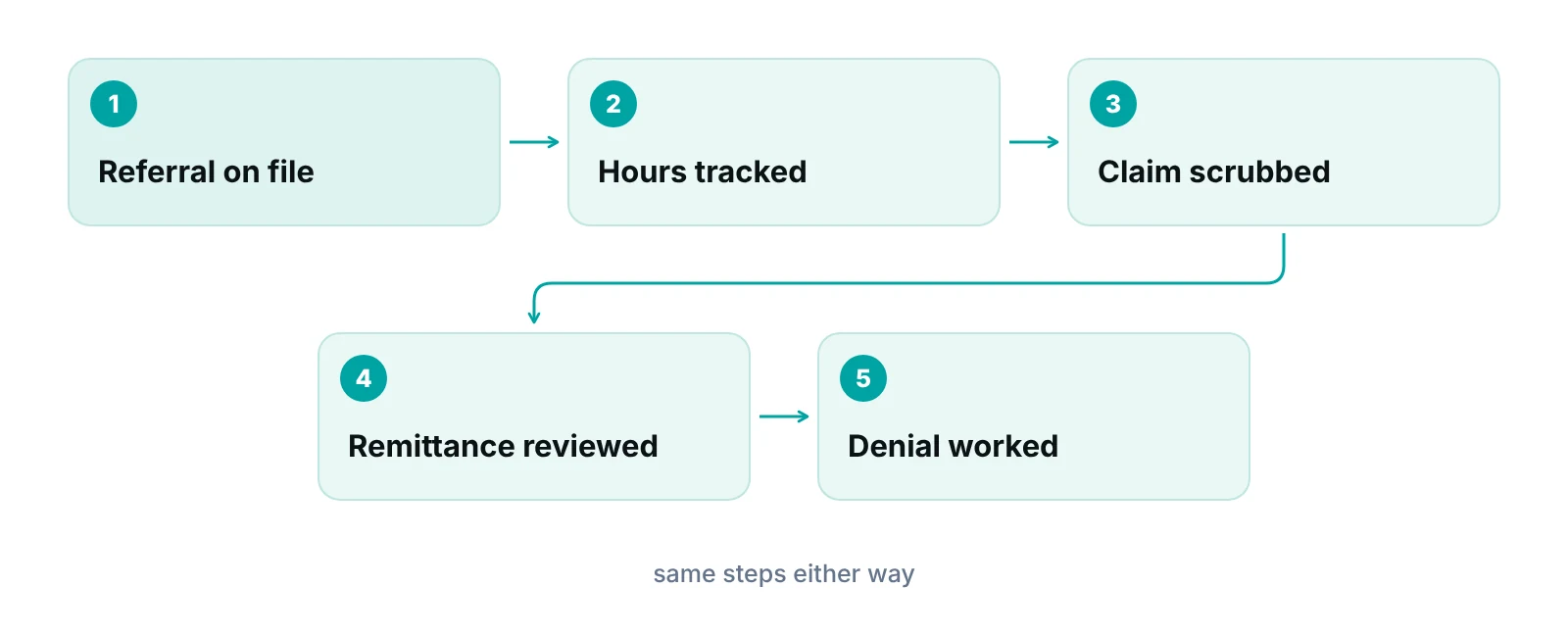
Treat a denial as data about your front end. If three claims deny for missing NPIs, the fix is the intake form, not the appeal. Our guides to clean claims and denial management cover the general method. If you want a team to run the follow-up, see our denial management services.
Should you bill MNT in-house or get help?
Bill in-house if you have a single dietitian, a small Medicare volume and someone who tracks hours reliably. Look for help when Medicare MNT volume grows, hours are tracked by hand or more than one payer’s rules are in play. The right answer depends on volume and on who in your office knows these rules, not on a single formula.
- In-house works when one person owns eligibility, referral tracking and claim follow-up, and a second person can cover absences.
- Outsourcing works when your dietitians would rather see patients than chase referrals, or when commercial plans each have different MNT rules to track.
- A hybrid works when your team handles scheduling and referrals and a partner handles claim submission and denials.
At the point where a partner takes over, ask three specific questions. How do you track MNT hours per patient per calendar year? What do you check before the claim leaves? What do you report back each week? The answers tell you more than a brochure does. Our team works inside your existing EHR (for example PrognoCIS, eClinicalWorks or athenahealth) when we take over claims, and our medical billing services include charge entry, claim scrubbing and denial follow-up. Pricing is quoted after a free practice audit.
Dietitian practices sit between several specialties, so browse our specialty billing pages to see how we describe billing for related fields such as endocrinology and nephrology, where many MNT referrals originate.
Want a second set of eyes on your MNT claims?
Send us a sample of recent Medicare MNT claims and we will review the referral, diagnosis and hour tracking before you decide how to bill.
Our recommendations
- Make the referral a hard stop. No referral on file, no appointment. A missing referral is a denial you can see coming, so build it into scheduling, not into billing.
- Verify the diagnosis before the first visit. Check that the referral names diabetes or a qualifying kidney condition, and that dialysis status is recorded. That keeps non-covered visits off the Medicare schedule.
- Track hours in one place. Keep a running count of units per patient per calendar year, not in the visit note. Review it before every follow-up is booked.
- Plan the extra-hours case early. If a patient’s condition changes, ask the physician for a new referral and written order before using G0270 or G0271, because those hours get reviewed after payment.
- Get an ABN ready for services that may exceed the limit. If a visit may go beyond what Medicare allows, discuss it with the patient in advance. Without a valid ABN, the provider carries the loss.
- Separate MNT and DSMT days. If your practice offers both, build the schedule so the same patient cannot be booked for both on one date.
Bottom line
Medicare MNT billing comes down to four checks done early: a physician referral, a qualifying diagnosis, hours remaining and an enrolled dietitian. Get those right and 97802, 97803, 97804, G0270 and G0271 are straightforward. If you want help with the claims side, our medical billing services can take it on, and our credentialing services can handle Medicare enrollment for your dietitians. You can also run your numbers in the revenue calculator or contact our team with questions.
Frequently asked questions
What is the CPT code for medical nutrition therapy?
Medicare uses 97802 for the first individual visit, 97803 for later individual visits and 97804 for group sessions. G0270 (individual) and G0271 (group) apply to extra hours after a second referral in the same year. Which code you use depends on the visit type and where the patient is in the benefit.
Who is eligible for Medicare medical nutrition therapy?
Beneficiaries with diabetes, chronic kidney disease or a kidney transplant in the past 36 months, referred by a physician. Chronic renal insufficiency is defined as a GFR of 15 to 59. Patients on maintenance dialysis are not covered under this benefit, and Medicare Advantage plans may differ.
How many MNT hours does Medicare cover?
Three hours in the first calendar year and two hours in each later year. Unused hours do not carry over, and later years need a new referral. More hours are possible when the physician documents a change in condition, diagnosis or treatment and orders them.
Can a doctor bill a dietitian's MNT visit incident to?
No. The CMS claims manual says MNT cannot be paid as an incident-to service. The registered dietitian or qualified nutrition professional must be enrolled in Medicare and the claim carries that provider’s ID, with the referring physician’s NPI.
Can MNT and diabetes self-management training be billed on the same day?
No. Both can be covered for the same patient if medically necessary, without reducing either benefit, but the manual says they cannot be furnished or billed on the same date of service. A duplicate edit blocks those claims.
Does a nurse practitioner's referral count for MNT?
The regulation defines the referring physician as an MD or DO. We could not confirm from the sources reviewed how Medicare treats referrals from other practitioners, so ask your Medicare contractor in writing before relying on one.
Get your free practice audit
Tell us about your practice. We will contact you using the details you give.
- A review of your recent claims, denials and A/R aging
- Where your front desk and prior authorizations slow payment
- A prioritized fix list you keep, whether or not you hire us
Pricing is quoted after the audit, based on your volume and the services you choose. Prefer to talk? Call +1 (302) 556-2288.
Sources
- National Coverage Determination 180.1, Medical Nutrition Therapy — CMS Medicare Coverage Database (2022)
- 42 CFR 410.132, Medical nutrition therapy — Cornell LII (eCFR text) (2026)
- 42 CFR 410.130, Definitions — Cornell LII (eCFR text) (2026)
- 42 CFR 410.134, Provider qualifications — Cornell LII (eCFR text) (2026)
- Medicare Claims Processing Manual, Ch. 4 Sec. 300 (Transmittal 11426) — CMS (2022)
- Medical nutrition therapy services — Medicare.gov (2026)
Disclaimer: This page is general educational information for practice owners, dietitians and billing staff. It is not legal, coding, billing-compliance or medical advice. CPT is a trademark of the American Medical Association. Medicare rules and payer policies change and vary by plan and contractor; confirm current requirements with your Medicare Administrative Contractor and each payer before billing.
