
Optometry practice management means running three revenue streams at once: medical eye care billed to health insurance, routine vision care billed to vision plans or patients, and eyewear. Decide the payer when the visit is booked, document to match it, track a short list of numbers, and move repeatable admin work off the doctor.
Most advice on running an optometry practice stops at communication, motivation and delegation. Those matter, but they leave out the questions that decide your income: which payer owns the visit, what Medicare will pay for and what a healthy cost structure looks like.
Below, we cover those questions with dated sources, and we say where the evidence is thin. For the billing detail, see our post on optometry billing services.
Key takeaways
- Optometry offices run three revenue streams: medical eye care, routine vision care and eyewear. Each has its own payer rules.
- Choose the payer at booking. The chief complaint, primary diagnosis and treatment plan should agree with it.
- Original Medicare excludes routine eye exams and eyeglasses, but covers exams that evaluate eye disease (CMS, June 2026).
- In IDOC’s 2025 data, the median independent practice kept 31% of collected revenue for doctor pay and profit.
- Keep billing in-house only if one trained person owns it and you can see denials by reason.
What makes optometry practice management different?
An optometry office sells medical eye care, routine vision care and eyewear, and each has its own payer and its own rules. Communication, motivation and delegation matter in every practice, but they do not tell you which insurer to bill for the 9:15 appointment. That decision sets what the visit pays, so it deserves more attention than any other management habit.
Most general management advice treats a practice as one business with one set of payers. An optometry practice is closer to three. A patient with a red eye is a medical visit. The same patient returning for new glasses is a routine visit with a vision plan. Buying frames adds a retail sale. Staff need to know which of these is happening before the patient reaches the exam lane.
“Before you hire another manager or buy another tool, make sure every person on your team can say, in one sentence, why a patient is on the schedule and who will pay for it.”
— Awais Afzal, Healthcare Operations & Data Analyst
This guide covers the four things an owner can control: how you choose the payer for each visit, what Original Medicare will and will not cover, how to divide work among doctors, opticians and the front desk, and how to measure the practice against sourced benchmarks. It ends with a way to decide whether billing stays in-house.
How do you decide whether a visit is billed to medical or vision insurance?
Bill medical insurance when the visit addresses a medical complaint or manages eye disease. Bill the vision plan when the visit is a routine exam. The chief complaint, the primary diagnosis and the treatment plan in the chart should all point to the same payer.
Writing in Optometry Times in 2020, Eric Botts, OD, described a wellness exam as one focused on refractive correction and on spotting abnormalities. Treating eye disease beyond refractive correction belongs in a medical exam. He noted that medical exams differ in the number of tests, the level of medical decision-making and the primary diagnosis, and that a medical exam needs a primary medical diagnosis and a treatment plan that answers the chief complaint. Some complaints fit both kinds of visit, which is why the decision cannot be left to habit.
| Question | Routine (vision-plan) visit | Medical visit |
|---|---|---|
| Why did the patient book? | Annual exam, or a glasses or contacts update | A symptom or complaint such as red eye or dry eye, or monitoring of an eye or systemic condition |
| What does the exam centre on? | Refractive correction and a check for abnormalities | Diagnosing and treating eye disease beyond refractive correction |
| What must the chart show? | A refractive diagnosis | A primary medical diagnosis and a treatment plan that addresses the chief complaint |
| Who is billed? | The vision plan or the patient | The patient’s medical carrier, if you are enrolled with it |
| What does the patient need to hear? | What the vision benefit covers and what it does not | That medical insurance will be filed and that a copay or unmet deductible may apply |
| How do payments compare? | Vision plans usually pay less than medical carriers | Medical carriers usually pay more, subject to your contract |
Sources: Eric Botts, OD, Optometry Times (2020); Professional Eyecare Associates of America (PECAA), ‘When To Bill Vision vs. Medical Insurance’ (2021). Payment levels depend on each contract.
Why does the patient's cost message matter?
Because the patient feels the difference at the counter. PECAA’s 2021 guidance gives the example of a patient with a red eye whose vision plan has a $10 copay and whose medical plan has an unmet $500 deductible. Using the vision plan costs the patient $10, while using medical insurance makes the patient responsible for the full exam cost. PECAA advises telling the patient during the exam when a medical issue has to be addressed, explaining that medical insurance will be filed and that copays or deductibles may apply, and documenting the decision if the patient declines medical care. The patient, not the practice, decides how to proceed once the facts are clear. Read your vision plan contracts too: some plans cover certain screening tests, and Botts advises checking that before you bill a test to medical.
What should the desk do before the patient arrives?
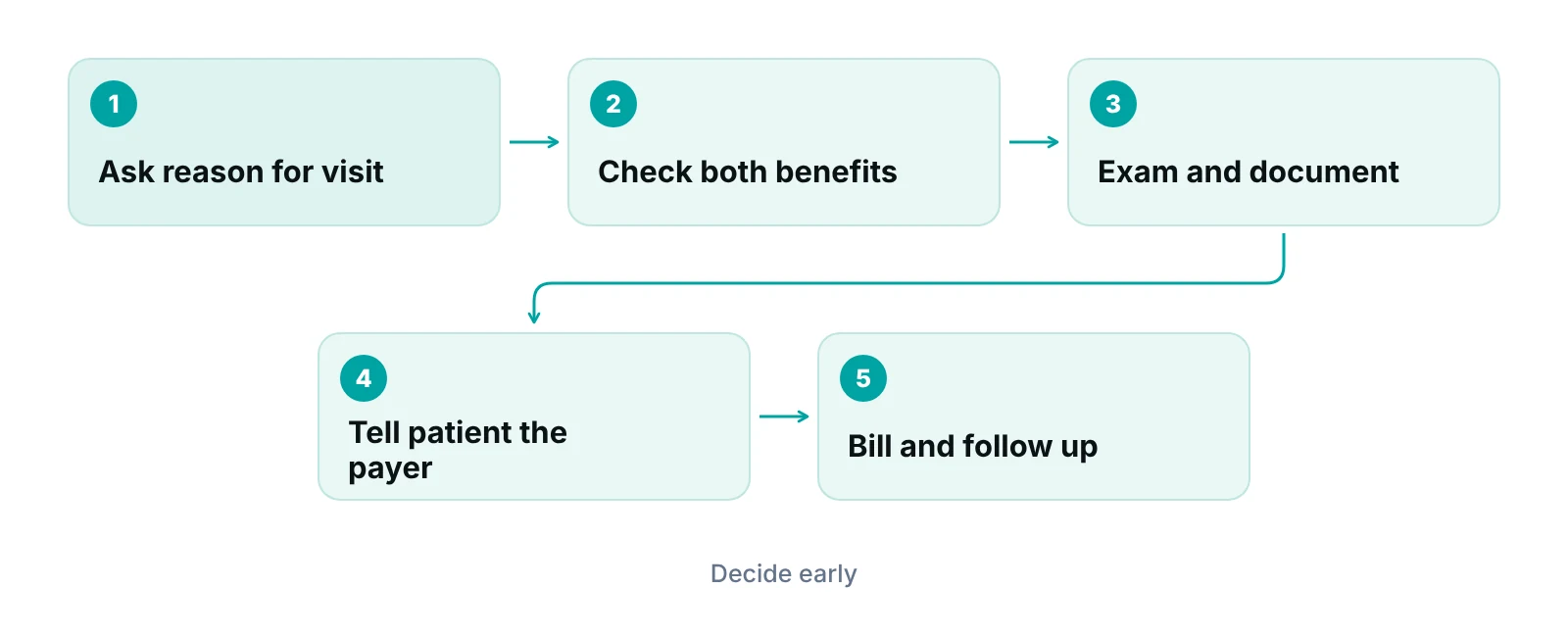
- Ask why the patient is booking and whether they have symptoms such as blurry vision. Botts describes this triage at scheduling as a way to route patients correctly.
- Check both the vision benefit and the medical benefit when you verify coverage. Our patient insurance verification guide walks through the steps.
- Use a written intake form that defines routine and medical care in plain words, and give patients the same message from the doctor and the staff.
- Keep a written policy for patients whose medical carrier you are not enrolled with, applied the same way every time. Staff can explain the likely out-of-pocket cost or refer the patient in-network.
Code what was done, and let the doctor own the code
PECAA’s guidance says reporting a less comprehensive code than the service performed is treated like upcoding in an audit, and that the doctor, not staff, is responsible for coding. Payer rules differ, so ask each payer and your compliance adviser how they handle visit-level coding. Our post on optometry billing services covers the billing side in more depth.
What do Medicare's vision rules mean for your desk?
Original Medicare does not pay for routine eye exams or eyeglasses. It does cover exams that evaluate eye disease or its signs and symptoms, plus a few named exceptions. The June 2026 CMS Medicare Vision Services booklet (MLN907165) says Original Medicare usually does not cover routine vision items, and the federal rule behind that exclusion is at 42 CFR 411.15.
| Service | Original Medicare | Where the rule comes from |
|---|---|---|
| Eye exam to prescribe, fit or change glasses or contacts for refractive error only | Excluded | 42 CFR 411.15(c); CMS MLN907165 (June 2026) |
| Refraction | Listed as noncovered | Noridian JE Part B optometry page |
| Eyeglasses and contact lenses | Excluded in general. One pair of conventional eyeglasses or contacts after each cataract surgery with an intraocular lens is an exception | 42 CFR 411.15(b); CMS MLN907165 (June 2026) |
| Eye exam to evaluate eye disease, including in patients with diabetes or with signs and symptoms | Covered | Noridian JE Part B; CMS MLN907165 |
| Glaucoma screening | Covered once every 12 months for eligible Part B patients: diabetes, family history of glaucoma, Black or African American and 50 or older, or Hispanic or Latino and 65 or older | CMS MLN907165 (June 2026); Noridian JE Part B |
| Who can bill | A doctor of optometry counts as a physician for services the state licence allows, and must be enrolled in Medicare | AOA summary of Social Security Act 1861(r) and 42 CFR 405.500 |
Sources: eCFR 42 CFR 411.15; CMS MLN907165 (June 2026); Noridian Healthcare Solutions, JE Part B; American Optometric Association. Original Medicare only; other plans set their own rules.
Three practical points follow from the table.
- Do not assume the exam is covered because the patient has Medicare. Coverage depends on why the exam was done. A visit for glasses only falls under the exclusion, and a visit to evaluate a symptom or manage disease does not.
- Notice rules. Noridian’s page says an Advance Beneficiary Notice is not required for noncovered services but may be given as a courtesy. Ask your own Medicare contractor how it wants noncovered routine services handled.
- Eyewear after cataract surgery has its own path. The CMS booklet says durable medical equipment suppliers submit those claims to their DME MAC, so confirm how your optical is enrolled before you dispense.
Enrolment matters on the medical side. You can only bill a medical carrier you are enrolled with, so keep payer enrolment current; our guide to insurance credentialing for group practices explains the process. Glaucoma, diabetic eye disease and cataract co-management also put your medical billing close to ophthalmology’s payer and documentation patterns. Our ophthalmology revenue cycle page shows how those patterns are handled, and it is a useful reference even if you are not an ophthalmology group.
How should work be split between doctors, opticians and the front desk?
Give each role one family of tasks and name an owner for every handoff. Doctors own clinical decisions and the codes that describe them. Opticians own eyewear. The front desk owns scheduling, benefits checks and check-in. Billing owns claims, payments and denial follow-up.
The handoffs are where optometry practices lose money. A visit booked as routine that turns medical, a vision benefit checked but not the medical one, or an encounter closed without a clear primary diagnosis all create work that lands on someone else days later. A short written list of who does what at each handoff costs nothing and shows gaps quickly.
- Doctors: choose the visit type from the chief complaint, document the diagnosis and plan, and review the codes assigned.
- Opticians and technicians: record what was dispensed and tested, and flag when a routine visit uncovers something medical so the doctor can speak to the patient.
- Front desk: ask the reason for the visit, check both benefits, collect what is due and pass a complete encounter to billing. Our post on the front desk’s effect on the revenue cycle sets out the six touchpoints.
- Billing: submit claims, post payments, work denials and report patterns back to the desk and the doctors.
Staff turnover and morale are real concerns, but we would not set a goal from a generic statistic. Track your own turnover and your own time-to-fill for each role, and look for the repeatable admin tasks that fill the front desk’s day. Reminders, eligibility checks and intake forms are the usual candidates to move to a trained remote assistant or to automation, which frees staff for the patients in front of them.
What do independent optometry practices keep from revenue?
In IDOC’s 2025 benchmarks for independent optometry practices, the median practice put 31% of collected revenue toward doctor pay and profit. The figures were reported by Optometry Times in October 2026 from IDOC’s third annual report, based on more than 175 of its bookkeeping clients across the US.
| Measure | 2025 figure | What to compare it with |
|---|---|---|
| Doctor pay and profit (median) | 31% of collected revenue; middle 60% of practices 25% to 38% | Your owner pay and net income divided by collections |
| Cost of goods sold (median) | 26% of collected revenue | Your frame, lens and supply costs |
| Non-OD staff pay (median) | 24% of collected revenue | Your payroll for opticians, technicians and front desk |
| Fixed overhead (aggregate) | 17% of collected revenue; middle 60% of practices 14% to 22% | Rent, utilities, admin and marketing together |
| Occupancy (median) | 6% of collected revenue | Your rent and related costs |
| General and administrative (median) | 9% of collected revenue | Your software, insurance, professional fees and office costs |
| Marketing (typical) | 1% to 2% of collected revenue | Your annual marketing spend |
| Total revenue (median) | $1.57 million; middle 60% of practices $800,000 to $2.64 million | Your annual collections |
Source: IDOC 2025 Optometry Benchmarks Report, as reported by Optometry Times (October 2026). Clients tend to be larger than average and IDOC sells bookkeeping services.
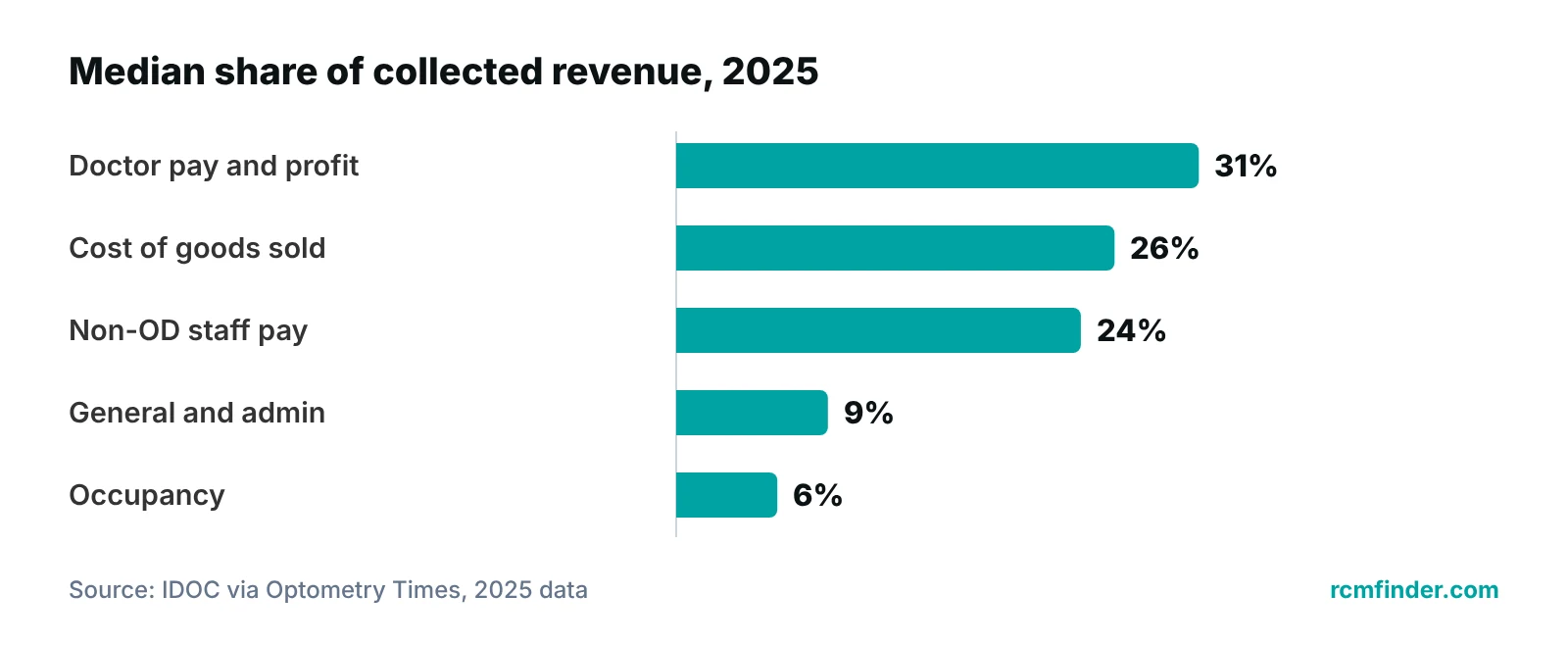
Use these as context, not as targets. The data comes from practices that pay for bookkeeping and benchmarking, which the article says tend to be larger than average, so a small or new practice may look different without being worse. IDOC does not report the share of revenue that comes from the optical in the article we reviewed, so we have not guessed at one. Start by calculating your own percentages for the last twelve months, then look at which line moves when you change a payer mix or a staffing pattern.
Which numbers and systems should the practice run on?
A short list reviewed every month beats a long dashboard that nobody opens. Choose measures you can pull from your own systems, and start with a baseline before you set any target. Our guide to revenue cycle KPIs defines the standard revenue cycle measures.
- Visit mix: the split between routine and medical visits by month.
- Denial rate by payer type: vision plans, medical carriers and Medicare, tracked separately.
- Days in A/R: how long unpaid medical claims wait.
- No-show rate: by provider and by appointment type.
- Net collections: collected revenue compared with what you expected to collect.
- Cost lines: staff pay, cost of goods and occupancy as a share of collections, compared with the table above.
Where the numbers live matters as much as which ones you pick. A practice management system should show claims by stage, the reason for every denial, who touched a record and what each staff role may see. Our portal does this through claim tracking by stage, role-based permissions, an audit log and reporting dashboards, and our team works inside your existing EHR (for example PrognoCIS, eClinicalWorks or athenahealth).
Size the revenue question first
Before you change a process, estimate what slow payments and denials may be holding up. The calculator takes your own volume and rates as inputs.
Should billing stay in-house or move to a billing partner?
Keep billing in-house if one trained person owns it, you can see denials by reason and the work is not crowding the front desk. Look at outsourcing or a hybrid model when any of those three is missing. The decision is about control and capacity, not about which option sounds more professional.
- In-house: suits a practice with a stable, trained biller, a backup person and reports that show denial reasons. The risk is that one resignation stops claims.
- Outsourced: suits a practice that cannot hire or keep a biller or wants specialist follow-up on medical claims. The risk is losing sight of the work, so insist on regular reports and access to claim status.
- Hybrid: the front desk keeps benefits checks and collections while a partner handles claims, denials and A/R follow-up. It needs a clear handoff for each encounter.
Whatever you choose, ask any vendor how it separates medical claims from vision-plan claims, who checks the diagnosis against the visit type, how denials are reported to you, and who can see patient records.
See where your own claims stand
Our free practice audit reviews how your visits are classified, how your denials are distributed and where the handoffs break. We quote any service after the audit.
Our recommendations
- Write a one-page visit-type policy. Define a routine visit and a medical visit in plain words, say who decides and give staff the sentence they say to the patient. Put it on the intake form.
- Ask the reason for the visit at booking. One extra question at scheduling routes the patient correctly and lets the desk check both the vision and the medical benefit before the patient arrives.
- Confirm your enrolment before you promise medical billing. List every medical plan you want to bill, check that you are enrolled with each, and write the policy for patients whose plan you do not take.
- Audit a sample of charts against the codes each month. We start with a sample of recent encounters and compare the chart, the diagnosis and the code billed. Gaps show up quickly and they are easy to teach from.
- Calculate your own percentages before you use anyone else's. Work out staff pay, cost of goods, occupancy and owner pay as shares of collections for the last twelve months, then use benchmarks only as context.
- Move repeatable admin work off clinical staff. Reminders, benefit checks and intake are good candidates for a trained assistant or automation, so doctors and opticians stay with patients.
Bottom line
Good optometry practice management starts with one decision: who pays for this visit. Make that decision at booking, document to match it, and measure a few numbers every month. If you want help with the billing side, our medical billing services cover claims, charge entry and coding support inside your existing EHR, and you can contact us to talk through your practice.
Frequently asked questions
What is optometry practice management?
It is the work of running the clinical, financial and staffing sides of an optometry office together. In practice that means choosing the right payer for each visit, keeping charts and codes aligned, dividing work among doctors, opticians and the front desk, and tracking a few numbers every month.
When should an optometrist bill medical insurance instead of a vision plan?
When the visit addresses a medical complaint or manages eye disease, with a medical diagnosis and a treatment plan in the chart. Routine exams and glasses updates go to the vision plan. Some visits include both, so tell the patient what will be filed and why, and check your contracts.
Does Medicare cover routine eye exams or glasses?
Original Medicare excludes routine eye exams and eyeglasses, according to 42 CFR 411.15 and CMS’s June 2026 vision booklet. It covers exams that evaluate eye disease or its symptoms, annual glaucoma screening for eligible patients and one pair of eyeglasses or contacts after each cataract surgery with a lens implant.
What profit should an independent optometry practice expect?
IDOC’s 2025 benchmarks, reported in October 2026, put median doctor pay and profit at 31% of collected revenue, with the middle 60% of practices between 25% and 38%. The data comes from more than 175 bookkeeping clients, so treat it as context rather than a target.
Should an optometry practice outsource billing?
Keep it in-house if one trained person owns it, you can see denials by reason and the front desk is not overloaded. Consider outsourcing or a hybrid when any of those is missing. Ask any partner how it separates medical and vision-plan claims and how it reports denials.
Which numbers should an owner review every month?
Visit mix between routine and medical, denial rate by payer type, days in A/R, no-show rate, net collections and cost lines such as staff pay and cost of goods as shares of collections. Set your own baseline before you set targets.
Get your free practice audit
Tell us about your practice. We will contact you using the details you give.
- A review of your recent claims, denials and A/R aging
- Where your front desk and prior authorizations slow payment
- A prioritized fix list you keep, whether or not you hire us
Pricing is quoted after the audit, based on your volume and the services you choose. Prefer to talk? Call +1 (302) 556-2288.
Sources
- 42 CFR 411.15 Particular services excluded from coverage — eCFR (US Government) (2026)
- Medicare Vision Services (MLN907165) — CMS Medicare Learning Network (2026)
- Optometry / Ophthalmology — Noridian Healthcare Solutions, JE Part B (2026)
- Doctors of Optometry as Physicians in Medicare – in Law — American Optometric Association (n.d.)
- Distinguish between wellness and medical eye exams — Optometry Times (Eric Botts, OD) (2020)
- When To Bill Vision vs. Medical Insurance — Professional Eyecare Associates of America (PECAA) (2021)
- Independent OD practices net 31% of revenue, IDOC benchmarks show — Optometry Times (IDOC 2025 Optometry Benchmarks Report) (2026)
Disclaimer: This article is general educational information for optometry practice owners and managers. It is not legal, compliance, coding or billing advice. Payer rules, vision-plan contracts and state scope-of-practice laws vary and change often. Confirm requirements with each payer and qualified advisers before acting.
